Canon to Come Out with a Canon RF 14mm f/1.4L VCM?

This could be the missing lens in the Canon setup for underwater photography. I'm very interested in knowing what the minimum focus distance is.
Bokeh underwater isn't really a thing (unless for macro with coloured backgrounds and strobes) so low light is the only benefit I can see of f1.4.
Good ISO performance and denoise algorithms have basically nullified those constraints.

Are you thinking of using it for wide-angle macro eg laowa probes? Maybe the EF8-15/4 would be a current/cheaper option.
 
Upvote 0
The fact that Canon hasn't released a fast ultra-wide prime for their main lens ecosystem when they've had 7 years to do it is nuts to me.
I've seriously considered the move to Sony due to Canon's attitude towards rounding out their ecosystem & limiting third-party lenses, especially since gear like this is so helpful for the type of stuff I shoot.
That being said, the VCM primes are phenomenal from the perspective of a hybrid shooter. Extremely interested in this (and I hope they get a move on!)
Not just 7 years of RF but in the EF lifetime there was only the 14/2.8 (I and II) were the only ultra wide angle primes as far as I know. Not great coma quality though. The Samyang 14/2.8 is a much better option.
 
Upvote 0
The RF 20mm f/1.4L VCM is a fast, ultrawide prime.
I guess by a lot of people's standards yeah, although it's a little bit semantics. Personally I wouldn't consider anything over 16mm FF ultra-wide, that's where I feel the use-case between focal lengths on each side becomes more defined. Maybe ultra-ultra-wide is more accurate if we're splitting hairs.
 
Upvote 0
I guess by a lot of people's standards yeah, although it's a little bit semantics. Personally I wouldn't consider anything over 16mm FF ultra-wide, that's where I feel the use-case between focal lengths on each side becomes more defined. Maybe ultra-ultra-wide is more accurate if we're splitting hairs.
Conventionally:
<24mm = ultrawide
24-35mm = wide
36-69mm = normal
70-299mm = telephoto
≥300mm = supertelephoto

We can all make up our own definitions, of course.

‘Fast’ is more loosely defined, but generally faster than f/2.8 for primes and f/2.8 or faster for zooms (not counting supertelephoto lenses, where ‘fast’ is anything with a front element diameter ≥100 mm).
 
  • Like
Reactions: 1 user
Upvote 0
Incredibly disappointing if true. This is something I am waiting for before making the switch from EF, and the 14mm f/2.8L II was an expensive investment, $2000 when I got it 20 years ago. So I'm guessing it would be like $4000 now since pretty much everything is twice the price now. To buy a $4000 lens where the image circle doesn't cover the sensor, and there's some kind of bullshit image scaling happening in the camera, what is this?? The image should be, without exception, exactly the light falling onto the sensor. If someone wants image correction that should be an optional feature not a crutch for a bad lens design. To make the lens body the same size as the rest of the RF lenses is the tail wagging the dog if I've ever seen one.
 
  • Like
  • Haha
Reactions: 1 users
Upvote 0
If someone wants image correction that should be an optional feature not a crutch for a bad lens design.
Photography, including lens design, is about compromise. I’m sorry you don’t understand that. When someone makes a perfect lens, it will probably cost tens of thousands of dollars and be too heavy to carry. But you go on hoping for that, if that’s what you want.

Personally, I think lenses like the RF 24-105/2.8, 14-35/4 and 10-20/4 are excellent designs, and those designs are made possible by relying on digital correction for the geometric distortion at the wide end. Compare the RF 10-20/4 to the EF 11-24/4 in terms of size, weight and cost. Similarly, the RF 16/2.8 comes in at the price it does for the same reason.

To make the lens body the same size as the rest of the RF lenses is the tail wagging the dog if I've ever seen one.
The VCM lenses are intended as hybrid, meaning for use in photography and video production. It’s clear you don’t understand the implications of that, although Canon does. Take a look at cinema lens lines, and notice how within a series they are all the exact same size, shape, filter thread diameter, etc. There’s a reason for that. Probably you won’t bother doing so, and instead, you’ll just go on thinking you know what you’re talking about.

 
Upvote 0
Okay that just tells me you've never used a 14mm (or wider) lens, that's a preposterous statement.
Lol, what it should tell you is that I understand the conventional designations for focal length in photography and you don’t. Anything wider than 24 mm is an ultrawide lens, by convention. You’re welcome to make up your own definitions, though people who do so usually end up looking foolish.

Incidentally, I owned the EF 11-24/4L for many years, and now own the RF 10-24/4L, both frequently used, the latter more so because it’s much easier to bring along on a trip. I also owned the EF 14-35/4L that I swapped for the RF 14-35/4L, and I still frequently use my TS-E 17/4L that gives the FoV of an 11mm lens with shift.

The only preposterous statement here is yours.
 
  • Like
Reactions: 1 user
Upvote 0
Photography, including lens design, is about compromise. I’m sorry you don’t understand that. When someone makes a perfect lens, it will probably cost tens of thousands of dollars and be too heavy to carry. But you go on hoping for that, if that’s what you want.

Personally, I think lenses like the RF 24-105/2.8, 14-35/4 and 10-20/4 are excellent designs, and those designs are made possible by relying on digital correction for the geometric distortion at the wide end. Compare the RF 10-20/4 to the EF 11-24/4 in terms of size, weight and cost. Similarly, the RF 16/2.8 comes in at the price it does for the same reason.


The VCM lenses are intended as hybrid, meaning for use in photography and video production. It’s clear you don’t understand the implications of that, although Canon does. Take a look at cinema lens lines, and notice how within a series they are all the exact same size, shape, filter thread diameter, etc. There’s a reason for that. Probably you won’t bother doing so, and instead, you’ll just go on thinking you know what you’re talking about.

I guarantee you didn't own the 14mm EF based on your ridiculous arguments. You're also putting words in my mouth, I didn't say anything about a "perfect" lens. I was entirely happy with the 14mm EF despite its minor flaws. And nobody shooting video is going to buy the 14mm. Maybe some dude shooting a music video will rent it sometimes. I don't care about zoom lenses, never owned one and never will, so don't know why you are bringing those up.
 
Upvote 0
On the plus side, today you can buy the RF 16/2.8 for $300, and it will give you about the same IQ as your EF 14/2.8L II, even in the digitally corrected corners.

Have a nice day. :p

I am aware of the 16 and at the wide side there every mm matters, which is why I said it was preposterous to put a 20 in the same category as the 14.

An iPhone's main camera is "24 mm equivalent". That's 84 degrees of view. A 20 mm is 94 degrees of view. So when you use a 20 mm you get something marginally wider than what most people expect to see in a snapshot.
 
Upvote 0
I guarantee you didn't own the 14mm EF based on your ridiculous arguments. You're also putting words in my mouth, I didn't say anything about a "perfect" lens. I was entirely happy with the 14mm EF despite its minor flaws. And nobody shooting video is going to buy the 14mm. Maybe some dude shooting a music video will rent it sometimes. I don't care about zoom lenses, never owned one and never will, so don't know why you are bringing those up.
I listed the lenses that I owned that cover the 14mm focal length (on FF). Did I include an EF 14mm lens? No. Thanks for your meaningless 'guarantee'.

For the sake of completeness, I used to own the Rokinon (Samyang) 14/2.8 for EF, which I used for astrophotography where it is frequently preferred over the Canon 14/2.8 because of the latter's relatively poor performance in terms of coma and astigmatism. In that context, it's worth noting that the RF 20/1.4 VCM performs much better for that use case than pretty much any EF lens.

Nice that you know what those shooting video will and won't buy. All of them. Truly impressive. Or complete BS. We both know which it really is. Well, maybe you don't.

I bring up zoom lenses because both zooms and primes benefit from the design possibilities of requiring correction of geometric distortion in post processing.
 
Upvote 0
I am aware of the 16 and at the wide side there every mm matters, which is why I said it was preposterous to put a 20 in the same category as the 14.

An iPhone's main camera is "24 mm equivalent". That's 84 degrees of view. A 20 mm is 94 degrees of view. So when you use a 20 mm you get something marginally wider than what most people expect to see in a snapshot.
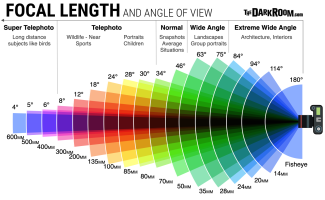
There are a whole bunch of charts/graphic out there like this one, that categorize focal lengths based on the conventional nomenclature. Extreme / Ultra Wide Angle is wider than 24mm.

Screenshot 2026-01-14 at 11.10.34 PM.png

You seem to want to make up your own categories. I know, let's call 20mm Fred and let's call 14mm Bob. No, let's not because making up your own categories is asinine.

Yes, 14mm is wider than 20mm. And the 10mm wide end of my RF 10-20/4 is wider still. But they're all ultrawide lenses. Or they're Fred and Bob, as you seem to prefer, and maybe Larry for 10mm. Sheesh.
 
Upvote 0
Hi!

VCM lenses are simply not what I need! I'm not interested in video and I simply want the best image quality for photos. Doing lot's of night photography and panoramas, I also need a good image quality in the corners and a low vignette. I assume that Canon knows their clients pretty well and I hear that VCM lenses are pretty popular. 'Two birds with one stone' is also a good argument to release the VCM lenses first. But that are simply no lenses for me.
It doesn't matters if 20mm are super-wide or not, Sony has a fast & good 14mm prime (and many other interesting UWA 3rd party lenses) and Canon has more-or-less nothing in that RF segment.
I would speculate that Canon will complete the VCM line now and equivalent fast(er) non-VCM primes are only released once the VCM lens is 'old-enough'. The RF VCM 35/1.4 was relaesed in 2024 and there is now rumor about a RF 35/1.2 lens.
 
Upvote 0
I would speculate that Canon will complete the VCM line now and equivalent fast(er) non-VCM primes are only released once the VCM lens is 'old-enough'. The RF VCM 35/1.4 was relaesed in 2024 and there is now rumor about a RF 35/1.2 lens.
There are patents for 35 1.2 lenses, there is still no "real" rumor for the release of one such lens
 
Upvote 0
Conventionally:
<24mm = ultrawide
24-35mm = wide
36-69mm = normal
70-299mm = telephoto
≥300mm = supertelephoto

We can all make up our own definitions, of course.

‘Fast’ is more loosely defined, but generally faster than f/2.8 for primes and f/2.8 or faster for zooms (not counting supertelephoto lenses, where ‘fast’ is anything with a front element diameter ≥100 mm).
I once read in an article in which the author defined the wide angle categories as following:

24-35mm standard wide angle
16-24mm moderate wide angle
8-16mm ultra wide angle

He also mentioned that a 28-35mm, 20-28mm and 8-20mm makes perfectly sense. The conlusion was that there is no general acknowledged definition and therefore all manufacturers praise a uwa lenses with totally different focal lengths. I kind a like the idea of three wide angle categories because the differences in focal are really dramatic.

Either way, my takeaway was that the RF 14-35mm is a great lens because it covers all three categories :)
 
Upvote 0
I once read in an article in which the author defined the wide angle categories as following:

24-35mm standard wide angle
16-24mm moderate wide angle
8-16mm ultra wide angle

He also mentioned that a 28-35mm, 20-28mm and 8-20mm makes perfectly sense. The conlusion was that there is no general acknowledged definition and therefore all manufacturers praise a uwa lenses with totally different focal lengths. I kind a like the idea of three wide angle categories because the differences in focal are really dramatic.

Either way, my takeaway was that the RF 14-35mm is a great lens because it covers all three categories :)
"Standard wide angle" seems incongruous, since 'normal' lenses are often called 'standard' lenses. Canon themselves state, "Standard lenses are those with a focal length of around 50mm, or more broadly from about 35mm to 85mm." So calling a 28mm lens a standard wide angle lens would be like calling an 85mm lens a wide telephoto lens (instead of 'mid' or 'short' telephoto lens, which is the typical nomenclature). Oxymoronic.

Canon also states, "Lenses with focal lengths below about 24mm (full frame equivalent) are sometimes referred to as 'ultra-wide'," in the same article.

You can argue that there is no generally acknowledged definition if you want, and as I said, people are free to make up their own definitions. I disagree, there is a conventional nomenclature for focal lengths, and Canon knows and uses it. So does Nikon, for example what they top-line billed as, "Nikon's fastest ultra-wide-angle lens yet," was the AF-S 20mm f/1.8, and likewise the Z 20mm f/1.8 S offers the, "Unique, ultra-wide perspective of a 20mm prime."
 
Upvote 0