Opinion: Love it or Hate it, Digital Correction is here to Stay

Thank you Richard, for this very interesting analysis and conclusion. I am with you, I think when Canon went mirrorless, it was logical to implement a more heavy-handed digital correction with such extremely demanding lens designs like the RF 14mm or with lenses that should be lighter, more compact and more affordable for what they offer to a photographer. With the EF lenses, the limitation to digital correction was not only caused by the optical viewfinders, Canon engineers had also to keep in mind that there are still some film shooters out there who wanted high quality optical corrected lenses. That was a minority, of course.

But now, with the RF mount, that's over, and Canon can look into the future without the need to make such compromises. We all use smartphones which tiny cameras only are useable because of a massively algorithm driven processing of the images. So it is logical to take some of these advantages to bigger digital cameras. In future, a camera-lens combo will be much more consequently treated as a complete system than it was, I guess.
That's absolutely right. As you wrote, in film times, optical correction was a necessity, lens manufacturers didn't have a choice.
Yet, when I see how good the VCM lenses have become, "despite" software correction, I wonder how long the debate optical vs. software can still go on...
 
  • Like
Reactions: 1 user
Upvote 0
I love e.g. the LAOWA 180 4.5 for very high correction & compactness & 1.5 max reprod. ratio & well implemented (while still limited) AF as a whole package.
If Canon would sell a 150 2.0 with medium need for correction at twice the price it would be similarly acceptable.
The types of corrections being discussed here result from the image circle being smaller than the sensor. Notice how we're talking about lenses like the RF 14/1.4, the RF 14-35/4, etc. With telephoto lenses, that typically does not happen so your proposals of 150-180mm lenses with a 'need for correction' is a red herring. They won't need it. Even a correction-requiring lens like the RF 24-105/2.8L Z covers the full image circle by 28mm, it's only at the very wide end that it needs digital correction to fill the corners.
 
Upvote 0
OpticalLimits has recently gotten its hands on the Canon RF 14-35mm f/4L IS USM, which was announced way back on June 29, 2021. That in itself probably isn't newsworthy. So instead of talking about the review itself, I focused on a specific part of the review that caught my eye. This part of the review […]

See full article...
The future is near! Over the years Hardware is getting les important and software is getting better and cheaper.
How do I get an uncorrupted picture? For canon it’s hard to migrate to more software without loosing your Core business.
AI is coming fast and change the game(s) The distance between an IPhone and the R1 is getting closer and shows the direction it all moves. Your pictures won’t developed in your camera. They go online (cloud)in big Data Centers to be converted. The next R1 has a Uni Lens that can converted by software in any lens….
We will see simple steps like Extender that will be replaced by software soon.
Nothing is impossible. And tks to Richard to share his thoughts.
And yes I am an old style and came from analog photography ;-))
 
Upvote 0
...I wonder how long the debate optical vs. software can still go on...
Well over a decade ago, I wondered how long the DR debate would go on.

 
  • Like
Reactions: 1 user
Upvote 0
Your pictures won’t developed in your camera. They go online (cloud)in big Data Centers to be converted.

We will see simple steps like Extender that will be replaced by software soon.

Not soon...already here.
 
  • Like
Reactions: 1 user
Upvote 0
That is crop no full replacement of a physical Extender but points in the right direction
The Digital Tele-Converter function crops the image then upscales it back to the original MP count of the full sensor. No, it's not a replacement of a physical extender...but it's doing digitally what the physical extender is doing optically – taking the central portion of the image and magnifying it to fill the sensor.
 
  • Like
Reactions: 1 user
Upvote 0
The Digital Tele-Converter function crops the image then upscales it back to the original MP count of the full sensor. No, it's not a replacement of a physical extender...but it's doing digitally what the physical extended is doing optically – taking the central portion of the image and magnifying it to fill the sensor.
Photoshop Generative Upscale does a reasonable 2x and 4x upscale as well.
 
  • Like
Reactions: 1 user
Upvote 0
Or look at the EF 100-400L vs the RF 100-400. The RF is much lighter, yes, but the EF is sharper and cheaper. And that's considered one of the best value RF lenses around.
I choked hard when I read the comment. Even the mki version from 1998 sells for around 630 - 680 €, whereas the RF 100-400mm sells used for around 500-580 €. The 100-400mm mki is nearly 30 years old and some of it is features (inferior IS, push zoom) are outdated. It actually should be cheaper, but it is not. Used copies of 100-400mm mkii start at 1.300 € and go all the way up the 1.800 €. That should be the lens to compare it with because IS is similar and the zoom design as well.
 
Upvote 0
What some are missing is that the 14-35L is an absolutely phenomenal lens. It is the best UW zoom I've ever owned/tried (I'm not including UUW lenses like the 11-24/10-24, which I have never used), and it's better than the 15-35L, which I also owned. As others have mentioned, the uncorrected lens is wider than 14mm (it may be closer to 13mm than to the 13.5mm already mentioned), so I struggle to find problems with the corners that are "cutoff" with correction
I agree to 100%. I have owned both, I chose the 14-35mm and sold off the 15-35mm. Never regretted it.
 
  • Like
Reactions: 1 users
Upvote 0
That's absolutely right. As you wrote, in film times, optical correction was a necessity, lens manufacturers didn't have a choice.
Yet, when I see how good the VCM lenses have become, "despite" software correction,
The VCM lenses are crazy good! I love my 50mm and find myself reaching for the 85mm F2 a lot less...
I wonder how long the debate optical vs. software can still go on...
I believe people on the internet will keep the debate going forever, just so they have something to complain and talk about.
Personally, I´ve made up my mind: I love digital correction! The results with the 16mm, 14-35mm and now 50mm are just marvelous! The weight savings are amazing and very welcome.
 
  • Like
Reactions: 1 user
Upvote 0
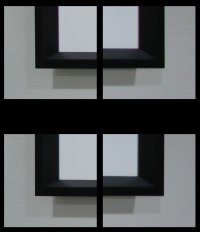
I want to make clear my discussion pertains to in-camera lens correction for JPEG output. My attachment sample is for chromatic aberration, but my point also applies to vignetting and geometric distortion.

Canon lens designers, with their Computer Aided Design (CAD) software, know exactly how a theoretical lens design performs regarding various aberrations. The lens design process involves numerous compromises to get to a marketable product.

One important lens design consideration is how easy it is to manufacture. A follow on from this is how consistent is unit to unit performance.

The in-camera lens correction software algorithm uses a ‘model’ of the lens to modify the internal RAW sensor data for JPEG engine output. Any ‘deviation’ of a particular lens being corrected from the model of that lens will result in a sub optimal corrected result.

My attachment is an EF 17-40mm f/4 L lens at 17mm and f/4. Top is software correction off and bottom is chromatic aberration correction on. The left and right sides are magnified crops of the left and right sides of an image of two framed photos – the frame is black and the matte board is white.

The uncorrected image clearly shows evidence of chromatic aberration with magenta and green fringing along the photo frame edges. However, on the corrected image, the magenta and green flip sides, albeit with a better result than non-corrected.

My conclusion is that my copy of the EF 17-40 doesn’t conform to the software model exactly. It’s overcorrected, so my copy is ‘better’ than the model, ha ha.

I understand post processing RAW gives one more flexibility regarding corrections, but my workflow is mostly JPEGs. In that regard, I’m greatly appreciative of in-camera software corrections.
 

Attachments

  • chromatic_abberation_OFF-ON.jpg
    chromatic_abberation_OFF-ON.jpg
    251.9 KB · Views: 6
  • Like
Reactions: 1 user
Upvote 0
As does Topaz. I have not used and have no intention of ever using Canon's digital tele-converter.
I've given up on Topaz for upscaling (and for everything else as well)- its more recent AI "improvements" invent too much. PS is much more realistic. I posted some examples comparing them on a thread somewhere, which I can't find.
 
Upvote 0
Well over a decade ago, I wondered how long the DR debate would go on.

Some debates will never die, they feed too many click loving "experts". ;)
 
Upvote 0
The VCM lenses are crazy good! I love my 50mm and find myself reaching for the 85mm F2 a lot less...
Does the VCM 50/1.4 require digital corrections to stretch image corners that do not cover the entire sensor? or just some geometry correction and lightening up vignetting?
I believe people on the internet will keep the debate going forever, just so they have something to complain and talk about.
or what, should we do away with forum such as CR? :p
 
Upvote 0
Definitely in the “hate it” side of this argument.. sure barrel distortion correction is lovely, and the ability to crop anywhere in an image to make a smaller also perfect image is something I do constantly… and you would think that being a EE with a specialization in DSP and image processing I would be all about this technology and pushing the boundaries….

But at the end of the day it all boils down to awareness of whats actually happening in the processing pipeline so that I, the photographer, can make the correct decision regarding exposure.. I have had landscaped photos ruined because of not realizing the amount of corner vignetting correction that was taking place. Now to be fair, I’m a hobbyist and those photos being ruined cost me nothing more than frustration..

That said, I hate the concept of digital correction because of not where it is today but rather than where it could go tomorrow. What is stopping them from making smaller lenses yet that have an APS-H image circle and then they stretch/scale it back to your full frame resolution.. should we care if ultimately the image is cleaner, sharper, etc.. I would on principle.. but if they took away the toggle to see the file without corrections we would probably never know.

I know I’m on the minority side of this argument.. and also that I shouldn’t care how the proverbial sausage is made.. but I’d like the believe that the these lenses don’t rely on post processing to stretch and brighten the image back to something acceptable to view.
 
  • Like
Reactions: 2 users
Upvote 0
Hi!

As mentioned by some contributors before: The vignette is pretty strong and limiting the use of such lenses for certain applications like night photography. I have a lot of experience with different lenses and a vignette of around 3EV is the limit for my work of panoramas at night.

Concerning the distortion correction: When I apply the classical 'distortion correction' before stacking (e.g. startrails), I get ugly moire pattern in the stack. So it seems that stretching is introducing subtle variations into the image which will only show up when stacking.

I see that there is an advantage with the digital correction for many applications, but there is also a disadvantage for other applications. It would be nice if we would have a larger selection of RF lenses so that each user would be able to select according to his needs (like in the good old 'EF-time').
 
  • Like
Reactions: 1 user
Upvote 0
Concerning the distortion correction: When I apply the classical 'distortion correction' before stacking (e.g. startrails), I get ugly moire pattern in the stack. So it seems that stretching is introducing subtle variations into the image which will only show up when stacking.
Can you stack uncorrected subframes? Something like: process raw without the lens profile, then stack, then apply the corrections to the finished stack, if you want?
 
  • Like
Reactions: 1 user
Upvote 0