What We Expect Canon to Announce in the Coming Months

Get the weight down, and I might be tempted.
This could be said about a few Canon lenses.
The 28-70 f/2L is what I see a lot of serious shooters using, and my three complaints with that lens are weight (c'mon, Sony are crushing it with their 28-70 GM weight which is around 500g lighter than the Canon), flare/glare when shot at wider apertures, and that 28mm just isn't wide enough. Knowing Canon, if they cheat and use digital correction, then I'm out, though.
Uhhhhh, I on the other hand would love Canon to "cheat" and use digital correction: how about a 24-70mm F2 which is as light as Sonys offering. That'd be great!
 
Upvote 0
The lenses would still benefit from updated technologies for focus motors, updated designs, etc., and personally I'd preorder an RF 600/4 + 1.4x lens.
I guess this new RF 600/4 will also be a tad sharper, since the current RF 600mm f/4.0 (optically identical with the EF 600mm Mk III as we know) is said (!) to be a little bit less sharp than the old EF 600mm f/4 II and Sony's current 600mm f/4.0 (btw I can't complain about my EF III, based on real life experience). Not sure if this is true, I did not yet stumble over any trusted lab review that compares these lenses, only MTF charts, but I am sure Canon will strive to take over the lead again anyway in this class of pro lenses. An integrated 1.4x TC like in Nikon's current 600/4 would be great, indeed, like Nikon's lens I guess it would be about 200 g heavier than a version w/o integrated TC, but many users (like me) carry a set of external TC's anyway frequently in their backpack.
 
Upvote 0
I think the macro strategy across the three major brands is to ship a 100mm and call it a day. I suspect Canon's weird-and-wonderful lens category will be tilt-shift innovations, for the real-estate photography market.

I am genuinely wondering how your MP-E 65 works at the higher 4-5x magnification range; I have struggled to get sharp results that aren't loaded with CA and softness at these focal lengths, when tripodded, using lights and high shutter speeds. I even had Canon check it and they said everything was optically fine. It was a cool party trick some 15+ years ago on the 40D, though, and has become useful for scientific/technical reasons, eg, inspecting vinyl record cartridge stylus tips.

I get great results out of the 180 3.5 still, in fact so much so that I had to send my EF 100L macro in to CPS for the second time (since the AF motor failed and was replaced, things have never been quite the same). The IBIS combined with the 180 3.5 even on my R5 works better than some EF optical IS lenses when I did some side by side comparisons - it's a very underrated piece of glass!

The 100 2.8 RF will do 1.4x which is a handy compromise (I don't yet have one though) but honestly my biggest disappointment was that Canon didn't build compatibility with their RF extenders unlike the leading competitor's option where you can slap on a 2x extender for a cool 2.8x magnification, albeit at 200mm.

If you want to see real macro innovation, check out the Laowa probe lenses. A wide angle FOV for 1:1 macro work is a super cool perspective.
Thanks for your comment, zardoz. On my side, I am very happy with the results I get with the MPE combined with my R5 and a diffused MT26EX-RT flash, without tripod (hand held), working at 3-4 magnification. I imagine what results could be obtained with a similar RF lens. I hesitate to buy an EF 180 macro, second hand, tu use it on the R5, because I still hope for a future RF 200 macro. If you want to have an idea of the results obtained with the MPE on the R5, have a look at my website https://www.lesjardinsmerveilleux.be/galerie.php?page=12 for example. The problem I see with Laowa macro lenses is the difficulty to use them with a good macro flash, like the MT-26. And as long as I see, the quality of the Canon MPE remains the best, even if this brave lens is quite old. 😊
 
  • Love
  • Like
Reactions: 1 users
Upvote 0
I am desperately waiting for a new macro lens, something to replace the beloved MPE-65 or at least a longer (200mm ?) macro lens... It seems that macro people have been forgotten in Canon strategy...
A MPE-65 replacement with an AF drive would be very attractive. I was thinking about purchasing such a lens for decades now, but my approach to macro photography (mostly freehand - spiders, insects in the wilderness) requires a good AF system. That's why I still stick with my old, trusted EF 100mm f/2.8 L IS USM lens, it works so well with the R7 and R5 II.
 
Upvote 0
The data show that ~63% of ILCs shipped last year were APS-C or m4/3. FF continues to increase, but it’s premature to say ‘the industry has moved on’ when the majority of cameras sold have crop sensors.
Interesting! Maybe that's the reason why Canon opened up their RF-S mount to 3rd party lens manufacturers. Canon still seems not to be a hurry to feed their native RF-S lens line quickly, so, they may feel forced to keep their crop camera segment as attractive as possible that way.
 
Upvote 0
Thanks for your comment, zardoz. On my side, I am very happy with the results I get with the MPE combined with my R5 and a diffused MT26EX-RT flash, without tripod (hand held), working at 3-4 magnification. I imagine what results could be obtained with a similar RF lens. I hesitate to buy an EF 180 macro, second hand, tu use it on the R5, because I still hope for a future RF 200 macro. If you want to have an idea of the results obtained with the MPE on the R5, have a look at my website https://www.lesjardinsmerveilleux.be/galerie.php?page=12 for example. The problem I see with Laowa macro lenses is the difficulty to use them with a good macro flash, like the MT-26. And as long as I see, the quality of the Canon MPE remains the best, even if this brave lens is quite old. 😊
Beautiful damselfly portraits! I am impressed that you get such good results with the manually focusing MPE and hand held - respect!
 
  • Like
Reactions: 1 user
Upvote 0
I am genuinely wondering how your MP-E 65 works at the higher 4-5x magnification range; I have struggled to get sharp results that aren't loaded with CA and softness at these focal lengths, when tripodded, using lights and high shutter speeds. I even had Canon check it and they said everything was optically fine.
Could diffraction be partly to blame? The effective aperture at the highest magnification is pretty narrow; maybe you're seeing it more on a higher resolution sensor?
 
Upvote 0
Thanks for your comment, zardoz. On my side, I am very happy with the results I get with the MPE combined with my R5 and a diffused MT26EX-RT flash, without tripod (hand held), working at 3-4 magnification. I imagine what results could be obtained with a similar RF lens. I hesitate to buy an EF 180 macro, second hand, tu use it on the R5, because I still hope for a future RF 200 macro. If you want to have an idea of the results obtained with the MPE on the R5, have a look at my website https://www.lesjardinsmerveilleux.be/galerie.php?page=12 for example. The problem I see with Laowa macro lenses is the difficulty to use them with a good macro flash, like the MT-26. And as long as I see, the quality of the Canon MPE remains the best, even if this brave lens is quite old. 😊
Honestly blown away with not just what that lens can do for you, but what you're doing with it! These are definitely shots that would be unachievable by anything else available on any camera system. I think it's time to sharpen my skills!

Interestingly enough, it's still actively supported by Canon but was only discontinued in 2022.

This could be said about a few Canon lenses.

Uhhhhh, I on the other hand would love Canon to "cheat" and use digital correction: how about a 24-70mm F2 which is as light as Sonys offering. That'd be great!
I have to run the 28-70 f/2 uncorrected at high ISO or else I end up with a wavy moire pattern in the noise profile. Sony seem to get away with minimal distortion at 28 on their lighter lens, so surely Canon can pull it off.
 
Upvote 0
An obvious path to smaller and lighter super telephotos is DO. The 600 and 800 f/11 are remarkably sharp for their price points, so Canon has clearly made some cost and performance improvements in DO since the last green ring lens. A 600 f/5.6 DO with a built in TC (ideally both 1.4 and 2x) could be very light and (compared to the big whites) cheap, particularly if built with engineered plastics rather than all metal. Going with f/5.6 would save considerable size and weight and keep it from competing directly with the big whites. I found it interesting that the 600 and 800 f/11 lenses used DO but didn't really talk about it nor did they sport the green ring. Nikon applied the Fresnel treatment to their Nikon Z 800mm f/6.3 PF VR S and that also points out how much weight and cost savings are possible with that approach.
 
  • Like
Reactions: 1 user
Upvote 0
I'm currently in Colombia chasing birds. I have seen a bunch of those Nikon primes. They're great. I would buy a 600 6.3 yesterday if it was an option. No point in the f/4 even for hummingbirds.
My wife has a 600mm 6.3, it's a wonderfully compact and light lens, you won't believe it is 600mm FF lens if you hold it in your hand. And it is a diffraction optics lens. So I do hope that Canon comes up with something competitive, given the fact, that Canon pioneered the DO lens technique with the 400mm f/4.0 DO. Would be a nice addition to Canon's RF lens line...
 
  • Like
Reactions: 1 users
Upvote 0
I found it interesting that the 600 and 800 f/11 lenses used DO but didn't really talk about it nor did they sport the green ring.
The quality and specs of these lenses aren't up to a green ring, the EF 400mm f/4.0 DO lenses had full L quality, which was reflected in their prices, of course.
Nikon applied the Fresnel treatment to their Nikon Z 800mm f/6.3 PF VR S and that also points out how much weight and cost savings are possible with that approach.
Plus the Z 600mm f/6.3, which is really sharp, my wife as a copy as I wrote in my previous post, and I am impressed by that little gem of a supertele lens. The Z 800mm must be impressively light, too, but I guess it is too long for birds-in-flight. When I pair my EF 600mm III with a 1.4x TC I really struggle to keep a fast flying bird in the very narrow image frame.
 
Upvote 0
I'm currently in Colombia chasing birds. I have seen a bunch of those Nikon primes. They're great. I would buy a 600 6.3 yesterday if it was an option. No point in the f/4 even for hummingbirds.
Yep, it's all about magnification. If the lens focuses close enough to make a hummingbird large in the frame, then f/8 is about as fast as you can go if you want the whole bird in focus and that is pretty much independent of focal length.
 
Upvote 0
I'm headed to Kenya on safari this spring, particularly looking for migratory birds that should be really plentiful in the rainy season. My main gear is the current RF 600 f/4 on the R5ii, and I'll also have an R7 with a much shorter lens, probably a 70-200 f/2.8, for larger and closer subjects. In my experience, the 600 sees almost all of the action on safari.

I'd happily shell out to replace it with a 300-600 f/4L even if it's heavier. No interest in a slower lens, as I've absolutely loved the extra light collection in poor conditions vs the otherwise excellent 100-500 lens, and honestly I struggle to see the big draw of 300-600 f/5.6 over that lens.

If they make a true RF 600 f/4 with a 1.4x toggle built in, I'll pre-order day 1.

Example shot from the 600x1.4 wide open; I don't buy the "have to stop down to get focus" argument.
 

Attachments

  • 461A7324-Enhanced-NR.jpg
    461A7324-Enhanced-NR.jpg
    1.3 MB · Views: 38
  • Like
Reactions: 1 users
Upvote 0
Example shot from the 600x1.4 wide open; I don't buy the "have to stop down to get focus" argument.
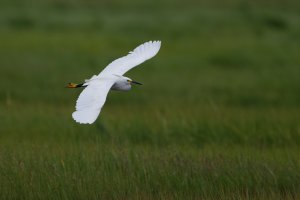
Depends on what you're shooting, the subject size and distance, and how much of that subject you want in focus. Here's a shot with the 600/4 II + 1.4x at f/6.3, the head and feet of the snowy egret are in focus but the wing tips are not (shutter speed was more than fast enough to freeze them). I don't mind the wingtips being outside the DoF, but if I had wanted the whole bird in focus then I'd have needed f/9 or so (this was ISO 500, so I had plenty of freedom to stop down).

SnowyEgret.jpg
 
  • Like
Reactions: 1 user
Upvote 0
Fwiw I essentially never* stopped down my 500, for me the gain of more of the subject being in focus was never worth making the backgrounds busier. Now I only have the 800f/11 which is fixed aperture.

*I did habitually stop it down just a touch when I mounted the 2x extender, because I believed that combination was too soft wide open.
 
  • Like
Reactions: 1 user
Upvote 0
Oh boy oh boy, this is surely another opportunity to whine about a
- proper 50mm lens in the $400-600 range
- proper 28mm lens in the $400-600 range
- 28-70/2L II with way less weight
- great ~150-180mm sub-2.8 L macro
- fullframe compact

The 300-600? Just release it at a good price and weight and I'm in!
 
Upvote 0