Report: New Canon Super Telephoto Lenses Coming in May

Do we expect these potential 400mm and 600mm big whites to be comparable in cost to their predecessors? I wish I were in that market... sigh. I feel there's a fair chance this 300-600L zoom is perhaps destined to remain a rumor lol.
No idea, but I'd expect that if the new 400mm and 600mm lenses have an integrated, switchable 1.4x TC (there were patents published on those about a year ago) then they'll go up in cost a bit over the current versions. Maybe $1K or $2K more? The 1.4x TC is selling for $600...

Even if the 300-600/5.6L is not a rumor, while it will likely be cheaper than the 400/2.8 and 600/4, it won't be 'cheap'. Likely a bit north of the RF 100-300/2.8, so figure on the order of $11.5-12.5K.
 
  • Sad
Reactions: 1 user
Upvote 0
That hypothetical 1x-1.4x TC would require reducing optics for the 1x setting, a completely different set of optics than the extender optics that would need to flip in when the 1.4x elements flip out. Same thing as the magical unicorn 1x-1.4x-2x TC that people have been dreaming about after someone misinterpreted a Canon patent for something completely different that happened to have 1-1.5-2x markings on the diagram.
Not sure that even reducing optics would solve the problem. A friend of mine who worked for Canon for many years once pointed out to me that the reason no one made the equivalent of a Metabones Speed Booster for EF-to EF is that focal reducers do not extend the focal plane like extenders do so they can only be made to fit inside the existing back focus distance of a lens. Hence, we have focal reducers that replace the EF to M and EF to R adapters, but no focal reducers for EF to EF or R to R.
 
Upvote 0
A friend of mine who worked for Canon for many years once pointed out to me that the reason no one made the equivalent of a Metabones Speed Booster for EF-to EF is that focal reducers do not extend the focal plane like extenders do so they can only be made to fit inside the existing back focus distance of a lens. Hence, we have focal reducers that replace the EF to M and EF to R adapters, but no focal reducers for EF to EF or R to R.
It's technically possible to have a focal reducer that maintains the same lens mount and flange focal distance - there is a 0.7x focal reducer for PL to PL. Of course, technically possible ≠ easy...that optic is 20 cm long, has 13 elements, rotates the image 180° and costs $5500. But it will give you 0.7x the focal length and an extra stop of light with a FF lens and an S35 sensor (or an S35 lens and an S16 sensor).

It might not be possible to accomplish that in a TC-sized optic, though the 'boost' would not need to anywhere near a full stop because the light loss from an extension tube (along with the magnification benefit) decreases with increasing focal length.
 
  • Like
Reactions: 1 users
Upvote 0
No idea, but I'd expect that if the new 400mm and 600mm lenses have an integrated, switchable 1.4x TC (there were patents published on those about a year ago) then they'll go up in cost a bit over the current versions. Maybe $1K or $2K more? The 1.4x TC is selling for $600...

Even if the 300-600/5.6L is not a rumor, while it will likely be cheaper than the 400/2.8 and 600/4, it won't be 'cheap'. Likely a bit north of the RF 100-300/2.8, so figure on the order of $11.5-12.5K.

Yeah, the integrated TC would seemingly add a bit to it. Definitely would make for some steep prices :cry:

It does seem like a 300-600 f/5.6L should be in the ballpark of the 100-300L unless some magic happens. Given the identical front end size requirement, do you figure getting to 600mm adds more cost than the 2x (instead of 3x) zoom factor reduces it? Honestly, unless some magic happens, I'm not really in the market for this one either 😓
 
Upvote 0
It's technically possible to have a focal reducer that maintains the same lens mount and flange focal distance - there is a 0.7x focal reducer for PL to PL. Of course, technically possible ≠ easy...that optic is 20 cm long, has 13 elements, rotates the image 180° and costs $5500. But it will give you 0.7x the focal length and an extra stop of light with a FF lens and an S35 sensor (or an S35 lens and an S16 sensor).

It might not be possible to accomplish that in a TC-sized optic, though the 'boost' would not need to anywhere near a full stop because the light loss from an extension tube (along with the magnification benefit) decreases with increasing focal length.
The 180 rotation makes sense. that would indicate that the adapter created an intermediate focal plane and supports what my friend told me. I guess you could create yet another focal plane and rotate the image back for only $12k ;).
 
  • Haha
  • Like
Reactions: 2 users
Upvote 0
No idea, but I'd expect that if the new 400mm and 600mm lenses have an integrated, switchable 1.4x TC (there were patents published on those about a year ago) then they'll go up in cost a bit over the current versions. Maybe $1K or $2K more?

Like any new lens, this will make it more expensive. If it adds a feature that's not found in other lenses, or is extremely rare, the price immediately skyrockets. I'd guess they'll add $3,000-4,000.I'd be happy to use the version with even just the 1.4.
 
Upvote 0
Canon has filed patent applications for a switchable 1.4x-2x TC, essentially a 1.4x with a second 1.4x that flips out. Not sure it will become a product, but Canon is certainly thinking about such an optic.

View attachment 228790
Ah, thanks for sharing! Looks quite complex...
 
Upvote 0
A 600mm f4 with a built in 1.4 extender would leave only a long RF macrolens on my RF lens wishlist.
I think we can expect a built-in 1.4 extender, because Nikon's current Z 600mm f/4.0 has one. I guess the old rivalry will drive Canon to come up with such a solution.
 
  • Like
Reactions: 1 user
Upvote 0
omg, how heavy was this lens? According to google AI, it was 16,8 kg. Instead of a tripod one should have probably used a golf cart :ROFLMAO: Useful for a safari, for sure. But for which sport would one use a lens like this?
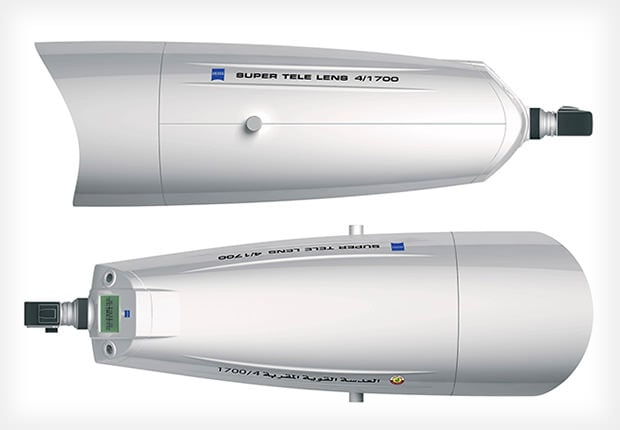
Well, Canon's 1200mm f/5.6 was still pocketable compared to the medium format 1700mm f/4.0 tele lens that Zeiss designed especially for a rich Sheikh and his Hasselblad(s). I guess this guy hasn't to carry that lens by himself ;).


Zeiss 1700.jpeg
 
Upvote 0
Not two TC, but Nikkor Z 600mm f/4 TC VR S is something Canon should have made long ago.
If Nikons Z8/9 perform with that lens AF wise like with the Z 600mm f/6.3 PF + 1.4,x extender (latest one from Nikon), I'd really prefer my Canon gear. Shooting side by side with comparable settings, my R5 II + EF 600mm f/4.0 and Canon's 1.4x TC III combo focuses much more reliably than the Nikon gear. I am really disappointed, since I made that 10 k€ gift to my wife as an upgrade of their DSLR F mount gear and hoped it will bring a boost in performance. The opposite is currently the case, and my wife is an experience photographer + she uses exactly the settings recommended by Nikon and Nikon reviewers for birding. Nikon really needs to improve their underwhelming Z AF system.
 
Upvote 0
If Nikons Z8/9 perform with that lens AF wise like with the Z 600mm f/6.3 PF + 1.4,x extender (latest one from Nikon), I'd really prefer my Canon gear. Shooting side by side with comparable settings, my R5 II + EF 600mm f/4.0 and Canon's 1.4x TC III combo focuses much more reliably than the Nikon gear. I am really disappointed, since I made that 10 k€ gift to my wife as an upgrade of their DSLR F mount gear and hoped it will bring a boost in performance. The opposite is currently the case, and my wife is an experience photographer + she uses exactly the settings recommended by Nikon and Nikon reviewers for birding. Nikon really needs to improve their underwhelming Z AF system.
Canon recognises and locks on to birds faster than Sony or even more so than Nikon. However, they are meant to have stickier tracking. (Faster AF acquisition is more important for me). Recently, I was shooting Peregrines and Kestrels side-by-side with my R5ii +RF 200-800mm and someone with the Sony A1ii and the 300mm f/2.8 + 2xTC against a tricky background. I was much more successful at catching them. It's probably a software thing and they should be able to catch up.
 
Upvote 0
Canon recognises and locks on to birds faster than Sony or even more so than Nikon. However, they are meant to have stickier tracking. (Faster AF acquisition is more important for me). Recently, I was shooting Peregrines and Kestrels side-by-side with my R5ii +RF 200-800mm and someone with the Sony A1ii and the 300mm f/2.8 + 2xTC against a tricky background. I was much more successful at catching them. It's probably a software thing and they should be able to catch up.
DPAF offers a great deal more focus information than Nikon or Sony have to work with. So long as Canon has that advantage, they are only limited by processing power to stay in the lead with AF. The price, of course, is continually processing twice as many pixels, so the processors are power hungry.
 
  • Like
Reactions: 1 user
Upvote 0
Well, Canon's 1200mm f/5.6 was still pocketable compared to the medium format 1700mm f/4.0 tele lens that Zeiss designed especially for a rich Sheikh and his Hasselblad(s). I guess this guy hasn't to carry that lens by himself ;).


View attachment 228817
So we’re playing ‘mine is bigger than yours’? ;)

Ok, I’ll see your Zeiss 1700mm f/4 and raise you a Canon 5200mm f/14.

1775690172287.png

It’s a great lens, as long as your subject is further away than the minimum focus distance…
 
  • Haha
Reactions: 1 user
Upvote 0
Canon recognises and locks on to birds faster than Sony or even more so than Nikon. However, they are meant to have stickier tracking. (Faster AF acquisition is more important for me). Recently, I was shooting Peregrines and Kestrels side-by-side with my R5ii +RF 200-800mm and someone with the Sony A1ii and the 300mm f/2.8 + 2xTC against a tricky background. I was much more successful at catching them. It's probably a software thing and they should be able to catch up.
The symptoms with the Z8 and the Z 600/6.3 are: the camera focuses fast (with no TC attached) and gets in particular very close to in-focus images with the first frame(s), but then starts to struggle with following frames, and the AF sort of micro-pumps around the precise focus position. First we thought it's a problem with object detection but switching off "birds" or switching it completely off doesn't really help (3D tracking activated). So the problem might be sitting deeper in the system, maybe I have to wipe dust off my old lenscal tool and check the system with it. Nikon's menus of the Z cameras allow for AF calibration, I have briefly seen at least for the Z6 III and 7 on the internet. I always thought that AFMA isn't needed anymore with modern ML cameras, but with Nikon you never know...
 
Upvote 0
So we’re playing ‘mine is bigger than yours’? ;)

Ok, I’ll see your Zeiss 1700mm f/4 and raise you a Canon 5200mm f/14.

View attachment 228818

It’s a great lens, as long as your subject is further away than the minimum focus distance…
Yepp, I know, there is also a youtube video about this crazy catadioptric lens Canon once made - but for 35mm format, if I remember correctly, not for medium format like the Zeiss monster. I guess you really run into trouble with such a huge focal length in many settings because of atmospheric blur. If Canon ever will come up with a modern version I'd highly recommend them to include an adaptive optics system to compensate for the distortion of incoming light wave fronts, like in astronomical telescopes (I edit a German physics magazine so I deal frequently with in-depth reviews of such technologies). That, of course, would only get haze caused by temperature gradients in the air better controlled, not dusty and/or misty or smog conditions.
 
Last edited:
Upvote 0
And they also have DO (PF in Nikon parlance) elements.

But apparently those don’t count as ‘innovative’ lenses…at least, not in the minds of those who think Canon must make the lens(es) they personally want, or else. Or else, what? Yeah.
Right, in fact, when I am getting in the age where I can't lift and carry any heavier tele lens anymore, such not-so-fancy lenses will gain a lot of attraction at least for me. Btw I met quite a lot of users, in particular young birders with a small budget, who are quite happy in particular with the 800mm f/11. If there is enough light available, these DO lenses seem to be better than what nerds like us would expect from the underwhelming specs of such lenses. Kudos to Canon that they came up with such tele gear.
 
  • Like
Reactions: 1 users
Upvote 0