What’s Coming Next from Canon?

That's a pretty big jump, you're effectively doubling the surface area of the front element. The entire lens would have to be redesigned, from each optical element to the body itself. It would be vastly different from the original 100-500: at least 1 kg heavier and bulkier. If it ever came out, it would certainly not cost "only" $4500-5000 and move much closer to the 100-300.
Canon's never done such a lens refresh. If they want to fill the gap, it'll be with a new lens.
To be fair, Craig did say $5000-6000 white tele lens, and i think a faster RF 100-500 L is a more viable expectation than the RF 300-600 f5.6 L in that price point. They made a big splash with the RF 28-70 f2 L, they would make a huge splash with a RF 100-500 3.2-5 L.

This assumes a 70-85% cost increase to producing a lens a full stop faster, economy of scale and projected sales. I have no idea on Canon’s pricing margins, it’s often said Canon’s profits aren’t driven by their top end gear, presumably because of units sold, but when you see them knock $8000 off the RF 1200 L lens, there’s obviously some room for pricing. Maybe that’s why the speculation of a RF 300-600 L in a sub $7000 range.

Again, if I have to speculate, a faster RF 100-500 L is less to make, unless they ramp up their production of the front and other lens elements that they can use in both the RF 100-300 2.8L and the RF 300-600 5.6L and take advantage of the economy of scale, like they did in their 24 MP sensors (R6 and R8) and other shared sensor cameras.

Things that increase costs are the things we all want, internal zooming and fixed aperture, but at the end of the day we will forgo those things based on sharpness, strong weather sealing and cost.
 
Last edited:
  • Like
Reactions: 1 user
Upvote 0
I suspect Nikon and Sony are making $4000-6000 supertele lenses for the same reason.
Canon has always made very targeted products for specific users, hence why we get both RF 100-400mm and RF 800mm f/11 that no other companies have been able to match in affordability. From my observations RF-mount was a rushed launched. The development capacity of lenses is limited and they have had to make priorities. Some user groups have been left out, astrophotography until recently. They had to let in Sigma and Tamron on RF-S. 4k to 6k supertele lenses will probably come someday. For now they can earn more profit making other lenses that either are higher volume or have better margin.
 
  • Like
Reactions: 1 user
Upvote 0
I am very curious about the R8 II though I've an inkling that it won't fit what I want. That's ok because the original R8 already does. :)

I do for example like that the R8 has no ibis, l and thus a moving part less. Makes me much more confident in throwing it into my daily bag with the 28mm on, inside a small pouch.

So let's what they'll bring, maybe the mark 2 will take the larger 6er batteries?
 
Upvote 0
Canon really needs to get with the program on the sub 5-figure "not quite the fastest" supertelephoto market.

Nikon (current prices on Adorama):
400mm f/4.5 - $3050
600mm f/6.3 - $4000
800mm f/6.3 - $6000

Sony:
100-400 f/4.5 - $4300
300mm f/2.8 - $6600

Sigma E-Mount:
500mm f/5.6 - $3300
300-600mm f/4.0 $6600

Canon:
Best we have is doubled 70-200Z, 100-500L, or 200-800 non-L (none really competing in this space).

Maybe we can take a break from 9 wide/ultrawide lenses in the last 18 months or so lol
View attachment 229546
No, no, no!
We can only take a break from wide/ultrawide lenses AFTER the introduction of number 10: The 14mm TS-E ! :)
 
  • Haha
Reactions: 1 user
Upvote 0
R6 mark ii (~USD2400)? All R bodies can adapt EF and EF-S lenses with the converter.
https://www.proshop.se/Kamera/Canon-EOS-R6-Mark-II-Body/3143406
You may even find a reasonable second hand R5 in Sweden for less money.
The R6 mark ii ($2585) has the same 24 Mpix sensor as R8 (currently $1550 in Sweden) but also with IBIS. It is a much bigger and heavier camera. I like the idea of a lightweight camera like the R8 with somewhat better specifications. IBIS and 32 Mpix sensor is my wish. I doubt that a 24 Mpix (3x2) sensor is good enough for 4K video with 1,6 crop and 16x9 aspect ratio.
 
Upvote 0
Canon really needs to get with the program on the sub 5-figure "not quite the fastest" supertelephoto market.

Nikon (current prices on Adorama):
400mm f/4.5 - $3050
600mm f/6.3 - $4000
800mm f/6.3 - $6000

Sony:
100-400 f/4.5 - $4300
300mm f/2.8 - $6600

Sigma E-Mount:
500mm f/5.6 - $3300
300-600mm f/4.0 $6600

Canon:
Best we have is doubled 70-200Z, 100-500L, or 200-800 non-L (none really competing in this space)

Canon really needs to get with the program on the sub 5-figure "not quite the fastest" supertelephoto market.

Nikon (current prices on Adorama):
400mm f/4.5 - $3050
600mm f/6.3 - $4000
800mm f/6.3 - $6000

Sony:
100-400 f/4.5 - $4300
300mm f/2.8 - $6600

Sigma E-Mount:
500mm f/5.6 - $3300
300-600mm f/4.0 $6600

Canon:
Best we have is doubled 70-200Z, 100-500L, or 200-800 non-L (none really competing in this space).

...
As primarily a bid photographer, the Canon 100-500L and the Canon 200-800 are the only two lenses I would even consider from this group, even though you consider that they don't even compete. The 3 Nikon lenses certainly look like good value for the money, but they are all primes, so much more difficult to handle for my use, and I would not even consider them. The two Sony lenses, not nearly long enough, although the new zoom sure looks good for other uses. The Sigma 300-600, way too expensive compared to the two Canon options. Under pretty much no circumstances would I need (or use) f/4 for birding.
 
  • Like
  • Wow
Reactions: 2 users
Upvote 0
I think the reason for no 7D III is because of the transition to mirrorless, the 7D was released in September 2009, the 7D II in September 2015, so it was do for a refresh in September 2019, and even though, Canon had the M-series, Canon was under pressure to address Sony in the mirrorless market, thus they released the Canon R (5D IV sensor) in September 2018, and the RP (6D II sensor) in March 2019. The R5 and R6 were released during the Covid lockdowns, July 2020 and August 2020 with all the uncertainties and supply chain issues. So the R7 was released in June 2022 with the R10 in July 2022.

Canon still had the DSLR's: 1DX III and 5D IV. So with what was going on, I don't think the 7D III refresh was as high of a priority, everyone I know raves about the 7D II, those customers were happy. If I was a birder, I would have gotten a 7D II, but as a landscape guy, I moved from the 7D to the 5D III and 5DS R. There was talk of Nikon going the way of Sears Roebuck, but the Nikon D800 and D850 DSLR's kept the faithful Nikon shooters with hope, until they hit a home run with the Z9 and later Z8. I think I got the last Nikon APS-C, the D780, which was struggling against the mirrorless environment.

Birders like their APS-C sensors, my first entrance into birds was on Safari last year and for that I have the 200-400 f4 + 1.4x, but it left me coming up short more than I would have liked. I had my R5, R6 & R7 on the trip, but since I was a first time safari, I often had the wrong set up on the river or on game drives trying to balance light and length. Then on a trip to the Amazon, I took my R5, R7 and R3, and exchanged the 200-400 for the 300 2.8 and the 200-800 for length. Unfortunately the AF on the R5 isn't nearly as capable as the R5 II and the folks shooting A1 II, as they could track monkeys moving through the trees, while my R5 and R3 struggled mightily.

I have moved my R7 to my underwater photography niche and was looking forward to the R7 II, or a high MP R3 which is even more of a question mark than the R7 II. I was thinking about converting a R5 or maybe R5 II also, but now I think I am going to go the Sony A7CR or wait on the A7CR II for my FF underwater camera as it affords higher MP's in a smaller housing.

As far as future buyers, I think those in the R50 segment, will probably be more of a candidate for a R10 I/II or R8 I/II. Heck the RP is still selling, long after the R. I think the people that are most enthusiastic about the R7 II are wildlife and to a lesser extent, outdoor sports shooters, they want a premium APS-C flagship, if you ask them , they would really like for it to be a R1 APS-C camera, is Canon going there, highly unlikely, but Canon wants to hold on to that segment, there are plenty of other cameras for new buyers to hop into the brand. How many birders would opt for a R6 I/II over the R7? How many will opt for a R6 III or wait for the R7 II? I am in the wait crowd, as my current travel combo now is the R1 & R5 II.

I am amazed that people have already forgotten the Covid lockdowns and supply chain issues (toilet paper ?). There were a lot of abnormal things occurring, and the current Iran/Strait of Hormuz oil and supply chain issues are probably forcing them to be flexible. Heck, with talk of the market dropping 40-60% here in the US, the camera market may all but dry up.
Some good points, but I think you are ignoring the 6 year gap between 7D and 7D II and the 7 year gap between the 7D II and the R7. And the fact that Nikon has never made a successor to their "flagship" wildlife crop camera, the D500. Judging from people on this forum and other places, I also think that many folks who were looking for a higher end R7, ended up going full frame with the higher mp R5. I think, all things considered, we are talking about a niche camera. I bought the R7 because it was affordable. As primarily a bird photographer, a high-end, more expensive R7 II does not interest me at all. Price matters. This is not to say I don't think Canon may indeed go high end with the R7 II. I think that the R7 and R10 may be too close in terms of specs, so taking the R7 to another level might make perfect sense.
 
Upvote 0
I'm super excited for the Canon R8 II and would like to see it use the R6 III sensor, 12 fps continuous shooting, larger battery (LP-E6NH), a rear dial / scroll wheel, two card slots and priced at $1,500 USD. To keep the cost down I think it's ok to avoid IBIS with plenty of stabilized lenses, electronic first curtain, no joystick and if they can save by holding back RAW, 7K, Open Gate and C-Log 2 video then fine. But it would be nice to get 4k 120 fps without a crop. That would be a great hybrid camera and a nice "step up" to full frame from APS-C. Frankly, the R8 is still a good option too but it should be closer to $1,000 USD. And since the R8 came out just 5 months after the R6 II we are about due for this camera any day now!
 
Upvote 0
Oh, and for a new lens, I am really hoping for Canon to complete the STM zoom "trinity" having the 16-28 f/2.8 and 28-70 f/2.8 now they only need the 70-180 f/2.8 and the HOLY TRINITY of lenses will be complete! For those of us more budget conscious it would be nice if this trinity came in under $3,500 USD which means it needs to be $1,300 USD. If that is too tall of an order, maybe they can shrink it to 70-150mm but it really shouldn't go less than that. This makes sense though since these are basically the Canon version of Tamron's best selling lenses. They should sell like hotcakes.
 
  • Like
Reactions: 1 user
Upvote 0
The R6 mark ii ($2585) has the same 24 Mpix sensor as R8 (currently $1550 in Sweden) but also with IBIS. It is a much bigger and heavier camera. I like the idea of a lightweight camera like the R8 with somewhat better specifications. IBIS and 32 Mpix sensor is my wish. I doubt that a 24 Mpix (3x2) sensor is good enough for 4K video with 1,6 crop and 16x9 aspect ratio.
Stop doubting and get informed. The information is widely available.

"The R6 II captures oversampled UHD 4K/60p video using the entire width of its sensor – no more crop. It's also possible to capture 4K/60p from an APS-C crop of the sensor." DPReview

"The R6 II also supports a ProRes RAW video workflow when paired with a compatible Atomos recorder. This includes 6K Raw video using the entire sensor width or 3.7K Raw video using a Super35 crop" DPReview
 
Upvote 0
For the sake of the enthusiasts I hope you get what you want, it would be fun to see some novel telephoto options. But it could be that Canon is segregating the long lens market differently to those other companies - or vice versa - and so there will never be precise equivalents of each thing across every range. It's often presented as though Canon needs to catch up with Nikon etc but they probably don't see it that way. In any case we have more and better choices now than in the EF days when I started; back then you could go to 400 f/5.6 at ~£1500 but no further without leaping up to the hugely expensive big big whites.

As an enthusiast, I hope I get what I want too lol :sneaky:

Certainly, I don't expect equivalents for every other lens here. Something would be a good start. All the lenses I listed above are fairly attractive, imo. I think Canon has excellent lenses, and certainly each company wants to find its lane to an extent. My "get with the program" complaint is also not intended to be overly serious lol. I'd just like to have more options, and Canon has not been in this particular lane as of recent.

No, no, no!
We can only take a break from wide/ultrawide lenses AFTER the introduction of number 10: The 14mm TS-E ! :)
Trust me, I already died a little inside at the thought lmao 😭

As primarily a bid photographer, the Canon 100-500L and the Canon 200-800 are the only two lenses I would even consider from this group, even though you consider that they don't even compete. The 3 Nikon lenses certainly look like good value for the money, but they are all primes, so much more difficult to handle for my use, and I would not even consider them. The two Sony lenses, not nearly long enough, although the new zoom sure looks good for other uses. The Sigma 300-600, way too expensive compared to the two Canon options. Under pretty much no circumstances would I need (or use) f/4 for birding.
I mean no insult to those lenses. Their exclusion is because they pretty clearly (imo) don't fall into the "not quite the fastest" target that I was exclusively discussing. That's not to say this is some objective taxonomy that I've derived, it's just a forum post/lamentation as I beg Canon to take my money on a new supertelephoto release. I also rather like zooms for fast-moving wildlife (birds, dragonflies, etc.) - if somehow we get a 300-600 f/5.6L under 5 figures (which I somewhat doubt), it would be very attractive imo. A recent article here mentioned a 500mm f/5.6L (not that patents will strictly translate to commercial lenses), which imo would be interesting as well: https://www.canonrumors.com/canon-shows-off-rf-500mm-f5-6-l-is-in-latest-patent/

Canon makes great zoom lenses! I am a staunch evangelist for the 70-200Z (including w/ 2x). All of these taken with the 2x on:
100k_E9A1881_DxO_R52.jpg
190k_E9A4128_DxO_R52.jpg
190k_E9A5329_DxO_R52.jpg
 
  • Like
Reactions: 2 users
Upvote 0
As an enthusiast, I hope I get what I want too lol :sneaky:

Certainly, I don't expect equivalents for every other lens here. Something would be a good start. All the lenses I listed above are fairly attractive, imo. I think Canon has excellent lenses, and certainly each company wants to find its lane to an extent. My "get with the program" complaint is also not intended to be overly serious lol. I'd just like to have more options, and Canon has not been in this particular lane as of recent.


Trust me, I already died a little inside at the thought lmao 😭


I mean no insult to those lenses. Their exclusion is because they pretty clearly (imo) don't fall into the "not quite the fastest" target that I was exclusively discussing. That's not to say this is some objective taxonomy that I've derived, it's just a forum post/lamentation as I beg Canon to take my money on a new supertelephoto release. I also rather like zooms for fast-moving wildlife (birds, dragonflies, etc.) - if somehow we get a 300-600 f/5.6L under 5 figures (which I somewhat doubt), it would be very attractive imo. A recent article here mentioned a 500mm f/5.6L (not that patents will strictly translate to commercial lenses), which imo would be interesting as well: https://www.canonrumors.com/canon-shows-off-rf-500mm-f5-6-l-is-in-latest-patent/

Canon makes great zoom lenses! I am a staunch evangelist for the 70-200Z (including w/ 2x). All of these taken with the 2x on:
View attachment 229568
View attachment 229569
View attachment 229570
Nice photos, I haven’t bought the RF extenders, and while I own both the EF’s, I haven’t ever shot with them, but given the amount of EF glass I have, I figure it better to have them and not need them, than to need them, and not be able to get them. I used the Sigma 1.4 on the 150-600 Sigma lens to shoot the moon, and occasionally flip the 1.4x into position on the EF 200-400 f4L +1.4x.

It was nice of you to share the photos, to see what the RF 2x can do on the Z.

I shot a dragon fly resting on a croc and flies on a caiman, but unfortunately the photos were too shallow of depth of field. I saw your photos and it I thought, great pictures, but man, if only all the wings were crisp or the entire butterfly was in focus, with the background blown out like it is, they would be National Geographicesque, I know, next to impossible with a dragonfly in flight.

I just don’t think I am ready to spend $589 for 1.4x and a loss of a stop of light, mentally, I think I prefer to shoot APS-C for the 1.6 crop factor, hence the interest in a high-end R7 II, and the thought of $689, while giving up two stops of light, has me hoping they come through with a $5-6K L tele zoom, c’mon Canon, don’t let us down.
 
Upvote 0
I have no idea on Canon’s pricing margins, it’s often said Canon’s profits aren’t driven by their top end gear, presumably because of units sold, but when you see them knock $8000 off the RF 1200 L lens, there’s obviously some room for pricing.

The RF 1200mm is a special case because it's essentially a RF 600mm with added TC elements. And i assume the 14K 600mm already has a healthy profit margin on it.
 
Upvote 0
I just don’t think I am ready to spend $589 for 1.4x and a loss of a stop of light, mentally, I think I prefer to shoot APS-C for the 1.6 crop factor, hence the interest in a high-end R7 II…
Ahhh, yes…the free lunch that comes with a smaller sensor. Truly magical. ;) The reality is that you’re losing over a stop of light with APS-C compared to full frame. Along with the smaller FoV (effective increase in focal length), you get 1.3-stops more noise. So, for example, ISO 3200 on APS-C looks like ISO 8000 on FF.
 
Upvote 0
Don't think about it, just do :)
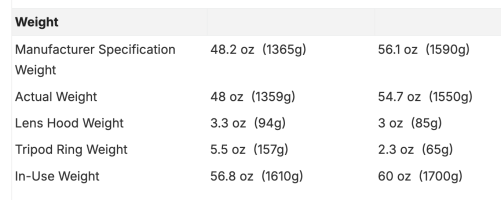
The 100-500 is 200g lighter than the 100-400 and a 16y newer lens with better IS, AF, etc.
For me it's very important because it's my #1 travel lens even when just backpacking around places like Iraq, Pakistan, Afganistan, etc, so wight matters a lot.
It's lighter by 200g only when its tripod ring is removed. The in-use weight is only 90g less - see the-digital-picture.com

Screenshot 2026-05-19 at 13.08.25.png
 
Upvote 0
It was nice of you to share the photos, to see what the RF 2x can do on the Z.

I shot a dragon fly resting on a croc and flies on a caiman, but unfortunately the photos were too shallow of depth of field. I saw your photos and it I thought, great pictures, but man, if only all the wings were crisp or the entire butterfly was in focus, with the background blown out like it is, they would be National Geographicesque, I know, next to impossible with a dragonfly in flight.
Actually, some blurring of a dragonfly's wings in flight is rather attractive and parallels shooting helicopters and prop aircraft when, I believe, the devotees want the propellers and rotors blurred. I've shot 1000s of dragonflies in flight and have quite a few with crisp wings. The head-on one has a blurred body but that to me adds life to the photo. All taken with the RF 100-500 on the R5 or R5ii - you need a light lens to swivel fast.

6L8A4478-DxO_ruddy_darter_dragonfly_flying_face_on.jpg309A2059-DxO_Emperor_dragonfly_flying_shsh.jpg309A4870-DxO_Ruddy_Darter_Dragonfly_flying-ls-topaz-sharpen.jpeg309A5432-DxO_Emperor_Dragonfly_Flying.jpg309A5457-DxO_Emperor_Dragonfly_Flying-1.jpg
 
  • Like
  • Wow
Reactions: 6 users
Upvote 0