Rest well Canon EOS 7D series [CR2]

I'm confused, too. I don't think there's a difference between RF and EF in terms of lens size (people claim there is, but there are no data to support that claim). But a smaller image circle can make a big difference at short FLs. Look at the EF 11-24 f/4L vs. the EF-S 10-18mm or 10-22mm.

I do suspect a lot of 7-series shooters use EF-S lenses, 10-18/22, 17-55/2.8, 15-85. Canon has ample data on this, certainly.

I think they could make a larger M body for better ergonomics, but that would mean adapting telephoto lenses to it.

Of course it's anecdotal, but almost all of the 7D Mark II shooters I know use FF bodies for WA work. They only use the crop body for telephoto.
 
Upvote 0
Those were DIGIC 6 processors. The new DIGIC 8 can probably handle the frame rate. As for focus points just reduce the number to the point that the DIGIC 8 can handle it.

It's not that simple. PDAF sensor pixels are MUCH larger than imaging sensor pixels, and are thus more sensitive (and don't have color filter overlays that require demosaicing). It takes multiples of imaging sensor pixels to equal one dedicated PDAF sensor pixel, thus the processing load is much greater for sensor based AF than for dedicated PDAF sensor based AF. Even so, the dual DiG!C 6 processors of the 7D2 are both used for image processing. There is a third processor chip roughly equivalent to the DiG!C 5+ that handles AF and iTR (combining mono PDAF sensor data with color data from the RGB+IR metering sensor to track moving subjects).
 
  • Like
Reactions: 1 user
Upvote 0
Suppose the EOSR 7D has an AF like the Sony A9. Their mid level A6400 has it now, too. Canon needs to up their game by speeding up the AF in their mirrorless to match or exceed the 7Dmk2 . If Canon dedicates themselves like they do the RF lenses, they would own the mirrorless sports world.

Except that Canon has yet to prove they can make a main imaging sensor that reads out fast enough to do predictive AI Servo AF at anything approaching 10 fps...

Every disappointment Canon has given its customers in the past five years or so can be explained by their inability to increase the readout speed of their sensors.

Every.Single.One.
 
  • Like
Reactions: 1 user
Upvote 0
The lenses of consequence that the 7D series sells are all 70-200mm and upwards. The attractiveness of an APS-C body with premium telephoto lenses is the pixel density of the cropped 20+ MP sensor that still gives fast frame rates. The 7D Mark II has the same pixel density as the 5Ds, but can go at 10 fps instead of 5 fps, and for many more frames before hitting the limits of the buffer. Much of what is shot with the 7DII is in dim to low light: night sports, gym sports, dawn/early morning or late afternoon/dusk wildlife, etc. Using a TC to remove the need to crop with a low density sensor would cost too much in terms of shutter speed.

What Canon is going to learn is that instead of moving to the R mount and much more expensive lenses, 7D shooters are going to move to the Nikon 500D and its successors. Or the Olympus E-M1x if that proves successful and Olympus comes up with some impressive fast glass in the 80-320mm range (equivalent to 100-400mm on 1.6X APS-C).

The only logical explanation for this is that Canon has no idea if they are ever going to be able to develop a sensor with fast enough readout to do AI Servo AF off the main imaging sensor at 10+ fps. This they are conceding the entire market niche filled by the 7D series to Nikon, Olympus, and Sony.
This is an interesting website that promotes mirrorless for bird photography but admits the D500 is the one to beat https://mirrorlesscomparison.com/best/mirrorless-cameras-for-wildlife-and-bird-photography/
For the hell of it, I tried one of the top recommended combinations, the Sony A6400 with their 100-400mm lens. It was awful compared with 400mm on my 5DSR, much poorer AF and IQ. My guess, based on my observations in the field and the equipment and lenses available, is that Nikon will be the winner in the nature/birds area, far ahead of Sony and Olympus. Though I do love my Sony RX10 IV, which has the heft of a Canon DSLR and an amazing performance but iso-restricted by its 1" sensor. Come on Canon, gives us some new bodies and lightweight telephotos!
 
Upvote 0
This. The solution that canon is bringing in 2019 could simply be a native 1.6x teleconverter for RF. Honestly, what would the downside be?

For most sports and wildlife shooting done in marginal light, the downside would be slower shutter speeds that are unacceptable. There's a huge difference between 1/1000 and 1/400 when shooting sports/action, which is what a 1.6X TC would force.
 
  • Like
Reactions: 1 users
Upvote 0
When getting ready to release the next model of an existing body or even unveiling a new body, it makes sense to build some suspense. But we are not in that situation.

Canon has introduced a radical new lens mount and that is creating a lot of uncertainty among their customers. While I'm usually a staunch defender of Canon, I'm no apologist. They really need to provide some clarity because high value customers are confused and uncertain about the future.

For reasons that many have stated here, the situation is heightened with the 7D. It's their flagship APS-C camera and to just drop it is going to leave a lot of customers with a bad taste in their mouths.

And...while I agree that they need to provide a road map, there is no credibility in claiming Canon is losing customers. That's factually wrong.

They're all losing customers: Canon, Nikon, Sony, Pentax, Olympus, etc. All of them. Some are being lost to other ILC makers, but many are being lost for good to the computational photography being done by smartphones.
 
Upvote 0
Speaking as someone who actually owns and uses an EOS R, the AF is not slow at all. Both the EOS R and the EOS RP reused existing DSLR sensors, hence the price-points of both the current R series cameras. If by 'new sensor tech' you actually mean 'new sensors', then undoubtedly we will see those when the next R series cameras are announced/released.


So you are saying your EOS R can do predictive AI Servo AF between each frame at 10+ fps?
 
Upvote 0
Important to note that the 1D used a CCD sensor, and after that Canon switched to and has remained with CMOS sensors. That CCD sensor is what made the faster shutter speed and Xsync possible, not the fact that it’s an APS-H sensor.

Sorry, but APS-H is in a coffin with plenty of nails.

That coffin was buried long ago and both it and the APS-H sensor have long returned to the dust of the earth. Ain't nothing short of Gabriel's trumpet going to resurrect it.
 
Last edited:
  • Haha
Reactions: 1 user
Upvote 0
My experience with DSLR PDAF is that the visualization of the AF spot in the view finder is smaller than the "spot" on the PDAF sensor - the sensor needs some extension to sample data for the AF calculations.
If the object is not perpendicular to the optical axis of your lens AF chooses the closest focus setting the "spot" can gain. The center of the "spot" is no longer in the focal plane. Does not matter with e.g. 50mm @ f/11 and subject 5m away but affects the AF quality in opposite conditions (longer FL, wide open).

You can check it if you try to AF some closer tiny objects near the AF spot visualisation: AF finds the object, not the background.

With mirrorless they show the real AF area - the M50 gives a larger "spot" and a tiny spot. The latter helps if you want to AF small objects in a scene with high depth of objects - e.g. a special flower in a meadow. But there is a tradeoff: In low light/low contrast scenarios the PDAF doesn't find enough structure with the tiny spot - here the larger spot helps.
DSLR PDAF sensors were optimized to work under all circumstances so they have chosen larger "spots" - with DPAF where the full sensor is the AF sensor it's just a matter of programming how large the AF spot is and correct visualization is done in a breeze on the computer monitor called EVF.

An image of a DSLR PDAF sensor (1DX) is provided by the-digital-picture - it shows the real extension of the AF "SPOTS":
at 75% of the page or search for " diagonal crosses " in the page

That picture at TDP shows what the viewfinder shows. The actual AF "points" are even larger.

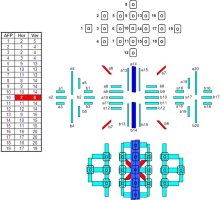
In my experience with Canon AF over the last decade plus, the camera focuses on the area of greatest contrast within the active AF areas if AF points are manually chosen (with or without surrounding AF assist points). Only when using Zone AF or Auto AF point selection is the nearest thing the one most likely to be chosen by the camera. Here's an old "map" of the original 7D AF system. The top line is what the viewfinder shows (but without the numbers next to each AF point). The middle line shows the physical layout of the PDAF sensor. The various lines do not have to be in the same relative position as the viewfinder due to the microlenses at the entry to the AF sensor that redirect light to the various sets of lines. The bottom line shows the actual areas of sensitivity for each AF "point". The chart to left shows which parts of the AF sensor are active for each AF "point".

184850
 
  • Like
Reactions: 1 user
Upvote 0
That picture at TDP shows what the viewfinder shows. The actual AF "points" are even larger.

In my experience with Canon AF over the last decade plus, the camera focuses on the area of greatest contrast within the active AF areas if AF points are manually chosen (with or without surrounding AF assist points). Only when using Zone AF or Auto AF point selection is the nearest thing the one most likely to be chosen by the camera. Here's an old "map" of the original 7D AF system. The top line is what the viewfinder shows (but without the numbers next to each AF point). The middle line shows the physical layout of the PDAF sensor. The various lines do not have to be in the same relative position as the viewfinder due to the microlenses at the entry to the AF sensor that redirect light to the various sets of lines. The bottom line shows the actual areas of sensitivity for each AF "point". The chart to left shows which parts of the AF sensor are active for each AF "point".

View attachment 184850

Thanks for the images - I referred to the image of the actual PD AF sensor silicon chip which supports your statements ... which can be found if you search for "diagonal cross" in that page. But your images show the situation much better. AlanF gave me the hint that the 5Div and 5Ds support Spot AF where the AF is much closer to the squares or rectangles in the viewfinder - i think it is the same like the normal and small AF frame in Canons ML cameras: Reduce the spot size, but at the trade off of AF responsivity under low contrast / low light conditions ...
 
Upvote 0
For most sports and wildlife shooting done in marginal light, the downside would be slower shutter speeds that are unacceptable. There's a huge difference between 1/1000 and 1/400 when shooting sports/action, which is what a 1.6X TC would force.
But this is offset by better high-ISO performance, so it ends up being a wash. Unless the teleconverter has poor light transmission, or otherwise effects focusing speed, in real world usage it shouldn't have any more impact on image quality than using an APS-C sensor would.
 
Upvote 0
But this is offset by better high-ISO performance, so it ends up being a wash. Unless the teleconverter has poor light transmission, or otherwise effects focusing speed, in real world usage it shouldn't have any more impact on image quality than using an APS-C sensor would.
As a rule of thumb, a 1.4xTC degrades MTF by 10% and a 2xTC by 20% for a good lens-TC match. My experience bears that out and it is always better to have a sensor with a higher pixel density than a lower density with an equivalent xTC on the same lens. (I am always switching between 1.4x and 2xTCs and between 5DIV and 5DSR bodies with my primes and telephotos and choose the best combinations for the particular situation.)
 
  • Like
Reactions: 3 users
Upvote 0
I can barely afford it. Thus the trepidation. News/Editorial staff have been cut and freelancing takes a while to build up to. I like the Canon glass lineup and the performance/value ratio, just not their bodies (love the UI though, muscle memory at it's best). I also don't want to use their adapter on R bodies and would rather use a native lens. I've concurrently used the 5dmk4 at various events but for outdoor sports, which I'm covering more of, I reach for the 7dmkII.

The "adapter" on the R body is nothing more than a spacer. There are no optics to degrade IQ. There's no f-number penalty. It's not like trying to convert Canon lens protocol to Sony body protocol and vice-versa. The R cameras are EOS cameras. The EF lenses are EOS lenses. They all speak the same language. You don't lose anything the EF lens can do on an EF body when it is used on an R body, except perhaps slower AF due to lower battery capacity. But that is also true when EF lenses are used on EF bodies with smaller batteries - AF speed of the same lens is slower on a Rebel than on a 1D X. When attached to a 7D Mark II it's somewhere in between.
 
Upvote 0
But this is offset by better high-ISO performance, so it ends up being a wash. Unless the teleconverter has poor light transmission, or otherwise effects focusing speed, in real world usage it shouldn't have any more impact on image quality than using an APS-C sensor would.


But it's never a wash when there are extra optical elements between the lens and the sensor. Especially with night sports, when bright light sources may be in the frame, there's a penalty in terms of contrast and flaring. Sensor pixel density gets more pixels on the same subjects with no additional optics in the light path.

I've shot it both ways: When I finally got frustrated enough with the poor shot-to-shot AF consistency and high ISO noise of the old 7D, I started putting the EF 70-200mm f/2.8 L IS II on the (then new) 5D Mark III and cropping more. When I started using the 7D Mark II, AF and high ISO noise was much better and I get better results using the 7D Mark II than cropping the 5D Mark III down to less than 10 MP. Plus it frees the 5D3 up to be used as my "short" body.
 
  • Like
Reactions: 1 users
Upvote 0
I think I'd be more likely to believe the earth is flat than "...many 7d2 users have moved onto Sony instead of waiting for Canon to upgrade their 7d2..."

I think the vast majority have just stopped buying anything and kept using what they already have until Canon finally reveals their hand. If this rumor is true that there will be no 7D Mark III, those who have put off both lens and body purchases for the last couple of years will be making decisions about whether to spend thousands upon thousands upon thousands of dollars for higher priced R bodies and lenses, or going elsewhere. To a LOT of them, the D500 will be awfully attractive. There are those who have already moved to the D500, particularly in the amateur birding community.

Canon bases their decisions on what they think will make them the most money, as they well should. They seem, based on their decision to kill the 7D III, to think they can make more money selling R bodies and very expensive glass to semi-pros and amateurs with a lot of money to burn. They're probably right considering how the numbers of true full-time pro sports shooters are rapidly dwindling to near nothing as too many well heeled "semi-pros" are willing to shoot major sporting events for next to nothing just to get sideline access.

Until Canon can produce a mirrorless camera capable of doing AI Servo AF tracking of moving subjects at 10+ fps, most 7D Mark II shooters are not going to jump on the R bandwagon. Even then, if such a mirrorless camera requires a 1-series level investment, many 7D Mark II shooters will be looking elsewhere. Canon seems to be saying to them, "Don't let the door hit you on the way out."
 
  • Like
Reactions: 3 users
Upvote 0
Are we approaching a point where consumers no longer put much faith in the "perceived reach advantages of the 1.6 crop factor," thanks to education and experience?

There's still an advantage when the 5Ds and the 7D Mark II have the same pixel density and one can only burst at 5 fps and the other can burst at 10 fps. When one needs more reach and fast frame rates in marginal light, a camera like the 7D Mark II beats a camera like the 5Ds or 5D mark IV at less than half the price.
 
  • Like
Reactions: 1 users
Upvote 0
I am seeing a silver lining in this conversation. I use the ORIGINAL 7D. I also have a Canon full frame and lots of amazing glass. I use the 7D for wildlife. I live on an island so about 80% my shooting is in a salt water environment. All those years of rugged use are starting take their toll on my ancient 7D . I am looking foreward to picking up a new 7DII at a fire sale price!

I don't know, it might be like the EF 24-70mm f/2.8 L when the EF 24-70mm f/2.8 L II was announced: the price went up several hundred dollars as people scrambled to get one of the last of the old ones before the $1,000+ price increase of the newer model.

You will be amazed at how much better the 7DII AF system is than the original 7D. You will kick yourself for not switching years ago. The 7DII body also has noticeably better build quality and weather sealing than the 7D.
 
Upvote 0
I've never shot anything shorter than a 70-200 on my 7D Mark II. That's what my 5D Mark III is for.
Many of your comments suggest that you believe you are representative of a typical 7DII owner. Do you really think most 7DII owners also have a FF camera? Seems unlikely.

Edit: I see you acknowledged that your experience is anecdotal. Anecdotes aren’t data.
 
  • Like
Reactions: 1 user
Upvote 0
My 6D MKii actually has Spot AF (and it does actually make a difference in some situations) ;)

On the other hand, the 6D II does not have iTR, nor even AF point manual selection plus four asist points or AF point manual selection plus surrounding assist points. The nine point Zone AF offered by the 6D Mark II does not give priority to the AF point in the center of the zone and tends to always choose whatever is nearest in any of the active AF areas. In contrast, AF point manual selection plus 4 or 8 assist points gives priority to the main point and focuses on the highest contrast, rather than the nearest object, it can find.
 
Upvote 0
Many of your comments suggest that you believe you are representative of a typical 7DII owner. Do you really think most 7DII owners also have a FF camera? Seems unlikely.

Many of the 7D/7D Mark II owners I know and see at events use FF cameras. Many of them use their personally owned 7D Mark II as a second body to their 1D X/1D X Mark II issued by their employers. I don't see many 7D Mark II owners shooting with a single body. The single body Canon APS-C shooters I see tend to use the 80D. The Rebel owners are in the stands.
 
Last edited:
Upvote 0