Canon EOS R7 Mark II & EOS R6 Mark III Announcement Delays?

What is the issue with the EVF resolution? Is it because it's not as high as others?

I get it for landscape photography, or macro, or portraits, but the Canon 7 series have always been aimed at sports/action/wildlife photographers. When I'm out shooting handheld and following fast moving subjects (in my case, planes), all I'm thinking about is following the subject and framing it in the FOV. Looking at colors and details comes later in post.

The almost 10 year old EOS R had a higher resolution EVF. I know resolution is not everything but still, feels like another product segmentation, so the R7 won't be "too good".
 
  • Like
Reactions: 1 user
Upvote 0
This is just a small update on two of the most anticipated cameras coming from Canon. There’s not much here in the way of new information, but things keep hitting our inbox. We have been told that a planned dealer presentation for new Cinema EOS and EOS products that was scheduled for later this month […]

See full article...

Anybody have a guess how much the R6 III will cost?
 
Upvote 0
What kind of price point is the R7 II supposed to be hitting?
Who knows since we don't know what actual improvements it will have. But if it is an R5-like body and features w/ a CMOS sensor then $2400 seems about right to me. It won't take marketshare from the R6 III since that's a full frame body. OTOH if all the rumors were just that and it improvements are at the margins -- maybe a faster, less noisy sensor then I wouldn't be surprised if it was around $1800.
 
  • Like
Reactions: 1 user
Upvote 0
He is being ironic - those Sony EVFs reputedly stink.
Stink is still being nice to describe it.

IMHO it's not usable in many uses.
It's too low-res to see small objects.
It generates noise artifacts during low-light usage(it's a Sony tradition, 9.XXM dot EVF on a1 also has the same behaviour), despite the final photo not showing noise artifacts.
It lags in low-light, worse than Canon/Nikon/Panasonic/Fuji/Olympus equivalent.

And top this off, the Sony 92k/1.04M LCD below the EVF also shares the same traits, with insufficient brightness for outdoor use. Crippled touch function with 92k models. Color & exposure inaccuracy across the board. The files might turns out ok once looked in iPad/PC/Mac/smartphone, but you cannot reliably check it during shooting frustrates me a lot.
 
  • Like
Reactions: 1 user
Upvote 0
Who knows since we don't know what actual improvements it will have. But if it is an R5-like body and features w/ a CMOS sensor then $2400 seems about right to me. It won't take marketshare from the R6 III since that's a full frame body. OTOH if all the rumors were just that and it improvements are at the margins -- maybe a faster, less noisy sensor then I wouldn't be surprised if it was around $1800.
With current orange market stressers, I was thinking closer to, if not more than, a round 2,000
 
  • Like
Reactions: 1 user
Upvote 0
Or maybe it's just because you're having a hard time of letting go what you're used to and embracing innovation. Your optical viewfinder only has disadvantages, try to shoot against bright sunlight and you get blinded, shoot in darkness and you see nothing, focus peaking or zebras are impossible, and you always have to chimp on the LCD screen to see the final image. EOS R's EVF has a higher magnification than 5D Mark IV and covers 100% of the image. While the resolution isn't extremely high, it's still like looking at a 1280x960 pixel screen which isn't too shabby (R5 has 1920x1080).
To me, the EVF and the autofocus of the EOS R were already a gamechanger compared to my older 6D. Especially for portraits where you can concentrate on composition, because the camera will nail the AF every time.
You misunderstood my post. It was a specific answer to the expected low definition of the R7 II.
Yet, the R's EVF was mediocre, especially in high contrast situations, where the OVF was still far superior. And I won't even mention the R's EVF colours...
The only real advantage of the EOS R was focusing with vintage lenses and the possibility to see, after the shot, the result.
The R5 II's EVF is a different story, on par with OVFs, plus all the EVF's advantages. And the reason why my R and 5 DIV are now collecting dust.
 
  • Like
Reactions: 1 user
Upvote 0
There are uses such as distant landscapes only visible behind the small opening of forest trees. Is it common? Probably not, but why limit ourselves?
For landscape I'd always prefer a FF camera with bigger pixels over the R7, at least for the classic approach with high f-stop numbers. The theoretical threshold for diffraction limited aperture (DLA) for the R7 is f = 5.2 (Bryan Carnathan has collected a nice overview list in his in-depth review of the R7 https://www.the-digital-picture.com/Reviews/Canon-EOS-R7.aspx). That means that already at very moderate f-stiop numbers diffraction blur starts to kick-in. But classic landscape photography with 35mm cameras starts with, say, about f = 10 minimum, up to f = 22 and more, to gain a maximum depth of field.

That said, DLA is fortunately a good-natured sort of image information loss, it can be "repaired" by digital sharpening in many cases in a way that it satisfies our visual perception, what is the benchmark of photography. But on the physics side of life, these losses are existing. You can say, of course, okay I render my images to sizes comparable to e.g. a 12 MP crop camera, like they were standard about 15-20 years ago. But with a FF body with bigger pixels and a good lens you can really catch more real details within the image frame when you close its aperture. That's why I often carry a FF body with me when I go out for birding, when I expect to find beautiful landscape sights, too. I still use my 5D4 OFV/mirror slapper, but of course for a FF ML body I'd prefer to have an EVF with more dots, too, since landscape is slow photography that allows you to set up your camera very careful. (Birding often is sudden action, and not always in settings where you can really control everything.)

 
  • Like
Reactions: 1 user
Upvote 0
For landscape I'd always prefer a FF camera with bigger pixels over the R7, at least for the classic approach with high f-stop numbers. The theoretical threshold for diffraction limited aperture (DLA) for the R7 is f = 5.2 (Bryan Carnathan has collected a nice overview list in his in-depth review of the R7 https://www.the-digital-picture.com/Reviews/Canon-EOS-R7.aspx). That means that already at very moderate f-stiop numbers diffraction blur starts to kick-in. But classic landscape photography with 35mm cameras starts with, say, about f = 10 minimum, up to f = 22 and more, to gain a maximum depth of field.

That said, DLA is fortunately a good-natured sort of image information loss, it can be "repaired" by digital sharpening in many cases in a way that it satisfies our visual perception, what is the benchmark of photography. But on the physics side of life, these losses are existing. You can say, of course, okay I render my images to sizes comparable to e.g. a 12 MP crop camera, like they were standard about 15-20 years ago. But with a FF body with bigger pixels and a good lens you can really catch more real details within the image frame when you close its aperture. That's why I often carry a FF body with me when I go out for birding, when I expect to find beautiful landscape sights, too. I still use my 5D4 OFV/mirror slapper, but of course for a FF ML body I'd prefer to have an EVF with more dots, too, since landscape is slow photography that allows you to set up your camera very careful. (Birding often is sudden action, and not always in settings where you can really control everything.)
There are occasions where it could be nearly impossible to get the landscape without a telephoto lens. A rainforest is one example
 
Upvote 0
Stink is still being nice to describe it.
So, Sony's EVFs of that camera section have the same quality like a small, cheap Sony TV from the 1980s? ;)

Never used a Sony. When the original A7 came out I was curious, of course, and played with one in a shop. But I was appalled by the delay of the electronic viewfinder when I quickly panned the camera. So I abandoned the idea of getting me an additional Sony with an adapter for my Canon lenses before I started to think about the resolution and the colors of its EVF back then. And I disliked Sony's crowded menu system back then, plus its overall ergonomics - but that's a matter of personal taste. That was the last time I had a Sony ML in my hands...
 
  • Like
Reactions: 1 user
Upvote 0
The theoretical threshold for diffraction limited aperture (DLA) for the R7 is f = 5.2 (Bryan Carnathan has collected a nice overview list in his in-depth review of the R7 https://www.the-digital-picture.com/Reviews/Canon-EOS-R7.aspx). That means that already at very moderate f-stiop numbers diffraction blur starts to kick-in. But classic landscape photography with 35mm cameras starts with, say, about f = 10 minimum, up to f = 22 and more, to gain a maximum depth of field.
But You get more DOF at the same f-stop if You use an APSC. At all there is no advantage to neither FF nor APSC:
Tested it with a DOF calculator: same pixel count (eg 24mpx), same AOV, same picture size, same distance. Both cameras set to the DLA, You get the same DOF.
 
  • Like
Reactions: 1 user
Upvote 0
There are occasions where it could be nearly impossible to get the landscape without a telephoto lens. A rainforest is one example
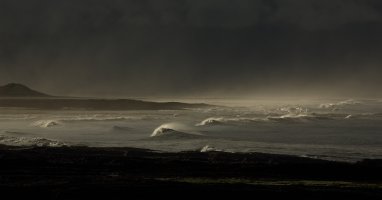
That's true, but a tele blows up small details to more frame filling parts of the motif, so an EVF with only 2.3 Mio. dots is sufficient. In fact, I love to shoot landscape details with a tele, too, because I get more abstract, compressed images of interesting details. I do that even in an open landscape that would also be suitable for wide angle lenses (what an average photographer would use then). Here's an example that I shot with my old Tamron 150-600 G2 and my 5D3, and if I remember correctly, with a tad more than 300mm: 2019_06_13 Seahouses Sturm.JPG
 
  • Like
Reactions: 2 users
Upvote 0
But You get more DOF at the same f-stop if You use an APSC. At all there is no advantage to neither FF nor APSC:
Tested it with a DOF calculator: same pixel count (eg 24mpx), same AOV, same picture size, same distance. Both cameras set to the DLA, You get the same DOF.
That is correct. When you put the crop factor, CF, into the formula for depth of field, it lowers the DoF by decreasing the circle of confusion by CF, and the diffraction limited aperture by another CF x, and increases it by CF x CF as the focal length of the lens is reduced. So, the changes cancel out.
 
  • Like
Reactions: 1 users
Upvote 0
.... I often carry a FF body with me when I go out for birding, when I expect to find beautiful landscape sights, too. I still use my 5D4 OFV/mirror slapper, but of course for a FF ML body I'd prefer to have an EVF with more dots, too, since landscape is slow photography that allows you to set up your camera very careful. (Birding often is sudden action, and not always in settings where you can really control everything.)
We all have different preferences. I carry an FF body for birding (R5ii or R5) and the R7 as a back-up. The reason is that for birds in flight, a wider angle of view is much easier for me to handle for finding and keeping in frame fast flying birds. Also, with narrower lenses, like the RF 100-500mm and the RF 200-800mm, the diffraction-limitations mean that in practice the R7 has little or no more reach than the R5.
 
  • Like
Reactions: 2 users
Upvote 0