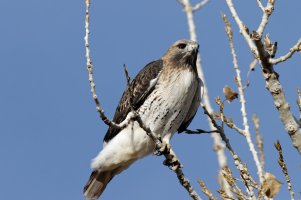
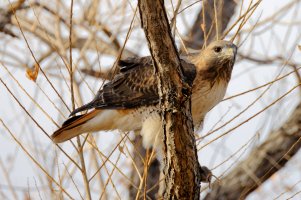
Show your Bird Portraits

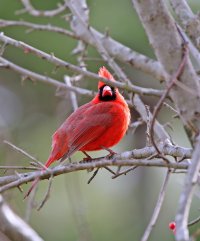
Cardinals here in Illinois today, too--quite a few, in fact. The exposure time for the handheld image of the redbird below was 1/180 sec (5D3/100-400 II @ 400 + 1.4 TC). Thank goodness for IS!

I saw references a couple of pages ago here referring to the sharpness properties of a 200-500 lens (a Nikon?). Before my purchase of the Canon 100-400 II, my go-to long zoom was a Tamron 200-500 (first gen, I think)...a decent enough lens for the price...but in my hands without image stabilization I pretty much always needed at least a monopod. I still own the Tamron--will be fun to try it with the EOS R5.

Which leads to a question or two.

How does the R5's IBIS work?

I presume the IBIS in the R5 supplies extra stabilization to Canon-branded lenses that feature IS (such as the 100-400 II).

I also presume the IBIS in the R5 supplies a couple of stops of stabilization for Canon-branded lenses that do NOT feature IS (such as the 11-24).

What about lenses such as the Tamron 200-500 (EDIT: my version of this lens; more recent versions do offer IS)...which does not offer any stabilization.

When the Tamron 200-500 (no IS) is coupled with the R5, are the images that result from this combination able to utilize the R5's IBIS?

=====

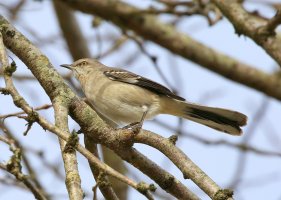
The second image here is a Northern Mockingbird, I think. It takes me back to my very first DSLR bird pic with a zoom lens (Rebel XT/350 @ ISO 1600; Canon 70-300)...about 15 years ago.

Thanks for reading.
5D3_0131 picasa cro ps3 fix - Copy.jpg5D3_0203 picasa crop ps3 fix - Copy.jpg
 
Last edited:
  • Like
Reactions: 11 users
Upvote 0
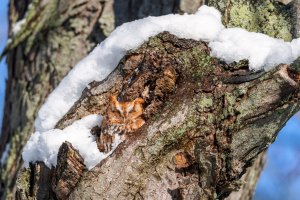
It snowed in Kentucky for Christmas eve & day (woo-hoo!). I took this through a double pane window, slightly downward, causing an offset ghost(s) to blur the photo somewhat. But at least I was able to get this.
R5 & RF 100-500 f4.5-7.1L @ 500mm, f7.1, 1/250", ISO 1600, E_1stCurtain.
5464x5464 reduced to 4000x4000 90% jpg for upload.

I really like this shot. Well done.
 
  • Like
Reactions: 1 users
Upvote 0
I really like this shot. Well done.
Thank you, Click. :) That double ghost really messes with the image when you're trying to get something super sharp (making it impossible). I should construct something like a suspended branch with a hidden back part with seed, and put it in the optimal point for photos from another window that already has a little sliding door my cat (Ollie) uses (to open for taking photos through). I've never done that before.
 
Upvote 0
Cardinals here in Illinois today, too--quite a few, in fact. The exposure time for the handheld image of the redbird below was 1/180 sec (5D3/100-400 II @ 400 + 1.4 TC). Thank goodness for IS!

I saw references a couple of pages ago here referring to the sharpness properties of a 200-500 lens (a Nikon?). Before my purchase of the Canon 100-400 II, my go-to long zoom was a Tamron 200-500 (first gen, I think)...a decent enough lens for the price...but in my hands without image stabilization I pretty much always needed at least a monopod. I still own the Tamron--will be fun to try it with the EOS R5.

Which leads to a question or two.

How does the R5's IBIS work?

I presume the IBIS in the R5 supplies extra stabilization to Canon-branded lenses that feature IS (such as the 100-400 II).

I also presume the IBIS in the R5 supplies a couple of stops of stabilization for Canon-branded lenses that do NOT feature IS (such as the 11-24).

What about lenses such as the Tamron 200-500 (EDIT: my version of this lens; more recent versions do offer IS)...which does not offer any stabilization.

When the Tamron 200-500 (no IS) is coupled with the R5, are the images that result from this combination able to utilize the R5's IBIS?

=====

The second image here is a Northern Mockingbird, I think. It takes me back to my very first DSLR bird pic with a zoom lens (Rebel XT/350 @ ISO 1600; Canon 70-300)...about 15 years ago.

Thanks for reading.
IBIS adds to IS only with designated RF lenses, like the 100-500mm, but not EF lenses. It probably adds only one stop extra combined with the 100-500. It is supposed to add several stops to all non-IS lenses but the amount will vary with focal length etc, and I guess not much with those long Tamrons. I seem to recall that the IBIS doesn't add to the IS of the 800/11.
 
  • Like
Reactions: 1 user
Upvote 0

Canon USA says that the "EOS R5’s IBIS will work in combination with Optical Image Stabilization found in many Canon RF and EF lenses."
 
Upvote 0

Canon USA says that the "EOS R5’s IBIS will work in combination with Optical Image Stabilization found in many Canon RF and EF lenses."
This has been discussed in an earlier thread. Unfortunately, the IBIS has little effect with non-RF IS. https://www.canonrumors.com/forum/threads/ibis-with-ef-lenses.39430/
 
Upvote 0
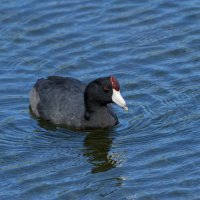
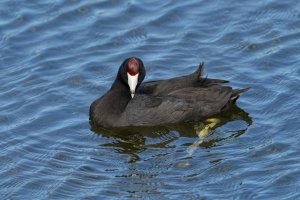
Just this Hawaiian Coot today. Wouldn't posted it if not this very dark-red shield: the red-shielded birds of this species are much more rare and I haven't seen so dark-red shield up to now...

DSC_8313_DxO.jpg
DSC_8386_DxO.jpg
 
  • Like
Reactions: 7 users
Upvote 0
I found the quote on Canon's website and passed it along. Take from it what you will.
You are absolutely right to quote that. Trouble is, from my reading many reviews, it seems that Canon is being somewhat economical with the truth. Here, for example, are Ken Rockwell's findings.
https://kenrockwell.com/canon/eos-r/r5.htm
“It adds about two stops improvement with unstabilized lenses, and little to no additional improvement with lenses that are already stabilized. See also my measurements of stabilizer performance (and comparisons to the EOS RP) at RF 600mm f/11 Stabilizer performance and RF 800mm f/11 Stabilizer performance. I show below that the R5's IBIS doesn't add anything that significant with the 24-240mm further below, and the best comparisons are at my RF 100-500mm Stabilizer performance tests.”

In that last link, his results comparing the 100-500mm on the RP, R5 and R6 at 500mm – the IBIS adds no detectable additional stabilization. So, don't expect any additional stabilization for your EF IS lens on the R5, I don't notice any extra stabilization with my 100-400mm II on my R5 compared with on my 5DSR. The additional RF stabilization is even less in practice than the promise.
 
  • Like
Reactions: 1 user
Upvote 0
Just this Hawaiian Coot today. Wouldn't posted it if not this very dark-red shield: the red-shielded birds of this species are much more rare and I haven't seen so dark-red shield up to now...

View attachment 194807
View attachment 194808
Interesting birds and nice to see. Like you, I wouldn't normally post a photo of the ubiquitous Coot but these are special.
 
  • Like
Reactions: 1 user
Upvote 0
You are absolutely right to quote that. Trouble is, from my reading many reviews, it seems that Canon is being somewhat economical with the truth. Here, for example, are Ken Rockwell's findings.
https://kenrockwell.com/canon/eos-r/r5.htm
“It adds about two stops improvement with unstabilized lenses, and little to no additional improvement with lenses that are already stabilized. See also my measurements of stabilizer performance (and comparisons to the EOS RP) at RF 600mm f/11 Stabilizer performance and RF 800mm f/11 Stabilizer performance. I show below that the R5's IBIS doesn't add anything that significant with the 24-240mm further below, and the best comparisons are at my RF 100-500mm Stabilizer performance tests.”

In that last link, his results comparing the 100-500mm on the RP, R5 and R6 at 500mm – the IBIS adds no detectable additional stabilization. So, don't expect any additional stabilization for your EF IS lens on the R5, I don't notice any extra stabilization with my 100-400mm II on my R5 compared with on my 5DSR. The additional RF stabilization is even less in practice than the promise.


Alan, Thank you for the info. I'll check it out.
 
Upvote 0
Thank you, Click. :) That double ghost really messes with the image when you're trying to get something super sharp (making it impossible). I should construct something like a suspended branch with a hidden back part with seed, and put it in the optimal point for photos from another window that already has a little sliding door my cat (Ollie) uses (to open for taking photos through). I've never done that before.
Our trees are just out of reach for shots this close. I've tried putting up a bird feeder closer to the house, but we think there isn't enough cover to make most birds comfortable staying on it for long. We occasionally get a cardinal, but mostly Savannah sparrows, which have the trick of scattering the seeds and then eating them off the ground.

How do you keep the birds from being startled when opening a window or patio screen door?
 
  • Like
Reactions: 1 user
Upvote 0
Our trees are just out of reach for shots this close. I've tried putting up a bird feeder closer to the house, but we think there isn't enough cover to make most birds comfortable staying on it for long. We occasionally get a cardinal, but mostly Savannah sparrows, which have the trick of scattering the seeds and then eating them off the ground.

How do you keep the birds from being startled when opening a window or patio screen door?
By not opening them.
 
  • Haha
  • Like
Reactions: 1 users
Upvote 0
Our trees are just out of reach for shots this close. I've tried putting up a bird feeder closer to the house, but we think there isn't enough cover to make most birds comfortable staying on it for long. We occasionally get a cardinal, but mostly Savannah sparrows, which have the trick of scattering the seeds and then eating them off the ground.

How do you keep the birds from being startled when opening a window or patio screen door?
If I open a window or door to my bird feeder & tree view (which is where my recent picture was) they always fly away since it's so close. That's why I was taking a photo through the double pane window overlooking it. I cleaned both inside & outside as well as possible but I'm on the 2nd floor and have to aim down a bit which causes a noticeable double ghost image when you look closely at the photo. If I was shooting perpendicular to the window I'd probably be fine, but that's not possible due to the location of the tree & window.
 
Upvote 0
Checking for bald eagles at a nearby reservoir. A couple dozen were parked about a mile away on the far shore in the trees and on the shoreline. M6m2, 100-400LII, 1.4XIII.
IMG_5480.jpg


Encountered a Red-tailed Hawk picking out lunch in the nearby field.
IMG_5365.jpg

Mission accomplished.
IMG_5392.jpg
 
  • Like
Reactions: 14 users
Upvote 0