I've been a certified diver for over 20 years, but only recently (2023) started with underwater photography. The impetus for it was my daughter getting her PADI certification. I don't count my first attempt, which was with a Kodak disposable underwater film camera I used off the coast of Belize in 2003.
I do have a set of Panasonic DMC-TS30A P&S cameras that are waterproof/shockproof and suitable for snorkeling, I got them for my kids to use on trips mainly for the durability. My middle kid uses hers a lot now that the P&S look is trendy.
When starting to look at underwater photo setups, I debated the three main categories in the article – a good underwater P&S, a dedicated camera like the SeaLife one, and a housing for one of my MILCs. I ended up settling on one option not discussed in the article, a housing for my iPhone. There were several factors to the rationale:
- I didn't want to spend a huge amount of money for something I'll use relatively rarely
- I wanted to spend most of the budget on lighting not the camera/housing
- I was looking to shoot both stills and video, and the iPhone is good at both (though not excellent)
- I bring enough photo gear when I travel and wanted avoid bringing another camera for a dedicated use
- A phone housing offers some degree of future-proofing for 'camera' upgrades, unlike a dedicated P&S or ILC housing
I set myself a budget of $2500, which was the same initial budget I picked for my first DSLR setup (in 2009, that got me the T1i/500D, EF-S 17-55/2.8, EF 85/1.8, Speedlite 430EX II and a Manfrotto CF tripod with an ok ballhead).
As with all photography, lighting matters...that's arguably even more true underwater. In addition to 'regular' underwater photography, I was interested in trying some fluorescence imaging (I have spent a lot of time looking at fluorescing cells under microscopes, so I thought it would be pretty cool to look at larger specimens). In researching multiple systems, SeaLife had a well-regarded iPhone housing and seemed to offer the most comprehensive setup that included fluorescent lighting. There are two components to underwater fluorescence imaging – a blue light source (or UV, but blue is better) and a yellow filter to block the reflected blue light so all you see/capture is the fluorescence.
In looking for a custom-fit yellow filter for the SeaLife phone housing, I connected with the physicist/diver who co-developed SeaLife's fluorescence imaging lights, and that turned out to be a great connection. He fabricated the filter for the housing, and also made custom-fit filters for mine and my daughter's masks for a better fit than the generic ones that come with the blue lights. I was also able to order SeaLife gear through him at a substantial discount from the direct/B&H pricing, so my $2500 budget went quite a bit further.
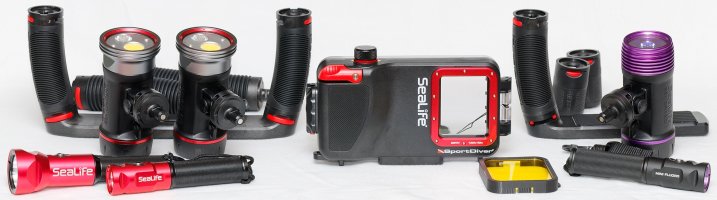
I ended up getting the SportDiver Smartphone Housing, a pair of Sea Dragon Pro Dual Beam white lights (flood plus spot), a Sea Dragon Fluoro Dual Beam (blue flood plus white spot), a pair of small handheld lights and a flouro mini light, along with trays/arms, handles so the big lights can be used mounted or handheld, and spare batteries.
View attachment 226939
Overall, a very bright and versatile setup that has worked well so far. My only hope is that I get more opportunities to use it in the coming years.