Dynamic range Nikon/Sony vs Canon

Nov 1, 2013
53
0
4,981
Hi.

As most of you are aware of Nikon and Sony (I know that Sony manufacture sensors for Nikon) sensors are better when it comes to DR and so on compared to Canon. I have read DXO-tests and many others that verify that. But there seems to be a point at a ISO-value where the difference is not that big. Of course there is an advantage in mp also for the 36mp bodies but the resolution is not what I am thinking of now.

My main interest is wildlife photography and I am almost all the time above ISO 800 to get quicker shutter speed.
At an ISO-level of 800 and more is the advantage and quality still better with Nikon D800?

I will soon spend a lot of money on a Canon 600mm and by purchase that lens I really commit myself to Canon. It would cost the same to go with a brand new D800 and their Nikon 600mm as only the Canon lens because of the big difference in cost. The Canon 600mm really is expensive!

So for you that have more knowledge than me.. Should I stay with Canon (5D mkiii and 7D) because the difference in DR at high ISO is not that big compared to the different brands at ISO 100 or is the image quality so much better overall for Nikon and Sony?

Testresults shows one thing but to use in real life under the circumstances can be so different.

My English is not the very best so no comments please 8)
 
Upvote 0
I do not own the EF 600mm lens and nor have I ever tried one (but that could change during my vacation in Australia this December, as I plan to rent one) ... but I do use both Canon & Nikon cameras/lenses ... from my limited experience of trying Sigma 150-500mm OS lenses on Canon 5D MK III & Nikon D800E, I could not find any difference in the RAW images (JPEGs were obviously different in the way the colors were displayed). I eventually chose to stick with Nikon D7100 for bird photography (due to the additional crop factor of 1.3 for more reach without losing too many megapixel) and 5D MK III for everything else.
 
Upvote 0
Morlin said:
Hi.

As most of you are aware of Nikon and Sony (I know that Sony manufacture sensors for Nikon) sensors are better when it comes to DR and so on compared to Canon. I have read DXO-tests and many others that verify that. But there seems to be a point at a ISO-value where the difference is not that big. Of course there is an advantage in mp also for the 36mp bodies but the resolution is not what I am thinking of now.

My main interest is wildlife photography and I am almost all the time above ISO 800 to get quicker shutter speed.
At an ISO-level of 800 and more is the advantage and quality still better with Nikon D800?

I will soon spend a lot of money on a Canon 600mm and by purchase that lens I really commit myself to Canon. It would cost the same to go with a brand new D800 and their Nikon 600mm as only the Canon lens because of the big difference in cost. The Canon 600mm really is expensive!

So for you that have more knowledge than me.. Should I stay with Canon (5D mkiii and 7D) because the difference in DR at high ISO is not that big compared to the different brands at ISO 100 or is the image quality so much better overall for Nikon and Sony?

Testresults shows one thing but to use in real life under the circumstances can be so different.

My English is not the very best so no comments please 8)

quite right, the DR advantage disappears at higher ISO when you look at the DXO mark tests.
Also, as pointed out, the DXO mark tests show you achieve better resolution with the Canon despite the smaller Nr of pixels, because each system is a composite of sensor resolution and lens resolution. So the Canon lens is better.
If you need higher pixel density, you can always hook up your 600mm lens to a 70D body
 
Upvote 0
photonius said:
quite right, the DR advantage disappears at higher ISO when you look at the DXO mark tests.
Also, as pointed out, the DXO mark tests show you achieve better resolution with the Canon despite the smaller Nr of pixels, because each system is a composite of sensor resolution and lens resolution. So the Canon lens is better.
If you need higher pixel density, you can always hook up your 600mm lens to a 70D body

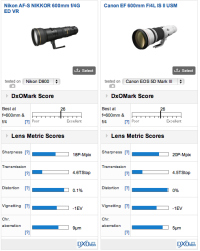
+1 - as you can see in the screenshot below, the combination of the Canon 5DIII + 600/4L IS II delivers better sharpness and less chromatic aberration (CA) than the combination of the Nikon D800 + 600/4G ED VR. (The fact that the Scores are the same despite the Canon combo being sharper and having less CA is a reflection of DxO's Biased Scores - abbreviated as BS for a reason.)

CA is the bane of many Nikon lenses, and their ED elements do not do as good a job of correcting it as Canon's fluorite elements. I like how Nikon claims (or at least, implies) their ED glass is optically as good as fluorite, and is a better choice because fluorite is so fragile: "Nikon developed ED (Extra-low Dispersion) glass to enable the production of lenses that offer superior sharpness and color correction by minimizing chromatic aberration. Put simply, chromatic aberration is a type of image and color dispersion that occurs when light rays of varying wavelengths pass through optical glass. In the past, correcting this problem for telephoto lenses required special optical elements that offer anomalous dispersion characteristics - specifically calcium fluoride crystals. However, fluorite easily cracks and is sensitive to temperature changes that can adversely affect focusing by altering the lens' refractive index." However, they now say about their new 800/5.6 lens, "...front and second elements are fluorite (a lightweight mono-crystal optical material), which provides superior optical characteristics and reduced weight for balanced handling." When they didn't use fluorite, it wasn't any better and was fragile - now, it's 'superior' and they are making a front element from it. Apparently, consistency isn't Nikon's strong suit.

Despite the DxOMark data below, I honestly think that images from either combo will be basically indistinduishable from an IQ standpoint (but it's worth noting that the Canon teleconverters deliver better IQ than their Nikon counterparts). Also, the 5DIII has a faster frame rate and arguably better autofocus, and the Canon 600/4 II is 2.5 lbs lighter than the Nikon 600/4. I can shoot with my 1D X + 600/4L IS II combo handheld, and I couldn't with the Nikon combo. That 2.5 lbs also makes a difference on a long walk/hike. So, based on the frame rate and weight benefits, I'd say the Canon combo is the better choice.
 

Attachments

  • 600mm lenses.png
    600mm lenses.png
    63.9 KB · Views: 4,252
Upvote 0
Terje said:
A very one-eyed explanation from Neuros side
this picture and 400mm lenses says something completely different regarding sharpness and CA

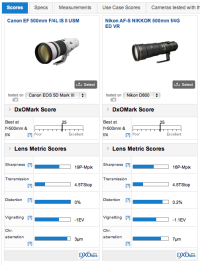
As pointed out by another member, the OP is asking about 600mm lenses, not 400mm lenses. Also, your screenshot shows the Canon 400/2.8 II on the 1DsIII, not the 5DIII which the OP is asking about (and where it the sharpness is 3 P-Mpix higher) . So either that's carelessness on your part, or you've intentionally added your own bias to that of DxOMark.

Why did you go down to 400mm lenses? The next step down the line is 500mm. Oh, wait - I know why you skipped the 500mm lenses...
 

Attachments

  • 500mm lenses.png
    500mm lenses.png
    70.8 KB · Views: 3,946
Upvote 0
neuroanatomist said:
CA is the bane of many Nikon lenses, and their ED elements do not do as good a job of correcting it as Canon's fluorite elements. I like how Nikon claims (or at least, implies) their ED glass is optically as good as fluorite, and is a better choice because fluorite is so fragile: "Nikon developed ED (Extra-low Dispersion) glass to enable the production of lenses that offer superior sharpness and color correction by minimizing chromatic aberration. Put simply, chromatic aberration is a type of image and color dispersion that occurs when light rays of varying wavelengths pass through optical glass. In the past, correcting this problem for telephoto lenses required special optical elements that offer anomalous dispersion characteristics - specifically calcium fluoride crystals. However, fluorite easily cracks and is sensitive to temperature changes that can adversely affect focusing by altering the lens' refractive index." However, they now say about their new 800/5.6 lens, "...front and second elements are fluorite (a lightweight mono-crystal optical material), which provides superior optical characteristics and reduced weight for balanced handling." When they didn't use fluorite, it wasn't any better and was fragile - now, it's 'superior' and they are making a front element from it. Apparently, consistency isn't Nikon's strong suit.
That's hilarious, I didn't know that they used to claim it was too fragile to use, um well except for the 800mm. ROTFL.
 
Upvote 0
Meh, before they (Nikon) had D3, they tell users that FF is useless, DX is the future. Now?

Before they had the D800, they tell users that 12MP is all you need. Now?

It is THE photographic company that eats their words the most, I am not surprised about their attitude towards fluorite element.
 
Upvote 0
neuroanatomist said:
Terje said:
A very one-eyed explanation from Neuros side
this picture and 400mm lenses says something completely different regarding sharpness and CA

As pointed out by another member, the OP is asking about 600mm lenses, not 400mm lenses. Also, your screenshot shows the Canon 400/2.8 II on the 1DsIII, not the 5DIII which the OP is asking about (and where it the sharpness is 3 P-Mpix higher) . So either that's carelessness on your part, or you've intentionally added your own bias to that of DxOMark.

Why did you go down to 400mm lenses? The next step down the line is 500mm. Oh, wait - I know why you skipped the 500mm lenses...

Neuro, you just made me spit up my coffee.

If this were a dance competition, one might be led to say that Terje got served.
 
Upvote 0
J.R. said:
RLPhoto said:
Now consider that 600LII will last several camera bodies. Will Nikon still be leading two or three generations down?

Comment of the day!

Well, the answer might well be yes. Canon's policy of manufacturing their own sensors limits the possibility of frequent tech upgrades. It means that if at any point Canon will have an edge again, it probably won't last long.

However, the great advantages of Sony sensors - at least of this generation - are only such up to ISO 800 - 1600. And on top of that, in the 500-600mm range Canon seems to have an edge. So for the OP's needs and wallet Nikon is not a sensible choice.
 
Upvote 0