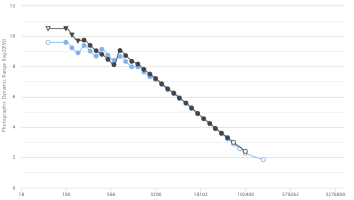
Canon R6 Mark III Dynamic Range Officially Measured

Sony makes BSI sensors for almost the entire camera market, as well as for a significant portion of the phones that are sold. Yet Canon can't manage to make them for their own cameras? That doesn't seem reasonable. If they can't, then they aren't investing what they should be.
Clearly, you know how to run Canon's business better than they do. Maybe you should apply for the CEO job. There is an old saying "don't should on me" and methinks it applies here 😉.
 
  • Like
Reactions: 1 users
Upvote 0
I thought about the yield rates - BUT. the R3 (canon's first I believe BSI "in theory" was 4 years ago. so assume what? working on BSI in the fab since 2020? so 5-6 years? if they haven't gotten yields up on what is a known process by now, someone would have been fired. Also my understanding is that there is no bonding outside of a strengthing substrate post thinning of the wafer. so vias etc aren't done unless you are making a stacked sensor. and for that, Canon actualyh bought out an entire company for via tech.
I would expect better yield rates over 5 years but my point on yields in general is that it is multiplied at each additional step in the process compared to FSI.
I’m not an expert so perhaps I have used ‘bonded’ incorrectly. The circuitry from the front side needs to be connected through the substrate to the thinned back side. With PCBs it is using VIA (Latin for ‘through’ (vertical interconnect access) for double sided boards
 
Upvote 0
I would expect better yield rates over 5 years but my point on yields in general is that it is multiplied at each additional step in the process compared to FSI.
I’m not an expert so perhaps I have used ‘bonded’ incorrectly. The circuitry from the front side needs to be connected through the substrate to the thinned back side. With PCBs it is using VIA (Latin for ‘through’ (vertical interconnect access) for double sided boards
You are absolutely correct about yields being impacted by additional process steps. In the case of BSI, the BIG ONE is the back lapping of the wafer followed by the cutting and handling of a 300mm wafer of silicon now only a tiny fraction of the thickness of a human hair. There are no vias required because the lapped backside is actually the photosensitive surface and is already internally connected to the circuitry on the "front" side. The "front" side (now the back side) still needs to be connected to the outside world, and I have not seen any description of that process, but clearly, the circuitry needs to be electrically connected to and possibly through (that would involve vias in the substrate) the support substrate that that the thinned chip is attached to. All these processes are VERY proprietary and there is very little public data with regards to the details.
 
  • Like
Reactions: 2 users
Upvote 0
Photons To Photos clearly shows in the chart (the triangles) that it is using NR on those low ISOs. When it changes to using circles, the NR is no longer there. You can see it's the low ISOs that use NR that "outperform" the R6 II which does not use NR on those same ISOs.

I realize that. But it doesn't necessarily mean it's truly NR. This is something I've discussed in prior PhotonsToPhotos analysis on CR, and Bill actually agrees. It's just assumed that it's why it's there, but we don't have actual, identifiable proof of it.

For all we know, it could have something to do with dual-pixel sensors in general, as Canon needs to do some processing as they are combining the results from two wells, and they have to include the possibility that only half of the A+B overflows, which will change both auto focus and also color accuracy.
 
Last edited:
Upvote 0
You are absolutely correct about yields being impacted by additional process steps. In the case of BSI, the BIG ONE is the back lapping of the wafer followed by the cutting and handling of a 300mm wafer of silicon now only a tiny fraction of the thickness of a human hair. There are no vias required because the lapped backside is actually the photosensitive surface and is already internally connected to the circuitry on the "front" side. The "front" side (now the back side) still needs to be connected to the outside world, and I have not seen any description of that process, but clearly, the circuitry needs to be electrically connected to and possibly through (that would involve vias in the substrate) the support substrate that that the thinned chip is attached to. All these processes are VERY proprietary and there is very little public data with regards to the details.

Absolutely, the flipping of the wafer and thinning the backside is the most challenging step, but if Canon has that step already done (in theory) for it's stacked sensors, then the process has already been moved in-house.

Alot of this is of course, congjecture becuase we have no idea how much of Canon's sensors are now manufacturered by Canon.
 
Upvote 0
Sony makes BSI sensors for almost the entire camera market, as well as for a significant portion of the phones that are sold. Yet Canon can't manage to make them for their own cameras? That doesn't seem reasonable. If they can't, then they aren't investing what they should be.

I'm not sure you realize just how hard it would be for Canon to change a fab over to a new process. It's incredibly expensive.

Absolutely, Sony has been doing it for years and at scale, but that makes it far easier to accomplish, while Canon is more of a boutique sensor fab.
 
  • Like
Reactions: 1 user
Upvote 0
I'm not sure you realize just how hard it would be for Canon to change a fab over to a new process. It's incredibly expensive.

Absolutely, Sony has been doing it for years and at scale, but that makes it far easier to accomplish, while Canon is more of a boutique sensor fab.

Then perhaps Canon should be sourcing their sensors from Sony.
 
  • Like
  • Haha
Reactions: 1 users
Upvote 0
I realize that. But it doesn't necessarily mean it's truly NR. This is something I've discussed in prior PhotonsToPhotos analysis on CR, and Bill actually agrees. It's just assumed that it's why it's there, but we don't have actual, identifiable proof of it.

For all we know, it could have something to do with dual-pixel sensors in general, as Canon needs to do some processing as they are combining the results from two wells, and they have to include the possibility that only half of the A+B overflows, which will change both auto focus and also color accuracy.
Yeah, and it's just pure coincidence that those are the only three graph points that chart significantly higher than the R6 II. Yep. Must be. Couldn't possibly be heavy use of NR to game the numbers from an ancient sensor tech that should have been retired a decade ago:

1766301482942.png
Blue = II, Black = III

Yet somehow when both are using NR & the mechanical shutter, the II and III track very, very closely over those same chart points. I'm sure that's just pure coincidence, too:

1766301603137.png
Blue = II, Black = III

It's okay to call Canon out on stuff like this. Really, it is. Canon should be pushed to do better on a camera priced at $3k + tax.
 
  • Like
Reactions: 1 user
Upvote 0
Clearly, you know how to run Canon's business better than they do. Maybe you should apply for the CEO job. There is an old saying "don't should on me" and methinks it applies here 😉.
I know that buying a three thousand dollar camera with a sensor using tech that should have been retired a decade ago isn't something I'm interested in doing. Add in the entirely locked down mount and I don't get the attraction at all. In a just world, Nikon and Canon would flip places in market share.
 
  • Haha
  • Like
Reactions: 1 users
Upvote 0
I know that buying a three thousand dollar camera with a sensor using tech that should have been retired a decade ago isn't something I'm interested in doing. Add in the entirely locked down mount and I don't get the attraction at all. In a just world, Nikon and Canon would flip places in market share.
It’s far more likely that the factors on which you base your camera buying decisions aren’t those that matter to the majority of camera buyers. It’s not injustice, it’s the reality of Canon knowing the market and you…not so much.
 
  • Like
  • Love
Reactions: 1 users
Upvote 0
I know that buying a three thousand dollar camera with a sensor using tech that should have been retired a decade ago isn't something I'm interested in doing. Add in the entirely locked down mount and I don't get the attraction at all. In a just world, Nikon and Canon would flip places in market share.
What about the current market share is unjust? If people want to buy "a three thousand dollar camera with a sensor using tech that should have been retired a decade ago" that's their perogative. Sony's Betamax was superior to VHS and look how that turned out.

With that said if you look at market share of Conon, Sony, Nikon and Fuji from a revenue perspective is appears to be getting a bit more balanced. However Fuji is the company gaining the most ground not Nikon.
 
Upvote 0