
I have yet to put the lenshood on my 100-400mm II, and just have a Marumi filter for protection. As a matter of interest, do others us the hood - I haven't had any problems with flare yet? I always have the hood on my 300/2.8, just for lens protection.
You are using an out of date browser. It may not display this or other websites correctly.
You should upgrade or use an alternative browser.
You should upgrade or use an alternative browser.
Do you use the lenshood on the 100-400mm II?
- Thread starter AlanF
- Start date

Yes, I always have the lens hood on the 100-400II. Even for storage, the lens hood is attached in reverse.
I think the hood does a great job in protecting the lens.
BTW, I never use a protection/clear/uv filter on any of my lenses.
I think the hood does a great job in protecting the lens.
BTW, I never use a protection/clear/uv filter on any of my lenses.
Upvote
0

I don't. I am often forced to quickly swap between two body+lens combos, a 5DIII and the 100-400II being one of them, and the time it takes to fit the hood / the extra space needed in the bag to keep it attached is does not justify it for me.
Also - have anyone noticed how the side window for adjusting filters is very loose? It seems to be forever open when I reach for the hood, even if I stored it in the bag closed... I know 50% of this is just the randomness of stuff, like cords getting tangled when you look away, but the other 50% seems to be a design thing.
Also - have anyone noticed how the side window for adjusting filters is very loose? It seems to be forever open when I reach for the hood, even if I stored it in the bag closed... I know 50% of this is just the randomness of stuff, like cords getting tangled when you look away, but the other 50% seems to be a design thing.
Upvote
0

I use a B+W nano clear protectionfilter.
I use the lenshood when using the lens on the beach and with sunny days
I noticed too that the CPOL adjustment window on the lenshood is too smooth. It often opens by itself. Good that I am using the protectionfilter.
I use the lenshood when using the lens on the beach and with sunny days
I noticed too that the CPOL adjustment window on the lenshood is too smooth. It often opens by itself. Good that I am using the protectionfilter.
Upvote
0
Generally, I keep the hood on the lens for added protection of the front element(s). I am not a pro shooter, so my need to make rapid lens changes is not as critical as those that make your livings shooting. When hanging on my side from BR strap, it can move around and always better safe than sorry, which is why I have protective filters on all of my lenses, too. Always stored with the hood in reverse position. Have not had any issues with the access panel, but who knows down the road...
Upvote
0

I use the hoods on all my lenses all the time. Previously, I placed a protectionfilter on the lens. The last year, I don't use the protectionfilter anymore unless extreme conditions like sand and salt. When there is sufficient of light I mostly use a CPL.
My practice showed me that a lens hood might give a better protection. And damage to a CPL is not that cheap, a good CPL like B&W or Singh-Ray is not being used as any kind of protection for my lens. So then the hood stays the easy way to protect from direct damage to the frontglass.
My practice showed me that a lens hood might give a better protection. And damage to a CPL is not that cheap, a good CPL like B&W or Singh-Ray is not being used as any kind of protection for my lens. So then the hood stays the easy way to protect from direct damage to the frontglass.
Upvote
0


AlanF said:I have yet to put the lenshood on my 100-400mm II, and just have a Marumi filter for protection. As a matter of interest, do others us the hood - I haven't had any problems with flare yet? I always have the hood on my 300/2.8, just for lens protection.
How do you know you haven't had any problems with flare yet, have you done comparison shots?
For what its worth, and each to their own, I always use hoods and very rarely use 'protective' filters.
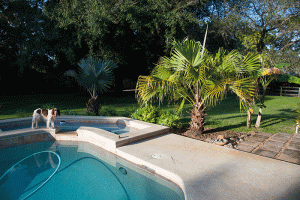
Here is a with and without 'protective' filter.
Attachments
Upvote
0
I am definitely with you on why it makes sense to use the hood - it just doesn't always make practical sense to try and attach the hood on a job (on a dogsled, for instance) if you have to swap field of view (from 24-70 to 100-40, for instance). Especially not if the trip is an overnight journey leaving no extra room in the bag for big lens compartments.
Upvote
0
L
Loswr
Guest
madspihl said:I am definitely with you on why it makes sense to use the hood - it just doesn't always make practical sense to try and attach the hood on a job (on a dogsled, for instance) if you have to swap field of view (from 24-70 to 100-40, for instance). Especially not if the trip is an overnight journey leaving no extra room in the bag for big lens compartments.
So space permits bringing a 24-70 and a 100-400 (instead of, say, a 28-300), but not the lens hoods? Ummmmm...ok. Not to mention that dogsleds tend to travel on this stuff that's really, really bright and reflective, a situation that's very conducive to flare which a hood is designed to mitigate.
Upvote
0
Rahul said:BTW, I never use a protection/clear/uv filter on any of my lenses.
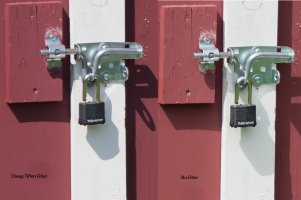
I went from a cheap filter (big mistake) to no filter to a good filter. I couldn't figure out why my pictures weren't sharp until I did some testing with/without the cheap filter. See below for my very unscientific test (taken on two different days as I was diagnosing the lack of sharpness - 20D, 100% crop) on the 400 f/5.6 prime. This only shows cheap filter vs. no filter. I can't really notice a difference with/without a filter once I moved to a better one.
Moral of the story - if you use a filter, don't skimp.
And, I always use the lens hood on my 400 prime, but since it's always on the lens ready to go, it really doesn't answer the OP's original question. Too bad that the new 100-400 can't use the same mechanism. Hopefully they'll keep it if they come out with the rumored 400 f/5.6 II.
Dave
Attachments
Upvote
0
AlanF said:I haven't had any problems with flare yet?
There's lens flare and camera flare - the latter is independent from what lens you use - and the origin is always unwanted light entering the camera. It can decrease contrast, or make the image "foggy", in the worst case. You should try to make some pictures in some unfavorable light conditions, with and without hood, and check the result. Hood can also protect the lens, but they are not designed with that in mind, or there would be any need to be so deep (for a tele), but they should be sturdier
 Anyway, they fit that purpose too, and not always a filter is enough. It's a matter of actual needs and convenience, light conditions, shooting conditions, etc. etc.
 Anyway, that's why I like the built-in hoods of some lenses...
Upvote
0
privatebydesign said:AlanF said:I have yet to put the lenshood on my 100-400mm II, and just have a Marumi filter for protection. As a matter of interest, do others us the hood - I haven't had any problems with flare yet? I always have the hood on my 300/2.8, just for lens protection.
How do you know you haven't had any problems with flare yet, have you done comparison shots?
For what its worth, and each to their own, I always use hoods and very rarely use 'protective' filters.
Here is a with and without 'protective' filter.
I use the 100-400mm for bird photography, and I shoot with the sun behind me for optimal results and never into the sun. I have done comparisons with filter on and off, and find no discernible degradation of the image.
For what it is worth, according to Canon: "The new Air Sphere Coating has been developed by Canon to minimise reflections and flare. It consists of tiny nano particles of air trapped in a film above the conventional multi-layer coatings. These Air Sphere particles form a super low reflective coating on the surface of the lens element to reduce reflection and act as a ‘crash mat’ to reduce the speed that light travels through the layer so there is not such a large change in speed when the light enters through the glass of the lens element. The major cause of reflections is the sudden change in the speed of light as it passes from air to glass, and this new technology prevents the cause of visible ghosting and flare."
The new lens is certainly better than the Mark 1.
http://www.the-digital-picture.com/Reviews/Lens-Flare.aspx?Lens=113&Camera=453&FLI=7&API=1&LensComp=972&CameraComp=453&FLIComp=4&APIComp=1
Upvote
0
L
Loswr
Guest
AlanF said:For what it is worth, according to Canon: "The new Air Sphere Coating has been developed by Canon to minimise reflections and flare. It consists of tiny nano particles of air trapped in a film above the conventional multi-layer coatings. These Air Sphere particles form a super low reflective coating on the surface of the lens element to reduce reflection and act as a ‘crash mat’ to reduce the speed that light travels through the layer so there is not such a large change in speed when the light enters through the glass of the lens element. The major cause of reflections is the sudden change in the speed of light as it passes from air to glass, and this new technology prevents the cause of visible ghosting and flare."
For what it is worth, according to Canon: "Ultrasonic motor (USM) for quick and quiet autofocusing," is stated in the description of the 85L II. Quick? Perhaps compared to the movement of glaciers and the growth of sequoias.
Upvote
0

Rahul said:Yes, I always have the lens hood on the 100-400II. Even for storage, the lens hood is attached in reverse.
I think the hood does a great job in protecting the lens.
BTW, I never use a protection/clear/uv filter on any of my lenses.
I have the same routine. A filter, even the best ones, is degrading the picture quality.
To not use the hood is also degrading the picture quality.
The hood also protest the front lens element.
I can't see any reason to not use the hood and use a filter instead. It is stupid really.
Upvote
0
neuroanatomist said:AlanF said:For what it is worth, according to Canon: "The new Air Sphere Coating has been developed by Canon to minimise reflections and flare. It consists of tiny nano particles of air trapped in a film above the conventional multi-layer coatings. These Air Sphere particles form a super low reflective coating on the surface of the lens element to reduce reflection and act as a ‘crash mat’ to reduce the speed that light travels through the layer so there is not such a large change in speed when the light enters through the glass of the lens element. The major cause of reflections is the sudden change in the speed of light as it passes from air to glass, and this new technology prevents the cause of visible ghosting and flare."
For what it is worth, according to Canon: "Ultrasonic motor (USM) for quick and quiet autofocusing," is stated in the description of the 85L II. Quick? Perhaps compared to the movement of glaciers and the growth of sequoias.
Canon's statement on flare is backed up for the 100-400mm in the link to TDP I included in my post.
As it is "stupid" according to the last post to use a filter, would everyone who owns B+W filters please send them to me - I'll pay for the postage - as giving them up will obviously make you smart.
Upvote
0

I have mostly kept the hood on my lens. I do not use it to protect the front element but to help with stray light. Coatings are very good, but not perfect.
I avoid using protective filters, but will use them if I think there is a dust storm coming.
Its pretty much a matter of choice, if your photos are with the sun at your back, its probably not going to be a issue unless there are reflections to block.
I avoid using protective filters, but will use them if I think there is a dust storm coming.
Its pretty much a matter of choice, if your photos are with the sun at your back, its probably not going to be a issue unless there are reflections to block.
Upvote
0
L
Loswr
Guest
AlanF said:neuroanatomist said:AlanF said:For what it is worth, according to Canon: "The new Air Sphere Coating has been developed by Canon to minimise reflections and flare. It consists of tiny nano particles of air trapped in a film above the conventional multi-layer coatings. These Air Sphere particles form a super low reflective coating on the surface of the lens element to reduce reflection and act as a ‘crash mat’ to reduce the speed that light travels through the layer so there is not such a large change in speed when the light enters through the glass of the lens element. The major cause of reflections is the sudden change in the speed of light as it passes from air to glass, and this new technology prevents the cause of visible ghosting and flare."
For what it is worth, according to Canon: "Ultrasonic motor (USM) for quick and quiet autofocusing," is stated in the description of the 85L II. Quick? Perhaps compared to the movement of glaciers and the growth of sequoias.
Canon's statement on flare is backed up for the 100-400mm in the link to TDP I included in my post.
In fact, given that there is flare clearly visible in the TDP shot with the 100-400 II, I'd say that the link to TDP actually demonstrates quite nicely that Canon's statement is false.
Upvote
0
Similar threads

- Replies
- 10
- Views
- 953

- Replies
- 4
- Views
- 534
