
You are using an out of date browser. It may not display this or other websites correctly.
You should upgrade or use an alternative browser.
You should upgrade or use an alternative browser.
17-40/4 L DxO Tested
- Thread starter JumboShrimp
- Start date

I took the plunge for the 16-35 II, based on the f/2.8 and supposedly better corner sharpness, but it seems that DxO's measurements don't match others:
http://www.dxomark.com/Lenses/Compare/Side-by-side/Canon-EF-17-40mm-F4L-USM-on-Canon-EOS-5D-Mark-III-versus-EF16-35mm-F2.8L-II-USM-on-Canon-EOS-5D-Mark-III___794_795_220_795
I'm satisfied with my decision, but this is just going to make the choice between lenses that much harder for those debating which of the two to buy. At least until Canon releases the mythical 14-24 / 16-35 III, etc. ;D
http://www.dxomark.com/Lenses/Compare/Side-by-side/Canon-EF-17-40mm-F4L-USM-on-Canon-EOS-5D-Mark-III-versus-EF16-35mm-F2.8L-II-USM-on-Canon-EOS-5D-Mark-III___794_795_220_795
I'm satisfied with my decision, but this is just going to make the choice between lenses that much harder for those debating which of the two to buy. At least until Canon releases the mythical 14-24 / 16-35 III, etc. ;D
Upvote
0
L
Loswr
Guest
Get your brooms, boys and girls…I declare shenanigans!!
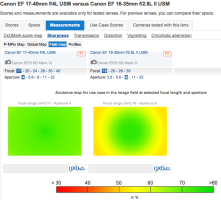
Comparing their actuance (sharpness) field map for the 17-40/4 af f/4 vs. the 16-35L II at f/8, where the 17-40 is sharp right into the corners and the 16-35 is soft even stopped down to f/8, pretty clearly demonstrates that their tests of the 17-40L are just plain wrong.
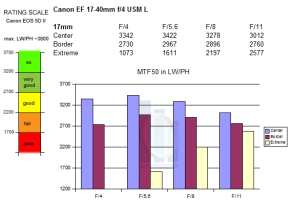
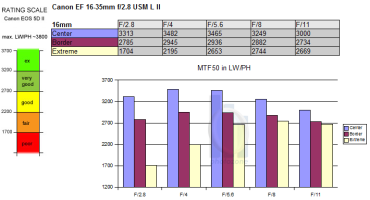
Compare the plot below to TDP's ISO 12233 crops (showing the same FL+aperture comparison as the DxOMark screenshot below) which match the experience of pretty much everyone. The 16-35 definitely has some corner softness, even stopped down. The 17-40 is pretty mushy in the corners wide open, certainly nothing like the very similar sharpness in the corners as in the center that DxO shows.
With both lenses stopped down to f/8, the sharpness is pretty similar - IMO, the reason to get the 16-35 II is if you need/want the f/2.8 aperture. I went that route, and the extra stop has often come in handy, particularly with an ultrawide where the DoF doesn't get too thin (16mm f/2.8 focused at 10', everything from 5' to infinity is in focus).
Wouldn't be the first time. Notably, they delcared that the 70-200/2.8 IS II was not quite as good as the original 70-200/2.8L IS which it replaced, a finding that completely contradicted everyone else who tested or used the lenses. They were called on it in the review comments, and they defended their test results. A year or more later, they quietly updated their original data and results to show that the MkII version is, in fact, the better lens. Surprise, surprise.mackguyver said:...it seems that DxO's measurements don't match others...
Comparing their actuance (sharpness) field map for the 17-40/4 af f/4 vs. the 16-35L II at f/8, where the 17-40 is sharp right into the corners and the 16-35 is soft even stopped down to f/8, pretty clearly demonstrates that their tests of the 17-40L are just plain wrong.
Compare the plot below to TDP's ISO 12233 crops (showing the same FL+aperture comparison as the DxOMark screenshot below) which match the experience of pretty much everyone. The 16-35 definitely has some corner softness, even stopped down. The 17-40 is pretty mushy in the corners wide open, certainly nothing like the very similar sharpness in the corners as in the center that DxO shows.
With both lenses stopped down to f/8, the sharpness is pretty similar - IMO, the reason to get the 16-35 II is if you need/want the f/2.8 aperture. I went that route, and the extra stop has often come in handy, particularly with an ultrawide where the DoF doesn't get too thin (16mm f/2.8 focused at 10', everything from 5' to infinity is in focus).
Attachments
Upvote
0
Neuro, yep, yep, and yep. No surprises after the 70-200 2.8 IS II "test" and I find the f/2.8 aperture quite useful as well. I tend to use the lens more for event / travel photos vs. landscape, but it's also useful for interior work where the extra brightness helps me with the composition and focus. I've seen excellent photos with both lenses, so I think it comes down to size/weight vs. price/aperture.
Upvote
0

I don't even bother with DxO reviews or tests anymore because they often totally contradict other reviews.
Upvote
0
I only agree with the ones that I like - the rest are all completely wrongmrsfotografie said:I don't even bother with DxO reviews or tests anymore because they often totally contradict other reviews.

Upvote
0
This is one potential reason why I've stayed away from their software. If they can't characterize the lenses correctly, does it affect their software products?
Upvote
0

I just picked up the 17-40 in Singapore on a whim... I like it, don't love it, but like it. I chose it over the 16-35 because I don't need the f/2.8, and I am anticipating a new UWA in the next year or so. DxO results do not convince me, nor direct my decision making process. I disagree with a lot of their "conclusions" and not others...
We should just start a pinned discussion entitled "DxO and all associated rants/complaints".
We should just start a pinned discussion entitled "DxO and all associated rants/complaints".
Upvote
0

Random Orbits said:This is one potential reason why I've stayed away from their software. If they can't characterize the lenses correctly, does it affect their software products?
I think that's one of the reasons why people are frustrated by the DxO 'tests'. Their software programs are quite highly regarded by many, in sharp contrast to their 'score summaries' which are joke, and a poor one at that. Trying to condense a lens's performance into a single 'score' is an insult to their programs.
Upvote
0
I agree completely and love their software which just keeps getting better. As for their tests, like many things on the Internet, I always say they're worth what I paid for themSporgon said:Random Orbits said:This is one potential reason why I've stayed away from their software. If they can't characterize the lenses correctly, does it affect their software products?
I think that's one of the reasons why people are frustrated by the DxO 'tests'. Their software programs are quite highly regarded by many, in sharp contrast to their 'score summaries' which are joke, and a poor one at that. Trying to condense a lens's performance into a single 'score' is an insult to their programs.

Upvote
0
neuroanatomist said:Get your brooms, boys and girls…I declare shenanigans!!"
I was under the impression that the 16-35mm has a slightly curved plane of focus on the wide end, and that this is why when shooting a flat test chart, it shows soft corners. If the plane of focus is indeed curved, when shooting a test chart (from close up) then closing the aperture might not necessarily give enough depth of field to improve corner sharpness.
In real world shooting (smaller than f/5.6) I haven't found the 16-35mm-II any better than 17-40mm. In this case I'd say my experience mirrors the findings of their measurements.
Upvote
0

GMCPhotographics
Canon Rumors Premium
StudentOfLight said:neuroanatomist said:Get your brooms, boys and girls…I declare shenanigans!!"
I was under the impression that the 16-35mm has a slightly curved plane of focus on the wide end, and that this is why when shooting a flat test chart, it shows soft corners. If the plane of focus is indeed curved, when shooting a test chart (from close up) then closing the aperture might not necessarily give enough depth of field to improve corner sharpness.
In real world shooting (smaller than f/5.6) I haven't found the 16-35mm-II any better than 17-40mm. In this case I'd say my experience mirrors the findings of their measurements.
I remember when th 17-40L was released, most of Canon's DSLR's were 1.6 or 1.3x crop sensors and this lens was intended to bridge the gap for a moderatly priced mid range zoom. At that point Canon had no dedicated 1.6x crop lenses and the ef-s mount hadn't been introduced. It performed so many roles that it became a huge hit. It started the f4 lens range, provided a really good quality ultra wide to the full frame film users (and later full frame DSLR users) and offered an approx 28-70mm lens for 1.6x users. no wonder it's sold so well.
When the 16-35IIL was launched it was to bring the f2.8 wide up to the f4 wide lens' optical capabilities.
Upvote
0
L
Loswr
Guest
StudentOfLight said:I was under the impression that the 16-35mm has a slightly curved plane of focus on the wide end, and that this is why when shooting a flat test chart, it shows soft corners. If the plane of focus is indeed curved, when shooting a test chart (from close up) then closing the aperture might not necessarily give enough depth of field to improve corner sharpness.
Yes, there's some field curvature at the wide end of the 16-35L II. It's not too bad, though. FWIW, for the TDP ISO 12233 crops that I linked before, the chart was shot at 64 cm, and at that distance and at f/8 everything from 40 cm to 157 cm should be within the DoF.
StudentOfLight said:In real world shooting (smaller than f/5.6) I haven't found the 16-35mm-II any better than 17-40mm. In this case I'd say my experience mirrors the findings of their measurements.
I'd disagree - you stated that you haven't found the 16-35L II to be any better than the 17-40L, but DxOMark is saying that the 16-35L II is worse than the 17-40L. DxOMark is showing that 16-35L II stopped down to f/8 has softer corners than the 17-40L af f/4, and also that corner performance of the 16-35L II at f/8 is actually slightly worse than at f/2.8. WTF?
Here are PZ's Imatest results, which align well with the TDP crops.
Attachments
Upvote
0
Sporgon said:Random Orbits said:This is one potential reason why I've stayed away from their software. If they can't characterize the lenses correctly, does it affect their software products?
I think that's one of the reasons why people are frustrated by the DxO 'tests'. Their software programs are quite highly regarded by many, in sharp contrast to their 'score summaries' which are joke, and a poor one at that. Trying to condense a lens's performance into a single 'score' is an insult to their programs.
I've never really tried DxO software. I currently use LR for basic edits and cataloging, Nik for B&W conversion and some HDR, and PS for focus stacking and photo-stitching. For others that use the same software that I use, is there an advantage to using DxO software? If so, which programs do you find useful?
Upvote
0
DXO is a joke when it comes to equipment reviews. This goes for lenses and cameras and comparisons. They may get some things right, but it's really difficult to give them credibility when they often publish results such as the one featured in this thread. I questions their testing methods and their controls. I wonder if they tested the same lens copy each week with the same test, that they would end up with a lot of variability in results at the end of the year.
Upvote
0
neuroanatomist said:The NR capabilities of their new PRIME algorithms are very, very impressive.
Yes, they are. It's also remarkably good at correcting geometric distortion, including volume anamorphosis:
http://www.dxo.com/intl/photography/dxo-optics-pro/features/optical-corrections/volume-anamorphosis
I also think its automatic correction of lens distortion is a bit better than the other software I use the most, lightroom's. I generally prefer LR overall, but it's nice to have other software for specific uses where they do better (I like Photo Ninja too, which restores highlights better than LR or DxO in extreme cases and comes closer to handling Fuji's RAW files than anyone else).
If comments here are typical, the normal progression is to start out by learning that DxO's lens/sensor tests are, um, perverse and then, based on that, to be biased against their software. I'm probably unusual in that I started out with their software, was impressed by that and thus was biased towards trusting their tests. I quickly shed that bias, but still like the software....
Upvote
0
neuroanatomist said:With both lenses stopped down to f/8, the sharpness is pretty similar - IMO, the reason to get the 16-35 II is if you need/want the f/2.8 aperture. I went that route, and the extra stop has often come in handy, particularly with an ultrawide where the DoF doesn't get too thin (16mm f/2.8 focused at 10', everything from 5' to infinity is in focus).
My experience mirrors DXO's. 17-40L is the sharper lens. Also less CA. Take note though, that my 17-40 was terrible new, and had to go into Canon twice to be fixed. Obviously the usual caveat about copy variation applies.
I do miss the extra mm, though. I may have to invest in one of the 14mm primes.
Upvote
0

Similar threads


- Replies
- 4
- Views
- 794


- Replies
- 21
- Views
- 5K
- Replies
- 23
- Views
- 5K
