
1Dx M2 Sensor Resolution - Back of envelop estimate

Northstar said:
takesome1 said:
Forsberg said:
its sad, because he had a point with noise and signal ratio and that noise doesent increase with higher iso

Gosh, why couldn't you have made your account just a few days earlier so you could have helped him with his point.

He has been booted from CR twice in one day. First as filluppa, then as Forsberg.

It's too bad, really. Having someone on who evidently can't grasp the concept of a ratio was... entertaining.
 
Upvote 0
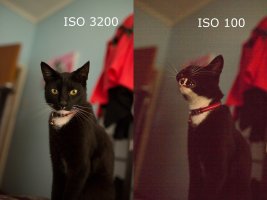
Please correct me if I'm wrong:
ISO amplifies signal, shot noise, pixel-response-non-uniformity-noise, thermal noise, but not the read noise. If you bump exposure up in post-processing then you amplify the signal as well as all sources of noise. If you choose a higher ISO you avoid having to amplifying read noise in post-.

I shot these two pictures at [1/250s, f/2] with only the ISO being different; ISO-3200 in picture A vs ISO-100 in picture B.

For real world usage the ISO-3200 properly exposed displays less noise than the ISO-100 underexposed-and-corrected.

The RAW files are available here for anyone who cares:
https://www.dropbox.com/sh/toq89y3rqgioal6/AAA-QtE7fBrxwYLzZnR1Elkna?dl=0
 

Attachments

  • ISO-comp.jpg
    ISO-comp.jpg
    1.1 MB · Views: 144
Upvote 0
I'm just checking to see how a discussion of Resolution can go on for 9 pages. I'm glad I missed the previous 8.

I did not even see anyone discuss the definition of resolution. That's a never ending topic itself, because some people believe that a 50mp camera has 50mp of resolution. I'm not going to get into that ball of worms, readers can look up resolution and the many ways people refer to it.
 
Upvote 0
SoL, yes that's what happen when you push 5 stops in post.

I only know from other electronics, so not sure if it maps 100% on cameras, but most signals can be less-noisy, the earlier you amplify it. So in your case, you amplify early (ISO3200) is better than in post.

Good example is the satellite dishes. The LNB has amp so that they can amplify everything already there. Then when there's attenuation on the cables, the noise gets reduced same amount and snr stays the same. But if you don't amplify at the LNB, then the snr will decrease when you amplify later. Same applies to all signals. The first stage is always to most important. If you google cascaded noise figure calculation formulas, you can easily see that most noise is crated at the first amp, and _assuming_ the first amp power level is adequate, then the later items don't count almost nothing. If the first amp is not enough, then all the filters and cables add plenty of noise.

So if that same applies to cameras, then the earlier you amplify, the better it will be for the end result.
 
Upvote 0
takesome1 said:
So would there ever be any advantage to underexposing, for instance to get more shutter speed. After all if its dark you need as much shutter speed as you can get for camera shake. Or should you always go with the right ISO.

Not necessarily a 5 stop PO cat push.

But say 1 or 2 stops.

Thoughts anyone?

If your camera has the ISO range to cope with it, why would you purposefully use two stops lower ISO to underexpose by two stops? The shutter speed would be identical in either scenario. You're just creating more work for yourself in post, and lack the ability to see anything useful on the camera screen.
 
Upvote 0
rs said:
takesome1 said:
So would there ever be any advantage to underexposing, for instance to get more shutter speed. After all if its dark you need as much shutter speed as you can get for camera shake. Or should you always go with the right ISO.

Not necessarily a 5 stop PO cat push.

But say 1 or 2 stops.

Thoughts anyone?

If your camera has the ISO range to cope with it, why would you purposefully use two stops lower ISO to underexpose by two stops? The shutter speed would be identical in either scenario. You're just creating more work for yourself in post, and lack the ability to see anything useful on the camera screen.

Shutter speed for one, if there is any advantage.
Another would be DR, sometimes underexposing to get the sky correct and lifting the shadows for your subject. That kind of thing.
 
Upvote 0
StudentOfLight said:
Please correct me if I'm wrong:
ISO amplifies signal, shot noise, pixel-response-non-uniformity-noise, thermal noise, but not the read noise. If you bump exposure up in post-processing then you amplify the signal as well as all sources of noise. If you choose a higher ISO you avoid having to amplifying read noise in post-.

That depends on what you're calling the read noise. What we generally call read noise is really several different sources all lumped into one term. The short answer though is that anything upstream of the amplifier will be amplified by changing ISO which in turn causes any downstream noise sources to have less of an impact; when we boost in post, however, those downstream sources have much more of an impact.
 
Upvote 0
takesome1 said:
So would there ever be any advantage to underexposing, for instance to get more shutter speed. After all if its dark you need as much shutter speed as you can get for camera shake. Or should you always go with the right ISO.

Not necessarily a 5 stop PO cat push.

But say 1 or 2 stops.

Thoughts anyone?

Well, there's more to it than what I'm going to say, but pushing in post will roughly increase noise linearly with signal while boosting with an analog ISO will increase as SQRT (slower). Digitally pushing signal in post (that's really all you're doing) is worse than analog amplification in-camera. But there are other things to balance in the real-life shot where you might shoot some parts of your scene underexposed.
 
Upvote 0
takesome1 said:
So would there ever be any advantage to underexposing, for instance to get more shutter speed. After all if its dark you need as much shutter speed as you can get for camera shake. Or should you always go with the right ISO.

Not necessarily a 5 stop PO cat push.

But say 1 or 2 stops.

Thoughts anyone?

If you were right at the top end, and still underexposing, then it's unavoidable I suppose (the hedgehog shots I mentioned in another thread are an example). Otherwise I think it's usually best to up the ISO, ETTR and then reduce the brightness afterwards.
 
Upvote 0
bdunbar79 said:
takesome1 said:
So would there ever be any advantage to underexposing, for instance to get more shutter speed. After all if its dark you need as much shutter speed as you can get for camera shake. Or should you always go with the right ISO.

Not necessarily a 5 stop PO cat push.

But say 1 or 2 stops.

Thoughts anyone?

Well, there's more to it than what I'm going to say, but pushing in post will roughly increase noise linearly with signal while boosting with an analog ISO will increase as SQRT (slower). Digitally pushing signal in post (that's really all you're doing) is worse than analog amplification in-camera. But there are other things to balance in the real-life shot where you might shoot some parts of your scene underexposed.

So if I'm shooting sports at 12800, with my 70-200 at 2.8, and 1/500( the slowest I'll shoot for sports) and I need to get another full stop of light in my shot, and my only option is to either increase ISO to 25600, or push it a full stop in post, you're saying it would be better to increase the ISO to 25600?

In other words, if IQ is the priority, and we're discussing a very low light /very high ISO situation, is it always better to shoot at the necessary high ISO to properly expose the shot even if that may lead to crazy high ISO's of 25600 or 51200..etc. Or at those very high ISO levels is pushing it in post a better way to go? OR, some combination of the two?

Thanks
North
 
Upvote 0
Northstar said:
In other words, if IQ is the priority, and we're discussing a very low light /very high ISO situation, is it always better to shoot at the necessary high ISO to properly expose the shot even if that may lead to crazy high ISO's of 25600 or 51200..etc. Or at those very high ISO levels is pushing it in post a better way to go? OR, some combination of the two?

Once you get above the native ISO settings (H1, H2, etc.), the camera is no longer amplifying the analog signal, rather it's digitally pushing the file so there's no advantage (underexposing and pushing in post is equivalent).
 
Upvote 0
neuroanatomist said:
Northstar said:
In other words, if IQ is the priority, and we're discussing a very low light /very high ISO situation, is it always better to shoot at the necessary high ISO to properly expose the shot even if that may lead to crazy high ISO's of 25600 or 51200..etc. Or at those very high ISO levels is pushing it in post a better way to go? OR, some combination of the two?

Once you get above the native ISO settings (H1, H2, etc.), the camera is no longer amplifying the analog signal, rather it's digitally pushing the file so there's no advantage (underexposing and pushing in post is equivalent).

Yes, great point. North I know you shoot with the 1Dx, so the last analog ISO on the 1Dx is 6400. So above that it wouldn't matter. But let's say something like shoot at ISO 1600 + 1 push in post is worse than ISO 3200 in camera, from a noise perspective. And in the 1Dx there are no tweener ISO's. So 4000 and 5000 are analog too.
 
Upvote 0
bdunbar79 said:
neuroanatomist said:
Northstar said:
In other words, if IQ is the priority, and we're discussing a very low light /very high ISO situation, is it always better to shoot at the necessary high ISO to properly expose the shot even if that may lead to crazy high ISO's of 25600 or 51200..etc. Or at those very high ISO levels is pushing it in post a better way to go? OR, some combination of the two?

Once you get above the native ISO settings (H1, H2, etc.), the camera is no longer amplifying the analog signal, rather it's digitally pushing the file so there's no advantage (underexposing and pushing in post is equivalent).

Yes, great point. North I know you shoot with the 1Dx, so the last analog ISO on the 1Dx is 6400. So above that it wouldn't matter. But let's say something like shoot at ISO 1600 + 1 push in post is worse than ISO 3200 in camera, from a noise perspective. And in the 1Dx there are no tweener ISO's. So 4000 and 5000 are analog too.

Good info guys, thx.
So all 1/3 stop increments are analog gain from base all the way up to 6400, but after 6400, the gain is a digital push like I can do in Lightroom?
Also, Neuro wrote that the analog amplification ceased once you get above native ISO, doesnt the native ISO go up to 51200, not 6400.... What am I missing?
 
Upvote 0
StudentOfLight said:
Please correct me if I'm wrong:
ISO amplifies signal, shot noise, pixel-response-non-uniformity-noise, thermal noise, but not the read noise. If you bump exposure up in post-processing then you amplify the signal as well as all sources of noise. If you choose a higher ISO you avoid having to amplifying read noise in post-.

I shot these two pictures at [1/250s, f/2] with only the ISO being different; ISO-3200 in picture A vs ISO-100 in picture B.

For real world usage the ISO-3200 properly exposed displays less noise than the ISO-100 underexposed-and-corrected.

The RAW files are available here for anyone who cares:
https://www.dropbox.com/sh/toq89y3rqgioal6/AAA-QtE7fBrxwYLzZnR1Elkna?dl=0

Your experiment is fundamentally flawed. You corrected the 100 shot by pushing, and that introduces noise. Pushing sort of speaking "changes" the ISO just like shooting at ISO 12,800 does vs. ISO 6400, in camera. Shooting at "ISO 100 and then pushing", is NOT the same as "shooting at ISO 100." Pushing digitally increases noise at a faster rate than analog amplification. So your ISO 3200 shot SHOULD have less noise.

The real experiment is to shoot one shot at ISO 800 and then a 2nd shot at ISO 1600 and measure noise in each shot, as an example. Once you push or pull in post you've sort of changed the ISO digitally.
 
Upvote 0
ok this is actually not that hard

sensor -> amplifier -> adc

each of those components introduces its own noise

raising the iso is turning up the amplifier, and amplifies the noise from the sensor

pushing in post amplifies the noise from all 3 stages

so yes, generally speaking, you get the best signal to noise ratio if your input signal is as hot as possible without clipping, and that means it's better to raise the analog iso in camera than push it in post
 
Upvote 0