
You are using an out of date browser. It may not display this or other websites correctly.
You should upgrade or use an alternative browser.
You should upgrade or use an alternative browser.
5D III or 7D II?
- Thread starter chrysoberyl
- Start date


tomscott said:The pics in this thread contradict your statement.
http://www.fredmiranda.com/forum/topic/1332307
If you get close enough and fill a significant fraction of the frame, most lenses are sharp enough. It is indisputable that those lenses do have low MTFs on APS-C and it shows when the subjects are further away and fill less of the frame. You pay money to get sharper lenses be able to crop more and get usable images.
You gave examples from Tongho58 to support what you said. But, here is what Tongho wrote in his comments:
https://www.flickr.com/photos/tongho58/15707862869/
"Tongho58 I'm disappointed with shots taken with 7D II, "at full resolution". Nothing beats full frame and a sharp lens!"
You have also attributed shots taken with the 5DIII to the 7DII, such as the above.
Upvote
0
tomscott said:Here are a few from that thread with the tamron 150-600mm and the 7DMKII borrowed from Tongho58
(Removed pics)
Most of the shots are at 600 and wide open. The guys obviously incredibly talented but this combo looks killer to me.
They are all wonderful shots but to address your "killer combo" comment.
I have this combo and I am struggling to get sharp shots with it. I am hoping my skill set is the limiting factor here. The 7D2 is the most complicated camera I have ever used and the tamron is the biggest lens I have used. Still trying and keeping fingers crossed.
Before anyone asks I did try AFMA but without concrete results so I disabled it.
Rod
Upvote
0

I shoot the 7Dii and 5Diii side by side at sports and find the 7Dii very noisey in anything other than good light. I am yet to use it extensively with the 100-400ii which I just purchased but will be taking both bodies, the 100-400ii, 300ii and 1.4 and 2x TC's to Zambia next month so I will have plenty of opportunity to compare all combinations on some wildlife. Like AlanF I will probably opt to go with the 100-400 on the 7Dii but use the TC's on the 5Diii.
Upvote
0

all these birds in flight photos and landscapes pics
and no action shots
i have both a 5d3 and 7d2 they both can do what u need them too do just have good glass and your be ok
 9W9A0872-1 by Bigz Ant, on Flickr
 9W9A1122-1 by Bigz Ant, on Flickr
 9W9A1306-1 by Bigz Ant, on Flickr
and no action shots
i have both a 5d3 and 7d2 they both can do what u need them too do just have good glass and your be ok
9W9A0872-1 by Bigz Ant, on Flickr9W9A1122-1 by Bigz Ant, on Flickr9W9A1306-1 by Bigz Ant, on Flickr
Upvote
0

GMCPhotographics
Canon Rumors Premium
chrysoberyl said:I have a 6D and it is a great camera, but not for BIF. My long lens is a 70-200 2.8 II with a 1.4X III teleconverter, but at some point I will buy a 400 or 500mm prime. So the 7D II would be nice to lengthen the reach. My main question is, is the 7D II AF substantially better than that of the 5D III? What other considerations should I have for BIF?
I can’t believe this topic has not come up – but if it has, I am sure someone will kindly direct me to that discussion.
Thanks,
John
In your situation I would go for a 7DII. But the 5DIII's af will not be the limitation for BIF images. I've got a lot of great images using 5DIII's. Regardless of how good the AF system is, technique and experience has a greater affect on your keeper rate.
Both are great cameras, MP is similar, AF is very similar and the handling is similar too. The only difference is the frame rate and physical size of the sensor.
Upvote
0

GMCPhotographics said:chrysoberyl said:I have a 6D and it is a great camera, but not for BIF. My long lens is a 70-200 2.8 II with a 1.4X III teleconverter, but at some point I will buy a 400 or 500mm prime. So the 7D II would be nice to lengthen the reach. My main question is, is the 7D II AF substantially better than that of the 5D III? What other considerations should I have for BIF?
I can’t believe this topic has not come up – but if it has, I am sure someone will kindly direct me to that discussion.
Thanks,
John
In your situation I would go for a 7DII. But the 5DIII's af will not be the limitation for BIF images. I've got a lot of great images using 5DIII's. Regardless of how good the AF system is, technique and experience has a greater affect on your keeper rate.
Both are great cameras, MP is similar, AF is very similar and the handling is similar too. The only difference is the frame rate and physical size of the sensor.
Thanks! Since going to 6D from 60D, I really want full frame, but the image quality in the posts has convinced me that the 7D II will be fine. And your point on technique and experience is well-made, especially in my case.
Upvote
0

I've never shot a 7D II but as a 5D3 shooter I found the 70D to be great fun to shoot BIF for a little while... alas the Full Frame perspective of the 5D3 will get you photographs that pop in ways an APS-C sensor physically cannot. There are people on this forum who will tell you (and have already told me) otherwise but I simply have to write off their opinions as, I don't know, some kind of APS-C fanboys/gals, because the results I've gotten from shooting the 400mm f/5.6L and 300mm f/4L are at times quite magical and when I see a lot of 7D II shots I just wonder how amazing they may have looked with the wider frame perspective... I enjoy trying to get great animal portraits, if just 'reaching' animals is enough, grab that 7D II...
Also, I shoot FF action shots (Roller Derby, mostly), FF adds a whole new dimension to the images, or at least expands on ALL three of the usual ones
Also, I shoot FF action shots (Roller Derby, mostly), FF adds a whole new dimension to the images, or at least expands on ALL three of the usual ones
Upvote
0
Sorry, but that really sounds like you are trying to justify to yourself why you spent all that money on the 5D3 when you already had the 70D. Of course with the same lenses it will look wider on FF than on APS-C, but when you scale the focal length and the f-stop with the crop factor you should get equivalent images. If you still have differences that is either because of differences in lens quality or sensor technology (age, price point and pixel count) but not caused by the sensor size itself. Of course images wide open on FF (like 50mm f/1.4, which would be 31mm f/0.9 on APS-C) are not easily reproducible with APS-C, but that usually happens in the shorter focal length range and not in the very long focal length ranges like the 300mm and 400mm you mentioned.Khufu said:I've never shot a 7D II but as a 5D3 shooter I found the 70D to be great fun to shoot BIF for a little while... alas the Full Frame perspective of the 5D3 will get you photographs that pop in ways an APS-C sensor physically cannot. There are people on this forum who will tell you (and have already told me) otherwise but I simply have to write off their opinions as, I don't know, some kind of APS-C fanboys/gals, because the results I've gotten from shooting the 400mm f/5.6L and 300mm f/4L are at times quite magical and when I see a lot of 7D II shots I just wonder how amazing they may have looked with the wider frame perspective... I enjoy trying to get great animal portraits, if just 'reaching' animals is enough, grab that 7D II...
Also, I shoot FF action shots (Roller Derby, mostly), FF adds a whole new dimension to the images, or at least expands on ALL three of the usual ones
Upvote
0
Precisely the argument that I'm talking about
The physics are different. To truly get a more closely matched perspective you'll need to shrink your subject and environment by 1.6x and bring them 1.6x closer to the image plane. A FF sensor is looking at the right-most subjects from further leftwards than a smaller, or "cropped" focal plane. Try observing the difference as you close one eye and shift your head an inch or so side-to-side, you'll notice everything in the world shifts slightly relative to eachother, shift far enough and you'll "see around" corners, features etc... A photographic representation isn't all observed from the same position, on a FF sensor it's observing from a 36mm perspective shift, from one edge to the other. This effect is increased as you move towards Medium Format and larger focal planes and reduced as you use smaller sensors, like in compact cameras and phones, hence the "ants eye view" kind of effect... That's how the world may look if you had tiny eyes.
The calculations people make reflect attempting to achieve similar Depth of Field and "spread" of captured subjects, but they rarely mention true perspective and it's a very real thing! I recommend looking at some old plate/large format images and seeing how the perspective feels much more open, regardless of Depth of Field.
For the record: I had the 5D3 some 2 years or so prior to the 70D.
Your words sound a lot to me like somebody trying to justify APS-C over FF
The physics are different. To truly get a more closely matched perspective you'll need to shrink your subject and environment by 1.6x and bring them 1.6x closer to the image plane. A FF sensor is looking at the right-most subjects from further leftwards than a smaller, or "cropped" focal plane. Try observing the difference as you close one eye and shift your head an inch or so side-to-side, you'll notice everything in the world shifts slightly relative to eachother, shift far enough and you'll "see around" corners, features etc... A photographic representation isn't all observed from the same position, on a FF sensor it's observing from a 36mm perspective shift, from one edge to the other. This effect is increased as you move towards Medium Format and larger focal planes and reduced as you use smaller sensors, like in compact cameras and phones, hence the "ants eye view" kind of effect... That's how the world may look if you had tiny eyes.
The calculations people make reflect attempting to achieve similar Depth of Field and "spread" of captured subjects, but they rarely mention true perspective and it's a very real thing! I recommend looking at some old plate/large format images and seeing how the perspective feels much more open, regardless of Depth of Field.
For the record: I had the 5D3 some 2 years or so prior to the 70D.
Your words sound a lot to me like somebody trying to justify APS-C over FF
Upvote
0

But an imaging sensor is not a 'spot', it is a rectangle.
The edges of your sensor are not in the same physical location, yet they're capturing edges of the same photograph. A larger sensor increases this separation, which becomes quite significant as you consider sensor sizes from phones through M4/3 to APS-C, 35mm type and greater...
I'm sorry if you struggle to understand this, or if you're just too miseducated and stubborn to consider what you're citing as is "the same" is actually a rough guide but ultimately not true.
The edges of your sensor are not in the same physical location, yet they're capturing edges of the same photograph. A larger sensor increases this separation, which becomes quite significant as you consider sensor sizes from phones through M4/3 to APS-C, 35mm type and greater...
I'm sorry if you struggle to understand this, or if you're just too miseducated and stubborn to consider what you're citing as is "the same" is actually a rough guide but ultimately not true.
Upvote
0

Khufu said:But an imaging sensor is not a 'spot', it is a rectangle.
The edges of your sensor are not in the same physical location, yet they're capturing edges of the same photograph. A larger sensor increases this separation, which becomes quite significant as you consider sensor sizes from phones through M4/3 to APS-C, 35mm type and greater...
I'm sorry if you struggle to understand this, or if you're just too miseducated and stubborn to consider what you're citing as is "the same" is actually a rough guide but ultimately not true.
?
No, candc is right. Perspective is a result of distance from a subject and has nothing to do with sensor size as long as framing is the same.
Earlier you talk about old images from LF plate cameras being more 'open'. Any perceived difference is to do with tonal graduation and significant (longer) lens magnification giving better detail, and also a fair amount of distortion from those old lenses.
Upvote
0
Let's assume the simplest form of a camera: the pinhole camera with an infinitesimal hole size (and not taking diffraction into account).
The effective focal length of the camera is the distance of the sensor to the hole. If you place an APS-C sensor at a specific distance and a FF sensor at 1.6 times the distance to the hole every light ray that passes through the hole will hit both sensors at corresponding points (e.g. center, corners, centers of edges, 50% from center to edge, ...). Also the same amount of light hits both sensors. So at least in this case we get exactly the same image from both sensors.
The effective focal length of the camera is the distance of the sensor to the hole. If you place an APS-C sensor at a specific distance and a FF sensor at 1.6 times the distance to the hole every light ray that passes through the hole will hit both sensors at corresponding points (e.g. center, corners, centers of edges, 50% from center to edge, ...). Also the same amount of light hits both sensors. So at least in this case we get exactly the same image from both sensors.
Upvote
0

midluk said:Sorry, but that really sounds like you are trying to justify to yourself why you spent all that money on the 5D3 when you already had the 70D. Of course with the same lenses it will look wider on FF than on APS-C, but when you scale the focal length and the f-stop with the crop factor you should get equivalent images. If you still have differences that is either because of differences in lens quality or sensor technology (age, price point and pixel count) but not caused by the sensor size itself. Of course images wide open on FF (like 50mm f/1.4, which would be 31mm f/0.9 on APS-C) are not easily reproducible with APS-C, but that usually happens in the shorter focal length range and not in the very long focal length ranges like the 300mm and 400mm you mentioned.Khufu said:I've never shot a 7D II but as a 5D3 shooter I found the 70D to be great fun to shoot BIF for a little while... alas the Full Frame perspective of the 5D3 will get you photographs that pop in ways an APS-C sensor physically cannot. There are people on this forum who will tell you (and have already told me) otherwise but I simply have to write off their opinions as, I don't know, some kind of APS-C fanboys/gals, because the results I've gotten from shooting the 400mm f/5.6L and 300mm f/4L are at times quite magical and when I see a lot of 7D II shots I just wonder how amazing they may have looked with the wider frame perspective... I enjoy trying to get great animal portraits, if just 'reaching' animals is enough, grab that 7D II...
Also, I shoot FF action shots (Roller Derby, mostly), FF adds a whole new dimension to the images, or at least expands on ALL three of the usual ones
I have the 5D Mark III and the 70D. The 5D Mark III IQ wipes the floor with the 70D every time. I like both cameras. When I need faster a frame rate I use my 70D. Otherwise, the 5D mark III gets used.
I too had the 70D first. Am I trying to "justify" the purchase? Nope. I don't have to justify it to anyone, especially not on an anonymous forum. Don't know why a thought like that would even enter your mind. Just silly.
Upvote
0
GMCPhotographics
Canon Rumors Premium
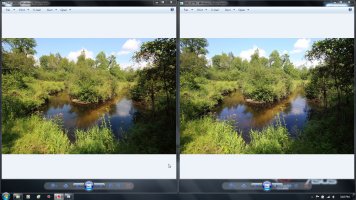
candc said:if the angle of view is the same then the perspective is the same if shot from the same spot.
example is 10mm on aps-c and 16mm on ff. shot from the same spot, the perspective is the same
The one on the left is clearly wider.
Upvote
0
No, they just do not point in the exact same direction. The left picture shows a little bit more on the left edge, the right picture shows about the same bit more on the right edge.GMCPhotographics said:candc said:if the angle of view is the same then the perspective is the same if shot from the same spot.
example is 10mm on aps-c and 16mm on ff. shot from the same spot, the perspective is the same
The one on the left is clearly wider.
And even if it were wider, you would not notice the slight difference withoud direct comparison. It is definitely far from a factor of 1.6!
Upvote
0

If you want to keep the 6D: take the 7D2. It adds more variety on your glass..
I do have both: 5d3 and 7d2. I travel with both. Here the Idea:
But the crop factor is the topic....
Some more: http://bit.ly/1CtrDbl
I do have both: 5d3 and 7d2. I travel with both. Here the Idea:
- [/size]14mm f2.8 on 5D3 (Samyang) this lens becomes:
- [/size]21mm f2.8 on 7D2
- [/size]35mm f2.0 IS on 5D3 (Canon EF) this lens becomes
- [/size]56mm f2.0 on 7D2
- [/size]85mm f1.4 on 5D3 (Sigma) this lens becomes
- [/size]136mm f1.4 on 7D2
But the crop factor is the topic....
Some more: http://bit.ly/1CtrDbl
Upvote
0
This is not exactly correct. You also have to scale the f number with the crop factor to really get the lens that gives equivalent images. If you scale both the focal length and the f number you keep the absolute diameter of the aperture constant, which is what then gives you the same DOF and the same amount of light per pixel (assuming same pixel count).JoFT said:
- [/size]14mm f2.8 on 5D3 (Samyang) this lens becomes:
- [/size]21mm f2.8 on 7D2
- [/size]35mm f2.0 IS on 5D3 (Canon EF) this lens becomes
- [/size]56mm f2.0 on 7D2
- [/size]85mm f1.4 on 5D3 (Sigma) this lens becomes
- [/size]136mm f1.4 on 7D2
This is also the main reason why you have higher noise on APS-C compared to FF at the same ISO. The ISO number is defined using the real (not the equivalent) f number. So what is called ISO 100 on APS-C is equivalent to ISO 100*1.6*1.6=250 on FF from a noise perspective. There might of course be some more differences resulting from more advanced technology in more expensive FF sensors compared to entry level APS-C sensors and better fill factor and less relative tolerances due to the bigger pixel sizes, but this is not the main contribution.
If you are limited by DOF (and shoot stopped down) you will not gain much with a FF sensor compared to APS-C, because you can use an f number which is 1.6 smaller on APS-C and consequently can reduce ISO by a factor of 1.6*1.6=2.5. The main advantage you get is in situations where you are not limited by DOF (or even want extremely shallow DOF) and can use low f numbers on FF which are not reachable equivalently on APS-C. And of course at the ultra ultra short end on APS-C you can get as low as 16mm equivalent (10mm) while on FF you can get to 11mm (canon lenses, non-fisheye), but the problem here is more lens design (and the distance of the back lens element from the sensor) and not so much caused by sensor size.
Upvote
0

