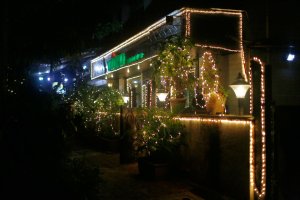
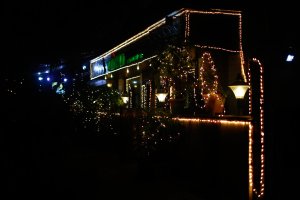
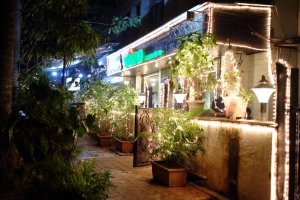
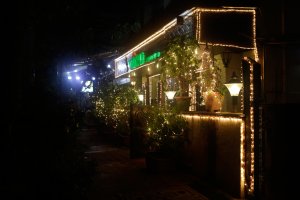
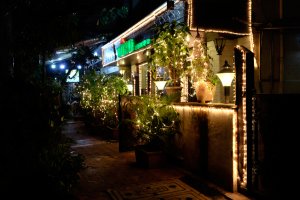
If you've shot these as in camera jpeg then my first suggestion is that it's a result on the Canon 'picture styles' and metering patterns. I have found that the default contrast has always been too high on all the cameras since the 5D. With these kind of lights at night shots there is massive contrast.
If I were to (try) and shoot bright lights at night in camera jpeg I'd set 'natural' or 'faithful' style ( less steep response curve), and set contrast to -4. I'd then expect tomhave to compensate for the cameras meter trying to expose for the lights.
So the Canon picture is both underexposed and too high in contrast.
Your test shows that when shooting joeys cameras such as the XE/2 are easier to manage.
Take a look at the exif data. Canon took aprox. 2 stops less light.
The scene has too much contrast, so the Canon decided to keep the highlights, the Fuji cared more about the shadows.
The Canon shots are obviously too dark, generally under exposed. But look at the lamps in the Canon shots, there is some good detail there.
Compare the lamps in the Fuji shots, detail is gone, completely blown out from over exposure.
Night scenes like these with lights do present one of the more difficult exposure problems, there is just too much dynamic range in the scene for any camera to deal with, there's even more DR than human eyesight can resolve all at once.
I've learned to love live view with exposure simulation activated. I tweak exposure and white balance in live view, switch back to the real, through glass view for composition and focus.
---
HDR is a marvelous post technique for this type situation. Exposure bracket at least three shots, best to shoot a few three shot sets with different exposure compensation applied to the bracketed set, then apply the over and under exposed frames as shadow masks in post.
The end result will have shadow detail like your Fuji shot, lamp detail like your Canon shot.
Do note that it's too easy to go way too far with HDR and end up with a surreal, psychedelic look.
As you create your shadow masks from the over and under exposed layers, create several masks from each, each mask with different opacity levels, then switch layer visibility off and on to choose the masks you want in your end result.
Evaluative is potentially problematic in scenes like this, for a start it is proprietary and Canon have never said how, exactly, the scene metering, and subsequent exposure, is influenced by the evaluation.
It looks to me like it automatically underexposed to protect the highlights, which most of the time would be a good thing. Obviously you needed to over expose the Canon image and under expose the Fuji image, but an interesting "test" would be to use each different exposure mode on the Canon and see what different exposures you get. If you can't chimp in a situation like this then any of the other three metering modes is going to be more consistent and predictable as there is no proprietary evaluation in the exposure calculation. Trying to outsmart Evaluative is not easy and often not intuitive.