70D/7DII vs 5DIII + TC

AlanF

Desperately seeking birds
Canon Rumors Premium
Aug 16, 2012
14,507
29,592
226,191
This is not yet another of the endless crop vs FF (famous last words) but a focus on a particular situation, which is of interest to some of us nature photographers who slap TCs onto our telephotos and plug them into a 5DIII or 1DX. How well would we do if we use the 7DII or 70D instead of a 1.4xTC, or a 7DII or 70D + 1.4xTC vs 5DIII + 2xTC?

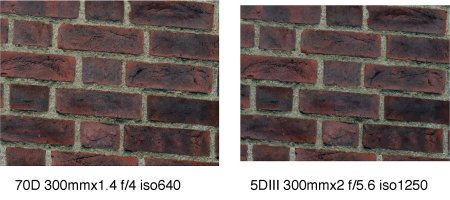
The answer will depend to a large extent on how sharp the bare lens is because the crops are very intolerant of soft lenses. So let's do this for really good lenses. The addition of a 1.4xTC will cause a small degradation of image but cut the light for a factor of 2 on the FF, compensating for the smaller pixels in the crop sensor. First is a photo (100%) crop of my favourite medieval brick chimney. The 300mm/2.8 II + 1.4xTC III on my 70D at iso640 is at least equal to my 300mm/2.8 II + 2xTC III on my 5D III at iso1250.

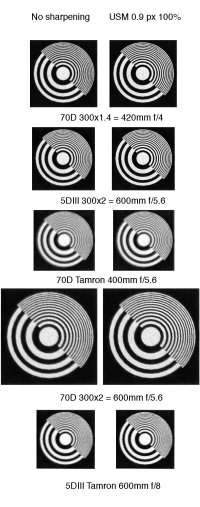
Below, are centre crops from the standard chart (printed out on rough photocopy paper). Again, The 300mm/2.8 II + 1.4xTC III on my 70D at iso640 is at least equal to my 300mm/2.8 II + 2xTC III on my 5D III at iso640.

Two further points. The 300mm/2.8 II + 2xTC III on my 70D has lost some IQ, and it is probably worth sticking to the 1.4xTC. The Tamron at 150-600mm at 400mm on the 70D is quite good and is much better than at 600mm on the 5DIII.

So, these tests have made up my mind for me. I am going to use the 100-400 II on a 70D or 7DII as my hiking/birding lens. I think that the new 400 DO II on the 7D II will be better than the 300/2.8 + 2xTC on the 5DIII for hiking/birding. Let's wait and see.
 

Attachments

  • 70D_420f4_5D_600_Annotated.jpg
    70D_420f4_5D_600_Annotated.jpg
    663.8 KB · Views: 267
  • Collage_420vs600_70D_5DIII.jpg
    Collage_420vs600_70D_5DIII.jpg
    289.7 KB · Views: 277
Looking at http://www.the-digital-picture.com/Comparisons/Canon-EOS-7D-Mark-II-ISO-Noise.aspx the 7D ii at 6400 (giving it a 1 stop start vs a 1.4x on FF) vs the 5DIII at 12800 looks comparable, with the 1Dx ahead.
 
Upvote 0
Thanks for this comparison, I’ve got similar results/observations.
Yes, these are great days for Canon crop user doing bird/nature photography. Not only 7d2 is available, but also some magnificent lenses. 55-250 STM for all small creatures and very big ones too close for my 500/4 L IS. Yet, for equal results on FF one need at least oldish 100-400 which is almost 10x that expensive. So no stress taking 55-250 STM into swamp, beach etc. And then there is also 10-18 STM for doing all the landscape work while in the terrain.
Of course FF is still valuable option for this kind of photography, especially in low light conditions. But it requires lenses that are much more expensive and much heavier.
 
Upvote 0
AlanF said:
So, these tests have made up my mind for me. I am going to use the 100-400 II on a 70D or 7DII as my hiking/birding lens. I think that the new 400 DO II on the 7D II will be better than the 300/2.8 + 2xTC on the 5DIII for hiking/birding.
Hi Alan,

This is exactly my opinion as well. I don`t have the 7D Mark II, which it looks to be a much better camera in low light than the original 7D and also with a superior AF. I think it is a better tool for bird and wildlife photography than a full frame camera.
I`m quite happy to see your "not yet another crop vs FF" test here:)

Thanks,
Nelu
 
Upvote 0
I am not saying the 7DII will be better than the FF for all bird photography but it does have advantages under particular circumstances, and wider circumstances than just "bright light". For example, the 7DII with a 400 DO II will be at least as good as a 5DIII with a 300/2.8 + 2xTC under most conditions, and weigh less. A 7DII (or 70D) with a 100-400 II at 400mm will be better than a Tamron 150-600 at 600mm on a 5DIII, and weigh less and be smaller. A 600mm II on a 5DIII or 1DX will be better than all of those for image quality - but it is too heavy for me as a hiking lens.
 
Upvote 0
Another totally irrelevant crop vs ff test. I thought these had died long ago with the 7D vs 5D II debate.
You are making the assumption that in camera firmware is the same and that sharpness set to 0 on one camera is the same as 0 on another.
It doesn't account for camera shake in the real world which can quickly negate any benefit of the smaller pixels.
Neither is the real world a flat wall and evenly lit.

These kind of tests oversell what you can really expect. If you want to find out what the real difference is set up the test in a real world situation with real world conditions. Outside with 3 dimensional subjects in real conditions that you normally shoot, processed to the best of your abilities.

Enough bashing your test, I would say so far I have found from testing mine that the 7D vs 5D II debate has narrowed since the old tests a few years back. The crop factor is closer and worth consideration but so far I am leaning toward the negatives of a crop sensor being to great. The biggest negative is the loss of light and high ISO noise, this translates in the real world to a slower shutter speed. Slower shutter speed translates in to additional camera shake.
 
Upvote 0
neuroanatomist said:
Since the 600 II isn't too heavy for me, I'll stick with the 1D X and 600 II as a hiking/birding combo. :)

Well:

1dx+600ii = $16k on a good day?

7dmkii+100-400= $4k.

So the costly combo is atleast 4x the cost of the more practical option, does it truly get one 4x the sales? 4x the results?

I'd LOVE to see some tax returns for those that actually do nature photography as a business. Not a "hobby." I'm curious how one affords the above combo yet still has enough in savings/retirement for when the economy implodes again. I suppose on the other hand, one can unload the costly combo and recover 90% of the cost, so it's a calculated risk in having that much money into camera gear.

I'm going for the cheaper combo even though I have the money for a 1dx+600ii, I just don't see how it's a fiscally responsible decision for 99% of the people that are not making a dime doing this as a "hobby."

There's the other part: Theft/Attention/Where do you get insurance on that kind of gear if you're just doing this as a "hobby."

Last question. For those that are actually doing this professionally as their sole source of income: How many of your customers have returned prints because they were not sharp enough?


Back to topic: Thanks for taking the time/effort to post your results!!!! We all owe you beer.

I've had the same results as you. The 5dmkiii + Tamron is a decent combo, but surprisingly, the 70-300L on my 70d nets MUCH better results for BIF/Moving objects than the Tamron regardless of the lighting. The Tamron is a great gateway lens, but it's also an exercise in frustration if you actually want interesting backrounds to your bird photos. It's fine for non moving objects however. Virtually any lens can get decent results if you like boring blue sky backrounds. ugh.

I'm going to give the 70d+100-400ii a shot, and then decide if it's worth going to the 7dmkii. The only issue with the 70d is the buffer. So one has to be more judicial for BIF sequences.
 
Upvote 0
takesome1 said:
Another totally irrelevant crop vs ff test. I thought these had died long ago with the 7D vs 5D II debate.
You are making the assumption that in camera firmware is the same and that sharpness set to 0 on one camera is the same as 0 on another.
It doesn't account for camera shake in the real world which can quickly negate any benefit of the smaller pixels.
Neither is the real world a flat wall and evenly lit.

These kind of tests oversell what you can really expect. If you want to find out what the real difference is set up the test in a real world situation with real world conditions. Outside with 3 dimensional subjects in real conditions that you normally shoot, processed to the best of your abilities.

Enough bashing your test, I would say so far I have found from testing mine that the 7D vs 5D II debate has narrowed since the old tests a few years back. The crop factor is closer and worth consideration but so far I am leaning toward the negatives of a crop sensor being to great. The biggest negative is the loss of light and high ISO noise, this translates in the real world to a slower shutter speed. Slower shutter speed translates in to additional camera shake.

Your comments are the totally irrelevant contribution.
1. They were taken in RAW with no in-camera sharpening or noise reduction, and your comments about assumptions about camera firmware are out of place.
2. The focal lengths used with crop are 1.4 x shorter than on the FF so the effects of shake are the same on both.

I have also done similar tests with real birds in real situations with the same results. As someone else wrote, you test under controlled conditions and use what you have learned from those in the field. If you ignore such tests, then the loss is yours.
 
Upvote 0
markesc said:
1dx+600ii = $16k on a good day?

7dmkii+100-400= $4k.

That supports a point that I make frequently...the main 'crop factor advantage' is lower cost.


markesc said:
I'm going for the cheaper combo even though I have the money for a 1dx+600ii, I just don't see how it's a fiscally responsible decision for 99% of the people that are not making a dime doing this as a "hobby."

Not really your call to make for anyone but yourself. For some people, a 600 II represents months of gross income, and buying one requires use of credit (and paying interest). For others, a 600 II represents a few days' worth of consulting income, without touching the paycheck from the day job, and they can walk into B&H and pay cash for it.


markesc said:
There's the other part: Theft/Attention/Where do you get insurance on that kind of gear if you're just doing this as a "hobby."

That's the easy part. Insurance for photo gear used for business purposes is more expensive and offered by fewer insurers. For 'hobby' gear, almost every issuer of homeowners'/renters' insurance offers coverage for items that exceed standard limits (jewelry, fine art, electronics, etc.). I pay $7.60/year per $1000 of covered photo gear, no deductible, full replacement coverage for theft/loss/damage worldwide.
 
Upvote 0
It would be interesting to compare your 1DX + 600/4 II + 1.4xTC with the 7DII + 600/4 II. A pity TDP is still using the softer 60D as the crop. The competition is getting hotter now.
 
Upvote 0
Excellent test..Thanks.
Confirms the same for me, a crop sensor 7Dmk2 with like for like lens gives me the much needed reach. Also, this 7Dmk2 vs 5D3 baffles me... It's like comparing a two seater roadster with a SUV. A better comparison would have been with the 1DX, however, the price comes into play. Similar to the difference between a mid level Ford and top rank BMW.
From my perspective..I would take the lightest body and smallest/lightest lens combo possible for wildlife and in particular BIF. CANON make great telephoto lenses and the 1.4 always gives superior IQ over the 2X.
 
Upvote 0
I think that it depends on how you use the lens/camera combo. If you handhold most of the time, lightweight is good, especially if you don't have image stabilization. I currently shoot with 60D and 400mm f/5.6L no-IS (camera 0.8 kg/ 1.7 pounds, lens 1.25 kg/ 3.7 pounds), and I do like handheld panning of BIF, and I am not particularly strong. I suppose shooting handheld with the non-IS 400mm lens has made me learn some technique that will serve me in good stead. I was in the local camera store recently, saw a clean used EF 600 f/4 L USM (no IS), circa 1988, 13 pounds - I stared at it and its reasonable price tag and its enormous front element, but that is a lens solely for use on a tripod, and that's not how I like to work. 85% handheld, 10% monopod, 5% tripod is my current pattern. The 500 f/4 L IS II weighs about half of that dinosaur, and that is a reasonably handholdable lens. So, for now the upgrade is the 7D2 sometime soon, and then in the spring arrange a rental of the 500 f/4 L IS II and maybe the 600 f/4 L IS II (plus upgrade my Custom Brackets Basic Gimbal to a full gimbal, because sometimes I do use a tripod, and I suspect that I would be using one 25% to 35% of the time with a heavy supertelephoto. After a trial of each, then I will decide if a supertelephoto is in my future.
 
Upvote 0
AlanF said:
takesome1 said:
Another totally irrelevant crop vs ff test. I thought these had died long ago with the 7D vs 5D II debate.
You are making the assumption that in camera firmware is the same and that sharpness set to 0 on one camera is the same as 0 on another.
It doesn't account for camera shake in the real world which can quickly negate any benefit of the smaller pixels.
Neither is the real world a flat wall and evenly lit.

These kind of tests oversell what you can really expect. If you want to find out what the real difference is set up the test in a real world situation with real world conditions. Outside with 3 dimensional subjects in real conditions that you normally shoot, processed to the best of your abilities.

Enough bashing your test, I would say so far I have found from testing mine that the 7D vs 5D II debate has narrowed since the old tests a few years back. The crop factor is closer and worth consideration but so far I am leaning toward the negatives of a crop sensor being to great. The biggest negative is the loss of light and high ISO noise, this translates in the real world to a slower shutter speed. Slower shutter speed translates in to additional camera shake.

Your comments are the totally irrelevant contribution.
1. They were taken in RAW with no in-camera sharpening or noise reduction, and your comments about assumptions about camera firmware are out of place.
2. The focal lengths used with crop are 1.4 x shorter than on the FF so the effects of shake are the same on both.

I have also done similar tests with real birds in real situations with the same results. As someone else wrote, you test under controlled conditions and use what you have learned from those in the field. If you ignore such tests, then the loss is yours.

Here is what I would do, ignore the test that does not matter, do not make buying decisions based on those tests.
Test like this might give you an idea but real world testing tells you what the finished product will be like. That is what matters in the end.


RAW files I can sharpen the 5D II places to a greater degree than the 7D II. The 7D II isn't taking as much sharpening as the old 7D files. Not all files are created equal. A good test would have been to sharpen your tests to the degree you normally do and then compare. Not set it at 0. Not all files are created equal. If they were we wouldn't have had to wait two weeks for LR to update for the 7D II.

In my field testing so far I would estimate the crop advantage at about 1.2x. It disappears in low light conditions and not using a tripod.

In the end result though I think your combinations are good;


So, these tests have made up my mind for me. I am going to use the 100-400 II on a 70D or 7DII as my hiking/birding lens. I think that the new 400 DO II on the 7D II will be better than the 300/2.8 + 2xTC on the 5DIII for hiking/birding. Let's wait and see.

Looking at the mtf charts the 400 DO II may make an excellent walk around hiking combination. I have never been a fan of any 2xTC combination.
 
Upvote 0
Thanks for this comparison, AlanF. I like comparisons that make me feel good about my 70D and don't start me dreaming about getting a 5DIII ;)

One question, though. You wrote that the Tamron at 400mm on the 70D is quite good and better than the same lens at 600mm on the 5D. I agree that the 70D at 400 looks better than on the 5D (I didn't see the difference at first looking at this on an iPad, but on a bigger screen I do see the difference). They both look quite a bit softer than any of the other shots, though. I know the Tamron isn't going to be as good as the 300, but even with the 2x converter the 300 looks significantly better. What does the difference look like in a real world situation? Do you have any bird shot comparisons between the Tamron on the 70D and the 300 with TC on the 5D?

Maybe I was expecting too much from the Tamron from all the praise it has received.
 
Upvote 0
AlanF said:
So, these tests have made up my mind for me. I am going to use the 100-400 II on a 70D or 7DII as my hiking/birding lens.

Thanks for the post, Alan. I have a 5D3, 7D2 (formerly a 70D), and 300 2.8 II. My own experience agrees with your testing. I love the 5D3/300 when I can fill its frame. For me, that's typically flights of historical airplanes. The 5D3 is also great for landscapes, grandkids, architecture, etc. Image quality is better than the 70D or 7D2 whenever you can fill the 5D3 frame.

However, for birds and wildlife, I almost always have the 300 + 2x III on my crop body. Even then, I'm often cropping away up to 50% of the photo to get the image I took. The 5D3 just can't get enough pixels on the subject to get a decent photo when the subject is some distance away.

I do have the 100-400 II on order at my local camera store, and I should get it on Friday. I've been playing with my old 100-400 with the 1.4 III extender. Auto-focusing on the 7D2 works well, and I expect the 100-400 II to do even better. I'm really looking forward to comparing the 300 + 2x and the 100-400 + 1.4x. I'm hoping that the 7D2 + 100-400 II (and sometimes with the 1.4 III) will give me image quality that's pretty close to the 300 + 2x III.

BTW - with regards to image quality, the current 100-400 + 1.4x III does not compare favorably with the 300 + 2x III. The new 100-400 needs to be significantly improved from the current 100-400. I'm expecting that the improvement will be there.

Regards, Jim
 
Upvote 0
GraFax said:
Regarding the big primes, I can count on one hand the number of times I have seen a photographer shooting with a 500/600mm prime lens more than a mile from their car in the last year. People say they do it, and some actually do, but it really raises the bar for getting out in the field. 95% of the time that I see someone shooting with a big prime, they are less than 50 ft from their car.

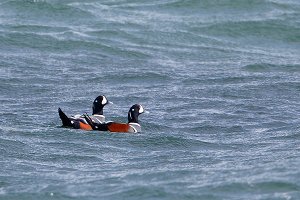
Ok, this was probably a bit less than a mile from my car as the crow flies (or seagull, in this case), at Sachuset Point NWR in Rhode Island just before Thanksgiving. The handheld shot with the 600 II + 1.4xIII was taken during a hike of 2.7 miles (along a pair of loop trails in a 'figure-eight' with the parking lot at the center), followed by scrambling down ~40' of wet rocks to get down to sea level. Not a good image, but it was a pretty windy day (>20 mph sustained) so the only things in the air were gulls and a lone harrier too far away.

Most of my spring/summer/fall shooting with the 600 II is done while walking/hiking distances of 2-10 miles, handheld or on a monopod if I'm stopping for a while. OTOH, during the winter months when I'm shooting raptors, I'm usually set up on a tripod/gimbal within 200' of the car.
 

Attachments

  • Harquelins.jpg
    Harquelins.jpg
    311.2 KB · Views: 1,574
Upvote 0
neuroanatomist said:
GraFax said:
Regarding the big primes, I can count on one hand the number of times I have seen a photographer shooting with a 500/600mm prime lens more than a mile from their car in the last year. People say they do it, and some actually do, but it really raises the bar for getting out in the field. 95% of the time that I see someone shooting with a big prime, they are less than 50 ft from their car.

Ok, this was probably a bit less than a mile from my car as the crow flies (or seagull, in this case), at Sachuset Point NWR in Rhode Island just before Thanksgiving. The handheld shot with the 600 II + 1.4xIII was taken during a hike of 2.7 miles (along a pair of loop trails in a 'figure-eight' with the parking lot at the center), followed by scrambling down ~40' of wet rocks to get down to sea level. Not a good image, but it was a pretty windy day (>20 mph sustained) so the only things in the air were gulls and a lone harrier too far away.

Most of my spring/summer/fall shooting with the 600 II is done while walking/hiking distances of 2-10 miles, handheld or on a monopod if I'm stopping for a while. OTOH, during the winter months when I'm shooting raptors, I'm usually set up on a tripod/gimbal within 200' of the car.

Unless you had a mirror Neuro you most likely didn't see a photographer with a big tele on your hike either.

Seriously though I have never seen one of the lenses on the trail either, except for the one I carry. I have always written this off to how rare these lenses are.
 
Upvote 0