A hypothesis concerning the RF mount

I completely understand your point, but in ten years, when most (?) people will have moved to mirrorless (imo), how will people react when they see the limitations of that retro-compatibility? Will people now criticize Canon for that decision?
I'm guessing Canon won't reinvent a completely new mount in just 10 years right?

I'm nowhere near an expert on the subject so keep in mind I'm just speculating here. But I think it's a mistake to limit the future because of the current/past. If Canon keeps that flange distance on their new mount, then every mirrorless camera in the next 20-30 years will be bigger for no reason.
[EDIT] I know size is not the only advantage of mirrorless but for many people, it is one important aspect.
I mean people weren't exactly shitting on Nikon for keeping the F Mount when Canon introduced the EF mount back in the days so it might be a similar scenario here. Plus the oh so new and innovative Z mount is pretty close to the EF mount. Fully electronic communication and just one mm more diameter for the Z mount. Seems like the EF mount was already p mirrorless-ready back in the days.
I think all of this comes down to some lens design changes for any RF (or EF-R?) lenses making them incompatible / unusable for normal EF cameras.
 
Upvote 0
So is it safe to say that EOS M was never intended to be developed into a full frame, pro-level system?

The major design focus for EOS M is small size and light weight. All the lenses have a diameter of 60.9 mm. It will be interesting to see if the 32 1.4 will also squeeze into that design parameter. It would be extremely surprising if the EF-M mount were used for a full -frame camera. Sony did something like that and it costs them dearly in design flexibility.
 
  • Like
Reactions: 1 user
Upvote 0
Someone came up with an idea, and someone else a graphic to illustrate it, of EF fitting normally and RF lenses having the rear element/s protruding into the camera body.

This way you retain 100% adaptor-less compatibility with EF lenses and RF lenses can still benefit from getting closer to the sensor & have a small(er) camera+lens size.

I don't know enough to have any idea whether this will restrict potential designs for RF lenses.

So far this idea makes the most sense and doesn't require removable mounts/adapters or a moving sensor. The EF mount is already as wide as it needs to be (54mm) so no need for Canon to make the RF mount any wider.
 
  • Like
Reactions: 1 user
Upvote 0
I would consider it a mistake if Canon doesn't shorten the flange distance in its new mount.

Why? As a practical matter Sony FF is as large as DSLR FF. Yes, yes, the bodies are a bit smaller but add a lens and you're within a few mm's/ounces of a professional DSLR setup.

Everyone assumes a shorter flange distance will equal great gains in size and weight. That has not happened.
 
Upvote 0
Why? As a practical matter Sony FF is as large as DSLR FF. Yes, yes, the bodies are a bit smaller but add a lens and you're within a few mm's/ounces of a professional DSLR setup.

Everyone assumes a shorter flange distance will equal great gains in size and weight. That has not happened.
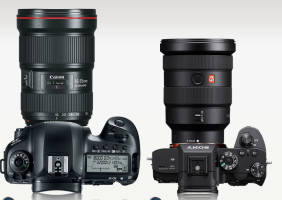
For most lenses that's true, but for some combinations there are opportunities to reduce size. The opportunities for savings appear mostly in wide angle lenses. This is the 16-35 f/2.8iii vs the 16-35 f/2.8 G master on a 5DIV and a7Riii:
Screen Shot 2018-08-30 at 2.22.32 PM.png
 
Upvote 0
[EDIT] I know size is not the only advantage of mirrorless but for many people, it is one important aspect.


This. We have to have a smaller camera option or a chunk of the market will laugh us away without a second thought.

I also prefer a full EF solution. But if that's all we offered we'd only delight some pros + some of the enthusiast community. The remainder of those groups and tons of the new generation of photographers, investors, etc. would regard full EF mirrorless -- as practical as it might be -- as a relic.

We must go thin.

We ought to go full EF.

Canon is big enough to do both.

- A
 
Last edited:
  • Like
Reactions: 1 user
Upvote 0
Why? As a practical matter Sony FF is as large as DSLR FF. Yes, yes, the bodies are a bit smaller but add a lens and you're within a few mm's/ounces of a professional DSLR setup.

Everyone assumes a shorter flange distance will equal great gains in size and weight. That has not happened.


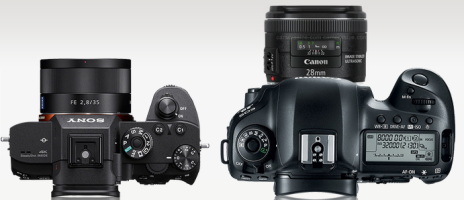
Small sells when it looks like this:

Screen Shot 2018-08-28 at 1.50.13 PM.png

Yes, this only applies to a handful of lenses, which is all Canon should make with the thin mount.

Make a thin mount offering and a full EF mount offering. Offer 4-6 lenses (f/2.8 primes, f/4 zooms and a pancake or two) for the thin mount and then put it on mothballs.

Viva EF for the proper flagship lens portfolio. No split loyalties/budgets/priorities to two FF mounts.

- A
 
Last edited:
  • Like
Reactions: 1 user
Upvote 0
that would be so typical "innovative Canon". Pig-snouted RF mirrorless cameras with a new mount, but cameras and lenses just as big and fat as mirrorslappers.

As if additional communications protocol stuff could not also be piped through existing EF glass electrical pins.
 
  • Like
Reactions: 1 user
Upvote 0
Something akin to (from the body - SPI master - point of view):
1. Detect that a lens is connected.
2. Start communicating on a default SPI clock rate (supported by all EF lenses).
3. If the lens reports that it supports a higher SPI clock rate, use a higher SPI clock rate.

Really nothing that would warrant changing the mount name.


Or size. Ooh, I worry about this. They could put out a full EF geometry/flange distance/ring/etc. but newer lenses can do newer things on that same mount.

Makes me worry about 10 years from now and EF is starting to look like Nikon F mount -- fragmentation of a system in which every physically connects together but functionality is conditional depending upon fine print, compatibility, etc. Right now, the first time you do something like this, you sell the upsides of the new lens on new body and stress [new on old] and [old on new] is fine.

Do this 2-3 times and then a new feature drops that you can only use if you have [insert conditions here] and it feels like a slow road to F mount confusion.

Am I being a cranky old fart here? Am I reading this wrong? Talk me down, please.

- A
 
  • Like
Reactions: 1 user
Upvote 0
Canon has every reason to do this.

Mount adapters are a weak point and introduce more problems then they solve. Light leakage, structural mounting for larger lenses, wear, etc.

The biggest advantage to doing this is allowing future bodies to adapt Cine lenses that protrude into the body. Canon could make one camera that adapts all their lenses without an adapter while locking out their competition from doing so. This is ultimately what you need to do to transition over the next 5 years from a mirror box depth while keeping your promise of long term lens usage going back to 1987. This is about customer commitment and finding a solution to a problem all the camera makers face.

EOS R = EOS Revolution
 
  • Like
Reactions: 1 users
Upvote 0
We're four pages deep in a frenzy right now over tea leaves, speculation and what ifs.

Mount rumors are the bug zapper and we (gleefully) keep flying right into it.

If 9/5 turns out to just be the M5 Mark II, some people's hearts will give out.

- A
 
  • Like
Reactions: 1 users
Upvote 0
Exactly. However, I feel like both Sony and now Nikon are still living off the fascination about the size of the first generation A7 cameras. The third generation A7 cameras as well as the Z6/7 are significantly beefier than the first gen A7 cameras (which had abysmal battery life and - at best - mediocre ergonomics). So while a thin camera body is nice in theory, recent camera models show that too thin isn't ideal either. Especially if you want to have a nicely sized grip, you're not gonna get a tiny camera.

And if you're powering an EVF and/or backscreen all the time and you want decent battery life, you NEED a heftier battery and hence a heftier grip.
 
Upvote 0
Also, everyone should probably bookmark this, because (with all due respect to CR Guy and a wonderful site) this is where the definitive proof will drop in the form of pictures.

I am not expecting a teaser campaign. It will go from fever pitch on rumors to BANG and then we'll have photos.

Of course, keep coming here. :) CR Guy will get the goods on the spec list and all that.

- A
 
Upvote 0
And if you're powering an EVF and/or backscreen all the time and you want decent battery life, you NEED a heftier battery and hence a heftier grip.


+1 Put a proper 5D-sized chunkomatic grip on this thing. You get more battery, great comfort, top LCD, all the buttons and controls and control wheel, etc. and it conveniently gives you more real estate for a bigger battery.

- A
 
  • Like
Reactions: 1 users
Upvote 0
I have the old FD cameras.
The FTb (F-1 and others also) is quite thin as far as the body goes yet is a FF camera with a mirror. Where the lens mounts the body extends a bit allowing for clearance of the mirror. Could a similar solution work for the RF series cameras? Native EF mount on a body with a bit thicker area where the lens mounts with RF lenses as needed protruding into the space between the mount and sensor. Thus a perceived smaller camera and some lenses extending less overall (Generally WA lenses) and long lenses don't need to staying the same.
For all we know the new 70-200 f2.8 and other very new lenses have the RF protocol in them and that is why they appeared to have no significant visible changes.
 
  • Like
Reactions: 1 users
Upvote 0
The more I think about this potential launch next week, the less I believe it.

When major products are launched, isn't it usually a big presentation by executives/engineers in front of an audience (in the case of cameras: photographers, reviewers, media, etc.)?

If there were an announcement next week for a major product like a FF mirrorless, surely the invitees of said launch event would already be invited and therefore be able to confirm the existence of the major event. Yet we hear nothing but subtle hints and speculation from unknown sources.

Just seems hard to believe. Nevertheless, I would love for it to be true.
 
Upvote 0
every mirrorless camera in the next 20-30 years will be bigger for no reason.

Well not no reason: plenty of people have expressed a desire to keep current ergonomics. FF lenses will mostly not be any smaller even with a new mount. Why introduce a new mount just for a small advantage for a few lenses? Nikon had their own reasons fo doing so, I believe...
 
Upvote 0