AA filter in the 5D mark IV

Michael Clark said:
On a typical Bayer pattern the Nyquist frequency of green is half the width of the Nyquist frequency of Red and Blue because Every 2nd sensel in each direction is green whereas only every 4th sensel in each direction is Red or Blue. After demosaicing the absolute resolution limit of a typical regular Bayer sensor works out to about 1.414x (√2) the pixel pitch.

So if you are going to photograph a woman wearing a shawl make sure it is not a green one ? :o
 
Upvote 0
neuroanatomist said:
Maiaibing said:
If you use the link above to dpreview you can download and /or check out the difference of the visible lines between the 5DIV and 5DS/R. It is - extremely - easy to see that the 5DS/R has much more detail than the 5DIV. You can simply see the lines along he ruler the whole way up to 50 while the lines blur to extinction already around the 38 mark on the 5DIV test photo.

I was quite surprised that the difference was so big and it seems accurate to say that the extra MPIX and no AA filter gives the 5DS/R a 50% advantage over the 5DIV.

Yes, the lack of an AA filter results in sharper images, if you compare ± AA filter with no sharpening or with the same amount of sharpening. However, you cannot apply much sharpening to an image from an AA-less camera before you start to see sharpening artifacts, whereas you can apply substantially more sharpening to the AA-filtered image. So in practice (i.e. where you appropriately post-process your images), although the lack of an AA filter will result in sharper images, the difference is no where near what the typical (somewhat misleading) comparisons show.

Of course, that applies when you're only looking at the effect of an AA filter. Comparing the 5DIV to the 5Ds, you'd see a significant advantage for the latter due to the extra resolution, with only a minor bump when going to the 5DsR (and assuming your image has no moiré). Also, there's a caveat about judging fine details on DPR's comparator at the present time, and they indicate that by coloring the little 'i' (information) icon yellow for the 5DIV images – they're processed using a beta version of ACR, and while Adobe has time to make the software read the images, they likely have not optimized it for that particular sensor (which is why it's a beta version). Kudos to DPR for calling that out with the icon color...yellow = caution.
Would have preferred to see them use something like Image Engineering CIPA TE252 High Resolution Test Chart using a LE7 light source or similar and analysis software. Minimising subjectivity is the best way to derive consistent testing that my view.
 
Upvote 0
neuroanatomist said:
East Wind Photography said:
neuroanatomist said:
midluk said:
East Wind Photography said:
It will be stronger due to the increase in pixel density. Every incremental increase in resolution requires a bit stronger AA filter.
Isn't the AA filter supposed to make the image satisfy the Nyquist–Shannon sampling theorem?
From this I would deduce that the AA filter strength should be proportional to the pixel pitch and therefore higher resolution requires a weaker AA filter.

True – East Wind Photography is incorrect.

Please share some links so we can better understand. Higher pixel pitch should produce more moire on finer detail and therefore a higher degree of aa is required. However, I'm not afraid to stand corrected. Just trying to understand the reason for the opposite.

Incremental increases in sensor resolution have pretty consistently caused a loss of sharpness. Resolution does increase detail but the two are different.

I haven't run across anything that delves into clear detail about the 'strength' of an AA filter, but maybe it's confusion about semantics?

An AA filter essentially spreads the incoming light (introduces blur), and the amount of that spread is proportional to the pixel pitch. So, as pixel pitch gets smaller (more MP for the same size sensor), the amount of blur that the AA filter needs to introduce to counteract aliasing also gets smaller. I think convention would say that a filter that introduces less blur is a weaker filter.

What an AA filter does is to add blur to prevent the aliasing (e.g. moiré) caused by repeating patterns in a subject where the periodicity is approximately half that of the pixel pitch or higher (Nyquist limit). Incidentally, that's why the AA filter is also called an optical low pass filter (OLPF) – it allows frequencies lower than the cutoff to pass, while blocking (blurring out, in this case) higher frequencies. For example, if a sensor's pixel pitch is 6 µm (the 5DIII is close), then patterns that repeat every 3 µm would be at the Nyquist frequency, patterns repeating every 4 µm would be lower than the Nyquist frequency, and patterns repeating every 2µm would be above it. It's the 'at or above' that the filter is designed to reduce/eliminate.

But it's a bit more complex than that, for two reasons. The first is that lenses aren't perfect. As pixel pitch decreases, eventually the blur introduced by the optics will reduce and potentially obviate the need for an AA filter. If you use crappy lenses, you won't have to complain about moiré. ;) The second (and for now, more important) reason is that manufacturers make choices regarding the strength of the AA filter – it's not simply 'set it equal to the Nyquist limit for the sensor' and be done.

There are plenty of examples of moiré in images from cameras with an OLPF, I know I've seen it in bird feathers and buildings with my 1D X. Also, moiré is more evident in video than in still photography – that's because it's not just the frequencies of the patterns, it's also the alignment of the patterns in the subject with the pixel array on the sensor. For example, if you take two shots of the same brick wall (same camera, lens, etc.) but move the camera 1 cm to the left, you may see moiré in one image but not the other. But if you're panning a video across that brick wall, you will see the moiré at some point in the footage.

So, if you're a camera maker you need to decide – do you make the AA filter stronger (set the cutoff lower than the Nyquist frequency for the sensor). If you do that, you will reduce moiré in both stills and video, and if you make it strong enough, you can make pretty darn sure that none of your users see moiré. But as you make the AA filter stronger, you introduce more blur, and that means softer images. Granted, the softness introduced by an AA filter is very amenable to sharpening, but that can have undesirable consequences too (accentuates noise, but you can do NR, but that softens the image again, etc.). Or, you can make the filter weaker (less blur) – or eliminate it entirely – which means a sharper native image but a higher propensity to show aliasing.

There's also a third reason, concerning your statement that, "Incremental increases in sensor resolution have pretty consistently caused a loss of sharpness." That's partly down to technique and camera build. With a lower resolution sensor, a given amount of camera shake (from any source, including mirror/shutter vibration) or subject motion might fall above the Nyquist frequency of the sensor. So for the 5DIII's 6 µm pixel pitch, if the camera is vibrating at an amplitude of 2.5 µm, you would not see any shake-induced blur. But if you switch to a 5Ds with a 4 µm pixel pitch, now that same amount of shake is below the the Nyquist limit, and you'll see the effect.

This discussion is very interesting for me, I'm an early adopter of the 5D MkIII and D800 and now I am on the fence since I would really like to have a body without AA filter but the 5DSR eems to have the old chip tech with off-chip ADC converter while the 5DmarkIV seems very promising about this aspect.
Anyway, for what I know, there's a small misunderstanding about the Nyquist theorem in this reasoning, especially when you say "What an AA filter does is to add blur to prevent the aliasing (e.g. moiré) caused by repeating patterns in a subject where the periodicity is approximately half that of the pixel pitch or higher (Nyquist limit). Incidentally, that's why the AA filter is also called an optical low pass filter (OLPF) – it allows frequencies lower than the cutoff to pass, while blocking (blurring out, in this case) higher frequencies. For example, if a sensor's pixel pitch is 6 µm (the 5DIII is close), then patterns that repeat every 3 µm would be at the Nyquist frequency, patterns repeating every 4 µm would be lower than the Nyquist frequency, and patterns repeating every 2µm would be above it. It's the 'at or above' that the filter is designed to reduce/eliminate."
Actually I understand that the patterns that will be unable to be correctly represented will be all those with a wavelength (i.e. a spatial repeating pattern) less than DOUBLE of that of the sampling spatial distance.
To put things as simple as possible referring to your example above, with a pixel pitch of 6µm it will be feasible to represent a pattern whose "wavelength" or repeating distance is 12µm or bigger. Every pattern that repeats on the sensor in less than 12µm will cause aliasin. Obviously all this reasoning is correct if we consider only one color at time, for the RGB pattern the reasoning has to be slightly modified as someone has already pointed out.
 
Upvote 0
Act444 said:
Not sure 100%, but judging from the samples DPR posted, there certainly appears to be a filter - perhaps even slightly stronger(?) than the one in the 5D3...

https://www.dpreview.com/reviews/image-comparison?attr18=daylight&attr13_0=canon_eos5dmkiv&attr13_1=canon_eos5dmkiii&attr13_2=canon_eos5dsr&attr13_3=canon_eos5ds&attr15_0=raw&attr15_1=raw&attr15_2=raw&attr15_3=raw&attr16_0=800&attr16_1=800&attr16_2=800&attr16_3=800&attr171_3=off&normalization=full&widget=1&x=0.4848647313366422&y=1.0164753417379968
Interesting. Thannks for sharing. I have checked it before, but just right now on this card I noticed the color shift.

Is it possible that the sharpness here is lost due to lack of contrast? Could it be due to better DR?

I can see there's a color shift for certain, because I write this on a calibrated monitor. And yet the above crossed my mind...
 
Upvote 0
Diko said:
Act444 said:
Not sure 100%, but judging from the samples DPR posted, there certainly appears to be a filter - perhaps even slightly stronger(?) than the one in the 5D3...

https://www.dpreview.com/reviews/image-comparison?attr18=daylight&attr13_0=canon_eos5dmkiv&attr13_1=canon_eos5dmkiii&attr13_2=canon_eos5dsr&attr13_3=canon_eos5ds&attr15_0=raw&attr15_1=raw&attr15_2=raw&attr15_3=raw&attr16_0=800&attr16_1=800&attr16_2=800&attr16_3=800&attr171_3=off&normalization=full&widget=1&x=0.4848647313366422&y=1.0164753417379968
Interesting. Thannks for sharing. I have checked it before, but just right now on this card I noticed the color shift.

Is it possible that the sharpness here is lost due to lack of contrast? Could it be due to better DR?

I can see there's a color shift for certain, because I write this on a calibrated monitor. And yet the above crossed my mind...

Most likely, it's due to the fact that they are using a beta version of Adobe software for the 5DIV images, which is not yet properly optimized for that sensor.
 
Upvote 0
neuroanatomist said:
Most likely, it's due to the fact that they are using a beta version of Adobe software for the 5DIV images, which is not yet properly optimized for that sensor.
Can you imagine?

All we have seen could be THAT buggy?!? Not to be excluded as a possibility. Let's hope for the best.

However I just saw this (again not for the first time) and in correlation to what we talked so far....

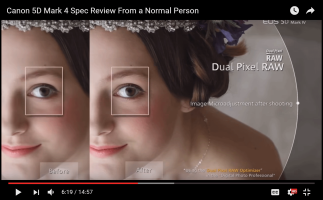
Could it be that the blurry-ness is not due to AA filter, but actually comes from the new DPRAW?
 

Attachments

  • 5d4.png
    5d4.png
    561.1 KB · Views: 163
Upvote 0
Diko said:
neuroanatomist said:
Most likely, it's due to the fact that they are using a beta version of Adobe software for the 5DIV images, which is not yet properly optimized for that sensor.
Can you imagine?

All we have seen could be THAT buggy?!? Not to be excluded as a possibility. Let's hope for the best.

However I just saw this (again not for the first time) and in correlation to what we talked so far....

Could it be that the blurry-ness comes from the new DPRAW?

I can easily imagine it, because that's exactly what happened with the 80D. At L east DPR highlights it by coloring the info button yellow, and they go back and reprocess the images with the actual release version once it's available.

It's not due to dual pixel RAW, because those files can only be processed using Canon's DPP.
 
Upvote 0
neuroanatomist said:
It's not due to dual pixel RAW, because those files can only be processed using Canon's DPP.

I don't reject the other theory. But the screenshot you see is from a promotional video processed with a beta version of DPP (true), and yet one of DPRAW main features so far is exactly, perhaps selecting the better shot or readjusting the focus thanks to shifting the DoF....

What I say is: don't dismiss DPRAW theory so fast. Will wait and see, of course ;-) It could be either a bug in DPP or even firmware, or it could be "a bug that is a feature" ;-)

Of course a third option is the stupid AA filter.
 
Upvote 0
Diko said:
neuroanatomist said:
It's not due to dual pixel RAW, because those files can only be processed using Canon's DPP.

I don't reject the other theory. But the screenshot you see is from a promotional video processed with a beta version of DPP (true), and yet one of DPRAW main features so far is exactly, perhaps selecting the better shot or readjusting the focus thanks to shifting the DoF....

What I say is: don't dismiss DPRAW theory so fast. Will wait and see, of course ;-) It could be either a bug in DPP or even firmware, or it could be "a bug that is a feature" ;-)

Of course a third option is the stupid AA filter.

To clarify, I was referring to the previous response where you quoted the link to the DPR comparison tool. For their comparison tool, they use Adobe Camera RAW to process images and so far, only DPP supports DPRAW images (Adobe has said they're working on it, though). Since the decision to use DPRAW has to be made before capture, the images for DPR's comparison tool would have to have been captured as regular RAW images, not DPRAW images...so DPRAW is not the explanation for 'softness' with the 5DIV in DPR's comparison tool.
 
Upvote 0
The 5D4 image RAWs also appeared soft in DPP 4.5 once I updated and was able to bring them in, not a whole lot better than what was on DPR to begin with. Not sure what is going on other than what I've speculated earlier. However, I'm positive the cause is not DPRAW as these are normal Raw files.

People should be getting this camera in their hands soon, so I expect a lot more follow-up re. this topic.
 
Upvote 0