Lot's of good info here. I'm going to pipe in here because this is by far one of favourite topics.
Light is simple physics which all products are governed by and there is nothing anyone can do about it. Light is energy which are called photons. This I think is the first most important thing for people new to flash to learn. Light travels in strait lines. There is no way of bending light to curve it around an object to reduce shadows, even if it is as small as persons nose.
I'm going to use a little off the wall explanation. Think of light photons as salt granules. We have a light bulb full of salt. If the light bulb explodes the granules are sent hurling in all directions. Same thing happens when we turn on a light bulb. Remember that the photons from the light bulb travel in a strait line. We may not be able to bend light but we can deflect it off a surface and send it in a different direction.
Second most important thing to learn. Creating soft light is all about the size and distance of the light source to your subject. Again this is physics and there is nothing we can do about it.
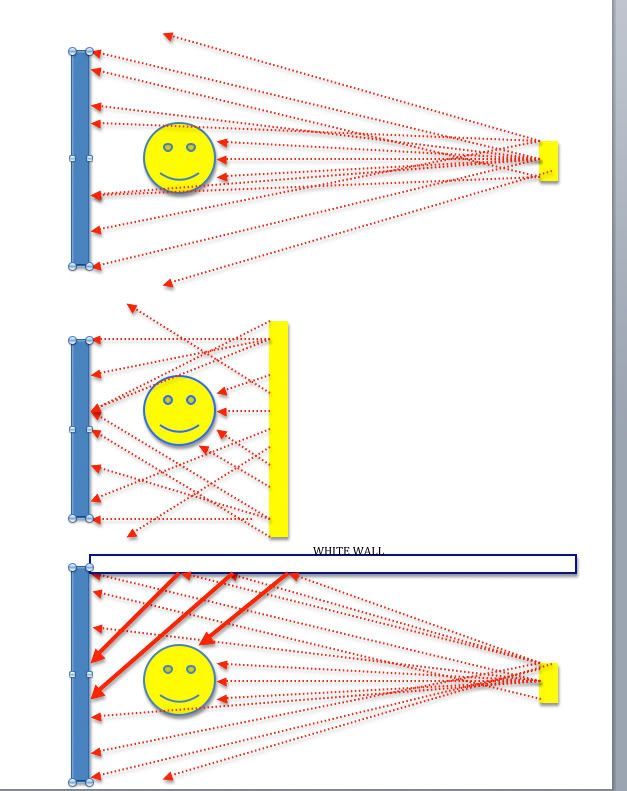
Here we are using a 2' by 4' softbox. In the first illustration we moved it 50 feet away from the subject. Now I know a strobe, etc will not have the power to do anything from that distance but just go with it for this demo. I can draw lines from the light source all day and not be able to get light around the head to eliminate shadows on the wall.
In the second illustration we moved the softbox so it is 5 feet from the subject. Now light from the outer edges of the softbox can eliminate the shadows behind the head.
The third illustration is just about bouncing light.
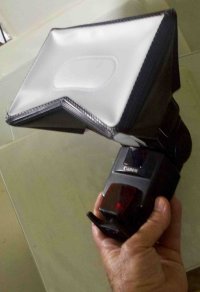
The lightsphere, Sto-fen and other such devices are bounce adaptors. They need surfaces to bounce light off surfaces and objects to be completely effective. It is what they were designed to do. They do a great job in a 10 by 10 by 10 room painted white. I would argue I can do just as well bouncing my flash of those walls. This is why I don't consider them as diffusers as compared to an umbrella or a softbox.
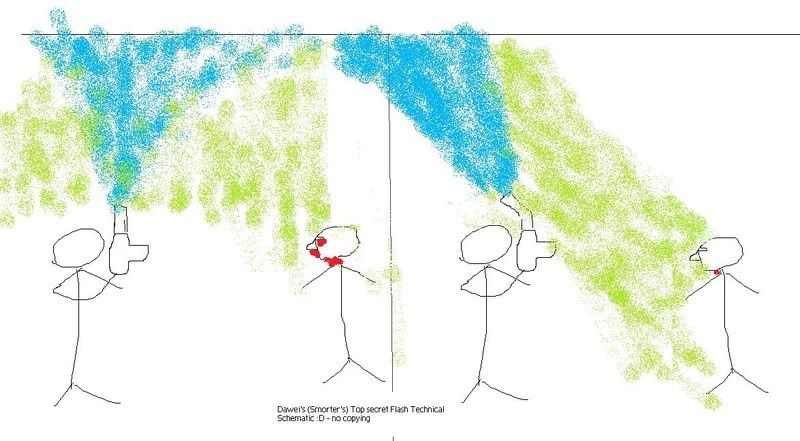
What if you are outdoors or in a huge arena? Remember the light bulb explanation. Light is sent in all directions. What percentage of the light from a dome like device is actually reaching your subject. 10 - 20%? And how much larger is this 10-20% surface area of the dome that is illuminating your subject compared to the surface area of the flash head itself. How much difference does a dome like device make to direct flash in this situation? It is a little larger so will make some difference but is it worth it to you to waste the other 80% of light? If it works for you in this situation great but it does not hurt to take the time to think about this. I have in this situation shot direct flash on a bracket and achieved decent lighting shooting people.
Bouncing light is my favourite method. I always keep my subjects away from walls and put my back to them. Corners are even better. Always pray for for a white ceiling at an event. If I have use this method which is a little wasteful but it solves the shadows under the eyes problem when bouncing off a ceiling if I have no walls behind me. One of my favourite methods.
I just purchased two big flip it's from Joe Demd. When I had no other choice I would shoot direct with the flash on a bracket and above the camera. The flip it is lighter and has more options so I will try it out.
So I'm not saying you should not use dome devices but I think it is important to understand what they are designed to do. They are another tool and all tools have their place.
http://russellspixelpix.blogspot.ca/2008/11/flash-diffusers-no-need-to-spend-big.html