Advice on Gray Fong's Lightsphere compared to Sto-fen Omni-bounce

Status
Not open for further replies.
FWIW, the brackets (either) with the softbox are also great for macro - the extensions let you get the softbox out over the subject at 1:1. That's why I got the Manfrotto bracket to begin with, in fact (the RRS was for use with the supertele).

Two bumps for the Demb - might have to give that a try. I'd likely still use it on the RRS ring to move it further off axis and allow landscape/portrait shifting. Thanks, Chris and PW!
 
Upvote 0
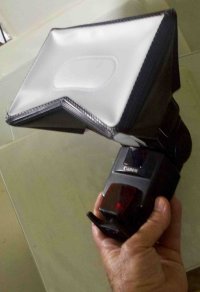
Wow, some really good inputs for everyone. Thanks neuro for the photos of the bad boy. Have you faced any AF assist issue since the softbox is partially blocking the assist beam senser on the flash unit?

Chris, I am looking at the Demb units Marsu42 has given links to. Which one are you using? Any photos taken with the Demb products would be cool, saw some samples on their websites and it looks pretty neat.
 
Upvote 0
killswitch said:
Wow, some really good inputs for everyone. Thanks neuro for the photos of the bad boy. Have you faced any AF assist issue since the softbox is partially blocking the assist beam senser on the flash unit?

No issues...other than the softbox blocks it so the AF assist doesn't work. ::)
 
Upvote 0
I am doing the same event photography and I use the lightsphere all the time. It works excellent for 15 feet and under. Large groups or further distance and the light gets to soft and to dark to use. It's amazing and far softer than any bounce flash. I am using it with a 580 ex ii.
 
Upvote 0
gjones5252 said:
I am doing the same event photography and I use the lightsphere ... far softer than any bounce flash.

Light 'softness' is determined not by praise for a product, but by the size of the light source relative to its distance from the subject. For your statement to be true, you must either have the LightSphere right in the subject's face, have a custom-made beachball-sized LightSphere, or ceilings the size of a postage stamp. Just sayin'... ;)

Actually, since the LightSphere sends most of the light up, I suspect you're really talking about LightSphere plus bounced flash, and the results would not be as good with high and/or dark ceilings. If you compare direct flash with a LightSphere on the head to bare flash bounced off a low white ceiling, the latter will be a lot softer. The point of the LightSphere and the StoFen is to bounce most of the light while throwing some forward to the subject.
 
Upvote 0
etg9 said:
I have the GF Lightsphere Collapsible and really like it plus it doesn't take up very much room in my bag. It's a nice defuser for what it is. I like that you can just pop the top out and fold the deal down to go back to normal flash without taking it off the flash. I also mount the dome different ways for different uses. because the dome sits in the cup it's easy to put a tissue in there to have it give off a much softer light.


I use the Lightsphere Collapsible with the dome installed and insert a 3x5 white card or even aluminum foil at the backside of the sphere to prevent "wasting" light away from the subject. It also focuses the light a little more forward, reduces battery drain, yet still produces a nice soft light (in a room with ceilings).
 
Upvote 0
Marsu42 said:
Thanks, that makes sense - exactly what diffuser do you have: http://www.dembflashproducts.com/flipit/

One question though: I'd like to have a nicer flash reflection in the eyes than the rectangular "bare" flash, esp. on macro shots - how does the demb-type diffuser do here (If it is available in Europe at all)? Thats seems to be one advantage of the Lightsphere - it's round.

I use the Big Flip-it. I tried the Pro kit with the little diffuser and didn't find it to be useful, so I just stick with the Flip-it by itself. I have a friend using the Mega and I am going to do some comparisons at some point soon, but I don't think it softens the light much more.

For catch lights, the Flip-it gives you a larger source that is close to square. When you're using a source that small, I don't think you'll be able to discern the difference in any of the on-camera modifiers. Even with large softboxes, catch lights are quite tiny.

A while back Joe Demb contacted me after I was talking up the Flip-it and he actually posted my endorsement on his site and had me build a gallery of images shot with the Big Flip-it, so you'll see lots of examples from event shoots and even some portraits.

http://chrisburch.com/Portfolio/DembFlip-it/
 
Upvote 0
Lot's of good info here. I'm going to pipe in here because this is by far one of favourite topics.

Light is simple physics which all products are governed by and there is nothing anyone can do about it. Light is energy which are called photons. This I think is the first most important thing for people new to flash to learn. Light travels in strait lines. There is no way of bending light to curve it around an object to reduce shadows, even if it is as small as persons nose.

I'm going to use a little off the wall explanation. Think of light photons as salt granules. We have a light bulb full of salt. If the light bulb explodes the granules are sent hurling in all directions. Same thing happens when we turn on a light bulb. Remember that the photons from the light bulb travel in a strait line. We may not be able to bend light but we can deflect it off a surface and send it in a different direction.

Second most important thing to learn. Creating soft light is all about the size and distance of the light source to your subject. Again this is physics and there is nothing we can do about it.

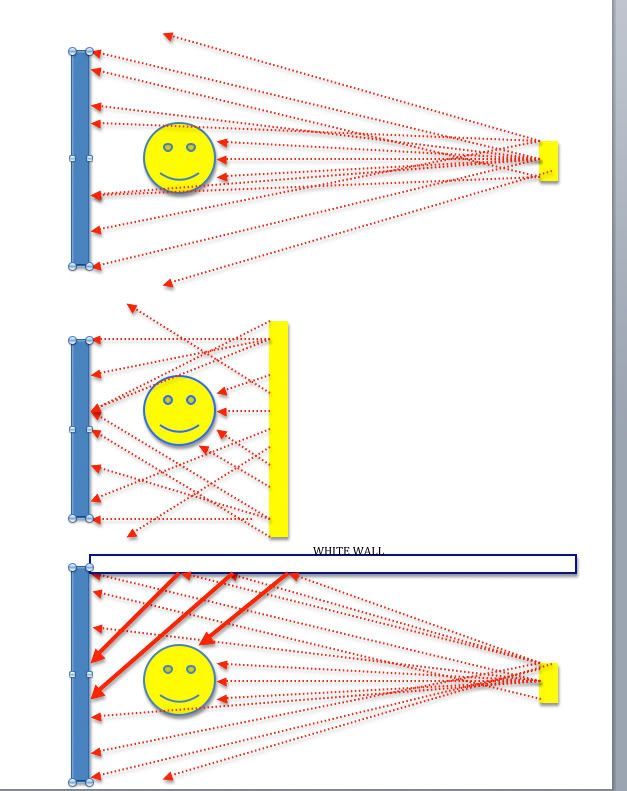
Here we are using a 2' by 4' softbox. In the first illustration we moved it 50 feet away from the subject. Now I know a strobe, etc will not have the power to do anything from that distance but just go with it for this demo. I can draw lines from the light source all day and not be able to get light around the head to eliminate shadows on the wall.

In the second illustration we moved the softbox so it is 5 feet from the subject. Now light from the outer edges of the softbox can eliminate the shadows behind the head.

The third illustration is just about bouncing light.

Light-2.jpg


The lightsphere, Sto-fen and other such devices are bounce adaptors. They need surfaces to bounce light off surfaces and objects to be completely effective. It is what they were designed to do. They do a great job in a 10 by 10 by 10 room painted white. I would argue I can do just as well bouncing my flash of those walls. This is why I don't consider them as diffusers as compared to an umbrella or a softbox.

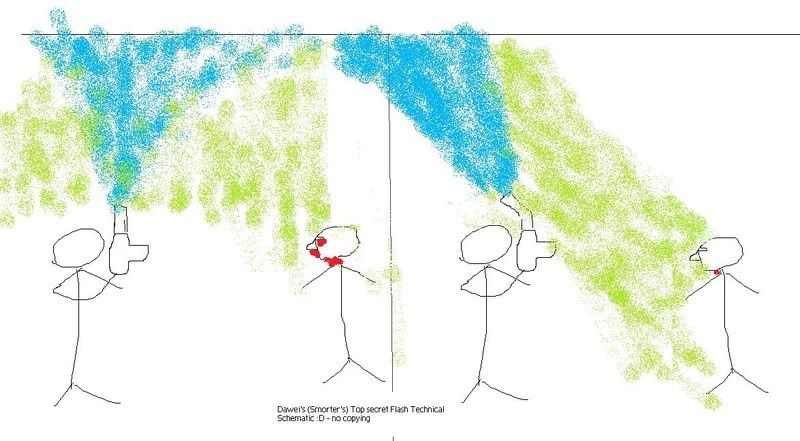
What if you are outdoors or in a huge arena? Remember the light bulb explanation. Light is sent in all directions. What percentage of the light from a dome like device is actually reaching your subject. 10 - 20%? And how much larger is this 10-20% surface area of the dome that is illuminating your subject compared to the surface area of the flash head itself. How much difference does a dome like device make to direct flash in this situation? It is a little larger so will make some difference but is it worth it to you to waste the other 80% of light? If it works for you in this situation great but it does not hurt to take the time to think about this. I have in this situation shot direct flash on a bracket and achieved decent lighting shooting people.

Bouncing light is my favourite method. I always keep my subjects away from walls and put my back to them. Corners are even better. Always pray for for a white ceiling at an event. If I have use this method which is a little wasteful but it solves the shadows under the eyes problem when bouncing off a ceiling if I have no walls behind me. One of my favourite methods.

p837681728-4.jpg


I just purchased two big flip it's from Joe Demd. When I had no other choice I would shoot direct with the flash on a bracket and above the camera. The flip it is lighter and has more options so I will try it out.

So I'm not saying you should not use dome devices but I think it is important to understand what they are designed to do. They are another tool and all tools have their place.

http://russellspixelpix.blogspot.ca/2008/11/flash-diffusers-no-need-to-spend-big.html

 
Upvote 0
I spent a lot of money and wasted a lot of time trying to find the latest and greatest. But I guess that is part of the journey. I took a lighting course, gave all my gizmos away and simplified everything. I did not understand diffusion but the word alone is mysterious and it hooked me.

Forgot to mention something about that reverse ceiling bounce method. First off there is no spill from the flash itself onto your subject. Also I have turned the flash to the left and right and achieved some very pleasing results.

This is my flash guru. He is a advocate of the no spill off the flash touching your subject.

http://neilvn.com/tangents/flash-photography-techniques/

Black foamy thing.

http://neilvn.com/tangents/2009/11/21/the-black-foamie-thing/

Of all products I see recommended by pros Demb seems to be near the top of the list. Not that pros don't use other products. I'm an each to his own person so this is not meant to be "this product is better than that one". I just believe in educated purchases. I look forward to give the flip it a try. I like how easy it is to flip it out of the way when required. Been a long time since I have had any modifier on my flash :)

Oh regarding that informative video. Another way to reduce shadows under the eyes if you bounce your flash off the ceiling is to tilt it forward and insure the bounce angle is not less than 45 degrees so you need to step back from your subject. Here is where the black foamie thing would come in handy.

A few more helpful links.

http://www.talkphotography.co.uk/forums/showpost.php?p=1382030&postcount=17

Ratings at the bottom of page.

http://photo-tips-online.com/review/best-flash-diffuser/#demb-flash-diffuser
 
Upvote 0
This is why I read this forum. To learn new things. My immediate reaction to the OP post was...

Moving event photography OR Still portrait tripod based? How do you shoot, wide and close or long and far away? All this makes a big difference!

I'm with Chris Burch on this, his points are my points too.

My input will be a bit redundant but here goes...

I use a StoFen most often for convenience and decent bounce/diffusion (for my use) most of the time. It's a no-brainer purchase for anyone's first basic diffuser. I use the Lumiquest Softbox III off camera and Gary Fong collapsible Lightsphere on camera with Custom Brackets flash bracket (and off camera flash cord) in small indoor spaces when I'm rarely doing controlled portrait stuff. When I am doing more "important" shoots like Eagle Court of Honors in a church sanctuary, I pound the crap out of my poor 580EX-II using a Gary Fong collapsible lightsphere (using the flash bracket) with whatever bounce I get based on the environment. I have also been known to modify these diffusers with foil, etc to change power and light distribution. I like many of the lumiquest products but I don't own a lot of them only because I haven't had a big need.

Don't restrict yourself reading marketing and only buying expensive products. Lots of things will work for manipulating light. White foam core and plastic, white plastic bags, car windshield shades in different colors/reflectivity, napkins, etc. Even just white index cards in a pinch. Heck, sometimes your hand or your fingers splayed out over the flash can get the look you want. All very inexpensive and portable.

NOW THAT I'VE READ THIS THREAD HOWEVER - I think I might have a look at the Demb products and consider using that instead of the Gary Fong. The lightsphere is pretty heavy so I have to be careful, esp when it's on the flash bracket. In most cases however when I'm on the move, the Sto-Fen will do fine for my needs. I keep the small SunPak RD2000 with Sto-Fen+foil on my camera most of the time anyway stopped down at least -1 or more and drag the shutter a lot with Av priority. I like the look of mostly ambient with just a bit of fill. But then, I shoot wide and up close most of the time so that works. If I shot long across the room, this is worthless.

I just learned a lot from everyone and I thought I already had some good experience of my own. Cool!!
 
Upvote 0
digital paradise said:
I spent a lot of money and wasted a lot of time trying to find the latest and greatest. But I guess that is part of the journey. I took a lighting course, gave all my gizmos away and simplified everything. I did not understand diffusion but the word alone is mysterious and it hooked me.
I think digital paradise is all over this with some great posts! He is the man! Way to go! However, I'll say this... eBay is a wonderful place to buy a LOT of cheap knock-off flash gizmos to try out and learn without spending a ton of money. You could buy about $50-$100 worth of all the different styles and kinds of stuff to learn how it works, how it throws light, etc and then later buy the "good" stuff when you have developed a style and decided what works best for YOU. There are knock-off chinese versions of EVERYTHING for only a few dollars. Once your research is done, go out and buy a piece or two of your favorites in high quality that will produce better results and last longer. The most valuable part of this venture is what you will learn working with all the different tools to see how they differ and how the light is changed using them.

Like this... http://www.ebay.com/itm/7in1-Flash-gun-adapter-Kit-f-Canon-580EX-II-Nikon-SB24-25-26-Nissin-Di622-CA-7A-/180914424142?pt=Camera_Flash_Accessories&hash=item2a1f57094e

I think you get the idea. Have fun with it and let us know what you choose and what you learn!
 
Upvote 0
Thanks but I did not figure this stuff out myself. There are a lot of smarter people than me out there. I just happen to really enjoy this so I invested some time to it. I purchased the flip its for a specific reason. I'm finding the bracket just more cumbersome to use so I will work with them when I have absolutely nothing to bounce off. I will experiment with some ceiling bounce since I have them. As for looking for other modifier, thanks to the link however I'm not going down that path again. It is like a drug. You get one but you always wonder if the next one will be better. Well I used to anyway.
 
Upvote 0
Lumiquest made a 5"x7" speedlite softbox for direct attachment whose shape at the bottom allowed the Canon sensor to measure the scene. Velcro on the head needed as with so many other modifiers. I have one. It folds into a very compact 5x7x0.5. Easy to throw in my bag.

The rectangle seen in the attached photo embedded in the white front panel is designed to better diffuse the light coming out of the head. I have opened panels on this ti allow light out the side or top, but rarely.

I do not know if this is still sold.

jonathan7007
 

Attachments

  • Lumiquest.jpg
    Lumiquest.jpg
    98.3 KB · Views: 870
Upvote 0
Status
Not open for further replies.