Analysis of RAW samples at Fred Miranda show weak DR

Jschmitt said:
When the specifications were released, I was about 95% sure that I was going to buy this camera. The resolution was in a sweet spot for me in terms of printing out large images (i.e. 20 x 30, which I have done in the past), it had a tilty-flippy screen (don't knock it until you've tried it - it is especially nice for those of us who are tall and don't want the potential vibration that comes with extending the center column of our tripod), and it had sufficient FPS for what I'm likely to shoot regarding wildlife. Maybe I was just being naive, but it didn't even occur to me as a possibility that the DR wouldn't have some improvement from the 6D. Truly, I'm not asking for pro body performance at an intro body price; I'm willing to accept some deficiencies that act as a differentiator between this and the 5D MIV. Base ISO DR seems like a strange place to make such a large gap, especially when they have the technology to make it better (but still sufficiently below the 5D MIV).

As this is a big purchase for someone like me, I was obviously going to wait for the reviews but the reviews were likely just a formality. Given all of the "little things" that have come out (lack of improvement of DR, somewhat compressed AF points, etc.) I've gone from 95% to probably 50% in terms of whether or not I'll get this camera. The reviews have gone from a formality to a necessity - and I'll probably spend a lot of time on DP playing with their DR and ISO studio scenes. If I don't get this camera, I'm not going to get the 5D MIV as I don't have that kind of money to invest in a hobby, even if it is one of my primary ones. I'll either look a lot more seriously at other brands (which I've only been doing a bit up until this point) or I'll settle for another crop frame camera that will still be a lot better than what I have. Either way, Canon would lose out on all of the EF lenses that I would be buying in the future.

There are obviously a lot of good things about this camera and I'm still weighing things like low-light performance versus this base ISO DR issue and other potential limitations. I'm sure that DP will not be as generous with this base ISO DR issue with this camera as they were with the D5 (really, you should go read their review on that particular issue), so I'll being looking at reviews from a lot of different sites to come to a conclusion. That being said, Canon has not made this the "easy buy" that it could have or should have been for someone like me.

You could not have described my own feelings better!
 
Upvote 0
Large first post, mostly skippable but for the question at the very end regarding on vs. off sensor ADC.

Jack Douglas said:
Jschmitt said:
Just to give some perspective, I feel like I'm in one of Canon's target markets for this camera. I've been shooting with a T3i since it came out and bought my wife a 70D when she was using my T3i a lot more than the other point and shoot we had. Unlike a lot of people on this forum, I'm obviously not a pro but I'm certainly an advanced amateur. [...]

Certain folk like to rain on every party. Typically it's finding a shortcoming and then blah blah blah. I'll never forget all the insults directed toward the 6D on CR and elsewhere because it HAD WiFi. I was fairly new to DSLR's coming from a Nikon D5100 when I bought the 6D 4 years ago. I've absolutely loved it in spite of its shortcomings and if my wife hadn't "forced" me to get the "best" camera (I tried hard to explain there was no "best") I quite possibly would be a 6D2 only guy, having now sold my 6D (I needed F8 focus). The 6D2 will be a great camera and a very nice step up from the 6D. It'll do you just fine I'm sure. [...]
Thanks for the encouragement to check out your images. It is nice to be remembered that even the original 6D can produce nice, natural looking images and that the 6DII will do that at least just as well. I feel like venting a little, just to get the 'inner Canon is doomed guy' under control :D

I find myself in a similar position as Jschmitt. I bought a T3i in school 5 years ago and enjoyed it very much for the biggest part of that time. But I had beeen looking forward to going full frame ever since the original 6D was released. Before the DR topic here arose, i was convinced I'd get the 6DII along with a Canon 16-35mm 4.0 L IS and either the Tamron 90mm 2.8 VC or Canon 100mm 2.8 L IS sometime in the next year.

I feel like I'm quite close to the target market, being passionate but not professional about photography, with enough technical enthusiasm to justify spending that much money on a hobby.

I also don't feel bothered by the other shortcomings like lack of 4K, dual cards or Af spread. I don't use video anymore, I don't do commercial work, I use MF most of the time. I shoot mainly macro before and around sunrise and cityscapes around and after sunset, along with a hint of landscape and astro and the usual family event and protrait stuff. There's a lot handheld but also a decent amount of tripod work in there. The lighting around sunset and sunrise becomes pretty challenging for the old T3i sensor and I feel like the body is way to small in terms of grip and balance. When I shoot macro handeld, with a Sigma 50mm 2.8 Macro and Canon 430EX II Flash, holding the thing is quite a strain on the fingers.

So I want a bigger body with better low light abilities. Going mirrorless isn't an option, at least I missed the part where reduces flange distance helps with the size and weigth of flashes and tripods, so any weight and size difference ther eis irrelevant for me. And I don't feel like switching systems, as they all do let me down in some simple fashion and I am somewhat invested in Canon (Canon 85mm 1.8, 50mm 1.8 II & 10-18mm IS, Sigma 50mm 2.8 Macro & 35mm 1.4 Art, Canon 430EF II).

I still feel pretty bummed about the lack of enthusiasm on Canon's side. I have no problem believing the Canon bashers ever since they released the 700D (T5i?) which ist almost exactly the same camera as the 650D (T4i?). And with this kind of money at stake my emotional side just wants to scream 'Doomed!' and buy a Nikon or Pentax... The 6DIi just doesn't feel like an easy buy anymore, just like Jschmitt said.

I think my concerns with the 6DII are mainly my ability to lift shadows, since I do that frequently with my macro work to give the image a hint of an unnatural HDR effect, which I like to underline the alien apperance of most bugs. But I shoot macro mostly at ISO 400, rarely at 200 or 800. I guess with a 6DII I would be mostly at 800 or higher, to get more out of the ambient light. Am I mistaken in thinking that with these high-ish ISOs the ability to pull up shadows isn't affected by on vs off sensor ADC?
 
Upvote 0
rfdesigner said:
privatebydesign said:
Changing the resolution post capture (Print) does not increase or decrease the amount of scene DR captured. The Print value reflects scores of over 14 stops from a 14 bit file, how can more than 14 stops of scene dynamic range be captured in a 14 bit file?

Isn't the relevant metric what range each pixel can capture (Screen)? That is what limits the scene illumination range that the sensor can accurately record, surely it is the thing that limits a photographers ability to capture scenes with large dr.

You nead to read up about decimation https://en.wikipedia.org/wiki/Decimation_(signal_processing) .... in Analog to Digital Converters this is part of delta-sigma conversion, it allows a "1 bit" system to represent any amount of dynamic range.

In Delta-Sigma digital to analog converters a high speed stream of 1s and 0s are averaged by analog componenets to produce an accurate voltage at any level between the levels of the 1s and the 0s.. and similarly in analog to digital converters or fractional-N-PLLs

If on a camera sensor you had a trillion pixels, each one being so small that it becomes a single photon detector, and has a "bit depth" of one bit, then at the pixel level your dynamic range would be next to zero, but as you down sample to fewer pixels decimation means you gain dynamic range in return for lower resolution, once reduced to say 20Mpix your dynamic range could be 8 or more stops.

Is any of that relevant to the cameras we actually have in our hands?

Do you believe any camera company is doing any of that in general public retail cameras?

I am talking about hands on take a picture of a Stouffer wedge and see what values we get at native resolution.
 
Upvote 0
privatebydesign said:
Assuming you believe DXO numbers:-

and why not?... they use a consistent measurement system and math (aside from some occasional errors)


If a scene contains 14.76 stops of dynamic range can a D810 accurately capture that? (Print)

No it can't.

Uhmmm... actually... maybe it CAN. :) LOL


If a scene contains 13.67 stops of dynamic range can a D810 accurately capture that? (Screen)

Yes it can.

Yes, it can.

If a scene contains 13.59 stops of dynamic range can a 5D MkIV accurately capture that? (Print)

No it can't.

uhmmm, again, actually, maybe it CAN. :)

If a scene contains 12.60 stops of dynamic range can a 5D MkIV accurately capture that? (Screen)

Yes it can.

yup, most likely


...Downsampling does not affect the capture capability, it might, arguably, impact the real world output capability in some way, but it doesn't increase the sensors ability to accurately record a range of luminance values.

OK. Maybe you missed this technical topic cuz I'm pretty sure I posted it years ago here on a similar discussion.

You CAN get more than X bits of ADC data from an X-bit ADC by using dithering (noise) and oversampling (scaling down).

random read noise makes a good dither signal and since single electrons make for pretty repeatable quanta, this is a workable dither signal.
Canon's previous imaging systems, with their fixed pattern noise, were NOT good for this as they didn't generate purely random noise.


I'm too tired to explain it, maybe there's an electronics engineering geek here who can do a better job but have a look at this:

https://www.bing.com/search?q=how+to+use+dithering+to+increase+ADC+resolution

specifically, from the absolute experts at T.I

http://www.ti.com.cn/cn/lit/an/snoa232/snoa232.pdf

Altho this app note is using audio signal digitizing as an example, the concept works with imaging too.
In fact I came up with a post-processing technique of using noise dithering to improve UPscaling a digital image.
Anyone who uses this method now owes me money!! LOL

meanwhile, here's an excerpt:

Code:
3.0 DITHER
To ameliorate the negative effects of quantization, early
workers added analog white noise to the ADC input signal.
In 1951 Goodall
1
noticed that the addition of dither to sig-
nals masked the contour effects in video systems. In 1960
Widrow
2
determined that the signal loss due to quantization
is minimized if the quantization error is independent of the
signal. Schuchman
3
determined the forms of dither signals
which yield a quantization error which is independent of the
signal. He found that for ideal converters, the optimum dith-
er is
(/3
LSB rms of white noise. Vanderkooy and Lipshitz
4
showed that with dither, the resolution of an ADC can be
improved to below an LSB.
We now show how it is possible to reduce harmonic distor-
tion and improve resolution in the A/D conversion of signals
by adding dither. In
Figure 6
we show a low level sinusoidal
signal centered on a quantization step. The peak-to-peak
amplitude of this signal is 1 LSB. When this signal is input to
an ADC, it will be represented by only two codes. If the sine
wave is centered on the threshold between the two codes,
the digital output will represent a square wave. Any offset
will change the duty cycle, but the digitized signal will always
take the form of a series of pulses at the same frequency as
the input. This is obviously a very poor representation of a
sine wave.
The addition of dither will cause the quantizer to toggle be-
tween the two (and possibly additional) states more fre-
quently
(Figure 7)
. Sub-LSB information is preserved in the
percentage of time spent between levels. With time averag-
ing the resolution can be increased significantly beyond an
LSB. What has been accomplished by adding dither is an
effective linearization of the ADC transfer curve. A power
spectrum of the output would show that the harmonic distor-
tion arising from the quantization process has been signifi-
cantly reduced, as compared to the case with no applied
dither. What one pays for a reduction in total harmonic dis-
tortion (THD) and improved resolution is a slightly degraded
signal-to-noise ratio and, if one uses time averaging, an in-
crease in the effective conversion time
 
Upvote 0
privatebydesign said:
rfdesigner said:
privatebydesign said:
Changing the resolution post capture (Print) does not increase or decrease the amount of scene DR captured. The Print value reflects scores of over 14 stops from a 14 bit file, how can more than 14 stops of scene dynamic range be captured in a 14 bit file?

Isn't the relevant metric what range each pixel can capture (Screen)? That is what limits the scene illumination range that the sensor can accurately record, surely it is the thing that limits a photographers ability to capture scenes with large dr.

You nead to read up about decimation https://en.wikipedia.org/wiki/Decimation_(signal_processing) .... in Analog to Digital Converters this is part of delta-sigma conversion, it allows a "1 bit" system to represent any amount of dynamic range.

In Delta-Sigma digital to analog converters a high speed stream of 1s and 0s are averaged by analog componenets to produce an accurate voltage at any level between the levels of the 1s and the 0s.. and similarly in analog to digital converters or fractional-N-PLLs

If on a camera sensor you had a trillion pixels, each one being so small that it becomes a single photon detector, and has a "bit depth" of one bit, then at the pixel level your dynamic range would be next to zero, but as you down sample to fewer pixels decimation means you gain dynamic range in return for lower resolution, once reduced to say 20Mpix your dynamic range could be 8 or more stops.

Is any of that relevant to the cameras we actually have in our hands?

Do you believe any camera company is doing any of that in general public retail cameras?

I am talking about hands on take a picture of a Stouffer wedge and see what values we get at native resolution.

1-bit conversions are very powerful if you have the time to oversample and filter adequately.
Dithering n-bit ADCs with noise is much more like what we're working with in a camera body.


edit:
fergot da-linky:

https://electronics.stackexchange.com/questions/69748/using-noise-to-increase-effective-resolution-of-adc
 
Upvote 0
Joules said:
I think my concerns with the 6DII are mainly my ability to lift shadows, since I do that frequently with my macro work to give the image a hint of an unnatural HDR effect, which I like to underline the alien apperance of most bugs. But I shoot macro mostly at ISO 400, rarely at 200 or 800. I guess with a 6DII I would be mostly at 800 or higher, to get more out of the ambient light. Am I mistaken in thinking that with these high-ish ISOs the ability to pull up shadows isn't affected by on vs off sensor ADC?

The only fair answer anybody can give you is wait until sample RAW files are out there, then download a few at the iso you are most interested in and play with the processing to see if they will do what you need.

As a comparison between pre and post on sensor ADC's, between the 1DX and 1DX MkII there is less than 1/3 stop difference at 800iso, between the 5D MkIII and 5D MkIV there is around half a stop. But that is in DR, which is not quite the same as shadow lifting.
 
Upvote 0
Joules said:
I think my concerns with the 6DII are mainly my ability to lift shadows, since I do that frequently with my macro work to give the image a hint of an unnatural HDR effect, which I like to underline the alien apperance of most bugs. But I shoot macro mostly at ISO 400, rarely at 200 or 800. I guess with a 6DII I would be mostly at 800 or higher, to get more out of the ambient light. Am I mistaken in thinking that with these high-ish ISOs the ability to pull up shadows isn't affected by on vs off sensor ADC?

At ISO 400-800, playing field is effectively leveled across all FF cameras from various brands (there are few minor exceptions as usual, irrelevant in real scenarios), so it should not matter that much.

Also, shadow push means just how far you want to go. I've been succesfully lifting shadows from my 6D images without any trouble, if one is reasonable. +2-3 EVstops push with selective +50-75 Shadows slider (Lightroom) is doable with a little noise. Nobody cares about 5-6 EV stops pushes except for DRones and measurebators anyway :)
 
Upvote 0
privatebydesign said:
Aglet said:
Blah blah blah blah.......

Aglet said:
Blah blah blah blah.......

Show me a Stouffer wedge with more than 14 stops of DR in it from an available retail camera that uses 14 bit RAW files.

I just pointed out how the process CAN be done.
it's been done for decades in various areas where analog data is digitized.

you can lead a horse to water...
but you sure as heck can't make it learn advanced math! ;)
 
Upvote 0
privatebydesign said:
The only fair answer anybody can give you is wait until sample RAW files are out there, then download a few at the iso you are most interested in and play with the processing to see if they will do what you need.

As a comparison between pre and post on sensor ADC's, between the 1DX and 1DX MkII there is less than 1/3 stop difference at 800iso, between the 5D MkIII and 5D MkIV there is around half a stop. But that is in DR, which is not quite the same as shadow lifting.

[quote author=privatebydesign]
At ISO 400-800, playing field is effectively leveled across all FF cameras from various brands (there are few minor exceptions as usual, irrelevant in real scenarios), so it should not matter that much.

Also, shadow push means just how far you want to go. I've been succesfully lifting shadows from my 6D images without any trouble, if one is reasonable. +2-3 EVstops push with selective +50-75 Shadows slider (Lightroom) is doable with a little noise. Nobody cares about 5-6 EV stops pushes except for DRones and measurebators anyway :)
[/quote]
Thanks for the answers, it's sometimes hard to grasp the true, real world impact of all the numbers being thrown at Canon. Waiting and seeing for yourself is probably the best and most rational advice, and in the meantime it is calming to hear that even the current 6D should outperform my old T3i easily for my appilcations.

Thanks!
 
Upvote 0
privatebydesign said:
rfdesigner said:
privatebydesign said:
Changing the resolution post capture (Print) does not increase or decrease the amount of scene DR captured. The Print value reflects scores of over 14 stops from a 14 bit file, how can more than 14 stops of scene dynamic range be captured in a 14 bit file?

Isn't the relevant metric what range each pixel can capture (Screen)? That is what limits the scene illumination range that the sensor can accurately record, surely it is the thing that limits a photographers ability to capture scenes with large dr.

You nead to read up about decimation https://en.wikipedia.org/wiki/Decimation_(signal_processing) .... in Analog to Digital Converters this is part of delta-sigma conversion, it allows a "1 bit" system to represent any amount of dynamic range.

In Delta-Sigma digital to analog converters a high speed stream of 1s and 0s are averaged by analog componenets to produce an accurate voltage at any level between the levels of the 1s and the 0s.. and similarly in analog to digital converters or fractional-N-PLLs

If on a camera sensor you had a trillion pixels, each one being so small that it becomes a single photon detector, and has a "bit depth" of one bit, then at the pixel level your dynamic range would be next to zero, but as you down sample to fewer pixels decimation means you gain dynamic range in return for lower resolution, once reduced to say 20Mpix your dynamic range could be 8 or more stops.

Is any of that relevant to the cameras we actually have in our hands?

Do you believe any camera company is doing any of that in general public retail cameras?

I am talking about hands on take a picture of a Stouffer wedge and see what values we get at native resolution.

Yes it is absolutley relevent

ADCs / DACs are "one dimentional".. they produce a single dimension of data, values-over-time., this makes them easier to understand.

Cameras produce "two dimentional" data, X&Y at one moment in time.. it's exactly the same processes on two axis.. harder so "see" so it's better to understand the single axis examples first then realise you can do the whole thing again on an orthogonal axis.
 
Upvote 0
Keith_Reeder said:
I'd love to know which Raw conversion software the "Canon has crap DR" obsessives use - because I convert files in Photo Ninja, and I can do whatever the hell I want with low ISO shadows in there...

ACR obviously. Advanced Canon Repulser/Revolter ;)
 
Upvote 0
privatebydesign said:
Aglet said:
Blah blah blah blah.......

Aglet said:
Blah blah blah blah.......

Show me a Stouffer wedge with more than 14 stops of DR in it from an available retail camera that uses 14 bit RAW files.

If I were Aglet, maybe I COULD...if I removed the sensor from the D810, put it in a custom enclosure with special firmware, then dithered and measurebated the images for a while, it is possible that the DR would just explode out of the RAW files and spurt all over the prints.

I'm just pointing out how the process could work. If you don't grasp the finer points of the math, that's not my fault. ;)
 
Upvote 0
Aglet said:
privatebydesign said:
rfdesigner said:
privatebydesign said:
Changing the resolution post capture (Print) does not increase or decrease the amount of scene DR captured. The Print value reflects scores of over 14 stops from a 14 bit file, how can more than 14 stops of scene dynamic range be captured in a 14 bit file?

Isn't the relevant metric what range each pixel can capture (Screen)? That is what limits the scene illumination range that the sensor can accurately record, surely it is the thing that limits a photographers ability to capture scenes with large dr.

You nead to read up about decimation https://en.wikipedia.org/wiki/Decimation_(signal_processing) .... in Analog to Digital Converters this is part of delta-sigma conversion, it allows a "1 bit" system to represent any amount of dynamic range.

In Delta-Sigma digital to analog converters a high speed stream of 1s and 0s are averaged by analog componenets to produce an accurate voltage at any level between the levels of the 1s and the 0s.. and similarly in analog to digital converters or fractional-N-PLLs

If on a camera sensor you had a trillion pixels, each one being so small that it becomes a single photon detector, and has a "bit depth" of one bit, then at the pixel level your dynamic range would be next to zero, but as you down sample to fewer pixels decimation means you gain dynamic range in return for lower resolution, once reduced to say 20Mpix your dynamic range could be 8 or more stops.

Is any of that relevant to the cameras we actually have in our hands?

Do you believe any camera company is doing any of that in general public retail cameras?

I am talking about hands on take a picture of a Stouffer wedge and see what values we get at native resolution.

1-bit conversions are very powerful if you have the time to oversample and filter adequately.
Dithering n-bit ADCs with noise is much more like what we're working with in a camera body.


edit:
fergot da-linky:

https://electronics.stackexchange.com/questions/69748/using-noise-to-increase-effective-resolution-of-adc

So what is your point? The data coming out of the camera is digital, not analog, because it has already been through an ADC. It is what it is. If you downsample the file after it comes out of the camera, and some of the noise in the file goes away, you can say that dynamic range increases, or at least some people think they can say that. But you haven't dithered anything, and nothing has changed in the data produced by the camera. Have you reduced noise? Yes, of course. Have you inclrease the dynamic range of the camera capture? Word games.
 
Upvote 0
rfdesigner said:
privatebydesign said:
Changing the resolution post capture (Print) does not increase or decrease the amount of scene DR captured. The Print value reflects scores of over 14 stops from a 14 bit file, how can more than 14 stops of scene dynamic range be captured in a 14 bit file?

Isn't the relevant metric what range each pixel can capture (Screen)? That is what limits the scene illumination range that the sensor can accurately record, surely it is the thing that limits a photographers ability to capture scenes with large dr.

You nead to read up about decimation https://en.wikipedia.org/wiki/Decimation_(signal_processing) & oversampling https://en.wikipedia.org/wiki/Oversampling .... in Analog to Digital Converters this is part of delta-sigma conversion, it allows a "1 bit" system to represent any amount of dynamic range.

In Delta-Sigma digital to analog converters a high speed stream of 1s and 0s are averaged by analog components to produce an accurate voltage at any level between the levels of the 1s and the 0s.. and similarly in analog to digital converters or fractional-N-PLLs
True. I considered mentioning this earlier but it's a bit technical and doesn't apply to today's cameras.

But, today's Analog to Digital Converters (ADCs) can do better than most naive people think.
A n-bit ADC can actually capture about n+0.5 stops of dynamic range; so 14-bit can do 14.5 stops
rfdesigner said:
If on a camera sensor you had a trillion pixels, each one being so small that it becomes a single photon detector, and has a "bit depth" of one bit, then at the pixel level your dynamic range would be next to zero, but as you down sample to fewer pixels decimation means you gain dynamic range in return for lower resolution, once reduced to say 20Mpix your dynamic range could be 8 or more stops.
Yes, exactly.
Another way to look at is is that out human vision system does after-the-fact pixel binning because of our limited visual acuity (why PDR relates to CoC).
So dynamic range of an individual pixel is not relevant, measured like PDR are resolution independent.
 
Upvote 0
Aglet said:
privatebydesign said:
Assuming you believe DXO numbers:-

and why not?... they use a consistent measurement system and math (aside from some occasional errors)
The short answer is DxOMark Landscape Score if OK but that Photographic Dynamic Range (PDR) is a better measure.
The quick reason has to do with the Photon Transfer Curve (PTC) and the fact that DxOMark uses only read noise while PDR finds an appropriate place on the PTC using a Signal to Noise Ratio (SNR) criteria.
 
Upvote 0
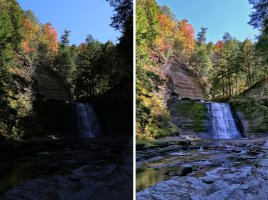
As is always the case, people should get the camera that they want and that best serves their purposes. I won't defend Canon if they aren't using the on-sensor ADC on the 6D II a I have seen the improvement in overall ability to lift shadows on my M5 compared to previous crop cameras. However. as has been mentioned many times, all of today's cameras should be more than good enough for any photographer who is interested in photos rather than interested in bragging about the specs.

As long as I can take shots that I could never have gotten in the old film days, then I am happy and you won't find me whining and complaining. This was shot with a 6D with minimal post-processing:
 

Attachments

  • sb-compare.jpg
    sb-compare.jpg
    940.8 KB · Views: 142
Upvote 0
bclaff said:
rfdesigner said:
privatebydesign said:
Changing the resolution post capture (Print) does not increase or decrease the amount of scene DR captured. The Print value reflects scores of over 14 stops from a 14 bit file, how can more than 14 stops of scene dynamic range be captured in a 14 bit file?

Isn't the relevant metric what range each pixel can capture (Screen)? That is what limits the scene illumination range that the sensor can accurately record, surely it is the thing that limits a photographers ability to capture scenes with large dr.

You nead to read up about decimation https://en.wikipedia.org/wiki/Decimation_(signal_processing) & oversampling https://en.wikipedia.org/wiki/Oversampling .... in Analog to Digital Converters this is part of delta-sigma conversion, it allows a "1 bit" system to represent any amount of dynamic range.

In Delta-Sigma digital to analog converters a high speed stream of 1s and 0s are averaged by analog components to produce an accurate voltage at any level between the levels of the 1s and the 0s.. and similarly in analog to digital converters or fractional-N-PLLs
True. I considered mentioning this earlier but it's a bit technical and doesn't apply to today's cameras.

But, today's Analog to Digital Converters (ADCs) can do better than most naive people think.
A n-bit ADC can actually capture about n+0.5 stops of dynamic range; so 14-bit can do 14.5 stops
rfdesigner said:
If on a camera sensor you had a trillion pixels, each one being so small that it becomes a single photon detector, and has a "bit depth" of one bit, then at the pixel level your dynamic range would be next to zero, but as you down sample to fewer pixels decimation means you gain dynamic range in return for lower resolution, once reduced to say 20Mpix your dynamic range could be 8 or more stops.
Yes, exactly.
Another way to look at is is that out human vision system does after-the-fact pixel binning because of our limited visual acuity (why PDR relates to CoC).
So dynamic range of an individual pixel is not relevant, measured like PDR are resolution independent.

Bother

No.. I'm not talking about the ADCs in Cameras.. merely as a concept to think about. once you understand how you can take 10 samples from an ADC and decimate it down to say 2 samples and in so doing gain dynamic range beyond the the bit depth of the native ADC then you should be able to see how you can down sample an image and gain dynamic range stops beyond the native performance of the original camera.

Taking a physics mentality, the way to approach things is to take the extremes and see how they work.. the extreme for low dynamic range is the one bit DAC/ADC.. if you can see the mental leap to go from 1 bit to N bits of DR there, you should be able to see what jump to make to go from a 14bit ADC to an image with more than 14 bits dynamic range.

anyway.. yes we're in agreement and the human vision point is also relevant.. as is the "need to pixel peep" or "you can't tell in web sized images" because images have been downsampled and benefitted from the DR boost.
 
Upvote 0