Announcing The Canon EOS-1D X Mark II

jeffa4444 said:
shutterlag said:
Another Canon body with zero "wow" to it. I shot the 5DSR over the weekend. It's got a high resolution sensor, but who the heck wants a one-trick pony in this day and age?
Really educated post about the 5DS / R. ...
So its far from a one trick pony and is aimed at Photographers that want more resolution and know how to use it.

Well, judging by his posts 'shutterlag' a one-trick user.
 
Upvote 0
It looks like a very solid evolutionary upgrade, which is exactly what most pros want, and while I won't be rushing out to get one, I will definitely pick one up in a year or two when the prices drop. In the meantime, I am curious about a few things:

I wonder if the battery and/or charger is backwards compatible. It looks doubtful given the naming. The 1D X
charge is big enough without having to lug two with me.

Does it support interchangeable focusing screens?

What do the fully-corrected JPEGs coming out of this look like?
 
Upvote 0
Don Haines said:
Pretty well what I expected to see, a great, solid camera with many incremental improvements... except no built-in WiFi? ? ?

WTF? One would expect the ability in such a high end camera to stream images back to the editor without buying expensive options..... It's sad to think of Olympic photographers with an Eye-fi card in their 1DX2....

If I am at "the big game", be it in Brazil, New York, London, or even at the Fitzroy Harbour elementary school ball field, when I press the shutter, the image should be appearing a few seconds later on the editor's computer, back at the home office.... be it a few kilometers away or half way around the world.

There are no "Olympic" togs using Eye-fi cards!! and if they are they really shouldn't be(based on my experience), WFT-Ex module is the way to go, and last time I went to the Olympics, the pros were tripping over CAT5 cables everywhere!
 
Upvote 0
neuroanatomist said:
Don Haines said:
If I am at "the big game", be it in Brazil, New York, London, or even at the Fitzroy Harbour elementary school ball field, when I press the shutter, the image should be appearing a few seconds later on the editor's computer, back at the home office.... be it a few kilometers away or half way around the world.

As it can be, with the WFT-E8.


Don Haines said:
except no built-in WiFi? ? ?

WTF? One would expect the ability in such a high end camera to stream images back to the editor without buying expensive options..... It's sad to think of Olympic photographers with an Eye-fi card in their 1DX2....

I suspect there's a good reason for the lack of built-in WiFi, beyond Canon wanting peple to pay for an accessory - country-specific regulations. Consider that for Canon bodies with built-in WiFi there is a 6D (WG) and a 6D (N), a 70D (W) and a 70D (N). For a body which will already be produced in relatively small numbers, two 'flavors' might not be desirable. It would be worse for Nikon, already producing two D5 variants for card slots, WiFi would mean four different cameras.
Good point..... this will be a relatively low volume product and that would make multiple versions a bit silly. I stand corrected!

P.S. I am not in the market for such a high end camera, but if I was, this would definitely be my first choice.
 
Upvote 0
Meatcurry said:
A bit disappointed that we have to use CF+CFAST cards, I think Nikon's interchangeable solution is better.

Agree that dual CFast would have been much better (for me, not that I'm planning on upgrading any time soon). I wonder what Nikon will charge for the CF to XQD change, it's not like you can DIY...
 
Upvote 0
Meatcurry said:
Don Haines said:
Pretty well what I expected to see, a great, solid camera with many incremental improvements... except no built-in WiFi? ? ?

WTF? One would expect the ability in such a high end camera to stream images back to the editor without buying expensive options..... It's sad to think of Olympic photographers with an Eye-fi card in their 1DX2....

If I am at "the big game", be it in Brazil, New York, London, or even at the Fitzroy Harbour elementary school ball field, when I press the shutter, the image should be appearing a few seconds later on the editor's computer, back at the home office.... be it a few kilometers away or half way around the world.

There are no "Olympic" togs using Eye-fi cards!! and if they are they really shouldn't be(based on my experience), WFT-Ex module is the way to go, and last time I went to the Olympics, the pros were tripping over CAT5 cables everywhere!
Cat5 is so 2014! We are playing with 60Ghz wireless links here :)
 
Upvote 0
Don Haines said:
Meatcurry said:
Don Haines said:
Pretty well what I expected to see, a great, solid camera with many incremental improvements... except no built-in WiFi? ? ?

WTF? One would expect the ability in such a high end camera to stream images back to the editor without buying expensive options..... It's sad to think of Olympic photographers with an Eye-fi card in their 1DX2....

If I am at "the big game", be it in Brazil, New York, London, or even at the Fitzroy Harbour elementary school ball field, when I press the shutter, the image should be appearing a few seconds later on the editor's computer, back at the home office.... be it a few kilometers away or half way around the world.

There are no "Olympic" togs using Eye-fi cards!! and if they are they really shouldn't be(based on my experience), WFT-Ex module is the way to go, and last time I went to the Olympics, the pros were tripping over CAT5 cables everywhere!
Cat5 is so 2014! We are playing with 60Ghz wireless links here :)
Well it was 2012, it could have been CAT5e??
 
Upvote 0
neuroanatomist said:
Meatcurry said:
A bit disappointed that we have to use CF+CFAST cards, I think Nikon's interchangeable solution is better.

Agree that dual CFast would have been much better (for me, not that I'm planning on upgrading any time soon). I wonder what Nikon will charge for the CF to XQD change, it's not like you can DIY...

We don't actually know if its up-gradable or not, I mean they haven't even announced it yet.....have they???
 
Upvote 0
Meatcurry said:
neuroanatomist said:
Meatcurry said:
A bit disappointed that we have to use CF+CFAST cards, I think Nikon's interchangeable solution is better.

Agree that dual CFast would have been much better (for me, not that I'm planning on upgrading any time soon). I wonder what Nikon will charge for the CF to XQD change, it's not like you can DIY...

We don't actually know if its up-gradable or not, I mean they haven't even announced it yet.....have they???

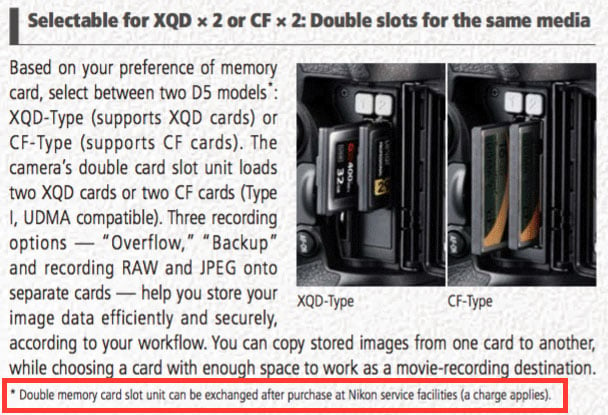
From Nikon's D5 brochure:

cardslotswap.jpg
 
Upvote 0
jebrady03 said:
Rahul said:
Having a touchscreen on all the time with an option to switch it off is non-starter. You would have to remember to disable it prior to shooting or your shots will get messed up.

Not true at all.

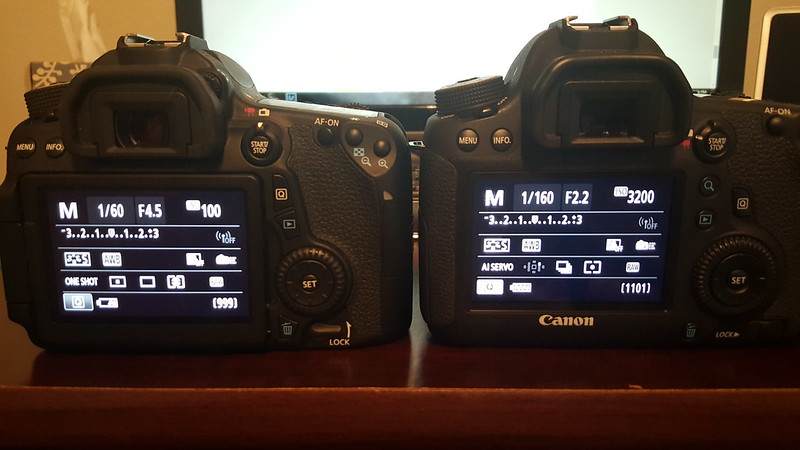
20151124_172417 by Jonathan Brady, on Flickr

Camera on the left is a 70D (has a touchscreen). This is the screen most of us see when shooting, no? If you press anywhere on that screen, NOTHING HAPPENS UNTIL you press the bottom left hand corner "Q" button on the screen. Notice how it looks different than the "Q" button on the screen on the 6D (camera on the right which doesn't have a touchscreen)? It's highlighted on the 70D to indicate that THIS is where you press to activate the touchscreen. Once you press that "Q", THEN you can press any of the other parameters on the screen to change them. Press the back button (replaces the "Q") to turn it off.

So, it's fast. You: press Q button, press parameter you want to change, change it, change anything else, press back button. Done. Just like "pinch to zoom" and "pan" within a zoomed picture when reviewing pics, it CAN be faster depending on your setup and the number of changes.

Personally, I don't use the screen to change parameters on my 70D. But I do use it to move through menus as well as pan through zoomed images. And obviously, also for touch-to-focus in video.

Thanks for this. I don't have the 70D so pardon my ignorance.

Doesn't using the Q button and then using fingers for the touchscreen experience slow you down? My typical use with the DSLRs is to grab the body with both hands, use the left thumb for menu/info buttons and the right thumb for operating the wheel and other buttons. I can't imagine what using my fingers for operating the touchscreen would feel like. Can you share your experience on this?
 
Upvote 0
With the exception of all 61 autofocus sensors which work up to f/8 and 4K video recording up to 60 fps with AF and 9MP still frame grab, Canon EOS 1D X Mark II is a disapointment, both in comparison to the Nikon D5 and as a standalone professional DSLR camera. No auto AF lens micro adjustment as in Nikon D5 (very important especially with the advent of Full Frame Mirrorless cameras such as the Sony a7S Mk II & Sony a7R MkII), 20 linear AF sensors out of 61 in total meaning that the Canon EOS 7D Mark II with its all selectable 65 cross type AF sensors remains the best as far as the total number of selectable cross type AF sensors is concerned while Nikon D5 with its 99 cross type AF sensors is much better at tracking fast erratically moving subjects, at least in theory since neither of these two AF systems have been tested in practise. Thus, since both the Nikon D5 and the Canon EOS 1D X Mark II are specifically targeted towards sports photographers, I believe that the Nikon D5 has a superior AF system for tracking moving subjects as far as still photography is concerned, unless the use of teleconverters brings the maximum lens aperture up to f/8 and/or when even 12 fps aren't enough in order to capture the perfect moment and one is willing to drop resolution to 9MP in order to have 60 fps while has the luxury of spending plenty of time post capture in front of a computer in order to select the perfect moment, in which case the Canon EOS 1D X Mark II with the addition of a much better 4K video recording implementation (duration, AF) becomes the better buy. All in all though, I believe that Canon was way too conservative in its last EOS 1 series body, probably trying to avoid AF issues such as in the recent past by copying Nikon in this instance by keeping essentially the same AF module for another generation, as Nikon did for the last 8 years (D3, D3S, D4, D4S). Canon was just unfortunate that at the time they chose to do so, Nikon brought to the market a radical new AF system which on paper at least looks very impressive while for the last 8 years during which Nikon kept essentially the same AF system, Canon didn't have an equivalent breakthrough. Finally, I would like to say, that both cameras embody the best technology their manufacturers have commercially available at the moment, with each camera strengthening even further the strong points of its manufacturer, either that is the AF algorithm for calculating the future position of a moving subject, low light AF performance, high ISO image quality and battery life in the case of Nikon or AF responsiveness both in lens and in camera body and 4K video implementation in the case of Canon.

 
Upvote 0
neuroanatomist said:
Meatcurry said:
neuroanatomist said:
Meatcurry said:
A bit disappointed that we have to use CF+CFAST cards, I think Nikon's interchangeable solution is better.

Agree that dual CFast would have been much better (for me, not that I'm planning on upgrading any time soon). I wonder what Nikon will charge for the CF to XQD change, it's not like you can DIY...

We don't actually know if its up-gradable or not, I mean they haven't even announced it yet.....have they???

From Nikon's D5 brochure:

cardslotswap.jpg

Yeah, no I meant we dont know if Canons is upgrade-able
 
Upvote 0
OdysseasP said:
With the exception of all 61 autofocus sensors which work up to f/8 and 4K video recording up to 60 fps with AF and 9MP still frame grab, Canon EOS 1D X Mark II is a disapointment, both in comparison to the Nikon D5 and as a standalone professional DSLR camera. No auto AF lens micro adjustment as in Nikon D5 (very important especially with the advent of Full Frame Mirrorless cameras such as the Sony a7S Mk II & Sony a7R MkII), 20 linear AF sensors out of 61 in total meaning that the Canon EOS 7D Mark II with its all selectable 65 cross type AF sensors remains the best as far as the total number of selectable cross type AF sensors is concerned while Nikon D5 with its 99 cross type AF sensors is much better at tracking fast erratically moving subjects, at least in theory since neither of these two AF systems have been tested in practise. Thus, since both the Nikon D5 and the Canon EOS 1D X Mark II are specifically targeted towards sports photographers, I believe that the Nikon D5 has a superior AF system for tracking moving subjects as far as still photography is concerned, unless the use of teleconverters brings the maximum lens aperture up to f/8 and/or when even 12 fps aren't enough in order to capture the perfect moment and one is willing to drop resolution to 9MP in order to have 60 fps while has the luxury of spending plenty of time post capture in front of a computer in order to select the perfect moment, in which case the Canon EOS 1D X Mark II with the addition of a much better 4K video recording implementation (duration, AF) becomes the better buy. All in all though, I believe that Canon was way too conservative in its last EOS 1 series body, probably trying to avoid AF issues such as in the recent past by copying Nikon in this instance by keeping essentially the same AF module for another generation, as Nikon did for the last 8 years (D3, D3S, D4, D4S). Canon was just unfortunate that at the time they chose to do so, Nikon brought to the market a radical new AF system which on paper at least looks very impressive while for the last 8 years during which Nikon kept essentially the same AF system, Canon didn't have an equivalent breakthrough. Finally, I would like to say, that both cameras embody the best technology their manufacturers have commercially available at the moment, with each camera strengthening even further the strong points of its manufacturer, either that is the AF algorithm for calculating the future position of a moving subject, low light AF performance, high ISO image quality and battery life in the case of Nikon or AF responsiveness both in lens and in camera body and 4K video implementation in the case of Canon.
 
Upvote 0
Rahul said:
jebrady03 said:
Rahul said:
Having a touchscreen on all the time with an option to switch it off is non-starter. You would have to remember to disable it prior to shooting or your shots will get messed up.

Not true at all.

20151124_172417 by Jonathan Brady, on Flickr

Camera on the left is a 70D (has a touchscreen). This is the screen most of us see when shooting, no? If you press anywhere on that screen, NOTHING HAPPENS UNTIL you press the bottom left hand corner "Q" button on the screen. Notice how it looks different than the "Q" button on the screen on the 6D (camera on the right which doesn't have a touchscreen)? It's highlighted on the 70D to indicate that THIS is where you press to activate the touchscreen. Once you press that "Q", THEN you can press any of the other parameters on the screen to change them. Press the back button (replaces the "Q") to turn it off.

So, it's fast. You: press Q button, press parameter you want to change, change it, change anything else, press back button. Done. Just like "pinch to zoom" and "pan" within a zoomed picture when reviewing pics, it CAN be faster depending on your setup and the number of changes.

Personally, I don't use the screen to change parameters on my 70D. But I do use it to move through menus as well as pan through zoomed images. And obviously, also for touch-to-focus in video.

Thanks for this. I don't have the 70D so pardon my ignorance.

Doesn't using the Q button and then using fingers for the touchscreen experience slow you down? My typical use with the DSLRs is to grab the body with both hands, use the left thumb for menu/info buttons and the right thumb for operating the wheel and other buttons. I can't imagine what using my fingers for operating the touchscreen would feel like. Can you share your experience on this?
Hi,
I also use my DSLRs this way... all the menu setting I might use is in "My Menu", so touchscreen is not so useful when shooting stills via OVF, but touchscreen is very useful for live view shooting and video shooting.

Anyway, I think most people who had experience in using a DSLR will turn off the screen to save battery power when shooting stills via OVF, so I don't think touchscreen will cause any problem especially when you need to press the 'Q' button first to activate the touchscreen in Canon DSLR.

Have a nice day.
 
Upvote 0
BIG DEAL what is the Clean HDMI out going to actually be? I am suspicious. If it was great would they not tout it? It must be 422 with at least 10 bit or 12 to make it in this league. Otherwise, the gray levels and color space will be not worth it. Then you must find a way to use raw video output and the problems of increased workflow and post processing that entails. By the way are they stating the dynamic range for the video? Did I miss that?
 
Upvote 0