Announcing The Canon EOS-1D X Mark II

kozakm00 said:
tony armstrong said:
Where is the usual Canon three pin cable release port? Also, as I suspected the Mark II 1DX is just a technology catch-up model, bringing the Mark I up to date. Canon will now be developing the 1DX's true replacement, due out in eighteen months time. So don't upgrade yet folks.

Maybe on the right side right above the vertical grip on/off switch?

Yep - new flap there. Low contrast, but I can make out the remote trigger symbol on it. Thanks!

New placement means no interference with L-plates.
 
Upvote 0
Rahul said:
Having a touchscreen on all the time with an option to switch it off is non-starter. You would have to remember to disable it prior to shooting or your shots will get messed up.

Not true at all.

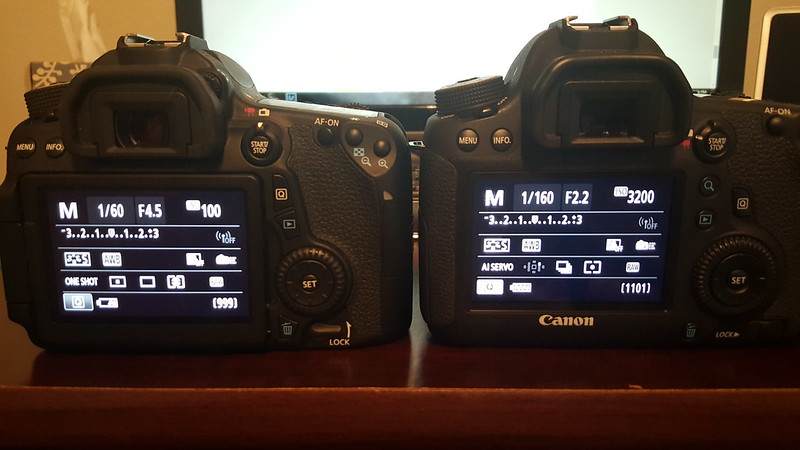
20151124_172417 by Jonathan Brady, on Flickr

Camera on the left is a 70D (has a touchscreen). This is the screen most of us see when shooting, no? If you press anywhere on that screen, NOTHING HAPPENS UNTIL you press the bottom left hand corner "Q" button on the screen. Notice how it looks different than the "Q" button on the screen on the 6D (camera on the right which doesn't have a touchscreen)? It's highlighted on the 70D to indicate that THIS is where you press to activate the touchscreen. Once you press that "Q", THEN you can press any of the other parameters on the screen to change them. Press the back button (replaces the "Q") to turn it off.

So, it's fast. You: press Q button, press parameter you want to change, change it, change anything else, press back button. Done. Just like "pinch to zoom" and "pan" within a zoomed picture when reviewing pics, it CAN be faster depending on your setup and the number of changes.

Personally, I don't use the screen to change parameters on my 70D. But I do use it to move through menus as well as pan through zoomed images. And obviously, also for touch-to-focus in video.
 
Upvote 0
derrald said:
What would the diffraction correction be and how would that work exactly? Sounds eerily like in-camera sharpening....

It's "DLO" (Digital Lens Optimizer). Check out Digital Photo Professional 4 to see what it can do. http://web.canon.jp/imaging/dlo/howto/index.html

FYI, using DLO in DPP 3 basically doubles the RAW file size. That's NOT the case in DPP 4 and I would assume that's the sort of implementation they've used in-camera for the 1DX Mark II. Earlier, I added DLO to a 6D image (same MP as the 1DX Mark II obviously) and the RAW file went from 22.9 MB to 23.0 MB.
 
Upvote 0
derrald said:
What would the diffraction correction be and how would that work exactly? Sounds eerily like in-camera sharpening....

Same thing that has been available in DPP for a few years now. The correction is tuned specifically for each lens's characteristics. So it's not just some fancy new in-cam sharpening.

Digital Lens Optimizer (DLO)

Digital Lens Optimizer is a special kind of image processing that achieves ideal optical characteristics by processing optical aberrations, image softening due to diffraction and the effects of using a low-pass filter with a CMOS image sensor. Canon has provided lens aberration and distortion correction within DPP for several years, but DLO has increased the capability to correct additional kinds of lens aberrations plus the softening effects of diffraction and the low-pass filter. Currently 29 different lenses are supported, in combination with several Canon EOS cameras, as shown in the tables later in this article.

Working with RAW images, Digital Lens Optimizer is able to correct seven types of lens aberrations and diffraction loss. The seven kinds of aberration that are corrected are:

Spherical aberration – this is image blur occurring in the centre of the image.
Curvature of field – this is blurring at the periphery of the image caused as a result of the lens’ focussing surface being curved.
Astigmatism – this is the blurring in the radial and circular directions at the image periphery.
Comatic aberration – this appears at the periphery of the image in a radial direction as image streaking or colour blurring.
Sagittal halo – this appears in the periphery of the image as a circular blur.
Chromatic aberration of magnification – this is the chromatic blurring at the periphery of the image.
Axial chromatic aberration – this is the mainly violet coloured blur that occurs in the centre of an image that has pinpoint light sources.

The overall softening of the image that is a result of small aperture diffraction loss and from the characteristics of the sensor’s low-pass filter is also corrected.
 
Upvote 0
The only thing I actually expected from 1DX Mark II was all cross type focus points and 9 dual cross type in the middle (forming a +).

I wonder if this also means Canon will bring 4k to the 5D4, but with 30FPS and lower bit rate.
 
Upvote 0
jebrady03 said:
derrald said:
What would the diffraction correction be and how would that work exactly? Sounds eerily like in-camera sharpening....

It's "DLO" (Digital Lens Optimizer). Check out Digital Photo Professional 4 to see what it can do. http://web.canon.jp/imaging/dlo/howto/index.html

FYI, using DLO in DPP 3 basically doubles the RAW file size. That's NOT the case in DPP 4 and I would assume that's the sort of implementation they've used in-camera for the 1DX Mark II. Earlier, I added DLO to a 6D image (same MP as the 1DX Mark II obviously) and the RAW file went from 22.9 MB to 23.0 MB.

Here is a pretty good explanantion of DLO: http://web.canon.jp/imaging/dlo/index.html
 
Upvote 0
Pretty well what I expected to see, a great, solid camera with many incremental improvements... except no built-in WiFi? ? ?

WTF? One would expect the ability in such a high end camera to stream images back to the editor without buying expensive options..... It's sad to think of Olympic photographers with an Eye-fi card in their 1DX2....

If I am at "the big game", be it in Brazil, New York, London, or even at the Fitzroy Harbour elementary school ball field, when I press the shutter, the image should be appearing a few seconds later on the editor's computer, back at the home office.... be it a few kilometers away or half way around the world.
 
Upvote 0
kozakm00 said:
tony armstrong said:
Where is the usual Canon three pin cable release port? Also, as I suspected the Mark II 1DX is just a technology catch-up model, bringing the Mark I up to date. Canon will now be developing the 1DX's true replacement, due out in eighteen months time. So don't upgrade yet folks.

Maybe on the right side right above the vertical grip on/off switch?

Could be right, that is definitely an addition.
 
Upvote 0
All the specs look pretty solid. Here's my thoughts -


AF:

Ok, Canon did not go for paper-specs and up the number of points. This shows that the 61 point system is more than capable. And the number of points isn't everything. But instead, the quality and speed of these points. Critics will bash Canon and say that Canon is recycling a 2011-era AF system in their flagship. However, the reality is this system is very strong and shows Canon was very far ahead of the competition.

I'm a little bit disappointed by the -3 EV autofocus, they should have pushed for -4 EV. I wonder if there are drawbacks to the AF system for going so very low light (speed or accuracy?) Time will tell.

Canon always suits their 1D for the needs of the pros who use and buy the 1D series. I doubt -4 EV was high up on the wants or needs list.


SENSOR:


No one knows anything until RAW image tests are done, so it's going to be a while. However, the ISO claims are well below that of Nikon.

The possibilities are:

Canon has only made a marginal leap in ISO.

Canon is more realistic with their ISO claims than Nikon.

Canon has made a big leap in ISO, changing the standards for IQ at high ISO's. In other words, 25,600 is now going to be cleaner than the 25,600 of previous generation WITHOUT having to add stops to the top end of the "native" ISO. This would imply that previous generation high ISO native limits were pushed too far with too weak of IQ. I would agree with this, as few people considered 25,600 to be useable. If the majority of users do not consider photographs from that setting to be usable, it shouldn't be in the "native" range. Just my opinion.

Canon is falling behind Nikon in ISO.

Canon has not improved ISO much, but instead relies more on noise reduction processing. This is what I suspect Nikon has done a lot of.


****


Other thoughts-


The camera looks solid. Would have been nice to see a 1/300 sync speed, but that's not a biggie. I doubt many 1DX owners will upgrade unless they absolutely need 4K or the F8 AF improvements.


This is going to be a big upgrade for all the other 1D series owners. There are many, many out there still cranking away with the older flagships.


Versus Nikon -


Canon has gone more for improving the existing pro features and things that sports shooters really need. Whereas Nikon is still in catch-up mode on that. The 1DX2 will still be the sports and action king. I don't want to prejudge as I'm sure IQ has improved, but it is likely Canon has made an incremental improvement, not a big improvement in IQ.


However, there's a segment of users out there who are NOT sports and action shooters. They are general photographers or even wedding pros who use flagships. For them, high ISO, low light and IQ will matter more than it does for the straight up sports shooters.

The IQ results will matter more to these types. Although, the Canon glass system is better and most are invested - I don't expect many defections if there's a big difference. First time users making the leap to flagship camera might switch if they have the need for that kind of ISO and DR.


Time will tell what the IQ results will be.


I think it will be a combination of - Nikon overhyping their IQ and sensor, and Canon making small, incremental improvements and being more honest about their specs. With Nikon probably edging Canon out in sensor IQ only by a small amount. With Canon glass making up a big part of the difference. Leaving Nikon only the DR advantage.

 
Upvote 0
Don Haines said:
If I am at "the big game", be it in Brazil, New York, London, or even at the Fitzroy Harbour elementary school ball field, when I press the shutter, the image should be appearing a few seconds later on the editor's computer, back at the home office.... be it a few kilometers away or half way around the world.

As it can be, with the WFT-E8.


Don Haines said:
except no built-in WiFi? ? ?

WTF? One would expect the ability in such a high end camera to stream images back to the editor without buying expensive options..... It's sad to think of Olympic photographers with an Eye-fi card in their 1DX2....

I suspect there's a good reason for the lack of built-in WiFi, beyond Canon wanting peple to pay for an accessory - country-specific regulations. Consider that for Canon bodies with built-in WiFi there is a 6D (WG) and a 6D (N), a 70D (W) and a 70D (N). For a body which will already be produced in relatively small numbers, two 'flavors' might not be desirable. It would be worse for Nikon, already producing two D5 variants for card slots, WiFi would mean four different cameras.
 
Upvote 0
stoneysnapper said:
kozakm00 said:
tony armstrong said:
Where is the usual Canon three pin cable release port? Also, as I suspected the Mark II 1DX is just a technology catch-up model, bringing the Mark I up to date. Canon will now be developing the 1DX's true replacement, due out in eighteen months time. So don't upgrade yet folks.

Maybe on the right side right above the vertical grip on/off switch?

Could be right, that is definitely an addition.

Yes, and if you magnify the image you can make out the cable remote trigger icon on that flap.
 
Upvote 0
shutterlag said:
Another Canon body with zero "wow" to it. I shot the 5DSR over the weekend. It's got a high resolution sensor, but who the heck wants a one-trick pony in this day and age?
Really educated post about the 5DS / R. Aside from the 50.6MP sensor the following are improvements over the 5D MKIII. a. metering sensor 150,000 252 zone b. Intelligent tracking c. Intelligent viewfinder II with AF point illumination on AI Servo d. crop modes, e. flicker detection f. mirror cam system to reduce shutter vibration with mirror lock up delay g. strenthened base plate h. intervalometer. It may not be geared for video or have the same dynamic range but Canon always stated its an addition to the range.
So its far from a one trick pony and is aimed at Photographers that want more resolution and know how to use it.
 
Upvote 0