ahsanford said:
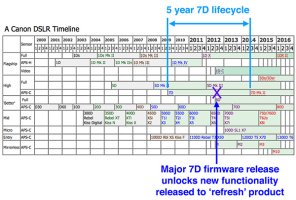
...we're only 2.5 years into its (presumed?) 5 year journey...It's not a rocksolid indicator of product lifecycles, but it shows a few key trends...
I disagree.
The 7DI had an unusually long life cycle that I doubt will be repeated. Several unique situations contributed to the life of the original 7D.
1) The 18 mp sensor used in the original 7D had an unusually long life cycle. For whatever reasons, Canon kept reusing the sensor in model after model, moving it downstream to the 60D, then the Rebels and even the SL1. Others who know more about this than I do, say that was because Canon was moving to new sensor manufacturing technology that was not ready until the birth of the 70D and 5DSr models. Those sensors, which are also the sensor used in the 7DII, showed significant improvements over the original 7D. Canon has now moved to even newer sensor manufacturing technology with the 80D, 1DX II and 5D IV. So, it's sort of a chicken and the egg question: was it the 7D that had a long life cycle?, or was it really the 18 mp sensor that had a long life cycle?
2) Nikon abandoned the high end crop sensor market until 2016 and then surprised everyone by jumping back in, in a very big way.For most of the 7D and 7DII life cycles, there was zero competition. That's no longer the case.
3) Canon has finally started including features like touch-screen and wifi in their higher end models. The fact that Canon introduced the SD card work-around for wifi indicates that Canon realized they have a competitive disadvantage against Nikon on connectivity. No doubt the SD card solution is a temporary fix meant to tide them over, but will never substitute for built-in connectivity.
4) All new Canon models are including multiple f8 focus points. They are doing this in order to keep the 100-400 II competitive with third party options. The single f8 focus point on the 7DII puts the 100-400 at a competitive disadvantage against the f6.3 zooms from Sigma and Tamron.
5) Comparisons between the original 7D and the 7DII are somewhat misleading. The original 7D was more of a successor to the 40D -- that is a high end, general purpose crop sensor camera. At the time of the release of the 7D I, the only available full frame cameras were the 5D and 1D series. Serious hobbyists and professionals had very limited choices and really no choice if they were not prepared to make the leap to full frame. The 7DII is very much a specialist camera, focused on sports, wildlife and birders. It is a "mini" 1DX, which is something the original 7D was not. With the 70D and now the 80D Canon has returned the XXD line to the place it occupied with the 40D. They then reinvented the 7DII. Comparing the life cycle of the 7DI to the 7DII is not relevant because they are very different cameras, targeted to very different markets.





 ;D
;D


