
You are using an out of date browser. It may not display this or other websites correctly.
You should upgrade or use an alternative browser.
You should upgrade or use an alternative browser.
Any chance for a 7D Mark 'II+'?
- Thread starter benkam
- Start date

Mikehit said:Isn't basing the '7D life cycle' on a sample size of 1 a bit risky?
Of course. It's a guess.
-A
Upvote
0

ahsanford said:Mikehit said:Isn't basing the '7D life cycle' on a sample size of 1 a bit risky?
Of course. It's a guess.
I say it's a well educated guess because the 7D type of construction and market (though different segment) is quite comparable to the 5D series. So we can take the 5D life cycle time into account as well. So 4 to 5 years seem reasonable.
Upvote
0

Mikehit said:Isn't basing the '7D life cycle' on a sample size of 1 a bit risky?
1DC 5 years (so far)
1DX 4 1/4 years
5D3 4 1/2 years
6D 5 1/4 years (so far)
7D 5 years
7D2 3 1/4 years (so far)
4 3/4 years seems to be the average and the 7D2 is at 3 1/4 years...... A reasonable GUESS at replacement time would be 1 1/2 years in the future.
Upvote
0
Don Haines said:Mikehit said:Isn't basing the '7D life cycle' on a sample size of 1 a bit risky?
1DC 5 years (so far)
1DX 4 1/4 years
5D3 4 1/2 years
6D 5 1/4 years (so far)
7D 5 years
7D2 3 1/4 years (so far)
4 3/4 years seems to be the average and the 7D2 is at 3 1/4 years...... A reasonable GUESS at replacement time would be 1 1/2 years in the future.
Yeah, I've been pegging my estimates based on other swim lanes... sometimes.
1D/5D/6D seem to be tracking around 4.5 years at present. It was faster 2 generations ago, but it appears to have slowed a bit due to so many new lines (6D, EOS M, Cinema, etc.) getting offered. There's also a 'release cadence' of 1D/5D/6D in a very deliberate and sequential/staggered manner, so I see those three brands' timing being linked. These brand lines are the most predictable based on now having nearly two full release rotations.
7D seems to be on the longer timeline as a niche product, but since there's nothing like it, it seems less depending on other product lines for a 'release window' to get all the spotlight.
The 80D line seems to be on a 3 year strategy and Rebels now seem to be a 2 year refresh.
5DS remains the mysterious animal that might get updated sooner rather than later. It should be part of the FF release order I referred to before, as a 1.5-2 year gap between 5DS and 5D4 leads to 5D-level 'feature-set envy' where prospective 5D-level buyers keep their money in their pocket because there might be new tech around the corner. So a fast follow-up to the 5DS is the most plausible product line to accelerate, IMHO.
- A
Upvote
0
unfocused
Photos/Photo Book Reviews: www.thecuriouseye.com
Mikehit said:Isn't basing the '7D life cycle' on a sample size of 1 a bit risky?
Yes. But, more to the point, people are basing the "7D life cycle" on arbitrary factors that Canon almost certainly considers irrelevant.
There is no doubt in my mind that Canon decides when to release new models based on market conditions and availability of technological improvements. The technology probably follows fairly consistent development cycles, but those cycles aren't going to be precise.
Since these two most important factors are unknown to us (we don't know anything about Canon's technology development cycles, nor do we really know anything about market conditions), people tend to assign significance to factors they can define. They might be right in their predictions, or they might be wrong, but the reality is, it is mere coincidence.
Still it is fun to speculate. After all that represents about 90% of the content on this forum.
My personal speculation:
The 7DIII will certainly have in-camera wi-fi and a full featured touch screen, will likely have 4K and could replace the SD slot with CFast. All of this is technology that is available today, so has little impact on the release date. (The release of the wifi card indicates that Canon was concerned enough about the Nikon D500 to create a workaround for the lack of connectivity. This can be argued is an indicator that they wanted to extend the life cycle of the 7DII, but it could also be argued that they simply wanted to get the workaround to market as quickly as possible to keep from bleeding sales.)
Canon has shown no hesitation to leapfrog the 1D series with improvements in autofocus as they become available. So I expect the autofocus of the 7DIII will be state of the art at the time of release.
The current sensor holds up quite well against both the D500 and 80D at ISO 400 and above. Dynamic range improvements at base ISO are nice, but not that significant to sports, bird and wildlife shooters, who are the primary users of this camera and it's competitor.
So, my argument would be that the next generation of 7DIII will wait until Canon achieves the next level of sensor performance (or until they decide that they are as close as they can get, within reasonable time frames)
We do know from the release of the 1DX II and the 5D IV that the latest generation of sensors seems to have significantly narrowed the old gap between higher megapixels vs. lower megapixels. By that, I mean that the lower megapixel count of the 1DX II results in only slight improvements in noise at higher ISO over the 5D IV. This, of course, bodes very well for future APS-C sensors.
The unknown here, is just how much of an improvement can we expect in the next generation of sensors. As noise performance becomes divorced from pixel density, are we moving toward an era where full-frame cameras won't have any real advantage over APS-C? My guess (hope too) is that Canon would love to release a 7D III that comes very close to the 5D IV in high ISO performance. A few years ago that would have been a completely unrealistic expectation, but given what we have seen in recent releases, it is now not that unlikely.
And, no, I don't believe Canon would be the least bit concerned about undermining 5D or 1D sales by offering a 7D that it "too good."
Upvote
0
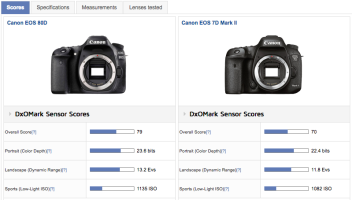
unfocused said:The unknown here, is just how much of an improvement can we expect in the next generation of sensors. As noise performance becomes divorced from pixel density, are we moving toward an era where full-frame cameras won't have any real advantage over APS-C? My guess (hope too) is that Canon would love to release a 7D III that comes very close to the 5D IV in high ISO performance. A few years ago that would have been a completely unrealistic expectation, but given what we have seen in recent releases, it is now not that unlikely.
Don't we already have a read on both of your questions based on the 80D sensor? Is it not the first on-chip ADC crop sensor Canon has made? See comparison below -- I think that broadly speak to the potential improvement that have many folks on this forum clamoring for in 7D2+ / 7D3: they want that new sensor tech in a high FPS crop body.
- A
Attachments
Upvote
0
unfocused said:The unknown here, is just how much of an improvement can we expect in the next generation of sensors. As noise performance becomes divorced from pixel density, are we moving toward an era where full-frame cameras won't have any real advantage over APS-C? My guess (hope too) is that Canon would love to release a 7D III that comes very close to the 5D IV in high ISO performance. A few years ago that would have been a completely unrealistic expectation, but given what we have seen in recent releases, it is now not that unlikely.
As to hoping for "a 7D III that comes very close to the 5D IV in high ISO performance", good luck with that. Using DXO's 'at-least-it's-consistent' low light sensor method, here's how they stack up.
DXO ISO / Sports score for each of these:
(on-chip ADC in blue -- please correct me if I've got this wrong)
1DX2: 3207
5D4: 2995
1DX1: 2786
6D: 2340
5DS R: 2308
5D3: 2293
80D: 1135
7D2: 1082
70D: 926
7D1: 854
I appreciate this is crude 'overall' lowlight score and glosses over the quality of the shot/noise/grain at higher ISO, but just drawing a rough trend: the line-leading sensors for low light in crop are a solid 1.5 stops behind the line-leading sensors for FF, and are still a solid full stop behind last-gen FF sensors like the 5D3.
I would argue that even with on-chip goodness going on, Canon's ability to improve low light performance over time is much smaller than the physical advantage FF has over APS-C.
I suppose backlighting the sensor like Sony does with the A7R II could deliver a considerable bump in high ISO performance, but that's not current Canon APS-C/FF sensor tech, is it? That's future tech for Canon, correct? (I'm not well read on that at all.)
- A
Upvote
0
unfocused
Photos/Photo Book Reviews: www.thecuriouseye.com
ahsanford said:Using DXO's 'at-least-it's-consistent' low light sensor method, here's how they stack up.
DXO ISO / Sports score for each of these:
(on-chip ADC in blue -- please correct me if I've got this wrong)
1DX2: 3207
5D4: 2995
1DX1: 2786
6D: 2340
5DS R: 2308
5D3: 2293
80D: 1135
7D2: 1082
70D: 926
7D1: 854
Perhaps I overreached. But, what I'm simply suggesting is that we seem to be seeing less of a clear-cut distinction between pixel density and noise than has been the case in the past.
Let's take a quick look at those DXO numbers. If we accept them, we are saying that the 30mp 5DIV outperforms the 18mp 1DX I. The scores also indicate that the 50mp 5D SR marginally improved upon the 20mp 5D III. (Neither of which used on-chip processing).
That, actually, may be the most significant number, because it shows how little price was being paid for pixel density in the previous generation of sensors. We now have the 1DX II and 5DIV to compare and it's pretty evident that the price being paid with the current generation of sensors is even smaller.
Of course, numbers mean nothing, since what ultimately counts is real world performance. I don't think anyone would argue that the either the 5DIV or the 1DX II offers three-times the high ISO performance of the 80D, despite what the scores might say.
If one were to attempt to translate that into real world performance, ISO 400 on the 80D would be comparable to ISO 1600 on the 5DIV and 1DX II. I can't vouch for the 80D, but I can assure you that when shooting the 7DII and 1D X II side by side, the ISO performance of the 1DX II is definitely not three times as good as the 7DII. On average I would give the 1DX II at best a one-stop advantage. (Unscientific, real world shooting).
I don't want to get into a meaningless debate, particularly since I know that many people are absolutely convinced that full frame sensors are visibly better under all circumstances. My point is simply that there appears to be a convergence going on and it will be interesting to see what Canon offers in the next top-of-the-line APS-C sensor.
Upvote
0
Hector1970 said:I find the sensor the worst thing about it. I find the pixels a bit mushy. It's poor at higher ISO and I use it a lot for sport at 1/500 sec so it's not at base ISO.AlanF said:What it needs most is a new sensor. The present one isn't bad, and can give great results. But, a crop from the 5DS R is better in terms of sharpness and noise. Personally, I would not upgrade until they put in a new sensor without a low-pass filter. The filter is too aggressive on these pixel dense sensors, far more so than on the FF 5DIV and 5DIII.
I think it's a cut down version of the 5DSR sensor. For me it too is poor at higher ISO.
The 5DIV has much more pleasing high ISO characteristics.
On the 7DIi I find the frame rate great and the focus is very clear and sharp through the eyepiece.
I find the resultant file to be short on what I expect.
Can you be more specific - are you talking about pixel-level 'ISO characteristics', or image-level? One would expect the camera with lower pixel density/larger pixels to look better at 100%, but when normalised things get muddier.
Upvote
0
Did I say I expected a 5D Image quality?
I find the 7D II has the same image issue as a 5DSR. Both have a smudginess in the pixels that make the images slightly unsharp.
I don't expect a 7DII to have the same image quality as a 5D camera so I'm not living in a fantasy land.
I expected a camera to have an excellent APS-C sensor.
It has an excellent focusing system and frame rate but for me it's let down by it's sensor.
You are obviously delighted with it so happy days for you.
As a camera I think it was a missed opportunity and it has most of the ingredients for a camera to not require an upgrade in the near term but let down by it's sensor.
I think it and the 5DSR suffer from the same problem of too many Megapixels crammed on the sensor.
Both work reasonably well in excellent light but fall short as soon as ISO needs to be raised up.
Photos look very sharp through the eye piece so its looks as if its focussing correctly.
I find the 7D II has the same image issue as a 5DSR. Both have a smudginess in the pixels that make the images slightly unsharp.
I don't expect a 7DII to have the same image quality as a 5D camera so I'm not living in a fantasy land.
I expected a camera to have an excellent APS-C sensor.
It has an excellent focusing system and frame rate but for me it's let down by it's sensor.
You are obviously delighted with it so happy days for you.
As a camera I think it was a missed opportunity and it has most of the ingredients for a camera to not require an upgrade in the near term but let down by it's sensor.
I think it and the 5DSR suffer from the same problem of too many Megapixels crammed on the sensor.
Both work reasonably well in excellent light but fall short as soon as ISO needs to be raised up.
Photos look very sharp through the eye piece so its looks as if its focussing correctly.
Mikehit said:Hector1970 said:I find the resultant file to be short on what I expect.
It depends what you mean by 'expect'. If you expect 5D image quality for the price of the 7D2 you are living in fantasy land.
The 7D2 was intended to be a top-of-the-range APS-C camera in much the same way as the 1Dx is the top of the FF range- it is a wildlife/action camera for those who can't afford the 1Dx.
And that is the compromise you choose when you go for the 7D line.
Upvote
0
Hector1970 said:Did I say I expected a 5D Image quality?
I find the 7D II has the same image issue as a 5DSR. Both have a smudginess in the pixels that make the images slightly unsharp.
I don't expect a 7DII to have the same image quality as a 5D camera so I'm not living in a fantasy land.
I expected a camera to have an excellent APS-C sensor.
It has an excellent focusing system and frame rate but for me it's let down by it's sensor.
You are obviously delighted with it so happy days for you.
As a camera I think it was a missed opportunity and it has most of the ingredients for a camera to not require an upgrade in the near term but let down by it's sensor.
I think it and the 5DSR suffer from the same problem of too many Megapixels crammed on the sensor.
Both work reasonably well in excellent light but fall short as soon as ISO needs to be raised up.
Photos look very sharp through the eye piece so its looks as if its focussing correctly.
Mikehit said:Hector1970 said:I find the resultant file to be short on what I expect.
It depends what you mean by 'expect'. If you expect 5D image quality for the price of the 7D2 you are living in fantasy land.
The 7D2 was intended to be a top-of-the-range APS-C camera in much the same way as the 1Dx is the top of the FF range- it is a wildlife/action camera for those who can't afford the 1Dx.
And that is the compromise you choose when you go for the 7D line.
Hard to know what you mean precisely without example images, but smaller pixels are bound to be at a disadvantage in some regards compared to larger ones. However, image-level sharpness should be better with more, smaller pixels (i.e. not viewed 100% or 1:1, but normalised to the same size as an image from a lower resolution camera with the same size sensor).
Upvote
0
Don Haines said:K said:Canon should not stick to these 3-4 year update intervals so strictly.
The 7DII is a prime example. Since its release, Canon has significantly updated their sensor technology with on-chip ADC which makes a big difference.
7D2 only needs the following, simple and very reasonable updates --
1. Updated Sensor
2. Touch Screen
3. Built in Wifi
UHS-II card compatibility would be nice, but not necessary. Beyond that, this camera is stacked with high performance features.
If they can do the above AND add just 0.5 or 1fps to make it 11fps (to be able to top Nikon D500 on specs, since FPS on these IS THE main point) ...then they could label it the 7D Mark III easily. It would be a respectable update, without much else.
2018 is probably when the 7D3 will happen. Shortly after, an updated or unified 5DSR2.
First point, it will be UHS-II because for the last few years nobody has designed for UHS-I because the modules are end of lifespan and are not being produced any more.....
Second point - touch screen..... I was amazed that the 7D2 did not have it nor did it have WiFi.... but at the time of the development cycle when the decision was made to lock down the hardware it obviously made good sense or they would have included it. Where we stand now, Touchscreens and WiFi interfaces are old hat.... the user interface software is written and runs reliably on a lot of different models, so including it on a 7D3 is probably a done deal....
Third point - updated sensor.... When the decision in the development cycle is made to lock the hardware design, Canon will use the best possible tech in the appropriate price range.... the point that many of us forget is that the development cycle of a camera is approximately 5 years long.... Work on the 7D3 would have started before the 7D2 was released. At some point, most likely 2 years before release date, the hardware design will be locked and contracts will start to go out to various companies to start producing the various components, the electronics, the camera body, printing manuals, etc etc.... by the time any camera (Canon, Nikon, Sony, etc) reaches the market it is obsolete.
And the big point.... Canon is really good at surprising us. It is possible that the 7D3 might be a mirrorless monster (EF-S mount and same size) that does things like face recognition and tracking and with a 60FPS burst mode and multi-image averaging... Who knows? Not me, but the speculation sure is fun.....
I don't think sensor price is an issue, the 80D sensor is better than the 7D2 sensor in a lower cost camera. It employs Canon's newest APS-C tech.
Touchscreen, wifi - ok whatever. Say it doesn't have it. But a sensor update is very reasonable and doesn't seem like it would require a complete redesign or some massive 5 year product development cycle. If that is the case, then Canon has some serious problems and development is too slow to compete in technology.
The 7D2 is almost the perfect APS-C machine. It's also probably one of Canon's best relatively speaking. Its only weakness is the sensor compared to the competition. Touchscreen and built in wifi are extras. New things. They don't make a better photo. But a newer sensor can.
7D2 is going to have a weaker, older tech sensor than the 80D and Rebel line. That doesn't make sense. T
UHS-II isn't exactly new, yet the 80D, 5D4 and 5DS doesn't have it. No Canon has it yet. Are you suggesting Canon implements new tech only when forced to by outside industry aka obsolescence? If so, that is sad.
I can understand why they didn't put it in the 5D4, this would have undermined the move to keep CF - an old as dirt standard, and the move to keep CF was to get the 4K recording fanatics off their back. Canon can say the card can't handle it, rather than say they intentionally weakened 4K recording in the 5D lineup to protect the 1DX2 and Cinema lines. I doubt Canon really gives a crap
But on the 80D? The camera only has 1 slot, at least make it the fastest it can be.
This reminds me of the lousy SD slot on the 5D3. What a piece of crap that thing is. Use 2 cards, which is the point of having two cards, totally kill your buffer unload times. Terrible. At least the 6D had an updated SD slot.
Upvote
0
unfocused
Photos/Photo Book Reviews: www.thecuriouseye.com
K said:..But a sensor update is very reasonable and doesn't seem like it would require a complete redesign or some massive 5 year product development cycle...
The 7D2 is almost the perfect APS-C machine...Its only weakness is the sensor compared to the competition..
Except that the difference in the 80D and 7DII sensor really only affects base ISO. At higher ISOs, where most 7DII users are likely to be shooting, the 7DII is at or close to both the 80D and the 500D. I believe Canon will wait until it can unveil a new sensor that actually improves upon performance at the ISOs that most 7DII shooters need.
Upvote
0
unfocused said:K said:..But a sensor update is very reasonable and doesn't seem like it would require a complete redesign or some massive 5 year product development cycle...
The 7D2 is almost the perfect APS-C machine...Its only weakness is the sensor compared to the competition..
Except that the difference in the 80D and 7DII sensor really only affects base ISO. At higher ISOs, where most 7DII users are likely to be shooting, the 7DII is at or close to both the 80D and the 500D. I believe Canon will wait until it can unveil a new sensor that actually improves upon performance at the ISOs that most 7DII shooters need.
80D can be even better than it is, 7D2 has the advantage of more advanced processing which is why it is very close despite an old technology sensor. D500 has an edge for sure.
It's the same thing Nikon does between the D3x00, D5x00 and D7x00 lines...processing leads to IQ advantages of the higher line camera, even though the sensors are basically identical. There's a lot of talk about sensors, but the processing is a big part of what you get. Different manufacturers can get different results from the same sensor. We've seen this in the industry before.
I'm thinking an 80D or slightly updated sensor in the 7D3 with the processing it has will be fantastic and finally match (maybe not surpass) the Nikon/Sony competitors.
Figure, the 7D2 sensor, while a big improvement for Canon at the time...was not at all the best APS-C sensor on the market when it was released. Now, nearly 3 years later - it is really showing its age. It's a different thing to be the best, cutting edge technology sensor on day 1. Because that can carry longer.
Upvote
0
Similar threads

- Replies
- 51
- Views
- 7K

- Replies
- 42
- Views
- 8K

- Replies
- 4
- Views
- 610
- Replies
- 15
- Views
- 2K

- Replies
- 48
- Views
- 6K