
You are using an out of date browser. It may not display this or other websites correctly.
You should upgrade or use an alternative browser.
You should upgrade or use an alternative browser.
Any thoughts on how the 5d3 will compare on dxo mark to the Nikon D800?
- Thread starter KKCFamilyman
- Start date
- Status
- Not open for further replies.
S
straub
Guest
peederj said:If they aren't using dithered ADCs, then you are right 14bits will not cut it for 14 stops...but if that were the case, we simply wouldn't have the dynamic range they are delivering. We would have more like 10 bits which you are claiming, but really, I think those bits are being lost at the DSP stage and not the ADC stage. All my posts on this subject have been addressed to the person that claimed the 5d3 and D800 were weak because they only had 14 bit ADCs, and I wanted to argue (though I am not an expert on photo sensors!) that that argument was likely false.
My point wasn't that the 5D3 or D800 would be "weak" per se, I'm sure that on any sensible criteria, they are superior to pretty much anything. My point was more about the fact that after a point, any extra DR will be practically unusable, and thus, using the calculated (or even measured) maximum DR as a criteria in comparing sensors or cameras is misleading at best. Now, I'm not sure what the practical maximum usable DR with 14 bits is; I picked 10 stops since at that level the quantization isn't yet too harsh in the bottom end (IMO).
Example: Let's say D800 has 14 stops and 5D3 12 stops. Using mild simplification, the D800 can represent the entire 14-bit range of [0,16383] and 5D3 only the range of [4,16383]. I'd assume the D800 now gets a significantly higher score in "objective" rating for DR, since after all, it has those two extra stops. But those extra stops are represented by values 0, 1, 2 and 3. Hardly a significant advantage, I'd say. Nor is it reason to moan that Canon have done nothing in 3,5 years since the 5D2 also had 12 stops.
Sure, dithering in the ADC may help with the posterization effects of the bottom stops, but the resultant pixel data will still be linear 14-bit integers. The bottom stops will still only have only a few possible brightness levels to represent their data.
Upvote
0

wickidwombat said:https://rapidshare.com/files/3227854404/045C0461.CR2pdirestajr said:Why is everyone taking pictures In the dark?
Is that a good enough reason?

People are taking pictures in the dark to increase the likelihood they'll get beat up by a jealous bf?
Upvote
0
Ah I see, your misunderstanding turns out to be extremely simple. What you must grasp, and I know this seems too simple to be true, but it's a fact...Each stop of dynamic range for each photocell contains one and only one bit of information!
Therefore for the 14th and dimmest stop, all we need to represent its complete state are the values 1 and 0. Any values beyond those are beyond the precision of the photocell and will just consist of random noise from brownian motion etc. There is no lost analog information whatsoever.
It's also true for every other stop, each bit will remain in base 2, either on or off, and the fact there are more bits to the right is no different than there being other bits to the left. The collection of all these bits that are significant and vary according to the signal being measured sums up to your precision, the number of those bits being your dynamic range. But each stop of that dynamic range is fully represented by its corresponding bit, and no more are needed or could be useful given the limitations of the sensor.
If you could somehow "see more" detail down at that dimness level 14EV below clipping, see more than simply a choice between pure black vs. infinitesimally lighter black, then...you'd have more than 14 stops of dynamic range in your photocell!
Obvious once you get it but hard to get there often!
And no you wouldnt want to snip off any of those bits of dynamic range and the fact they use 14 bit ADCs for 14 bits of information is great. If you used 10bit ADCs your sensor would only have 10 usable stops of dynamic range no matter what you did subsequently. Dithering prevents quantization effects from harming the delivered quality at no loss of dynamic range. You will get all 14 bits and 14 EV's and they will all be equally useful and good.
And my main concern with the reported figures as I said isn't the dynamic range of the sensor or ADCs, it's the narrow 16 bit space the DSP is done within. If that is an accurate report.
Therefore for the 14th and dimmest stop, all we need to represent its complete state are the values 1 and 0. Any values beyond those are beyond the precision of the photocell and will just consist of random noise from brownian motion etc. There is no lost analog information whatsoever.
It's also true for every other stop, each bit will remain in base 2, either on or off, and the fact there are more bits to the right is no different than there being other bits to the left. The collection of all these bits that are significant and vary according to the signal being measured sums up to your precision, the number of those bits being your dynamic range. But each stop of that dynamic range is fully represented by its corresponding bit, and no more are needed or could be useful given the limitations of the sensor.
If you could somehow "see more" detail down at that dimness level 14EV below clipping, see more than simply a choice between pure black vs. infinitesimally lighter black, then...you'd have more than 14 stops of dynamic range in your photocell!
Obvious once you get it but hard to get there often!
straub said:My point wasn't that the 5D3 or D800 would be "weak" per se, I'm sure that on any sensible criteria, they are superior to pretty much anything. My point was more about the fact that after a point, any extra DR will be practically unusable, and thus, using the calculated (or even measured) maximum DR as a criteria in comparing sensors or cameras is misleading at best. Now, I'm not sure what the practical maximum usable DR with 14 bits is; I picked 10 stops since at that level the quantization isn't yet too harsh in the bottom end (IMO).
Example: Let's say D800 has 14 stops and 5D3 12 stops. Using mild simplification, the D800 can represent the entire 14-bit range of [0,16383] and 5D3 only the range of [4,16383]. I'd assume the D800 now gets a significantly higher score in "objective" rating for DR, since after all, it has those two extra stops. But those extra stops are represented by values 0, 1, 2 and 3. Hardly a significant advantage, I'd say. Nor is it reason to moan that Canon have done nothing in 3,5 years since the 5D2 also had 12 stops.
Sure, dithering in the ADC may help with the posterization effects of the bottom stops, but the resultant pixel data will still be linear 14-bit integers. The bottom stops will still only have only a few possible brightness levels to represent their data.
And no you wouldnt want to snip off any of those bits of dynamic range and the fact they use 14 bit ADCs for 14 bits of information is great. If you used 10bit ADCs your sensor would only have 10 usable stops of dynamic range no matter what you did subsequently. Dithering prevents quantization effects from harming the delivered quality at no loss of dynamic range. You will get all 14 bits and 14 EV's and they will all be equally useful and good.
And my main concern with the reported figures as I said isn't the dynamic range of the sensor or ADCs, it's the narrow 16 bit space the DSP is done within. If that is an accurate report.
Upvote
0
S
straub
Guest
peederj said:Ah I see, your misunderstanding turns out to be extremely simple. What you must grasp, and I know this seems too simple to be true, but it's a fact...Each stop of dynamic range for each photocell contains one and only one bit of information!
Therefore for the 14th and dimmest stop, all we need to represent its complete state are the values 1 and 0. Any values beyond those are beyond the precision of the photocell and will just consist of random noise from brownian motion etc. There is no lost analog information whatsoever.
It's also true for every other stop, each bit will remain in base 2, either on or off, and the fact there are more bits to the right is no different than there being other bits to the left. The collection of all these bits that are significant and vary according to the signal being measured sums up to your precision, the number of those bits being your dynamic range. But each stop of that dynamic range is fully represented by its corresponding bit, and no more are needed or could be useful given the limitations of the sensor.
If you could somehow "see more" detail down at that dimness level 14EV below clipping, see more than simply a choice between pure black vs. infinitesimally lighter black, then...you'd have more than 14 stops of dynamic range in your photocell!
Obvious once you get it but hard to get there often!
I understand that the DR is 14 stops. My point is that the bottom stops are not usable in any practical situation since the quantization destroys any detail at that level. You can dither so that the average quantization error over the whole frame is zero, but still the local pixels have little to do with the actual frame you were trying to capture. There is simply not enough resolution for the bottom stops, unless you performed everything in floating point math. And as such the DR is a poor metric for the sensor's quality in capturing shadow detail.
Upvote
0
straub said:I understand that the DR is 14 stops. My point is that the bottom stops are not usable in any practical situation since the quantization destroys any detail at that level. You can dither so that the average quantization error over the whole frame is zero, but still the local pixels have little to do with the actual frame you were trying to capture. There is simply not enough resolution for the bottom stops, unless you performed everything in floating point math. And as such the DR is a poor metric for the sensor's quality in capturing shadow detail.
That's the thing, there is no "resolution" for a given photocell, there is only dynamic range. And each stop and each bit of that is useful (assuming the ADC is good enough to measure all 14 stops and output them accordingly...you could have a 14 bit ADC that was faulty and only yielded 10 bits of information). If your ADC is up to spec it will faithfully report all 14 bits and they will not need floating point math or anything else to be useful and high quality.
Now taking that readout and performing DSP on it, that _would_ benefit from floating point math.
The "bottom stops" and shadow detail will have just as many possible gradations as those at all other light levels. Slightly lighter black or slightly darker white, how slightly you can vary is determined by your dynamic range, culminating in your least significant bit. Least significant, yes, but still significant and valuable.
Upvote
0
S
straub
Guest
peederj said:That's the thing, there is no "resolution" for a given photocell, there is only dynamic range. And each stop and each bit of that is useful (assuming the ADC is good enough to measure all 14 stops and output them accordingly...you could have a 14 bit ADC that was faulty and only yielded 10 bits of information). If your ADC is up to spec it will faithfully report all 14 bits and they will not need floating point math or anything else to be useful and high quality.
Now taking that readout and performing DSP on it, that _would_ benefit from floating point math.
The "bottom stops" and shadow detail will have just as many possible gradations as those at all other light levels. Slightly lighter black or slightly darker white, how slightly you can vary is determined by your dynamic range, culminating in your least significant bit. Least significant, yes, but still significant and valuable.
Perhaps resolution was the wrong word. What I meant was that
-the lowest measured EV, mark it EV(0), will be a '1' in the output (as opposed to a '0' which is below the DR).
-one stop brighter EV(1) is a '2'. Any brightness between EV(0) and EV(1) will be quantized to one of these. So *any* detail less than <1EV at this level is lost.
-one stop brighter still, EV(2) is a '4'. We can resolve a half-stop difference between EV(1) and EV(2), but nothing more.
-one stop brighter still, EV(3) is a '8'. We can resolve quarter-stop differences between EV(2) and EV(3), but nothing more.
-etc.
Upvote
0
pdirestajr said:Why is everyone taking pictures In the dark?
Photography is about capturing the light. I think it's nuts that so many "camera testers" care so much about these insane ISO levels. What were you photographing a few years ago when high ISO was terrible? Or when you had 100 Speed film loaded in your camera?
I think it's all a bit out of hand. And I don't want to hear the line "pros need these better tools blah blah blah..."
Pros have been capturing images for generations! It's all marketing now. ALL of these cameras are capable of capturing amazing images. Enjoy the camera you choose, and learn it's strengths and weaknesses.
While I agree with the sentiment, I have to laugh about good enough ISO's a few years ago.
They were terrible.
Now the Canon Rebel XTi is by no means a Pro Camera, but it was pretty good when I purchased it a few years back. While waiting for the 5DmIII to be announced and delivered, my trusty 7D was in damage repair due to a tripod accident. So for the NASCAR Hauler Parade in Las Vegas, I had to pull out the XTi. I knew it was going to be bad, but I needed some shots for friends and their 4-year old.
Wow - it was a raging blizzard of noise at 1600 ISO - all I could use since slower was a motion blur...
We have come a long way!

(whoops, its an adobeRGB image in sRGB space... oh well, its 2:45 am and the noise is the point of the image)
(oh, and even if I had the 5DmIII, Tony Stewart's hauler had the equivalent of three train locomotives worth of horns - so it was extremely noisy in a different way. Good Night!)
Attachments
Upvote
0
Oh Ok I'm now interpreting you as criticizing the fact it's a linear 14 bit fixed point encoding scheme coming off the ADCs. Well there's absolutely nothing wrong with linear encoding if it encompasses the full dynamic range of the photocell. Using a floating point encoding scheme would usually be done to throw information away, i.e. compress the data that was less interesting. Since we are interested in every gradation of the visible light spectrum equally, using linear encoding is the high end way to do it, not a compromise.
straub said:Perhaps resolution was the wrong word. What I meant was that
-the lowest measured EV, mark it EV(0), will be a '1' in the output (as opposed to a '0' which is below the DR).
-one stop brighter EV(1) is a '2'. Any brightness between EV(0) and EV(1) will be quantized to one of these. So *any* detail less than <1EV at this level is lost.
-one stop brighter still, EV(2) is a '4'. We can resolve a half-stop difference between EV(1) and EV(2), but nothing more.
-one stop brighter still, EV(3) is a '8'. We can resolve quarter-stop differences between EV(2) and EV(3), but nothing more.
-etc.
Upvote
0

straub said:Example: Let's say D800 has 14 stops and 5D3 12 stops. Using mild simplification, the D800 can represent the entire 14-bit range of [0,16383] and 5D3 only the range of [4,16383]. I'd assume the D800 now gets a significantly higher score in "objective" rating for DR, since after all, it has those two extra stops. But those extra stops are represented by values 0, 1, 2 and 3. Hardly a significant advantage, I'd say. Nor is it reason to moan that Canon have done nothing in 3,5 years since the 5D2 also had 12 stops.
For those who aren't as technically inclined in things electronic, what does this mean in plain English
?I understand that the DR is 14 stops. My point is that the bottom stops are not usable in any practical situation since the quantization destroys any detail at that level. You can dither so that the average quantization error over the whole frame is zero, but still the local pixels have little to do with the actual frame you were trying to capture.
Same question as above. The reason I ask is that I see all these people crying or rejoicing that the D800 crushes the 5DII and III by 2.5 stops of DR. Perhaps I don't have discriminating eyes, but I'm having an awfully hard time distinguishing any substantial advantage of the Nikon's DR in high contrast sample images. I'd think that 2-3 stops of DR would be very obvious to the naked eye, even if it's untrained.
Upvote
0
The D800's photocells look to have very similar DR to the 5D3's, but the D800 has packed them more densely, and DR improves when reducing resolution, so the D800's advantage in MP will be felt in the noise performance of an uncropped but reduced resolution output. So if you are delivering 8MP JPEGs from RAW originals with the same per-pixel DR, the 36MP original will have better delivered performance than the 22MP one. At least that is how I understand the theory there.
So ask people making those claims if they are based on 100% crops/full-res or reduced resolution output. It was claimed DXO normalizes to 8MP in making their analysis which would be the latter case and favor the D800 enormously.
I don't believe the D800 has any per-pixel DR advantage over the 5D3, but it doesn't look like a disadvantage either. That they have packed the pixels that tightly and maintained DR is impressive, apparently they have built a degree of ADC out onto the sensor itself to help with that, or at least help pull all that data down efficiently.
So ask people making those claims if they are based on 100% crops/full-res or reduced resolution output. It was claimed DXO normalizes to 8MP in making their analysis which would be the latter case and favor the D800 enormously.
I don't believe the D800 has any per-pixel DR advantage over the 5D3, but it doesn't look like a disadvantage either. That they have packed the pixels that tightly and maintained DR is impressive, apparently they have built a degree of ADC out onto the sensor itself to help with that, or at least help pull all that data down efficiently.
Upvote
0
peederj said:The D800's photocells look to have very similar DR to the 5D3's, but the D800 has packed them more densely, and DR improves when reducing resolution, so the D800's advantage in MP will be felt in the noise performance of an uncropped but reduced resolution output. So if you are delivering 8MP JPEGs from RAW originals with the same per-pixel DR, the 36MP original will have better delivered performance than the 22MP one. At least that is how I understand the theory there.
I know it's an apples to oranges comparison, but does this mean that the D800's DR advantage is most obvious when its resolution is reduced to the same level as the 5DIII? I can see why you'd downsize the resolution if you're DxO to level the playing field with sensors of different resolutions, but I can't see doing this in real life. A massive part of the D800's appeal is its resolution and DR, so I can't see why you'd pay for a 36 megapixel sensor only to throw those pixels away.
I've tried to comprehend the DxOMark test standards the best I can, but apparently I'm not the smartest person out there. When I think about the practical advantages of greater DR, I envision that it would enable me to recover burned out highlights, or pull out more shadow detail, out of a high-contrast scene.
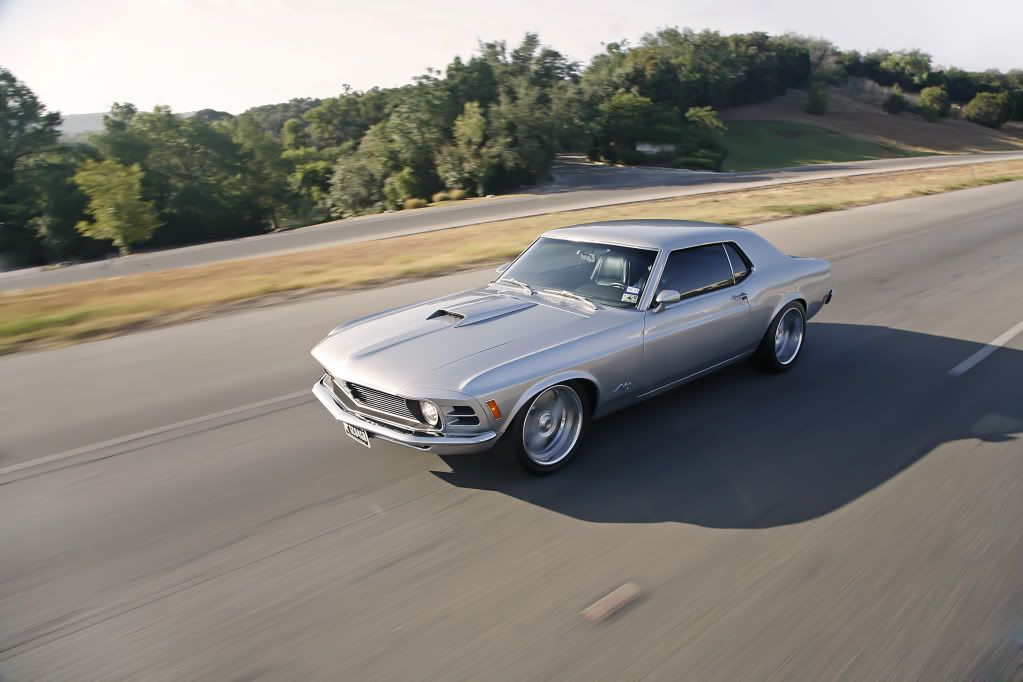
For instance, I have no idea how many stops of DR is captured in this image. What I'd like to know is if having 14.4 stops of DR instead of 11.9 would allow me to pull more shadow detail out of the wheels, body panels, and asphalt on the shadow side of the car. I'd like to think so, since the highlights on the hood/grille compared to the wheels/asphalt seems to have maxed out the DR of the 5DC's sensor.
Upvote
0
Yes absolutely more DR means a greater amount of perceptible detail from the shadows (noise floor) to the highlights (clipping headroom). You won't crush your blacks (lose shadow detail and/or have perceptible sensor noise) or blow out your highlights (e.g. lose the clouds in the sky) when you have more DR. And shooting RAW with lots of DR, exposure settings aren't as critical as a result, you will retain detail even with relatively poor metering.
Upvote
0
B
briansquibb
Guest
peederj said:Yes absolutely more DR means a greater amount of perceptible detail from the shadows (noise floor) to the highlights (clipping headroom). You won't crush your blacks (lose shadow detail and/or have perceptible sensor noise) or blow out your highlights (e.g. lose the clouds in the sky) when you have more DR. And shooting RAW with lots of DR, exposure settings aren't as critical as a result, you will retain detail even with relatively poor metering.
We have heard that the D800 has wonderful metering must take the shots in green square mode ;D ;D ;D
Upvote
0
peederj said:Yes absolutely more DR means a greater amount of perceptible detail from the shadows (noise floor) to the highlights (clipping headroom). You won't crush your blacks (lose shadow detail and/or have perceptible sensor noise) or blow out your highlights (e.g. lose the clouds in the sky) when you have more DR. And shooting RAW with lots of DR, exposure settings aren't as critical as a result, you will retain detail even with relatively poor metering.
That's what I figured. My next question is if the DR difference should be noticeable in out-of-camera raws, or do you have to manipulate the files in post production to maximize the DR? It's a dumb question in some respects, but I believe the 7D has better DR than a 5DC according to DxOMark, yet I've noticed that with dark subjects, the 5DC will capture detail in the clouds while they'll get blown out with the 7D. The highlights seem more difficult to recover with the 7D as well despite it's superior DR. Maybe I'm just doing something wrong
Upvote
0
briansquibb said:We have heard that the D800 has wonderful metering must take the shots in green square mode ;D ;D ;D
Who needs green square mode? I heard you can run a USB cable from the 5DIII into your ear, and it will compose, frame, and meter your shots telepathically
Upvote
0
B
briansquibb
Guest
V8Beast said:peederj said:Yes absolutely more DR means a greater amount of perceptible detail from the shadows (noise floor) to the highlights (clipping headroom). You won't crush your blacks (lose shadow detail and/or have perceptible sensor noise) or blow out your highlights (e.g. lose the clouds in the sky) when you have more DR. And shooting RAW with lots of DR, exposure settings aren't as critical as a result, you will retain detail even with relatively poor metering.
That's what I figured. My next question is if the DR difference should be noticeable in out-of-camera raws, or do you have to manipulate the files in post production to maximize the DR? It's a dumb question in some respects, but I believe the 7D has better DR than a 5DC according to DxOMark, yet I've noticed that with dark subjects, the 5DC will capture detail in the clouds while they'll get blown out with the 7D. The highlights seem more difficult to recover with the 7D as well despite it's superior DR. Maybe I'm just doing something wrong
Personally I am not convinced about the DxO measurements - they dont pass the common sense tests
Upvote
0
B
briansquibb
Guest
V8Beast said:briansquibb said:We have heard that the D800 has wonderful metering must take the shots in green square mode ;D ;D ;D
Who needs green square mode? I heard you can run a USB cable from the 5DIII into your ear, and it will compose, frame, and meter your shots telepathically
I was using my old fashioned heads up spectacles with eye control for focus, direction and pupil size for metering.
I was a bit concerned that my images were soft, but now OK after the 7D cataract removal operation
Upvote
0
briansquibb said:Personally I am not convinced about the DxO measurements - they dont pass the common sense tests
I'm of the same opinion, but I figure that if so many people think they're the holy grail of judging IQ, there must be something to it. I'd like to try to understand it better before making any further judgements concerning its usefulness.
Upvote
0
Y
Yasmin
Guest
briansquibb said:Personally I am not convinced about the DxO measurements - they dont pass the common sense tests
I tend to agree. Their website shows Nikon d700 rated at 80 and 5D Mark II at 79?
Upvote
0
- Status
- Not open for further replies.
Similar threads
D
- Replies
- 32
- Views
- 5K


- Replies
- 21
- Views
- 6K

- Replies
- 14
- Views
- 2K