Bird Photography Critique/Tips

Alan I don't understand your point.

Is it,
a: A $5,000 lens on a $3,000 body will give you better results than a $1,500 lens on a $1,500 body?
b: That it is impossible to take a sharp picture of a bird with a 100-400?

If it is the first, well that seems pretty self explanatory, certainly somebody paying $8,000 would expect better IQ than somebody that only spent $3,000, that doesn't mean it will be a better picture, just that they could reasonably expect better IQ.

If it is the second, well that is patently false. All these images were shot with a 7D and 100-400 hand held and wide open at 400mm.

http://capture-the-moment.co.uk/tp/tfu29/upload/bridlington/stonechat_flamborough_3.jpg
http://www.capture-the-moment.co.uk/tp/tfu29/upload/101010/goldcrest_st_marys_12.jpg
http://capture-the-moment.co.uk/tp/tfu29/upload/bridlington/fulmar_flamborough_2.jpg
http://www.capture-the-moment.co.uk/tp/tfu29/upload/7D_1000/240710/jackdaw_amble_3.jpg
http://www.capture-the-moment.co.uk/tp/tfu29/upload/7D_1000/240710/eider_amble_1a.jpg
http://capture-the-moment.co.uk/tp/tfu29/upload/bridlington/fulmar_bempton_1.jpg
http://www.capture-the-moment.co.uk/tp/tfu29/upload/310111/turnstone_2a.jpg
http://www.capture-the-moment.co.uk/tp/tfu29/upload/270311/stonechat_1.jpg
http://www.capture-the-moment.co.uk/tp/tfu29/upload/bridlington/gannet_bempton_10.jpg
http://www.capture-the-moment.co.uk/tp/tfu29/upload/270311/pigeon_blyth_6.jpg
http://www.capture-the-moment.co.uk/tp/tfu29/upload/bridlington/knot_bridlington_3.jpg

Even the legendary bird photographer Arthur Morris is happy to recommend the 100-400 for its versatility with no questioning its IQ, though he does point out if you are going to use it almost exclusively at 400 the 400 f5.6 prime is a better buy.

Now chasinglight asked for advice to improve his images. The most obvious, considering the crop was only 12% of the sensor, get much closer, the other, improve your post processing, and he took them both on board. At this point, and possibly never, is there any need to spend an additional $8,000 and even if he did he would still need to improve his post processing skills.

Can you post an uncropped version of your first image? Thanks.
 
Upvote 0
Private
I told him it was too soft, and where to look for examples that are good. I then said the trick for the 100-400mm is to fill as much as the frame as possible because the lens isn't that sharp. You came in with the 100-400mm L lens being sharp enough. I go out photographing birds twice a week and share my photos with other enthusiasts. They have all given up the 100-400mm L since it isn't sharp enough. It is a fine zoom lens for photographing elephants and planes at long distances but it isn't sharp enough any more for bird work, except close up. I have taken 1000s of bird photos with the 100-400mm L, but in future will use it only as a back up or use a cheap Powershot, which actually performs better much of the time.

I showed the photos of the lampshade to illustrate the the relative softness of the lens. Now if you want figures to show the relative sharpness of those lenses, look at slrgear.com
http://slrgear.com/reviews/zproducts/canon100-400f45-56is/ff/tloader.htm

I know when I have written enough and am now stopping writing on this subject.
 
Upvote 0
Referring to the OP. Overall you did a great job on this. The birds beak is a little "hot" Bringing back the highlights would help this. Also, image looks a little soft. Nothing that some layer masking sharpening or a simple smart sharpen would not fix.
 
Upvote 0
Canon1 said:
Referring to the OP. Overall you did a great job on this. The birds beak is a little "hot" Bringing back the highlights would help this. Also, image looks a little soft. Nothing that some layer masking sharpening or a simple smart sharpen would not fix.

Thanks! What I am learning is that what I know about post processing barely scratches the surface for getting the most out of my images. I am always looking for good tutorials and resources on post processing. Do have any suggestions?
 
Upvote 0
There are no sharp images with an EF 100-400mm. Especially at the long end... Everyone knows that, which is exactly why they never sold very many... ::)

I hate this lens and wish I never purchased it... >:( Lol...

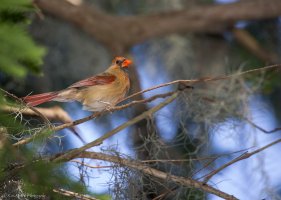
EF 100-400mm
1/1600 sec
F/5.6
ISO - 2500
FL: 400mm
 

Attachments

  • Female-0330.JPG
    Female-0330.JPG
    2.2 MB · Views: 1,153
Upvote 0
chasinglight said:
AlanF said:
It is far too soft. Look at www.birdpix.nl to see what enthusiasts expect in terms of IQ and composition. I had the same trouble with the 7D + 100-400mm L - 50% of my photos were rejected by birdpix as being too soft and/or noisy. Since upgrading to the 5D III and 300mm f/2.8 + 2xTC, the IQ of my shots has improved so dramatically so that most photos are acceptable. If you can't afford that gear, the Canon SX50 also does much better than the 7D + 100-400mm for static subjects.

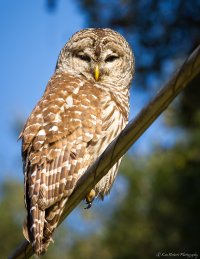
Ya that is something I have been noticing; that the 100-400 just isn't that sharp unless you are very close. I have some shots with the lens that you can see each individual hair on an owl, but not many. This shot is as focused as sharp as can be for this lens as verified by 200% view. I think being closer would have captured more detail.

I am not sure I can justify the cost of a canon great white like the 300 2.8 at this time as I am preparing to buy a new condo. Do you think a 400 5.6 would be sharper than the 100-400? Or are better results possible with the 100-400 with better technique?

I agree with alan, the image is pretty soft. Notorious problem with the 100-400. That said, I would try to fine tune AFMA for that lens on that body before you buy something new. I had serious softness problems with my copy on a 7D, but using Reikan FoCal, I eventually ended up with s -12 AFMA that made it a lot sharper. Still not as sharp as a 300/2.8 or 600/4, but definitely much sharper than it was originally. Could save you a lot of money.

Another option, if you really want maximum sharpness for a great price, is the EF 300mm f/4 L IS. Not as sharp as the EF 300mm f/2.8 L IS II, but sharper than the 100-400 even w/ AFMA, and FAR lighter than the 300/2,8. It works with the 1.4x TC for a 420/5.6 in case you need some extra reach and have good light.

One of the most important things in bird photography, more so than composition IMO, is head angle. You want the bird to engage the viewer...do a HA where the bill is 3-4 degrees inward towards the viewer tends to be best. Parallel to the sensor is ok, too. More than 5-7 degrees, and your getting into more specialized territory...it can work, but often not as well as a slighter angle. Any angle outward, away from the viewer, and the photo quickly loses its appeal, with a few exceptions (i.e a parent feeding a chick, where the parent may be facing slightly away.)

Once you get HA down, then worry about composition. ;) BTW, I should note that the HA in your posted photo is a good example of GOOD HA...so keep striving for that. I think as long as HA is good, explicitly following the "rules" of composition is less important (especially since they are guidelines, not rules, in the first place.)
 
Upvote 0
Krob78 said:
100-400mm is really irritating on the 7d too... (sarc., implied ;))
1/320 sec.
f/5.6
ISO 100

I downloaded the photo to check the exif data. It is at f = 190mm, the sweet spot of the lens, not the full 400mm, the weakest length. The lens is very sharp at ~200mm and f/5.6-8. I have had some great shots under those conditions, as well as 400mm when I could fill much of the frame.

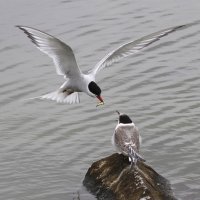
You must have been very close to the owl to get it to fill so much of the frame. And, that is the way to get the most from any lens. Here is the lens with 100% crop on 7D at 100mm of terns feeding (is0 400, f/5, 1/1600 s).
 

Attachments

  • Tern_7D_100-400@100f5_1600.jpg
    Tern_7D_100-400@100f5_1600.jpg
    610.9 KB · Views: 901
Upvote 0
AlanF said:
It is far too soft. Look at www.birdpix.nl to see what enthusiasts expect in terms of IQ and composition. I had the same trouble with the 7D + 100-400mm L - 50% of my photos were rejected by birdpix as being too soft and/or noisy. Since upgrading to the 5D III and 300mm f/2.8 + 2xTC, the IQ of my shots has improved so dramatically so that most photos are acceptable. If you can't afford that gear, the Canon SX50 also does much better than the 7D + 100-400mm for static subjects.

So is the SX50 really better? Yes, on paper it's 1200mm (ff equivalent), versus 640mm (FF equivalent) for a 400mm on a 7D. The SX50 gives a factor 2 more reach, but it's f6.5 at 1200mm, where it is substantially diffraction limited, and you can perhaps get no more than 2-4Mp worth of image quality. A proper, controlled shootout might be called for.

see also http://www.cambridgeincolour.com/tutorials/diffraction-photography.htm
http://www.luminous-landscape.com/tutorials/resolution.shtml
 
Upvote 0
We have had several SX-50 threads too.

http://www.canonrumors.com/forum/index.php?topic=12154.0

In good light when small sensors can actually use their density and technology advantages to best effect, yes, something I have said since getting a G10 years ago. Raise iso, need lens speed, shallow dof, fast AF and they become much more limiting.

http://www.luminous-landscape.com/reviews/kidding.shtml

Now, for clarity, I wish Alan would just post his initial image uncropped. I have already shown that many people get superb bird images with the 7D 100-400 combo, including in flight, handheld, wide open and at 400mm,, that chasinglight was not getting the best out of his post processing, and he did a huge crop. I believe his two main issues were, primarily, needing to crop as hard as he did (subject distance), and post processing, nothing more.

Sure there are many "better" lenses, but the one he has is capable of much higher quality output. Why not move forwards with what we have, the 100-400 and PS, than spend other peoples money when there are basic techniques we can suggest to improve our skills and output that would need work even if he had a 600 f4 IS MkII.
 
Upvote 0
Maxaperture said:
Owners of the 100-400 should take the lens and body to Canon (especially crops cameras) and have them "paired".
You have $3000 worth of kit, it's worth the trip/trouble.
A friend of mine did this, and his 100-400 is banging out much sharper shots, he's so much happier.

Pairing is only free if you are a CPS member, I believe. At least in the US, you have to pay (a fairly hefty price, if I remember) to have the two calibrated for each other.
 
Upvote 0
Maxaperture said:
Owners of the 100-400 should take the lens and body to Canon (especially crops cameras) and have them "paired".

They don't really 'pair' them - they calibrate the body to a standard 'ideal' lens, and calibrate the lens to a standard 'ideal' body of the same type you tell them you have.
 
Upvote 0
Private
Sorry, packing my gear for a trip to France tomorrow. Here is a link.
https://www.dropbox.com/sh/p40mvgq3k3rwc30/-EnCRluAhd

They are not terribly exciting. You can get all of the data from the exifs etc. The 100-400mm says 390mm, the Sigma Apo Tele Macro is 400mm (it is a cracking lens, seriously better than the Canon 400 f/5.6); and the 300mm f/2.8 II + 1.4 xTC is, of course 420mm). This is only one test, but I have shot zillions with all three lenses.
 
Upvote 0
jrista said:
One of the most important things in bird photography, more so than composition IMO, is head angle. You want the bird to engage the viewer...do a HA where the bill is 3-4 degrees inward towards the viewer tends to be best. Parallel to the sensor is ok, too. More than 5-7 degrees, and your getting into more specialized territory...it can work, but often not as well as a slighter angle. Any angle outward, away from the viewer, and the photo quickly loses its appeal, with a few exceptions (i.e a parent feeding a chick, where the parent may be facing slightly away.)

Once you get HA down, then worry about composition. ;) BTW, I should note that the HA in your posted photo is a good example of GOOD HA...so keep striving for that. I think as long as HA is good, explicitly following the "rules" of composition is less important (especially since they are guidelines, not rules, in the first place.)

Wow that is the first time I have read that, but it makes sense. I will try to make use of that. Thanks for the advice!
 
Upvote 0
AlanF said:
Private
Sorry, packing my gear for a trip to France tomorrow. Here is a link.
https://www.dropbox.com/sh/p40mvgq3k3rwc30/-EnCRluAhd

They are not terribly exciting. You can get all of the data from the exifs etc. The 100-400mm says 390mm, the Sigma Apo Tele Macro is 400mm (it is a cracking lens, seriously better than the Canon 400 f/5.6); and the 300mm f/2.8 II + 1.4 xTC is, of course 420mm). This is only one test, but I have shot zillions with all three lenses.

Alan, not interested in the lampshade image, I am interested in your first image, the bird with the plumage, an uncropped version of that would be greatly appreciated.

This one, but uncropped.
 

Attachments

  • index.jpg
    index.jpg
    58.2 KB · Views: 662
Upvote 0
privatebydesign said:
Sure there are many "better" lenses, but the one he has is capable of much higher quality output. Why not move forwards with what we have, the 100-400 and PS, than spend other peoples money when there are basic techniques we can suggest to improve our skills and output that would need work even if he had a 600 f4 IS MkII.

For the record I think this is great advice. I want to learn to get everything out of the gear I have before I plunk down 4-12k. I would hate to upgrade and still get not stellar results solely because I don't have the proper knowledge or skills.
 
Upvote 0
Thanks for that Alan.

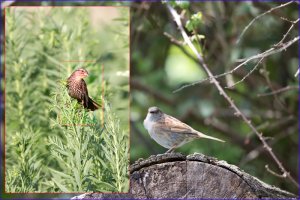
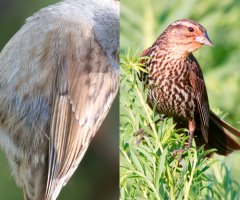
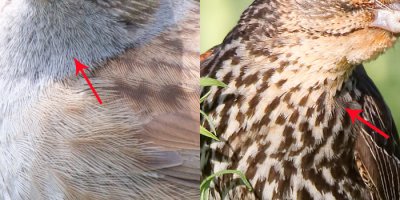
Here are three images that I hope illustrate my point, that this is basically a distance/cropping issue and has nothing to do with the fact that the 100-400 is not "as good" as several other lenses. I agree that it isn't, but it is more than good enough to take some superb images of birds, assuming you have AFMA'd and your lens is not faulty and you get close enough.

First is a size corrected picture in a picture. It demonstrates how much bigger Alan's bird is than chasinglight's bird. By my calculations Alan's is around 3.5 times bigger, by area. I laid chasinglight's full image on top of Alan's and corrected for sensor size, so these two images are what they both saw through the viewfinder. The red bounding box in the 7D image is the 100% crop I posted earlier and represents less then 12% of the sensor area, around 5% of the 5D MkIII sensor area, the blue box.

Second is a crop of the same sensor area, for chasinglight I used the 100% crop from earlier, from Alan I cropped the same sensor area, so same magnification, of his bird's body. I have rotated Alan's bird body to better fit the comparison.

Third is a same magnification comparison of detail size. Yet again, I agree that the 100-400 is not the best lens available, but, it is clearly resolving detail comparable in size to the plumage in Alan's image.
 

Attachments

  • bird11.jpg
    bird11.jpg
    145 KB · Views: 639
  • bird13.jpg
    bird13.jpg
    209.1 KB · Views: 622
  • bird12.jpg
    bird12.jpg
    135.3 KB · Views: 604
Upvote 0
privatebydesign said:
...the 100-400 is not "as good" as several other lenses. I agree that it isn't, but it is more than good enough...

Human nature is also a factor. My 7D had great AF...then I got a 1D X. My 100-400L was a very sharp lens...then I got a 600 II.
 
Upvote 0