Canon Confirms Development of High Megapixel Camera

jrista said:
You are taking so many things I've said way out of context there, it's unbelievable.

You've developed an unappealing habit of thinking everyone is talking about you. The cave...remember your failure at the cave... Like the 'noticeably better shadow IQ of the Exmor sensor' that turned out to be a Canon sensor, I suspect you've been easy prey for the bait in another of PBD's little traps.

Look back over some of AlanF's posts from a couple years ago, his calculations of the theoretical resolving power of the 7D and his feather test shots with the 7D that apparently confirmed those calculations, then forward to his posts after getting a 5DIII and performing actual comparisons, and his calculations based on the DPR sample images...maybe you'll see some numbers there that align well with PBD's statements.
 
Upvote 0
neuroanatomist said:
jrista said:
You are taking so many things I've said way out of context there, it's unbelievable.

You've developed an unappealing habit of thinking everyone is talking about you. The cave...remember your failure at the cave... Like the 'noticeably better shadow IQ of the Exmor sensor' that turned out to be a Canon sensor, I suspect you've been easy prey for the bait in another of PBD's little traps.

Look back over some of AlanF's posts from a couple years ago, his calculations of the theoretical resolving power of the 7D and his feather test shots with the 7D that apparently confirmed those calculations, then forward to his posts after getting a 5DIII and performing actual comparisons, and his calculations based on the DPR sample images...maybe you'll see some numbers there that align well with PBD's statements.

;D

Darn it Neuro, you unwrapped my Christmas gift to myself. ;)

Flaming of member removed by Admin.
 
Upvote 0
Excuse me, if the following has been said before:

When Canon sees the world devided into
  • sports and
  • studio
type-of-work, then I would expect
  • terrific autofocus, fast cameras like the 1Dx, with a rather lower pixel count and high fps & ISO, and
  • high MP, slow cameras like the one in development, with a large sensor (why not square?) and high pixel count, but inferior autofocus and low-light capabilities, like the 5D2 with a high resolution sensor.

I honestly do not hope for both: the best autofocus and the highest resolution.
 
Upvote 0
sulla said:
Excuse me, if the following has been said before:

When Canon sees the world devided into
  • sports and
  • studio
type-of-work, then I would expect
  • terrific autofocus, fast cameras like the 1Dx, with a rather lower pixel count and high fps & ISO, and
  • high MP, slow cameras like the one in development, with a large sensor (why not square?) and high pixel count, but inferior autofocus and low-light capabilities, like the 5D2 with a high resolution sensor.

I honestly do not hope for both: the best autofocus and the highest resolution.

I'm struggling to think of any situation where high-MP would be useful without great AF. For bird and nature photography, you need great AF. For landscapes, if you really need a high-MP landscape photo, you can save a few thousand bucks by just stitching multiple shots together, because landscapes aren't moving.

I'm pretty sure if they don't put great AF in the high-MP camera, it will go down like a lead balloon.
 
Upvote 0
Maiaibing said:
Anyone else share my worry 2014 could be the year that makes or breaks Canon as the DSLR market leader?

Why do you care whether Canon remains "the DSLR market leader"? I certainly don't - all that matters to me is that it's able to keep producing impressive lenses and cameras, and servicing them efficiently as required. Concern about whether it's #1 or #2 smacks of sports team nonsense.
 
Upvote 0
I'm pretty sure if they don't put great AF in the high-MP camera, it will go down like a lead balloon.

I don't quite think so. For studio work AF is not necessary at all, strictly speaking. Neither for landscape work. If we are talking about a 50 MP (as suggested by Canon) studio camera, you will need a tripod anyway to make use of all those pixels. And if you take all the time to set everything up properly, AF is not of concern. Focussing by live-view would be enough and preferred anyway. So a simple AF system would suffice for such a camera.
 
Upvote 0
dgatwood said:
For landscapes, if you really need a high-MP landscape photo, you can save a few thousand bucks by just stitching multiple shots together, because landscapes aren't moving.

Lol. Do you ever look at nature? Oceans, rivers, wind, lots of stuff moving in nature.
 
Upvote 0
dak723 said:
Despite the fact that many reviewers have stated that there is virtually no difference in practice between a 20Mp and 36 Mp camera and that you can't get the best resolution without a tripod and the best lenses [....]

How much difference there is between 20Mp and 36Mp and whether it matters rather depends on what sort of photos you take and how you look at them - what's virtually none to A may be significant to B.

As for the rest, I don't understand why there's so much concern in this forum with getting the *ultimate* resolution from a higher MP sensor when Canon releases a camera containing one. That inquiry is fine if that's what you want, but it's hardly obvious why anyone *should* want that. I would have thought that what mattered more was the practical question whether any given lens, when you attach it to a higher resolution sensor, can create images that have better resolution and/or otherwise look better than it does on a sensor with lower resolution.

I currently own 3 FF cameras, Canon 6D (c. 20Mp), Sony a7r (36mp) and Sony a7s (12Mp), and owned until recently a 5DIII, and of the lenses I own I can't think of a single one which can't at least "keep up" on the a7r or which makes photos that look better via the a7s - even a fairly elderly Minolta Rokkor X 50mm f1/4 for which I paid c. $50 at KEH last year (and they all look better on any of these cameras than they do on my Canon SL1 and Sony a6000). (Cf one of Roger Cicala's blog posts where he notes, among other things, that although the Canon 24-70 II has greater resolving power than the Tamron equivalent, the latter on a Nikon D800 outresolves the former on a 5DIII.)

The same goes for shooting hand-held: I see no more evidence of camera-movement-induced blur on my a7r than I do on my other cameras. This is all anecdotal, of course, but others seem to have similar experiences; at any rate, warnings about the need to spend a fortune Zeiss Otus lenses and use tripods at all times strike me as a mild form of theory-based scare-mongering.

Or will a 50Mp sensor create problems along these lines that a 36 Mp sensor doesn't? I guess we'll find out before long....
 
Upvote 0
StudentOfLight said:
Lee Jay said:
StudentOfLight said:
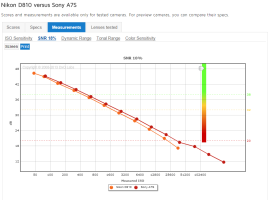
In practice, does pixel size affect low light performance for the same sensor area?

In practice, for moderate to high ISOs, smaller pixels do better.
Why is the red line above the orange line?

Different sensors, entirely. The A7S has higher QE and lower read noise, neither of which goes with larger pixels.
 
Upvote 0
At diffraction limited fast apertures, lenses will always resolve more than the smallest physics-limited pixels, which is around 800nm (0.8um)...manufacturers are already wary of implementing 900nm pixel sizes...the smallest so far are 1000nm, which are already smaller than the 1100mm infrared limit for silicon based sensors.

This is just one barrier. It's not even an optical one (because we just speak about apertures). So the used glas has to be very clean and with each optical element you loose light, arrange new lightsplitting effects, reflections and so on. With the new apochromatic calculations, better with IS elements and 18 Elements in 12 Groups or more you get really a difficult formula. To get 50 MP on the chip itself was a difficult work 10 years back... that's not the problem anymore. The problem is to serve them...

Simple fact: smaller pixels resolve more detail. I think that has been demonstrated thoroughly well over the last decade, throughout the continual march towards ever smaller pixels paired with frequently improving optics.

Theoretically you're right, but in real live this isn't true...

I believe under more ideal conditions, the 7D can realize about a 45% advantage over the 5D III

This have to be quite good conditions. Don't forget that the 7D uses the sweet spot of a fullframe-lens, to get the same resolution on the full sensorplane you should use mediumformat-lightcircles on fullframe. That's the reason why the Fuji GX680 performs excellent, it uses large format circles on medium format.

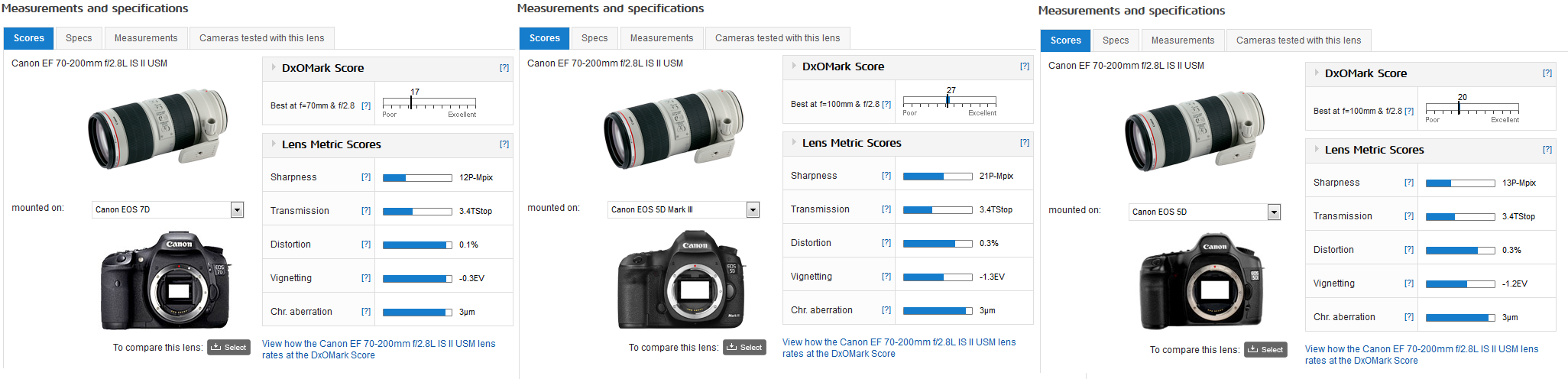
But to get back to the APS-C/7D Owners claiming more resolution. Let's check the facts. I will use DXO, but there are more sources on this. So screaming out "this is no test, I see more than the lab can say in numbers... here are at least measurements (still better facts than private opinions on boards, I think)

http://www.dxomark.com/Lenses/Canon/Canon-EF70-200mm-f28L-IS-II-USM-mounted-on-Canon-EOS-7D__619

Let's summarize it on 3 Bodies:

sensor_compare.png


I choosed the 70-200 L IS II 2.8 as it is wellknown as one of the best performers out there, at least on Canonlenses. So the lense shouldn't be the weak point here. What can you see there? Even the old fullframe 5D outperformes the "18MP" 7D Body. The 5DM3 is way beyond the 12MP from the 7D. Nearly double. So how can this be? More pixels are theoretically better on resolution. I could explain it to you, but please entertain me with a counterproof ;) But please more than "DXO is nothing to trust on".

 
Upvote 0
vscd said:
I could explain it to you, but please entertain me with a counterproof ;)

Go to DPreviews Scene comparison tool, select the 5D3 and D8x0 or A7r and look at the shrinking text bits.
If the text remains legible to different lines the idea that the additional resolution doesn't change a thing is absurd.
If not one should better see the doctor...
 
Upvote 0
Lee Jay said:
StudentOfLight said:
Lee Jay said:
StudentOfLight said:
In practice, does pixel size affect low light performance for the same sensor area?

In practice, for moderate to high ISOs, smaller pixels do better.
Why is the red line above the orange line?

Different sensors, entirely. The A7S has higher QE and lower read noise, neither of which goes with larger pixels.
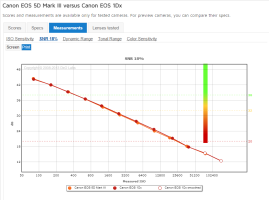
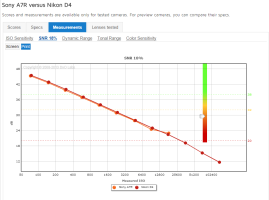
How about "5D-III vs 1D-X" or "A7R vs D4"? (see attached)
Are those equal sensor technologies?
 

Attachments

  • 5D-III vs 1D-X.png
    5D-III vs 1D-X.png
    48.6 KB · Views: 152
  • A7R vs D4.png
    A7R vs D4.png
    48.5 KB · Views: 183
Upvote 0
StudentOfLight said:
Lee Jay said:
StudentOfLight said:
Lee Jay said:
StudentOfLight said:
In practice, does pixel size affect low light performance for the same sensor area?

In practice, for moderate to high ISOs, smaller pixels do better.
Why is the red line above the orange line?

Different sensors, entirely. The A7S has higher QE and lower read noise, neither of which goes with larger pixels.
How about "5D-III vs 1D-X" or "A7R vs D4"? (see attached)
Are those equal sensor technologies?

Virtually identical as you can see, plus DXO's testing doesn't for why smaller pixels win, which I posted up thread with samples.
 
Upvote 0
vscd said:
Let's summarize it on 3 Bodies:

sensor_compare.png


I choosed the 70-200 L IS II 2.8 as it is wellknown as one of the best performers out there, at least on Canonlenses. So the lense shouldn't be the weak point here. What can you see there? Even the old fullframe 5D outperformes the "18MP" 7D Body..

Yes, let's compare.
7D - 12MP
5DIII - 21MP
5D - 13MP

7D pixels on a full-frame sensor (46MP) = (1.6^2)*7D = 1.6*1.6*12MP = 30.7MP.
 
Upvote 0
sdsr said:
Maiaibing said:
Anyone else share my worry 2014 could be the year that makes or breaks Canon as the DSLR market leader?

Why do you care whether Canon remains "the DSLR market leader"?

You are right - and I do not. It only reflects on what you write next, which is the real issue: does Canon have the gear to satisfy my needs?

So my worry is really that I may have to sell my Canon gear in 2015 as I upgrade from my excellent but aging 5DII's next year - something that will be time consuming & expensive at the very least. And could be futile at its worst.
 
Upvote 0
Lee Jay said:
StudentOfLight said:
Lee Jay said:
StudentOfLight said:
Lee Jay said:
StudentOfLight said:
In practice, does pixel size affect low light performance for the same sensor area?

In practice, for moderate to high ISOs, smaller pixels do better.
Why is the red line above the orange line?

Different sensors, entirely. The A7S has higher QE and lower read noise, neither of which goes with larger pixels.
How about "5D-III vs 1D-X" or "A7R vs D4"? (see attached)
Are those equal sensor technologies?

Virtually identical as you can see, plus DXO's testing doesn't for why smaller pixels win, which I posted up thread with samples.
Virtually the same... So how exactly is it that small pixels are better in low light? ??? I remind you that you earlier said: "In practice, for moderate to high ISOs, smaller pixels do better."

In general smaller pixels appear to be ever-so-slightly-worse with SNR. If you consider the Dynamic Range you'll see that larger pixel are clearly superior at higher ISO. Colour sensitivity is virtually identical. I'm failing to see how smaller pixels (with equivalent technology) are any better in low light. In what way are they doing "better"?

As for your post on why smaller pixels win, how about this: 20MP, at 200mm f/4 which is sharper?
http://www.the-digital-picture.com/Reviews/ISO-12233-Sample-Crops.aspx?Lens=458&Camera=963&Sample=0&FLI=0&API=3&LensComp=458&CameraComp=819&SampleComp=0&FLIComp=0&APIComp=3
 
Upvote 0
StudentOfLight said:
Virtually the same... So how exactly is it that small pixels are better in low light? ??? I remind you that you earlier said: "In practice, for moderate to high ISOs, smaller pixels do better."

I'll explain it again.

Larger pixels do nothing but block-average versus smaller pixels. However, modern noise reduction software is far superior at removing noise and preserving details than simple block averaging. So, after modern processing is applied, you can usually end up with both more detail and lower noise when starting with smaller pixels in larger numbers. And here's an example. Everything is the same between these two shots - focal length, f-stop, ISO, shutter speed, light, distance, processing from raw, final size - everything I could hold constant I did. But the pixel size (area) is different by a factor of 16. This is so that any small other differences are swamped out by the enormous difference in pixel size. Small pixels on the left, big pixels on the right. Which has a better detail-to-noise ratio in your opinion?

Pixel%20density%20test%202%20detail%20filtered.jpg
 
Upvote 0
StudentOfLight said:
As for your post on why smaller pixels win, how about this: 20MP, at 200mm f/4 which is sharper?
http://www.the-digital-picture.com/Reviews/ISO-12233-Sample-Crops.aspx?Lens=458&Camera=963&Sample=0&FLI=0&API=3&LensComp=458&CameraComp=819&SampleComp=0&FLIComp=0&APIComp=3

I'll remind you of a phrase in your original question: "...for the same sensor area...". Obviously, those images are not from the same sensor area.
 
Upvote 0