Canon Confirms Development of High Megapixel Camera

StudentOfLight said:
jrista said:
privatebydesign said:
It is funny I have been saying this same thing for years, nearly 7, when I first compared the 7D to the 1Ds MkIII and I used to get no end of crap for saying it. Probably the most vocal maths oriented poster here used to crucify me, he was a 7D owner and insisted that his camera had vastly more 'resolution' than mine, he has since got a 5D MkIII and done the tests, guess what? His estimation of the crop cameras 'resolution advantage' has gone from >60% to around 15% at best on manual focus bench tests.


You are taking so many things I've said way out of context there, it's unbelievable. First, I've never said the 7D had a mere 15% advantage over the 5D III. I did say it might be about 25% on average for the average use case (i.e. no tripod, less than ideal focus, etc.) The 60% statement was qualified with the fact that ignores the bayer array or AA filter...i.e. it's the raw, monochrome mathematical advantage of the 7D's pixel size.


I believe under more ideal conditions, the 7D can realize about a 45% advantage over the 5D III. That is just a resolving power advantage, which when were talking about micrometer sized pixels, isn't something that jumps out of the screen at you...that would be something more like a 200% or 300% advantage, which at the moment only small form factor sensors have with 1.0-1.2 micron pixels.


You and I see different things, which is why subjective comparisons are useless. Maybe I sit closer to my screen than you do, who knows. I see the advantage of the 7D, you do not. Neither of us is right until someone actually does a proper test with proper testing tools and gets some actual resolution numbers. However we all know how well real numbers go down here on these forums as well...so again, it's all entirely pointless.


Simple fact: smaller pixels resolve more detail. I think that has been demonstrated thoroughly well over the last decade, throughout the continual march towards ever smaller pixels paired with frequently improving optics.
I agree that smaller pixels can resolve more detail if the lens has sufficient resolving power.

In practice, does pixel size affect low light performance for the same sensor area?


By "for the same sensor area", I assume you mean when your subject fills the same absolute area of sensor (i.e. you would need to crop the FF to get the same FoV as the APS-C). In that case, the pixel size isn't really going to affect things much. Assuming same lens, same aperture (which would be necessary for identical subject size and DoF at the sensor), then your going to gather the same amount of light in total for your subject, regardless of which sensor you use. The FF could have bigger pixels, or it could have the same size pixels as the APS-C. The pixel size doesn't really matter...it's just an arbitrary factor. In the end, for an APS-C sized crop of an FF sensor, you gathered the same amount of light as the APS-C itself. Therefor, noise should be the same once the results are normalized. If the FF has the same pixel size as the APS-C, then simply cropping would be enough to normalize. If the FF had larger pixels than the APS-C, then downsampling the APS-C to the same image dimensions as the FF would average pixel data together, resulting in the same noise.


Now, if you framed the subject the same with both cameras, and used the same aperture with both, then the FF camera, regardless of pixel size, is going to perform better.


Pixel size, ultimately, affects resolving power. Smaller pixels, higher resolving power. If you move from an FF sensor with 10 micron pixels to an FF sensor with 5 micron pixels, your going to resolve more detail. Strait out of camera, the image made with smaller pixels will appear noisier...unless you downsample it to the same dimensions as the 10 micron image. Then noise will appear the same, however the 5 micron image will still be sharper and more detailed.


Smaller pixels, assuming same or better technology, can never be a bad thing. On a normalized basis, smaller pixels mean more detail (all else being equal.)
 
Upvote 0
StudentOfLight said:
Lee Jay said:
StudentOfLight said:
Lee Jay said:
StudentOfLight said:
Lee Jay said:
StudentOfLight said:
In practice, does pixel size affect low light performance for the same sensor area?

In practice, for moderate to high ISOs, smaller pixels do better.
Why is the red line above the orange line?

Different sensors, entirely. The A7S has higher QE and lower read noise, neither of which goes with larger pixels.
How about "5D-III vs 1D-X" or "A7R vs D4"? (see attached)
Are those equal sensor technologies?

Virtually identical as you can see, plus DXO's testing doesn't for why smaller pixels win, which I posted up thread with samples.
Virtually the same... So how exactly is it that small pixels are better in low light? ??? I remind you that you earlier said: "In practice, for moderate to high ISOs, smaller pixels do better."

In general smaller pixels appear to be ever-so-slightly-worse with SNR. If you consider the Dynamic Range you'll see that larger pixel are clearly superior at higher ISO. Colour sensitivity is virtually identical. I'm failing to see how smaller pixels (with equivalent technology) are any better in low light. In what way are they doing "better"?

As for your post on why smaller pixels win, how about this: 20MP, at 200mm f/4 which is sharper?
http://www.the-digital-picture.com/Reviews/ISO-12233-Sample-Crops.aspx?Lens=458&Camera=963&Sample=0&FLI=0&API=3&LensComp=458&CameraComp=819&SampleComp=0&FLIComp=0&APIComp=3


The image comparison there is flawed, as it is same-framing, rather than same subject distance. It doesn't matter what you do, if you put more pixels on subject, then your going to get a better result. The 6D has larger pixels AND more pixels, so when that test chart is framed identically, your putting more pixels, and more sensor area, onto the chart. Of course it is going to be better.


When you frame such that the subject fills the same absolute sensor area (in other words, the chart would have to fill only the central 1.6x crop area of the FF sensor that matches an APS-C sensor), then the smaller pixels are going to resolve more detail (all else equal...the 6D uses newer pixel technology, so all else is NOT equal.)
 
Upvote 0
Lee Jay said:
StudentOfLight said:
Virtually the same... So how exactly is it that small pixels are better in low light? ??? I remind you that you earlier said: "In practice, for moderate to high ISOs, smaller pixels do better."

I'll explain it again.

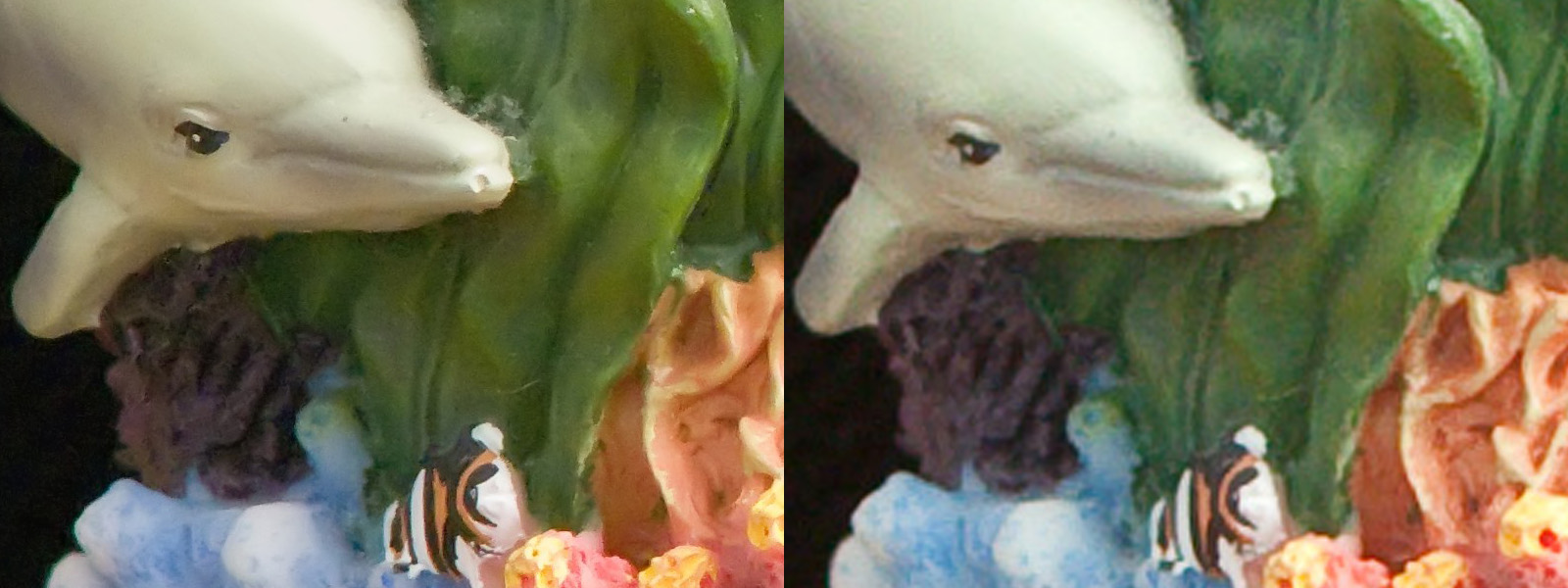
Larger pixels do nothing but block-average versus smaller pixels. However, modern noise reduction software is far superior at removing noise and preserving details than simple block averaging. So, after modern processing is applied, you can usually end up with both more detail and lower noise when starting with smaller pixels in larger numbers. And here's an example. Everything is the same between these two shots - focal length, f-stop, ISO, shutter speed, light, distance, processing from raw, final size - everything I could hold constant I did. But the pixel size (area) is different by a factor of 16. This is so that any small other differences are swamped out by the enormous difference in pixel size. Small pixels on the left, big pixels on the right. Which has a better detail-to-noise ratio in your opinion?

Pixel%20density%20test%202%20detail%20filtered.jpg

Utterly meaningless without the camera details. So which two same generation crop and ff cameras were these?

It would be easy to post something similar showing how much 'better' a cell phone camera resolution is than a Hasselblad H5, but I know which will take 'better' pictures.
 
Upvote 0
privatebydesign said:
Utterly meaningless without the camera details. So which two same generation crop and ff cameras were these?

They are cameras that came out within three months of each other but have pixels different in size by a factor of 16.

It would be easy to post something similar showing how much 'better' a cell phone camera resolution is than a Hasselblad H5, but I know which will take 'better' pictures.

A cell phone camera will crush an H5 for the same sensor area. The H5 has an advantage because it has more area not because it's better per unit of sensor area, which it isn't.
 
Upvote 0
Lee Jay said:
privatebydesign said:
Utterly meaningless without the camera details. So which two same generation crop and ff cameras were these?
They are cameras that came out within three months of each other but have pixels different in size by a factor of 16.

Your unwillingness to answer a direct, specific question with a direct, specific answer says a lot about your credibility. I have little respect for anyone who conducts a test but refuses to fully disclose their methods, nor do I accept at face value the data from such 'tests'.
 
Upvote 0
Lee Jay said:
privatebydesign said:
Utterly meaningless without the camera details. So which two same generation crop and ff cameras were these?

They are cameras that came out within three months of each other but have pixels different in size by a factor of 16.

So they are not a relevant comparison, just yet another academic illustration that doesn't apply to the specifics of the actual thread.

Lee Jay said:
privatebydesign said:
It would be easy to post something similar showing how much 'better' a cell phone camera resolution is than a Hasselblad H5, but I know which will take 'better' pictures.

A cell phone camera will crush an H5 for the same sensor area. The H5 has an advantage because it has more area not because it's better per unit of sensor area, which it isn't.

I know that is why I said it would be easy to demonstrate it.
 
Upvote 0
Go to DPreviews Scene comparison tool, select the 5D3 and D8x0 or A7r and look at the shrinking text bits.
If the text remains legible to different lines the idea that the additional resolution doesn't change a thing is absurd.
If not one should better see the doctor...

The Tests on dpreview have a totally different base, as for example even the focal lengths and the whole lenstypes differ. To get the different sensortypes out of the equation we should only compare the same Manufacturer and the same lens, otherwise the whole test has too many different sideeffects. For example, the sensor from the A7R and Nikon D800 are even the same sensors, but the results differ. Explain it. And the Sigma Merrill as APS-C even beats the Medium Format Pentax 645.

(f.y.i.: http://tf.weimarnetz.de/downloads/sigma.png)

I just posted a picture that, for example, a Canon 7D with 18 MPixel was not able to get the sharpness of an old Canon 5D with 13 MPixel. The same cam was totally outperformed by the 5DM3. I choosed the same lense on purpose and the same manufacturer (Canon). On your theory (was it yours?) the pure resolutionpower of a 7D (>40 MP calculated up to the 5D Sensor), should always be better than Cam with less MPixel; at least get their very own 18 MPixel covered.

Can you see the results? If not, one should better see the doctor.


Yes, let's compare.
7D - 12MP
5DIII - 21MP
5D - 13MP

7D pixels on a full-frame sensor (46MP) = (1.6^2)*7D = 1.6*1.6*12MP = 30.7MP.

Muahahahaaa... are you a politician? Turning existing results into the opposite? The 70-200 2.8 L IS II is even in it's centered "APS-C"-sweet spot not able to resolv the 18 MPixel of the 7D (that was the conclusion of the test) . Sampling the Resolution from the 7D up to a 40MPixel fullframe would have even poorer results as the corners of the lens are even weaker. It's an old truth that small sensors need better optics.

If you know a Nikon Pro with a D800/D810 ask him what lenses are able to resolve the full resolution of the cam. There are 3 known lenses from Nikon and 3-4 Zeiss. And we speak of 36MP, not 50.
 
Upvote 0
vscd said:
Yes, let's compare.
7D - 12MP
5DIII - 21MP
5D - 13MP

7D pixels on a full-frame sensor (46MP) = (1.6^2)*7D = 1.6*1.6*12MP = 30.7MP.

Muahahahaaa... are you a politician? Turning existing results into the opposite?

I just gave you the facts. The 7D has a lot less area than the other two cameras so I extrapolated its results to a sensor of the same size. That's it.

The 70-200 2.8 L IS II is even in it's centered "APS-C"-sweet spot not able to resolv the 18 MPixel of the 7D (that was the conclusion of the test) .

So, the "sweet spot" doesn't mean as much as the reduced enlargement factor of the larger sensor. That's correct. So I compensated for that factor so we could compare sensors of the same size.

Sampling the Resolution from the 7D up to a 40MPixel fullframe would have even poorer results as the corners of the lens are even weaker.

You just contradicted your own argument. You really think a 46MP full-frame sensor would have less resolution than an 18MP crop camera? Get real.
 
Upvote 0
privatebydesign said:
Lee Jay said:
privatebydesign said:
Utterly meaningless without the camera details. So which two same generation crop and ff cameras were these?

They are cameras that came out within three months of each other but have pixels different in size by a factor of 16.

So they are not a relevant comparison, just yet another academic illustration that doesn't apply to the specifics of the actual thread.

This thread is about keeping sensor area the same (full-frame in this case) and dividing that area up into more pieces (50MP versus 22MP). That's exactly what I compared - same area, different number of pixels. It's thus exactly relevant to this thread.

Lee Jay said:
privatebydesign said:
It would be easy to post something similar showing how much 'better' a cell phone camera resolution is than a Hasselblad H5, but I know which will take 'better' pictures.

A cell phone camera will crush an H5 for the same sensor area. The H5 has an advantage because it has more area not because it's better per unit of sensor area, which it isn't.

I know that is why I said it would be easy to demonstrate it.

Glad you agree that it's true, since it is. The smaller pixels (and higher performance) of the cell phone sensor would give it much better performance for the same sensor area. Of course, that's going to be entirely dominated by the absolutely huge difference in actual area so the MF system will still win easily, but not because of larger pixels, because of larger sensor area (and thus larger lens aperture at the same f-stop and framing).
 
Upvote 0
Lee Jay said:
neuroanatomist said:
Lee Jay said:
privatebydesign said:
Utterly meaningless without the camera details. So which two same generation crop and ff cameras were these?
They are cameras that came out within three months of each other but have pixels different in size by a factor of 16.

Your unwillingness to answer a direct, specific question with a direct, specific answer says a lot about your credibility. I have little respect for anyone who conducts a test but refuses to fully disclose their methods, nor do I accept at face value the data from such 'tests'.

Well, this Private guy is such a dork that he'll pick some irrelevant detail of the test and declare the whole thing invalid, so I'm not giving this particular person any information that isn't relevant to the test. They are both Bayer sensors of the same generation with very similar performance per unit of area, and they were both shot in the same way in the same conditions. No tiny changes in read noise or quantum efficiency or anything else will mean anything compared to the enormous difference in pixel size (factor of 16 in area). But Private will latch onto something irrelevant and ignore the relevance.


Why not just provide the names of each camera? That isn't difficult to do, and Private isn't the only one who cares. Being specific about your test is the only way for it to be taken seriously. Personally, I agree with you that smaller pixels are not a bad thing, but don't be so obscure...it really DOES make you seem like you are hiding something, and that does go to your credibility. (Especially on these forums... ::) )
 
Upvote 0
jrista said:
Lee Jay said:
neuroanatomist said:
Lee Jay said:
privatebydesign said:
Utterly meaningless without the camera details. So which two same generation crop and ff cameras were these?
They are cameras that came out within three months of each other but have pixels different in size by a factor of 16.

Your unwillingness to answer a direct, specific question with a direct, specific answer says a lot about your credibility. I have little respect for anyone who conducts a test but refuses to fully disclose their methods, nor do I accept at face value the data from such 'tests'.

Well, this Private guy is such a dork that he'll pick some irrelevant detail of the test and declare the whole thing invalid, so I'm not giving this particular person any information that isn't relevant to the test. They are both Bayer sensors of the same generation with very similar performance per unit of area, and they were both shot in the same way in the same conditions. No tiny changes in read noise or quantum efficiency or anything else will mean anything compared to the enormous difference in pixel size (factor of 16 in area). But Private will latch onto something irrelevant and ignore the relevance.


Why not just provide the names of each camera? That isn't difficult to do, and Private isn't the only one who cares. Being specific about your test is the only way for it to be taken seriously. Personally, I agree with you that smaller pixels are not a bad thing, but don't be so obscure...it really DOES make you seem like you are hiding something, and that does go to your credibility. (Especially on these forums... ::) )

Fine, S3, 5D, not that it matters at all.
 
Upvote 0
Lee Jay said:
jrista said:
Lee Jay said:
neuroanatomist said:
Lee Jay said:
privatebydesign said:
Utterly meaningless without the camera details. So which two same generation crop and ff cameras were these?
They are cameras that came out within three months of each other but have pixels different in size by a factor of 16.

Your unwillingness to answer a direct, specific question with a direct, specific answer says a lot about your credibility. I have little respect for anyone who conducts a test but refuses to fully disclose their methods, nor do I accept at face value the data from such 'tests'.

Well, this Private guy is such a dork that he'll pick some irrelevant detail of the test and declare the whole thing invalid, so I'm not giving this particular person any information that isn't relevant to the test. They are both Bayer sensors of the same generation with very similar performance per unit of area, and they were both shot in the same way in the same conditions. No tiny changes in read noise or quantum efficiency or anything else will mean anything compared to the enormous difference in pixel size (factor of 16 in area). But Private will latch onto something irrelevant and ignore the relevance.


Why not just provide the names of each camera? That isn't difficult to do, and Private isn't the only one who cares. Being specific about your test is the only way for it to be taken seriously. Personally, I agree with you that smaller pixels are not a bad thing, but don't be so obscure...it really DOES make you seem like you are hiding something, and that does go to your credibility. (Especially on these forums... ::) )

Fine, S3, 5D, not that it matters at all.


Well, it matters enough that it stopped the conversation. ;P At least now we can move forward.
 
Upvote 0
Lee Jay said:
neuroanatomist said:
Lee Jay said:
privatebydesign said:
Utterly meaningless without the camera details. So which two same generation crop and ff cameras were these?
They are cameras that came out within three months of each other but have pixels different in size by a factor of 16.

Your unwillingness to answer a direct, specific question with a direct, specific answer says a lot about your credibility. I have little respect for anyone who conducts a test but refuses to fully disclose their methods, nor do I accept at face value the data from such 'tests'.

Well, this Private guy is such a dork that he'll pick some irrelevant detail of the test and declare the whole thing invalid, so I'm not giving this particular person any information that isn't relevant to the test. They are both Bayer sensors of the same generation with very similar performance per unit of area, and they were both shot in the same way in the same conditions. No tiny changes in read noise or quantum efficiency or anything else will mean anything compared to the enormous difference in pixel size (factor of 16 in area). But Private will latch onto something irrelevant and ignore the relevance.

Still not a direct, specific answer to the question. But thanks for finally 'fessing up.


vscd said:
Muahahahaaa... are you a politician?

Indeed...politicians are well known for evasive, semi-truthful answers to simple questions.
 
Upvote 0
jrista said:
StudentOfLight said:
Lee Jay said:
StudentOfLight said:
Lee Jay said:
StudentOfLight said:
Lee Jay said:
StudentOfLight said:
In practice, does pixel size affect low light performance for the same sensor area?

In practice, for moderate to high ISOs, smaller pixels do better.
Why is the red line above the orange line?

Different sensors, entirely. The A7S has higher QE and lower read noise, neither of which goes with larger pixels.
How about "5D-III vs 1D-X" or "A7R vs D4"? (see attached)
Are those equal sensor technologies?

Virtually identical as you can see, plus DXO's testing doesn't for why smaller pixels win, which I posted up thread with samples.
Virtually the same... So how exactly is it that small pixels are better in low light? ??? I remind you that you earlier said: "In practice, for moderate to high ISOs, smaller pixels do better."

In general smaller pixels appear to be ever-so-slightly-worse with SNR. If you consider the Dynamic Range you'll see that larger pixel are clearly superior at higher ISO. Colour sensitivity is virtually identical. I'm failing to see how smaller pixels (with equivalent technology) are any better in low light. In what way are they doing "better"?

As for your post on why smaller pixels win, how about this: 20MP, at 200mm f/4 which is sharper?
http://www.the-digital-picture.com/Reviews/ISO-12233-Sample-Crops.aspx?Lens=458&Camera=963&Sample=0&FLI=0&API=3&LensComp=458&CameraComp=819&SampleComp=0&FLIComp=0&APIComp=3


The image comparison there is flawed, as it is same-framing, rather than same subject distance. It doesn't matter what you do, if you put more pixels on subject, then your going to get a better result. The 6D has larger pixels AND more pixels, so when that test chart is framed identically, your putting more pixels, and more sensor area, onto the chart. Of course it is going to be better.


When you frame such that the subject fills the same absolute sensor area (in other words, the chart would have to fill only the central 1.6x crop area of the FF sensor that matches an APS-C sensor), then the smaller pixels are going to resolve more detail (all else equal...the 6D uses newer pixel technology, so all else is NOT equal.)
When I say same sensor area I mean when comparing:
a) full-frame to full-frame
b) APS-C to APS-C

The 6D was released in September 2012, 7D-II has a newly developed sensor and was only just released in 2014. 7D-II also has been reported to have a higher QE than the 6D. Is it really fair to say that the 6D has newer pixel technology? Also, I just opened some CR2 files to look at the actual flie resolution. 6D resolution is 5472x3648 (19.96MP) and the 7D-II resolution is 5472x3648 (19.96MP). So in practical terms, no difference.

On my "flawed" normalizing:
1) Would you agree that a photographer should frame the subject as they intend to print it?
2) Should photographers use different composition rules when shooting on Full frame than they do when shooting APS-C? (i.e. Should Full frame users only frame their images in the tiny APS-C-equivalent portion of the frame?)
 
Upvote 0
StudentOfLight said:
On my "flawed" normalizing:
1) Would you agree that a photographer should frame the subject as they intend to print it?
2) Should photographers use different composition rules when shooting on Full frame than they do when shooting APS-C? (i.e. Should Full frame users only frame their images in the tiny APS-C-equivalent portion of the frame?)
For this comparison you should frame as if both cameras had the same sensor format as the goal is to get an impression of how a full frame sensor with higher pixel density would perform.
Framing as intended to print implies different magnifications - leading to a massively oversized picture for the uncropped 4.7µ-Sensor. Your option 1 introduces an error of about the magnitude you would have between a 5D3 and the ancient 20D/30D.
 
Upvote 0