Canon Continues to Research Sensor Cooling

But the camera sealing must be very good then. Not to avoid dust/moisture getting in, but H2 He from getting out. 🤣
As long as you keep it below 4.2K it's a liquid and lasts quite a while in a cryostat. And, you can add a Gifford-McMahon refrigerator to condense any that boils off. Actually, detectors for far IR etc in the Herschl Space Observatory and the Planck HFI use liquid He at 0.1-1.7K. Professional observatory CCDs are cooled to 150-170K with liquid N.
 
  • Like
Reactions: 1 user
Upvote 0
As long as you keep it below 4.2K it's a liquid and lasts quite a while in a cryostat.
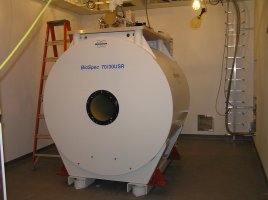
As long as it stays inside. LHe is also used to cool the coils in an MRI (an NMR with a bigger bore), like this 7 T / 30 cm bore magnet I 'bought' (with corporate funds, obviously) for small-animal imaging.

7T installed.JPG

The other thing that helps keep the coils cold is mylar insulation. Lots of mylar insulation. How do I know that? Pro tip to anyone installing a system like this...when first filling it with LHE, remember to open the pressure relief valve that is closed during transport. What happens when the team doing the install doesn't is...

After the Kaboom.jpg

The cylinder itself is pretty tough, most of the force of the explosion went out through the control box in back, the access door for which is seen in the bottom right image after being blown through the wall behind the magnet. Fortunately this happened at about 4 AM so no one was injured. Bruker replaced the magnet they destroyed (and paid to fix the room). The second install went fine.

 
  • Wow
Reactions: 3 users
Upvote 0
  • Haha
  • Like
Reactions: 5 users
Upvote 0
As long as it stays inside. LHe is also used to cool the coils in an MRI (an NMR with a bigger bore), like this 7 T / 30 cm bore magnet I 'bought' (with corporate funds, obviously) for small-animal imaging.

View attachment 227063

The other thing that helps keep the coils cold is mylar insulation. Lots of mylar insulation. How do I know that? Pro tip to anyone installing a system like this...when first filling it with LHE, remember to open the pressure relief valve that is closed during transport. What happens when the team doing the install doesn't is...

View attachment 227064

The cylinder itself is pretty tough, most of the force of the explosion went out through the control box in back, the access door for which is seen in the bottom right image after being blown through the wall behind the magnet. Fortunately this happened at about 4 AM so no one was injured. Bruker replaced the magnet they destroyed (and paid to fix the room). The second install went fine.
Wow! That's a pretty interesting look at procedure failure. The new things I get to see on the forums!
I should remember these images during my next plumbing repair!
 
Upvote 0
I'm curious if it'll be better to use oil/liquid cool. The fluid itself can dampen the sensor, and wouldn't the cooling be more effective as there's more surface to conduct the heat away from CMOS.

That would make life considerably more difficult. From what I gather from Canon's patents on cooling, they want as low as possible the amount of friction or dampening on the sensor. that would make IBIS's life even more difficult.

then, how would you do it? liquid cool the backside of the sensor platform in something like non-conductive fluorinert? You couldn't put it at the front of the sensor, or refraction would cause so many issues.

I can't see how liquid cooling an IBIS sensor would work - if the camera didn't have IBIS though, sure, tons of things could be done.
 
Upvote 0
That would make life considerably more difficult. From what I gather from Canon's patents on cooling, they want as low as possible the amount of friction or dampening on the sensor. that would make IBIS's life even more difficult.

then, how would you do it? liquid cool the backside of the sensor platform in something like non-conductive fluorinert? You couldn't put it at the front of the sensor, or refraction would cause so many issues.

I can't see how liquid cooling an IBIS sensor would work - if the camera didn't have IBIS though, sure, tons of things could be done.
For liquid cooling, you wouldn't immerse the sensor in liquid, but rather attach a thin liquid chamber to the back side (i.e. the non-illuminated side) with very small and light tubes to carry the liquid to a heat sink (either the body of the camera of a small radiator). A micro pump would be required, but would only be needed when the sensor was getting too hot. Mechanically complicated, but it could actually be quite small and light. Water has the highest specific heat of handy liquids (ammonia is higher, but it is nasty and needs pressurization), so the most likely choice. The Canon patent is clearly aimed at mechanical simplicity, which makes sense, but liquid cooling is possible. High specific heat is important for maximum heat transfer with minimum mass of fluid.
 
Upvote 0
For liquid cooling, you wouldn't immerse the sensor in liquid, but rather attach a thin liquid chamber to the back side (i.e. the non-illuminated side) with very small and light tubes to carry the liquid to a heat sink (either the body of the camera of a small radiator). A micro pump would be required, but would only be needed when the sensor was getting too hot. Mechanically complicated, but it could actually be quite small and light. Water has the highest specific heat of handy liquids (ammonia is higher, but it is nasty and needs pressurization), so the most likely choice. The Canon patent is clearly aimed at mechanical simplicity, which makes sense, but liquid cooling is possible. High specific heat is important for maximum heat transfer with minimum mass of fluid.
If a cooling liquid was used can it not create additional problems related to the liquid's movement?
 
Upvote 0
If a cooling liquid was used can it not create additional problems related to the liquid's movement?
Possible vibration, but probably manageable with careful hydrodynamics. It is not a likely path unless sensor power levels go considerably higher, but it is a possible means for aggressive cooling. For reference, an Nvidia RTX5090 chip is smaller than a FF sensor (760 sq mm) with 92 billion transistors and it sucks 600 watts plus. Cooling is either by heat pipe (evaporative cooling) or water cooling depending on the card design. Needless to say, there are big fans and radiators involved in transferring all that heat to the air, but key is the amount of heat that can be effectively removed from so small an area while keeping the chip under 100 deg. C.
 
Last edited:
  • Like
Reactions: 1 user
Upvote 0
As long as it stays inside. LHe is also used to cool the coils in an MRI ...
What happens when the team doing the install doesn't is...
Fortunately this happened at about 4 AM so no one was injured. ...
Thanks for showing such insights... and I am very happy that no one was injured.
 
  • Like
Reactions: 1 user
Upvote 0
For liquid cooling, you wouldn't immerse the sensor in liquid, but rather attach a thin liquid chamber to the back side (i.e. the non-illuminated side) with very small and light tubes to carry the liquid to a heat sink (either the body of the camera of a small radiator). A micro pump would be required, but would only be needed when the sensor was getting too hot. Mechanically complicated, but it could actually be quite small and light. Water has the highest specific heat of handy liquids (ammonia is higher, but it is nasty and needs pressurization), so the most likely choice. The Canon patent is clearly aimed at mechanical simplicity, which makes sense, but liquid cooling is possible. High specific heat is important for maximum heat transfer with minimum mass of fluid.

I think there was a patent already with something like this, with a novel heat pipe that attached to the sensor.

but there's a matter of flex - those tubes are under constant movement, and have to be insanely flexible with a low as possible resistance to movement.
 
  • Like
Reactions: 1 users
Upvote 0