Canon EF 24-70 f/2.8L IS Mentioned Again [CR2]

Maiaibing said:
dilbert said:
On the other hand, the 1/500 with a f/4.0 is going to be a bit darker than the 1/500 with f/2.8, but that can be easily taken care of in post. Oh, except Canon's sensors don't let you do that like Sony's do.

But then again Canon will let you shoot with AF @f/1.2 which SONY will not...

1. definitely NOT with the EF 24-70/2.8 ;)
2. EF 50/1.2 and 85/1.2 also work on Sony cameras. With the right adapter even with AF. 8)
 
Upvote 0
dilbert said:
TeT said:
kraats said:
Nitroman said:
24-105 f4 IS II please ...

I'm sure we'd all like a little extra length. ;)

This ......

There is absolute no need for canon to add IS to the 24-70 f2.8 if They make a 24-105 f4 II.

That is incorrect... f/4 with or without IS cannot support fast enough shutter speeds to stop action indoors in dim/poor lighting. F/2.8 does; F/2.8 with IS lets you shoot slow shutter speeds indoors to capture images that you would otherwize be flipping to Primes for...

Rubbish. f-stop has nothing to do with shutter speed. I can use 1/8000 quite ok with an f/5.6.

On the other hand, the 1/500 with a f/4.0 is going to be a bit darker than the 1/500 with f/2.8, but that can be easily taken care of in post. Oh, except Canon's sensors don't let you do that like Sony's do.
Am over the whole Sony-pissing-on-Canon thing by the Sony sensor worshippers!

Please just accept the fact that Canon will almost certainly not use a direct competitor to manufacturer key components such as a sensor in a flagship photography product.

And, in fact f stops have a direct relationship to shutter speed and sensor sensitivity that can easily be taken care of at the time of taking a photograph. Please just accept that photography is about capturing light more than it's about digital post processing if you've got a slow lens then you just have to accept that you won't get brilliant daylight-like pictures on a moonless night!
Yes - I'm exaggerating but I really am sick of the pro Sony anti Canon bigots. If I wanted a Sony camera I would have bought one. As it is I want to hear about the capabilities of Canon gear not the capabilities of Sony gear!

Sorry for the rant. I rarely post, do enjoy reading all the very interesting and knowledgeable posts from the regular contributors here, but really don't care for the Sony worshipping done by some. My 5D3 camera is perfectly fine and I'm sure that whatever Canon does in the future will be fine too.
 
Upvote 0
Could it be possible that since talk about 120MP camera 2 years away, all new top level L grade lenses (starting by 35L Mk. II) actually target that sensor resolution as well? That could explain 18-24 month to release this one with a new formula, not just the current non-IS with IS.
 
Upvote 0
CarlMillerPhoto said:
rs said:
joejohnbear said:
Nikon's VR was a turd because they rushed it to market, and they further delayed released, so all you people complaining about 18 months for a lens with a 15-30 year cycle are idiots. You should buy the 24-70 VR from Nikon which is available now and is sharper and faster focusing than the non VR lens... Oh wait! It's none of those things!
At least the Nikon 24-70 VR is smaller than the Canon 24-70 II. Oh, hold on...

..........the Nikon has internal focusing..................

So does the Canon ...
 
Upvote 0
rs said:
AvTvM said:
"One of the major reasons an IS version of the lens wasn’t released was the size the lens would be with image stabilization, so Canon released a smaller EF 24-70 f/2.8"

Urban myth. IS adds very little size/weight to a lens. Just look at Canon 70-200/4 L with and without IS. Hardly any difference in size and weight to talk about.

24-70 is not a huge focal length range, not even 3x. F/2.8 is not a very fast aperture. We are not talking about a 24-120/1.4 L IS. No reason at all for a 24-70/2.8 L IS to be any bigger than the current non-IS.

Where does the IS group sit in a typical lens? Near the rear. What lenses have a natural gap near the rear? Telephoto lenses or retrofocus lenses? Employing IS on a wide angle lens is much less straightforward that a tele lens. Compromises have to be made. Usually size and weight lose out.

While I cannot prove it, I am quite confident, that e.g. a Non-IS version of the EF 24-105/4 would be pretty similar in both size and weight.

I am sick and tired of constantly hearing the myth "that adding IS to an optical formula will make the resulting lens significantly larger and/or heavier". In my mind, it is just a lame excuse for various shortcomings in Canon's and other makers lens lineups, nothing more. If properly designed, IS will add very little in size & weight to any lens. Even in Canon's lens lineup there are multiple examples of lenses with IS and Non-IS versions - with very little differnece in size/weight between them e.g. EF 70-200/4 L or EF-S 18-55 IS and Non-IS versions.

Most of any increase in size & weight in new IS lenses is attributable to improved optical performance, rather than addition of IS.
 
Upvote 0
AvTvM said:
rs said:
AvTvM said:
"One of the major reasons an IS version of the lens wasn’t released was the size the lens would be with image stabilization, so Canon released a smaller EF 24-70 f/2.8"

Urban myth. IS adds very little size/weight to a lens. Just look at Canon 70-200/4 L with and without IS. Hardly any difference in size and weight to talk about.

24-70 is not a huge focal length range, not even 3x. F/2.8 is not a very fast aperture. We are not talking about a 24-120/1.4 L IS. No reason at all for a 24-70/2.8 L IS to be any bigger than the current non-IS.

Where does the IS group sit in a typical lens? Near the rear. What lenses have a natural gap near the rear? Telephoto lenses or retrofocus lenses? Employing IS on a wide angle lens is much less straightforward that a tele lens. Compromises have to be made. Usually size and weight lose out.

While I cannot prove it, I am quite confident, that e.g. a Non-IS version of the EF 24-105/4 would be pretty similar in both size and weight.

I am sick and tired of constantly hearing the myth "that adding IS to an optical formula will make the resulting lens significantly larger and/or heavier". In my mind, it is just a lame excuse for various shortcomings in Canon's and other makers lens lineups, nothing more. If properly designed, IS will add very little in size & weight to any lens. Even in Canon's lens lineup there are multiple examples of lenses with IS and Non-IS versions - with very little differnece in size/weight between them e.g. EF 70-200/4 L or EF-S 18-55 IS and Non-IS versions.

Most of any increase in size & weight in new IS lenses is attributable to improved optical performance, rather than addition of IS.

I'd go along with that, but I'd also suggest that the max speed of the lens - f1.4 - f5.6 - for a given focal length, and metal vs polycarbonate are greater factors in the weight of a lens than whether or not it's got IS.
 
Upvote 0
ahsanford said:
jeffa4444 said:
I disagree I think Canon have every intention of keeping a "L" lens in the 24-105mm range you cannot put the genie back it the bottle and the price for the existing lens has actually gone up since the 24-105 f3.5-5.6 IS arrived and many "want" the premium L lenses on full-frame bodies.

I think a lot of people got emotionally attached to that 24-105L or strongly prefer the added length, even if it limits the IQ somewhat. It's a fine lens and I have nothing against it.

But consider some headwinds that a 24-105 f/4L IS II would face to get made:

  • The current 24-105 f/4L is in spectacular supply in the field, and you can't walk two feet on the internet without bumping into a $600 24-105L deal. Sure, a great deal of that is due to resellers prying that lens out of 6D and 5D3 kits to maximize their profits, but the fact they need to resort to such low prices implies that (a) folks already have a standard EF zoom and don't need another, (b) they don't find the 24-105 f/4L IS desirable over alternatives, or (c) they don't find the 24-105 f/4L to be worth it at a higher price. Two out of three of those reasons might scare Canon off from making another.


  • There is now a better lens sitting in the starter L bucket, the 24-70 f/4L IS. It's shorter, yes, but it's sharper and offers the 0.7x macro. Canon would clearly rather push that lens than the 24-105 f/4L IS: it is now starting to be kitted with FF bodies.


  • Canon wants FF body owners to buy pricey 70-something L lenses. Overlapping into those FLs might deter people from looking into buying one. (This is a bit of reach of course, but I don't put it past Canon to think this way.)


  • A 4-5x zoom lens is not for IQ snobbish pros, so this lens needs to be inexpensive. I think that's why they put out the 24-105 f/3.5-5.6 IS STM -- it's just as sharp at the 24-105 f/4L IS from what I've read, but losing the constant aperture, weather-sealing and USM lets Canon reduce the cost of this lens to something that is right-sized for its slot in the market.

I could be terribly wrong here, and I know (believe me) how many folks strongly prefer a 24-105 or pine for a 24-120, but I just don't see Canon offering an a new L-level offering like that in the future.

- A

While your points are plausible, I can make an equally strong argument in favor of a 24-105 II or better yet a 24-120 f4 "L".

The fact that the current version of the 24-105 "L" is readily available and inexpensive doesn't preclude the development of a II version.

The low cost of the current version was caused directly by Canon choosing to offer it as part of a kit with full frame DSLRs. Canon is therefore completely in control of the cost and availability of new 24-105 lenses. If they switch to the 24-70 f4 for the 5DIV and the 24-105 STM for the 6DII it will eliminate this problem.

Since the 24-70 actually retails for less than the 24-105, it makes good financial sense for Canon to switch to this lens as the new standard kit for the 5DIV.

The huge supply of 24-105 "L" lenses means an equally huge embedded user base for the focal length. Many of us are loyal fans of the lens. I use mine almost daily for my paid work. I need the flexibility it offers and would never consider a 24-70 as an acceptable substitute. For anything that ends up in print or the internet, the 24-105 is more than adequate.

Give it two years with the 24-70 and 24-105 STM as the kit lenses, stop flooding the market with cheap white box versions of the 24-105 "L", then announce a 24-105 "L" II or a 24-120 "L" with new IS, new coatings, improved optical formula, weather sealing, etc. -- price it at $1,600-ish and it will sell very well.
 
Upvote 0
privatebydesign said:
ahsanford said:
privatebydesign said:
In other words, even when we are pretty anal about it clicking the lens corrections option doesn't have a noticeable negative impact on output at most reasonable sizes.

Yep. It's only critical for me to hit the LCP when I am correcting lens vignetting on wide-open shooting or if I've got an expectation of a very very straight line in the shot -- architecture, ocean at the horizon, etc.

But not being able to tell the 24-70 f/2.8L I vs. newer glass, I would disagree. I've never shot the 24-70 f/2.8L II, but my 24-70 f/4L IS absolutely outclassed my 24-70 f/2.8L I on a same-aperture tripod test, esp. in the corners.

- A

Disagree as much as you like, as always I have comparative images to back up my assertions. But I was only talking about the 24-70 f2.8 MkI and MkII, for instance I owned the 16-35 f4 IS and that was a substantial improvement in IQ over any other ultra wide zoom Canon had made to that point, it blows the various 16-35 f2.8's (and 17-40 f4) out of the water!

But back to the 24-70 f2.8's, after looking at hundreds of 100% crops like these two I realised the only differences I was seeing in actual real world images were to do with the point of focus, not the lens IQ. I did comparisons at all focal lengths and all apertures, nothing convince me to get a MkII.

Initially the right hand images looks much sharper, but open the file at full size and look at the trunk and the left image is sharper........

Ive opened them and the point of focus looks more forward on the left image than the right image. In the left the leaf on the right is soft so is the grass, on the right their both sharp but the trunk is softer.
 
Upvote 0
Ladislav said:
Could it be possible that since talk about 120MP camera 2 years away, all new top level L grade lenses (starting by 35L Mk. II) actually target that sensor resolution as well? That could explain 18-24 month to release this one with a new formula, not just the current non-IS with IS.

Interesting... I have seen images from the 5DS using the 24 105L & the 17 40L that are incredible (so I am not sold on the "your old lens will be obsolete" theory) Better glass will be able to do more (how much more ? I leave for others) on any body.

I think the key is the statement that they have 3 separate prototypes to narrow it down from (or combine from) and that they probably have the R&D mostly done but need testing and cannot even set up production (or get the bits & pieces pre produced) until they know which way to go.
 
Upvote 0
You can get excellent images from the 24-105 on the 5DS. Wide open it's soft by comparison to f8, sure, but it's not bad or obsolete by any means. It's not a top level lens and everyone knows this and it's not meant to be. Granted, by comparison to the 24-70 MK II also set wide open... it makes it seem "obsolete" or under-performing, but it's not. My 5DSR makes my 6D look bad, but is the 6D suddenly a bad camera now? Hell no. I still use it and love it. Everything has it's place, and it's important to keep gear in the proper perspective.

TeT said:
Ladislav said:
Could it be possible that since talk about 120MP camera 2 years away, all new top level L grade lenses (starting by 35L Mk. II) actually target that sensor resolution as well? That could explain 18-24 month to release this one with a new formula, not just the current non-IS with IS.

Interesting... I have seen images from the 5DS using the 24 105L & the 17 40L that are incredible (so I am not sold on the "your old lens will be obsolete" theory) Better glass will be able to do more (how much more ? I leave for others) on any body.

I think the key is the statement that they have 3 separate prototypes to narrow it down from (or combine from) and that they probably have the R&D mostly done but need testing and cannot even set up production (or get the bits & pieces pre produced) until they know which way to go.
 
Upvote 0
TeT said:
Ladislav said:
Could it be possible that since talk about 120MP camera 2 years away, all new top level L grade lenses (starting by 35L Mk. II) actually target that sensor resolution as well? That could explain 18-24 month to release this one with a new formula, not just the current non-IS with IS.

Interesting... I have seen images from the 5DS using the 24 105L & the 17 40L that are incredible (so I am not sold on the "your old lens will be obsolete" theory) Better glass will be able to do more (how much more ? I leave for others) on any body.

I think the key is the statement that they have 3 separate prototypes to narrow it down from (or combine from) and that they probably have the R&D mostly done but need testing and cannot even set up production (or get the bits & pieces pre produced) until they know which way to go.

Yep, this is a common misconception. Virtually all lenses show record higher imatest scores with higher resolving sensors, but you may not get as great an improvement with older/poorer designs, and you may not see those improvements consistently across the frame:

http://www.lensrentals.com/blog/2015/06/canon-5ds-and-5ds-r-initial-resolution-tests

So a 50MP (or 120MP) sensor will help just about any lens resolve more detail, but how much more detail you'll see and where in the frame you'll see it will vary.

Canon will quasi-arbitrarily set an 'minimum lens performance' threshold to go on these larger MP sensors and publish a list of recommended lenses. If your lens isn't on it, that doesn't mean you need to buy a new one. Try that current lens out and see what happens.

- A
 
Upvote 0
Ladislav said:
CarlMillerPhoto said:
rs said:
joejohnbear said:
Nikon's VR was a turd because they rushed it to market, and they further delayed released, so all you people complaining about 18 months for a lens with a 15-30 year cycle are idiots. You should buy the 24-70 VR from Nikon which is available now and is sharper and faster focusing than the non VR lens... Oh wait! It's none of those things!
At least the Nikon 24-70 VR is smaller than the Canon 24-70 II. Oh, hold on...

..........the Nikon has internal focusing..................

So does the Canon ...
I think he meant to say that the 24-70L II extends when zooming:
http://www.the-digital-picture.com/Reviews/Canon-EF-24-70mm-f-2.8-L-II-USM-Lens-Review.aspx
 
Upvote 0
StudentOfLight said:
Ladislav said:
CarlMillerPhoto said:
rs said:
joejohnbear said:
Nikon's VR was a turd because they rushed it to market, and they further delayed released, so all you people complaining about 18 months for a lens with a 15-30 year cycle are idiots. You should buy the 24-70 VR from Nikon which is available now and is sharper and faster focusing than the non VR lens... Oh wait! It's none of those things!
At least the Nikon 24-70 VR is smaller than the Canon 24-70 II. Oh, hold on...

..........the Nikon has internal focusing..................

So does the Canon ...
I think he meant to say that the 24-70L II extends when zooming:
http://www.the-digital-picture.com/Reviews/Canon-EF-24-70mm-f-2.8-L-II-USM-Lens-Review.aspx

Yep. Not internal focusing -- internal zooming. From B&H: “The Nikon AF-S NIKKOR 24-70mm f/2.8E ED VR lens has an internal zooming mechanism. So the lens does not change length.”

Oh, good gravy, that Nikon doesn't compact down for packing/travel? We've seen internal zooming on UWA zooms and short teles, but I'm not aware of a 24-70 that internally zooms. All of them shorten, to my knowledge. Wow.

- A
 
Upvote 0
dilbert said:
privatebydesign said:
dilbert said:
The problem with the 24-70/f4 and the 24-105/f4 is the horrid field curvature at the wide end. I'd be happy if Canon decided to make a 28-105 or 30-105 f/4L IS USM that didn't suck at the wide end.

Have you ever done a test to measure the actual IQ hit from using the lens corrections button in DPP or LR?

Where transformations squeeze data in, image data is lost. Where transformations expand images out, software has to invent pixels using pre-programmed algorithms.

Yes, I've "done that" but see above about LR inventing pixels.

So can you give me an example of an image of yours where auto lens corrections have had a noticeably negative impact at a reasonable output size?
 
Upvote 0
dilbert said:
TeT said:
F/2.8 with IS lets you shoot slow shutter speeds indoors to capture images that you would otherwize be flipping to Primes for...
...

How does f/2.8 compete with f/1.2 or f/1.4?

The f/1.4 collects 4 times as much light as the f/2.8. If the IS on the f/4.0 is of no use then the IS on the f/2.8 is also of no use because both are used in situations when there isn't enough light to stop small amounts of body movement causing image blur.

If IS on f/4.0 is of no use indoors then IS on f/2.8 is of no use indoors.

So why have IS?

Because when you need to stop down to f/8 or f/11 to get the required DoF, closing the shutter speed down to a point where IS is required to keep it sharp.

In short, the IS isn't being added for the benefit of anyone shooting action indoors.

We've beaten this animal to death.

TeT is 100% correct that a 2.8 IS will help you get a sharp shot handheld in a dark room. (I don't believe TeT said anything about moving subjects or action, Dilbert). IS will help in a darker environment compared to another 2.8 lens that doesn't have IS. I agree 100% with that.

Dilbert is also 100% correct that IS lets you net more DOF than a non-IS lens and get away with it (shutter speed-wise).

You can slice IS many different ways, but any way you slice it, it's USEFUL in a ton of circumstances. Let's assume two lenses could be used -- the 24-70 f/2.8L II or the same lens with a roughly 3-stop IS system. Provided your subject is not moving and a tripod is unavailable (i.e. a common circumstance for many of us), you can:

  • Use the IS to crank down the ISO by 3 full stops. ISO 8,000 without IS is magically ISO 1,000 with IS. That's massive.
  • Whereas the non-IS lens might need to be shot wide open at f/2.8 to net a shot in a darker room, the IS lens can stop down to f/8 and get the same exposure. So in this case, you'll accept equivalent noise to the non-IS lens and you are putting the IS to work to increase the working DOF. Again, it's a win.

You get the idea: IS. Pretty damn useful.

Non-IS + large aperture lenses certainly have their place, but they can handcuff you in static scenes in low light in that you have to shoot nearly wide open all the time. That may not suit what you are trying to shoot.

But yes, if you are shooting a rock concert, IS will not do you any favors in capturing the musicians. That's fast prime + painful ISO territory.

- A
 
Upvote 0
ahsanford said:
StudentOfLight said:
Ladislav said:
CarlMillerPhoto said:
rs said:
joejohnbear said:
Nikon's VR was a turd because they rushed it to market, and they further delayed released, so all you people complaining about 18 months for a lens with a 15-30 year cycle are idiots. You should buy the 24-70 VR from Nikon which is available now and is sharper and faster focusing than the non VR lens... Oh wait! It's none of those things!
At least the Nikon 24-70 VR is smaller than the Canon 24-70 II. Oh, hold on...

..........the Nikon has internal focusing..................

So does the Canon ...
I think he meant to say that the 24-70L II extends when zooming:
http://www.the-digital-picture.com/Reviews/Canon-EF-24-70mm-f-2.8-L-II-USM-Lens-Review.aspx

Yep. Not internal focusing -- internal zooming. From B&H: “The Nikon AF-S NIKKOR 24-70mm f/2.8E ED VR lens has an internal zooming mechanism. So the lens does not change length.”

Oh, good gravy, that Nikon doesn't compact down for packing/travel? We've seen internal zooming on UWA zooms and short teles, but I'm not aware of a 24-70 that internally zooms. All of them shorten, to my knowledge. Wow.

- A

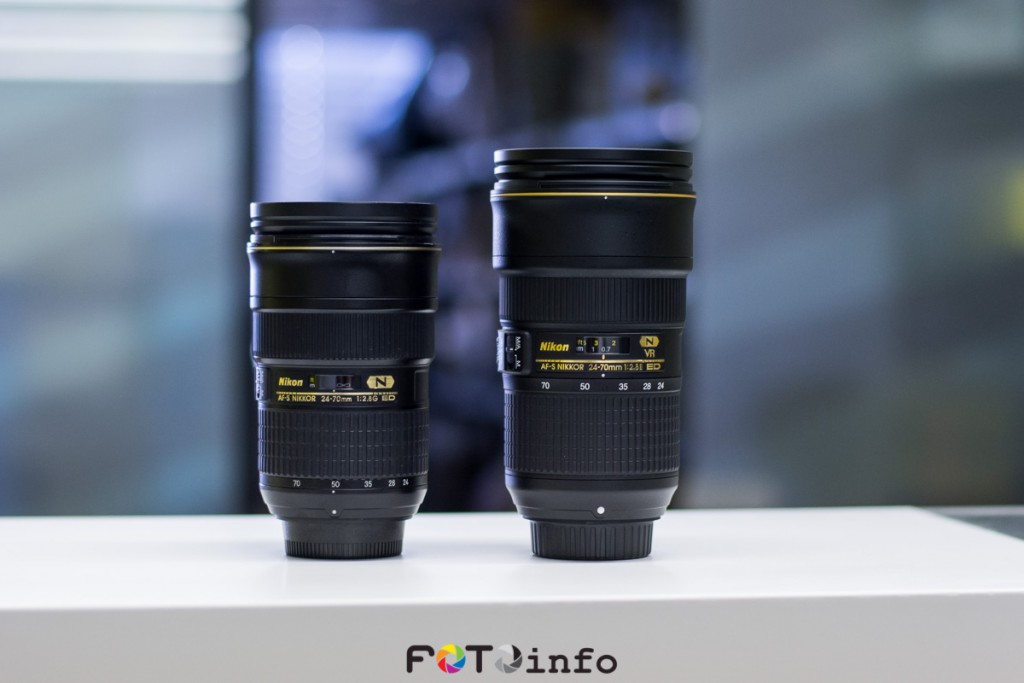
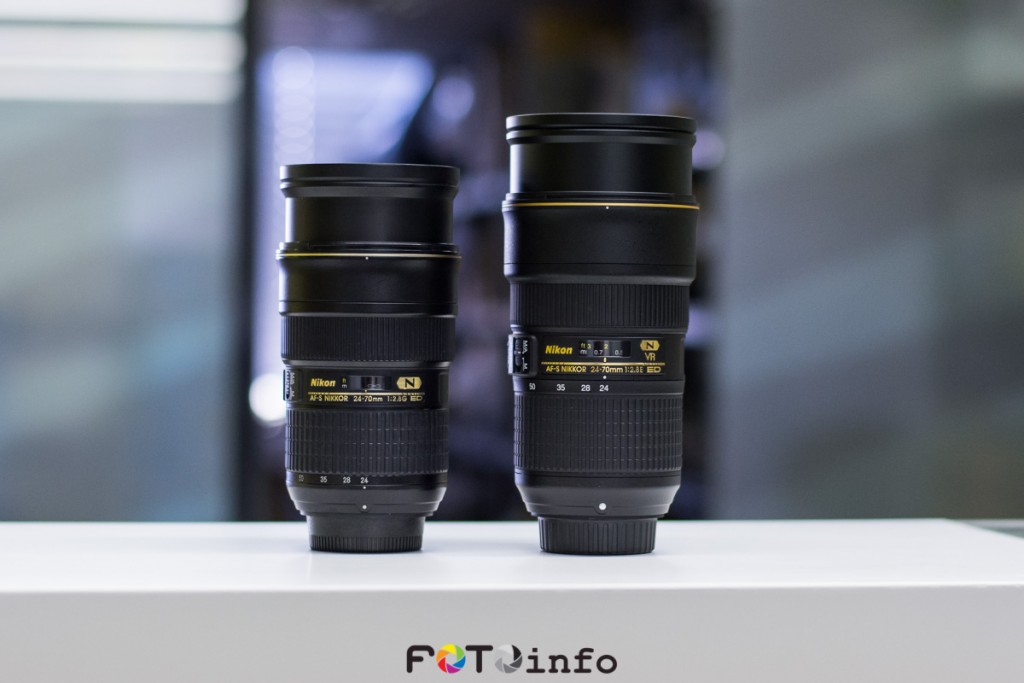
Internal zooming? Really?

Nikon-24-70mm-f2.8G-ED-vs.-24-70mm-f2.8E-ED-VR-lens.jpg

Nikon-24-70mm-f2.8G-ED-vs.-24-70mm-f2.8E-ED-VR-lens-2.jpg
 
Upvote 0
rs said:
Internal zooming? Really?

Nikon-24-70mm-f2.8G-ED-vs.-24-70mm-f2.8E-ED-VR-lens.jpg

Nikon-24-70mm-f2.8G-ED-vs.-24-70mm-f2.8E-ED-VR-lens-2.jpg

Wow. So that B&H quote was 100% wrong. Thanks for linking the shots. That settles that.

And wouldn't you look at that -- it's just like the 24-70 f/2.8L I: it gets longer on the 24mm end. I wonder if it has the mondo but idea-for-all-FL hood as well.

- A
 
Upvote 0
ahsanford said:
jeffa4444 said:
I disagree I think Canon have every intention of keeping a "L" lens in the 24-105mm range you cannot put the genie back it the bottle and the price for the existing lens has actually gone up since the 24-105 f3.5-5.6 IS arrived and many "want" the premium L lenses on full-frame bodies.

I think a lot of people got emotionally attached to that 24-105L or strongly prefer the added length, even if it limits the IQ somewhat. It's a fine lens and I have nothing against it.

But consider some headwinds that a 24-105 f/4L IS II would face to get made:

  • The current 24-105 f/4L is in spectacular supply in the field, and you can't walk two feet on the internet without bumping into a $600 24-105L deal. Sure, a great deal of that is due to resellers prying that lens out of 6D and 5D3 kits to maximize their profits, but the fact they need to resort to such low prices implies that (a) folks already have a standard EF zoom and don't need another, (b) they don't find the 24-105 f/4L IS desirable over alternatives, or (c) they don't find the 24-105 f/4L to be worth it at a higher price. Two out of three of those reasons might scare Canon off from making another.


  • The 24-105mm f/4L is a kit lens. It's *supposed* to be cheap.
 
Upvote 0
As an owner of a 5DSR and A7Rii, I have stopped using any non IS lenses on the 5DSR and I use my fast primes (50L, 85L and 135L) on the Sony.

I use the following lenses on the 5DSR (35F2 IS, 24-105F4 IS, 70-200 F2.8 & F4 IS, 100-400 II IS)

I tried and tried using non IS lenses on the 5DSR but if you really care about tack sharp (i.e. you are using a 5DSR) then you either need a tripod or very fast shutter speeds with non-IS lenses.

Because of the above, and because I basically wanted a 24-70 F2.8 IS (or a lens as sharp as this lens with IS), I have recently purchased a Sigma 24-105 F4 IS. The Sigma, besides at 35mm, is sharper than the Canon at F4 at every FL - and the zone of sharpness is very good in the middle of the frame. Importantly, unlike the Canon, it is truly an F4 lense at the long end and it is at its sharpest in the portrait FL of 70-105 at F4 - and at F5.6 it is tack, tack sharp - at is almost 1 TStop faster at the long end than the Canon 24-105.

I own most L lenses so I am not a Sigma fanboy - but take a look at the Sigma 24-105 - it is a very good mid range zoom - not light - but from a studio, wedding portrait perspective for a high megapixel camera it is a great choice - I would weld it to the 5DSR and call it a day for that camera if it wasn't for the 100-400II IS which is also incredible - and my current favourite lens.
 
Upvote 0