L
Loswr
Guest
Neutral said:Looking at the DPR test shots 1DXm2 has clear advantage over 1DX and over Sony a7r2.
Do not know why DPR decided that a7r2 is better at high ISO that 1DXm2
Why? Bias.
Upvote
0
Neutral said:Looking at the DPR test shots 1DXm2 has clear advantage over 1DX and over Sony a7r2.
Do not know why DPR decided that a7r2 is better at high ISO that 1DXm2
Why bring the A7R II or the D810 into the discussion at all?rishi_sanyal said:Jack Douglas said:[email protected] said:I think it's fair to say that this beginning of their 1DX2 review shows in the least a sloppiness in framing these consumer choices, which happens to leave the impression the 1DX2 is less of a camera than it is. I also think it is eyebrow raising that the review does seem to have inverted the importance of low- versus high- ISO performance corresponding precisely with Canon and Nikon having swapped their own design priorities in their respective refreshes. One of our number here on CR actually (jokingly) suggested before-hand that DPR would do this if Canon ever went to on-chip circuitry to provide better low-ISO noise reduction.
I'd doesn't have the inverted importance because the 1D-X II only shows an improvement relative to already underperforming Canons. It's still well behind the best the competition offer, and we DID emphasize it beats its only real peer, the Nikon D5 significantly. What more would you have us say? Lie and say it now matched the D810 or a7R II? Because it doesn't.
[email protected] said:I suspect that there is no real motive to be biased, but that - like someone who likes Chevy over Ford, etc. - one has to justify to oneself why after reviewing a competing brand one still prefers the favorite brand. That dialog in one's mind winds up focusing on negatives of the thing being reviewed. This is why DPR needs a few more people who primarily own the Canon system.
In sum, no, I don't think the impressions of bias are meritless. But, no, I really doubt this is deliberate. I bet with guys like Rishi and Barney doing this, they get better and better.
Jack Douglas said:What it comes down to is this. Not everyone has an excellent command of the English language for whatever reason. There are many, including ESL, limited education, disinterest in language as opposed to technology and so forth. Such people probably are incapable of discerning the nuances that contribute to the bias they present. From previous statements by the author I believe there is a sincere desire to be unbiased but that doesn't mean there is no bias.
Yes there has been a flip, now that Canon has improved DR in low ISO, and DR continues to get way too much emphasis.
Jack
Well, I'm sure that's not racist or anything, but it does seem to avert the fact that Barney actually learned proper English in England and is quite a writer, and as an American born citizen myself, I resent the ESL implication, and the 'lack of secondary education' implication concidering English is my first language. Nevermind your comments re: education, considering we both went to gradute studies, and I myself graduated from two Ivy League schools.
Really fun and productive place to be around, these forums, I'm beginning to see. Would a second Princton degree help? If so perhaps I'll consider one. Oh the horror of spending time with some of the most brilliant people on the world.
Rishi Sanyal, Ph.D
Technical Editor, dpreview.com

StudentOfLight said:Here is a recent 4 stop push. Wanted to retain star colours and lift some of the faint nebula detail out as well. More DR would be helpful.
Neutral said:Looking at the DPR test shots 1DXm2 has clear advantage over 1DX and over Sony a7r2.
Do not know why DPR decided that a7r2 is better at high ISO that 1DXm2
For proper high ISO comparison one need to select low light scene comparison option – this is where luminance in shadow areas is significantly lower compared to test shot at normal lighting.
When using such low light conditions it is better to evaluate more accurately high ISO performance, including high ISO DR. I believe that many people here were doing comparisons at normal light where sensor performance differences are less obvious.
From these snapshots, see attached, I could see that 1DXm2 has about 1/3 or may be a bit better high ISO performance compared to 1DX and some smaller advantage over Sony a7r2.
In addition, a7r2 has some issues at rendering low contrast shadow areas, which is clearly seen on snapshots, maybe due to default compressed RAW settings. Possibly, with uncompressed RAW setting there would be no such artefacts.
What is most important is that 1DXm2 noise pattern is uniform, less blotchy and has a bit higher frequency compared to 1DX and a7r2 noise – more close to Gaussian noise pattern. So as result is looks more natural, more pleasant to eye and easy to filter out by NR. DXO Prime NR probably will be working very well removing such kind of noise.
So for me as owner of 1DX and Sony a7r2 these 1DXm2 results together with other 1DXm2 improvements (significantly improved AF, anti-flicker mode etc.) is enough to make decision for upgrade from 1DX. New 1DXm2 should be working noticeably better than 1DX in dim lit conditions – both image quality and AF performance.
As for D5 it clearly has at least 1/2 stop advantage over 1DXm2 at high ISOs closing to theoretical limit for Bayer sensor type. Interesting to know what they did for that.

Keith_Reeder said:StudentOfLight said:Here is a recent 4 stop push. Wanted to retain star colours and lift some of the faint nebula detail out as well. More DR would be helpful.
So don't push in Lightroom - it's crap for this kind of adjustment.
Why don't people get this? I've demonstrated low ISO 5 stop pushes - from a 70D, FFS - that were squeaky-clean in the shadows because I used the right converter for the job...
Keith_Reeder said:StudentOfLight said:Here is a recent 4 stop push. Wanted to retain star colours and lift some of the faint nebula detail out as well. More DR would be helpful.
So don't push in Lightroom - it's crap for this kind of adjustment.
Why don't people get this? I've demonstrated low ISO 5 stop pushes - from a 70D, FFS - that were squeaky-clean in the shadows because I used the right converter for the job...
Keith_Reeder said:Just saying. Banging on about your credentials isn't a convincing defence against allegations of bias (whether or not unintended) and of sloppy testing...
Oh - and as an American, maybe you don't see the irony of you complaining about this forum as a place to spend time, given the utterly dismal experience that is DPR...
So, you are here arguing about silly people who are bragging about 1/3 EV benefit. As every one pointed, that Sony camera you compared is not better at high iso. What about other Sony class leader in high iso and why not compare with D5 and 1DX2 . Why do you think Sony is better than 1DX2 and D5 at high iso with not so good noise pattern.rishi_sanyal said:nvsravank said:I think both of you are correct.
One is saying it is better to have more DR so you have more flexibility.
The other is saying that DPReview is making a mountain of a mole hill when they say 1DXii is worse than another product when the differences are not that big anymore. But that is journalism for you (I hope you weren't expecting objective measurements from DPR)
unfocused said:Refurb7 said:Points (since you asked):
a) Photographers with current and past Canons get the job done with basic knowledge of exposure and light; it's not some impossible or insurmountable thing.
b) The claim that Canon can't do sports in bright sun (without big noise) is proven wrong every day.
c) DPR exaggerates Canon's "weaknesses" with tests that seem to be designed to do just that ... find a distinction and then keep hammering it.
d) DPR's vision of photography seems to be one of maximum data in every corner of the image, which is a very narrow technical view of photography.
e) One can't come away from a DPR review without feeling that Canon is deficient in sensor design; and yet there is a world of photography that proves otherwise, especially pro photography at the extremes.
f) DPR makes basic errors, like judging "skin tones" based on a picture of a picture. Experienced photographers know how flawed that is. It would be the same if you judged "foliage" based on a picture of a picture.
You say "Just because we are able to deal with existing circumstances doesn't mean there aren't advantages to technological improvements." I agree. What I'm saying is that in their effort to draw distinctions and promote certain technological improvements, some people promote a false narrative that we CAN'T deal with existing circumstances with current technology or that it's much too difficult.
I answered the question of my experience in reply #58 above. http://www.canonrumors.com/forum/index.php?topic=29759.msg594932#msg594932
First of all, hats off to you. Delivering 30,000 edited images every year for 15 years sounds pretty much like my worst nightmare. That's more than 80 images every day 365 days a year. I'd shoot myself if I had to produce that kind of volume.
But, to be clear, no one suggested you can't take great images with Canons (or nikons or sonys), I think what East Wind was saying (and I know what I was saying) was that there are lots of situations where raising shadows by several stops is a valuable characteristic to have in a camera. We both offered examples of how that is useful.
Your response is to completely dismiss these examples and to suggest that only photographers without skill can use additional dynamic range. Your "points" seem to be aimed at what you perceive to be bias from DPReview, but that was not the subject of our comments.
I find it interesting that it was previously OK to talk about 1/3 EV benefits in high ISO dynamic range for the 6D - something you don't even see unless you're pushing already noisy high ISO files, but a point I saw made here on CR all the time - and yet it's not OK to point out the more apparent midtone (SNR 18%) noise benefit of the class-leading (in this regard) D5.
And just since the 1D-X II shows improvements in low ISO DR, we're supposed to overemphasize it because, well, Canon tried, despite still remaining probably a stop or more behind class leaders in this regard. I mean, we already said its 'significant that it beats its only real peer the D5', but that wasn't enough because on the next page where we look at high ISO, we shouldn't have pointed out the D5 beats the 1D-X II.
Interesting logic.
A CR member then passively aggressively attributes the supposed bias - if you still believe it exists after reading my comments above - to possible ESL and lack of education (no racist underpinnings, I'm sure) with respect to the reviewer, who happens to be a graduate of two Ivy League colleges, and born in the United States, by the way.
This is a fantastic place, thank you for graciously allowing my presence here.
Rishi Sanyal, Ph.D
Technical Editor, dpreview.com
ritholtz said:So, you are here arguing about silly people who are bragging about 1/3 EV benefit. As every one pointed, that Sony camera you compared is not better at high iso. What about other Sony class leader in high iso and why not compare with D5 and 1DX2 . Why do you think Sony is better than 1DX2 and D5 at high iso with not so good noise pattern.rishi_sanyal said:nvsravank said:I think both of you are correct.
One is saying it is better to have more DR so you have more flexibility.
The other is saying that DPReview is making a mountain of a mole hill when they say 1DXii is worse than another product when the differences are not that big anymore. But that is journalism for you (I hope you weren't expecting objective measurements from DPR)
unfocused said:Refurb7 said:Points (since you asked):
a) Photographers with current and past Canons get the job done with basic knowledge of exposure and light; it's not some impossible or insurmountable thing.
b) The claim that Canon can't do sports in bright sun (without big noise) is proven wrong every day.
c) DPR exaggerates Canon's "weaknesses" with tests that seem to be designed to do just that ... find a distinction and then keep hammering it.
d) DPR's vision of photography seems to be one of maximum data in every corner of the image, which is a very narrow technical view of photography.
e) One can't come away from a DPR review without feeling that Canon is deficient in sensor design; and yet there is a world of photography that proves otherwise, especially pro photography at the extremes.
f) DPR makes basic errors, like judging "skin tones" based on a picture of a picture. Experienced photographers know how flawed that is. It would be the same if you judged "foliage" based on a picture of a picture.
You say "Just because we are able to deal with existing circumstances doesn't mean there aren't advantages to technological improvements." I agree. What I'm saying is that in their effort to draw distinctions and promote certain technological improvements, some people promote a false narrative that we CAN'T deal with existing circumstances with current technology or that it's much too difficult.
I answered the question of my experience in reply #58 above. http://www.canonrumors.com/forum/index.php?topic=29759.msg594932#msg594932
First of all, hats off to you. Delivering 30,000 edited images every year for 15 years sounds pretty much like my worst nightmare. That's more than 80 images every day 365 days a year. I'd shoot myself if I had to produce that kind of volume.
But, to be clear, no one suggested you can't take great images with Canons (or nikons or sonys), I think what East Wind was saying (and I know what I was saying) was that there are lots of situations where raising shadows by several stops is a valuable characteristic to have in a camera. We both offered examples of how that is useful.
Your response is to completely dismiss these examples and to suggest that only photographers without skill can use additional dynamic range. Your "points" seem to be aimed at what you perceive to be bias from DPReview, but that was not the subject of our comments.
I find it interesting that it was previously OK to talk about 1/3 EV benefits in high ISO dynamic range for the 6D - something you don't even see unless you're pushing already noisy high ISO files, but a point I saw made here on CR all the time - and yet it's not OK to point out the more apparent midtone (SNR 18%) noise benefit of the class-leading (in this regard) D5.
And just since the 1D-X II shows improvements in low ISO DR, we're supposed to overemphasize it because, well, Canon tried, despite still remaining probably a stop or more behind class leaders in this regard. I mean, we already said its 'significant that it beats its only real peer the D5', but that wasn't enough because on the next page where we look at high ISO, we shouldn't have pointed out the D5 beats the 1D-X II.
Interesting logic.
A CR member then passively aggressively attributes the supposed bias - if you still believe it exists after reading my comments above - to possible ESL and lack of education (no racist underpinnings, I'm sure) with respect to the reviewer, who happens to be a graduate of two Ivy League colleges, and born in the United States, by the way.
This is a fantastic place, thank you for graciously allowing my presence here.
Rishi Sanyal, Ph.D
Technical Editor, dpreview.com

rishi_sanyal said:nvsravank said:I think both of you are correct.
One is saying it is better to have more DR so you have more flexibility.
The other is saying that DPReview is making a mountain of a mole hill when they say 1DXii is worse than another product when the differences are not that big anymore. But that is journalism for you (I hope you weren't expecting objective measurements from DPR)
unfocused said:Refurb7 said:Points (since you asked):
a) Photographers with current and past Canons get the job done with basic knowledge of exposure and light; it's not some impossible or insurmountable thing.
b) The claim that Canon can't do sports in bright sun (without big noise) is proven wrong every day.
c) DPR exaggerates Canon's "weaknesses" with tests that seem to be designed to do just that ... find a distinction and then keep hammering it.
d) DPR's vision of photography seems to be one of maximum data in every corner of the image, which is a very narrow technical view of photography.
e) One can't come away from a DPR review without feeling that Canon is deficient in sensor design; and yet there is a world of photography that proves otherwise, especially pro photography at the extremes.
f) DPR makes basic errors, like judging "skin tones" based on a picture of a picture. Experienced photographers know how flawed that is. It would be the same if you judged "foliage" based on a picture of a picture.
You say "Just because we are able to deal with existing circumstances doesn't mean there aren't advantages to technological improvements." I agree. What I'm saying is that in their effort to draw distinctions and promote certain technological improvements, some people promote a false narrative that we CAN'T deal with existing circumstances with current technology or that it's much too difficult.
I answered the question of my experience in reply #58 above. http://www.canonrumors.com/forum/index.php?topic=29759.msg594932#msg594932
First of all, hats off to you. Delivering 30,000 edited images every year for 15 years sounds pretty much like my worst nightmare. That's more than 80 images every day 365 days a year. I'd shoot myself if I had to produce that kind of volume.
But, to be clear, no one suggested you can't take great images with Canons (or nikons or sonys), I think what East Wind was saying (and I know what I was saying) was that there are lots of situations where raising shadows by several stops is a valuable characteristic to have in a camera. We both offered examples of how that is useful.
Your response is to completely dismiss these examples and to suggest that only photographers without skill can use additional dynamic range. Your "points" seem to be aimed at what you perceive to be bias from DPReview, but that was not the subject of our comments.
I find it interesting that it was previously OK to talk about 1/3 EV benefits in high ISO dynamic range for the 6D - something you don't even see unless you're pushing already noisy high ISO files, but a point I saw made here on CR all the time - and yet it's not OK to point out the more apparent midtone (SNR 18%) noise benefit of the class-leading (in this regard) D5.
And just since the 1D-X II shows improvements in low ISO DR, we're supposed to overemphasize it because, well, Canon tried, despite still remaining probably a stop or more behind class leaders in this regard. I mean, we already said its 'significant that it beats its only real peer the D5', but that wasn't enough because on the next page where we look at high ISO, we shouldn't have pointed out the D5 beats the 1D-X II.
Interesting logic.
A CR member then passively aggressively attributes the supposed bias - if you still believe it exists after reading my comments above - to possible ESL and lack of education (no racist underpinnings, I'm sure) with respect to the reviewer, who happens to be a graduate of two Ivy League colleges, and born in the United States, by the way.
This is a fantastic place, thank you for graciously allowing my presence here.
Rishi Sanyal, Ph.D
Technical Editor, dpreview.com
Jack Douglas said:Sadly, racial undercurrents surface when something isn't quite the way one would like it to read. You have read between the lines incorrectly.
There are many factors that go into the level of English that any/all of us have. I am definitely not racist and am married to an ESL. We all have our strong and weak points and I'm not an English major. The fact is that the English language has many variants relative to how ideas can be expressed and these are not always perceived by all. The bias that has been referred to is minor and really inconsequential (should really stop making references to it) and yes CR folk often take advantage by skewing their comments as pointed out - clearly unfair. I try my best not to do that.
Rishi this was not meant to be a personal attack in any way and take it with a grain of salt since I'm only a BSc EE. You must have thick skin to survive given the job you have chosen to do. Just do your best and don't take things so personally.
Jack
rishi_sanyal said:Jack Douglas said:Sadly, racial undercurrents surface when something isn't quite the way one would like it to read. You have read between the lines incorrectly.
There are many factors that go into the level of English that any/all of us have. I am definitely not racist and am married to an ESL. We all have our strong and weak points and I'm not an English major. The fact is that the English language has many variants relative to how ideas can be expressed and these are not always perceived by all. The bias that has been referred to is minor and really inconsequential (should really stop making references to it) and yes CR folk often take advantage by skewing their comments as pointed out - clearly unfair. I try my best not to do that.
Rishi this was not meant to be a personal attack in any way and take it with a grain of salt since I'm only a BSc EE. You must have thick skin to survive given the job you have chosen to do. Just do your best and don't take things so personally.
Jack
OK Jack, no worries, thanks for the clarification.
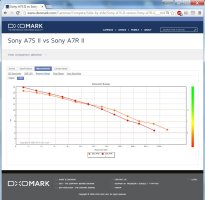
To get back to 'why did DPR say the 1D-X II falls slightly behind the a7R II when normalized' - a SNR analysis shows the following for the darker grey (2nd from right) patch at ISO 51,200:
Canon 1D-X II: SNR = 2.86
Sony a7R II: SNR = 3.39 (normalized to 1D-X II resolution)
So, both the visual analysis and SNR analysis indicate less noise for the a7R II, which has 18.5% more SNR for that grey patch relative to the 1D-X II. To put that in perspective: 1 EV better noise performance would yield 41% more SNR when operating in a shot-noise limited region.
So that's about a 1/2 EV advantage for the a7R II. Note, discussions moire should not be conflated with discussions of noise.
-Rishi
rishi_sanyal said:Because look at Neutral's crops here: the a7R II does have a very slight advantage (less blotchy noise) in the grey patch, and meanwhile the author conflates aliasing artifacts (moire) with 'poor rendering of low contrast areas'. No... That's moire due to the high res sensor and lack of AA filter.

rishi_sanyal said:Jack Douglas said:[email protected] said:I think it's fair to say that this beginning of their 1DX2 review shows in the least a sloppiness in framing these consumer choices, which happens to leave the impression the 1DX2 is less of a camera than it is. I also think it is eyebrow raising that the review does seem to have inverted the importance of low- versus high- ISO performance corresponding precisely with Canon and Nikon having swapped their own design priorities in their respective refreshes. One of our number here on CR actually (jokingly) suggested before-hand that DPR would do this if Canon ever went to on-chip circuitry to provide better low-ISO noise reduction.
I'd doesn't have the inverted importance because the 1D-X II only shows an improvement relative to already underperforming Canons. It's still well behind the best the competition offer, and we DID emphasize it beats its only real peer, the Nikon D5 significantly. What more would you have us say? Lie and say it now matched the D810 or a7R II? Because it doesn't.
[email protected] said:I suspect that there is no real motive to be biased, but that - like someone who likes Chevy over Ford, etc. - one has to justify to oneself why after reviewing a competing brand one still prefers the favorite brand. That dialog in one's mind winds up focusing on negatives of the thing being reviewed. This is why DPR needs a few more people who primarily own the Canon system.
In sum, no, I don't think the impressions of bias are meritless. But, no, I really doubt this is deliberate. I bet with guys like Rishi and Barney doing this, they get better and better.
Jack Douglas said:What it comes down to is this. Not everyone has an excellent command of the English language for whatever reason. There are many, including ESL, limited education, disinterest in language as opposed to technology and so forth. Such people probably are incapable of discerning the nuances that contribute to the bias they present. From previous statements by the author I believe there is a sincere desire to be unbiased but that doesn't mean there is no bias.
Yes there has been a flip, now that Canon has improved DR in low ISO, and DR continues to get way too much emphasis.
Jack
Well, I'm sure that's not racist or anything, but it does seem to avert the fact that Barney actually learned proper English in England and is quite a writer, and as an American born citizen myself, I resent the ESL implication, and the 'lack of secondary education' implication concidering English is my first language. Nevermind your comments re: education, considering we both went to gradute studies, and I myself graduated from two Ivy League schools.
Really fun and productive place to be around, these forums, I'm beginning to see. Would a second Princton degree help? If so perhaps I'll consider one. Oh the horror of spending time with some of the most brilliant people on the world.
Rishi Sanyal, Ph.D
Technical Editor, dpreview.com
9VIII said:rishi_sanyal said:Because look at Neutral's crops here: the a7R II does have a very slight advantage (less blotchy noise) in the grey patch, and meanwhile the author conflates aliasing artifacts (moire) with 'poor rendering of low contrast areas'. No... That's moire due to the high res sensor and lack of AA filter.
Yes, Neutral's samples are specifically looking at a spot with some very high frequency data, none of the cameras render that well at high ISO.
If you look at other things, like the four main photographs of people's faces, it's obvious that the A7RII is crushing tons of detail. The D5 generally looks best but the original 1DX still pulls ahead in a few instances. Maybe that could be attributed to the random nature of high ISO noise but it's clear the two are performing very similarly, and much better than the A7RII.

lux said:Ok, a lot of the stuff here I'm not really following so I was hoping someone might give information that is actually useful.
I had a xti and 2ti that I would take photos at ISO 800 happily
I have a 70d which I'll take to 1600
I have a 6d and 70dii that I'll take to 3200-6400.
Part of this is the camera and part is my ability to use Lightroom and properly expose which has improved over the years
If I purchased a 1dxii (or maybe a 5div later) how high would I take the ISO.
The reality for me and a lot of folks is that I'm not taking a lot of photos where I want to push shadows 5 stops. If I need to do that I've already messed up somewhere. However I'm asked to take photos in poorly lit gyms or churches with some frequency and noise at high ISO is important.
If the next generation of cameras gives me another stop that would be a big deal.
So those of you with 1dxii how we doing at high ISO.