Canon FF mirrorless Poll

I would buy a Canon FF mirrorless camera... (choose the ONE answer that BEST applies)


  • Total voters
    103
I still see this as too hard to call. There are clear pros and cons to both sides of this argument, and not just for us but also for Canon.

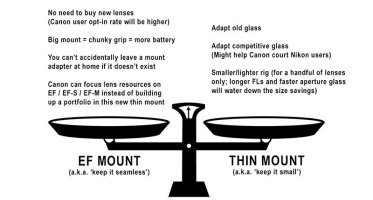
To me it's all a question of Canon letting this market define itself or if they are brave enough to define it:

  • If they wait, it may have to be a thin mount because common-sense notwithstanding, thin will be the entrenched notion of the market. (And it would likely be a fine product.)

  • If they are brave, they could come out sooner rather than later and sell the world on the seamlessness of a 2nd body that'd identical to their 5D in handling/size/controls, that mirrorless is more than just about size, that an EVF removes certain constraints and unlocks certain opportunities, etc.

And don't mistake my tone below as being one way or the other. I've gone around and around on this and I have a hard time landing on an answer. Both mounts offer opportunities and limitations.

- A
 

Attachments

  • mirrorless mount options.jpg
    mirrorless mount options.jpg
    46.1 KB · Views: 133
Upvote 0
martti said:
There have been rumors about Nikon FF mirrorless for many years now. We see no such thing. What would be the reason for Canon to launch a FF mirrorless? To compete with Sony? What Canon needs is a better sensor and some fine tuning in their current FF DSLRs. Yet another form factor with its own lineup of lenses does not seem like a good idea economically.
Canon is driven by the bottom line and they know they are on a diminishing market where all camera makers are facing losses. They'd need a new approach to social media oriented mass products. There might still be some money to be made as everybody is vlogging and YouTubing. Now look at the GoPro flock, it is enormous! Look at the shaky, vertical pixelated stuff people post...now there I see a market.
Canon thinks "camera" they should think "audience".

You are thinking small potatos, Canon is thinking big - Very BIG!

Canon has announced their new approach to the drop in camera sales, and its not into a market where competition is so stiff that there are almost no profits.

They spent billions to buy Axis, the big surveillance camera manufacturer which sells very expensive systems to the government, military, and big companies who can afford big bucks for security. We are talking billions of dollars.

"Canon Inc (7751.T) made a 23.6 billion-Swedish-crown ($2.83 billion) offer for network video surveillance leader Axis AB (AXIS.ST) on Tuesday -- the biggest purchase ever for the Japanese firm trying to expand beyond a shrinking camera market." The deal will make Canon a top player in the video surveillance market, which was worth an estimated $15 billion at the end of last year, according to researcher IHS. Within that market, there is a $3.86 billion segment for network-connected security cameras which is led by Axis with a 17.5 percent share as of 2013.

Secondly, they are buying and expanding even more into the Medical Imaging field, once again, high end, expensive products that are very profitable. Hospitals with huge budgets for new products trust Canon because of their support. They pay the price for quality and reliability.
"Under Phase V of its Excellent Global Corporation Plan, a five-year initiative launched in 2016, Canon aims to embrace the challenge of new growth through a grand strategic transformation. With regard to reinforcing and expanding new businesses in particular, which represents one of the important strategies to be carried out during this phase, Canon intends to cultivate its health care business within the safety and security sector as a next-generation pillar of growth.
Toshiba Medical is one of the leading global companies in the medical equipment industry. Within the field of medical X-ray computed tomography (CT) systems in particular, Toshiba Medical is the overwhelming market share leader in Japan and has been steadily increasing its global market share. Additionally, Toshiba Medical is the only company in the industry with a broad product portfolio that spans diagnostic X-ray systems, magnetic resonance imaging (MRI) systems, diagnostic ultrasound systems and diagnostic nuclear medicine systems. The company also offers cutting-edge medical imaging solutions and in-vitro diagnostics aimed at individualized care."

Third, industrial applications like machine vision where, once again, Canon can leverage their reputation to convince buyers to spend big bucks on Canon equipment.

Canon feels that these areas are growth markets, and so far they have been right.

Canon is also creeping into the sensor market, and offering sensors for sale. They do not seem to be diving in big time, so their intentions are not known.

 
Upvote 0
jolyonralph said:
I can't see the point in having anything except EF-M mount.

The point might be image quality. The shorter the flange distance, the more difficult it seems to be to have lenses that don't have major issues with corner and edge sharpness, CA and vignetting. Even with the smaller APS-C size sensor, the EF-M mount has vignetting issues that are off-the-scale bad, based on lens testing.
 
Upvote 0
dak723 said:
jolyonralph said:
I can't see the point in having anything except EF-M mount.

The point might be image quality. The shorter the flange distance, the more difficult it seems to be to have lenses that don't have major issues with corner and edge sharpness, CA and vignetting. Even with the smaller APS-C size sensor, the EF-M mount has vignetting issues that are off-the-scale bad, based on lens testing.

This is because the shorter the mount, the greater the angle that light will hit the sensor....
 
Upvote 0
Don Haines said:
This is because the shorter the mount, the greater the angle that light will hit the sensor....

Not totally correct.

This is ENTIRELY dependent on lens design.

An EF lens attached to an adaptor projects light onto the FF Mirrorless sensor in exactly the same way as it would do on a standard DSLR EF mount camera.

IF your new EF-M lens was to have the elements as far back as could physically fit then yes, there could be a problem (although a problem that Sony seem to have solved with FE lenses.)

But... there is also a middle ground. A new FF EF-M lens could fit somewhere in the middle, ie have some gap between the rear elements and the mount, but still be closer to the sensor than an EF lens.

Then it becomes an issue of working out the best combination of size/weight and optical performance that you can get for these lenses. For many optical formulae there is likely to be a size/weight benefit to using EF glass while retaining excellent optical quality.

Using the EF-M mount gives you the flexibility to do this. Sticking to the EF mount might require new EF Mirrorless lenses that stick further into the body than EF-S does, but I think that's a less elegant solution than using EF-M mount.
 
Upvote 0
Hi,
I choose "ONLY if Canon uses its existing EF FF mount and flange distance" basically because:
1) My EF lens will work,
2) I want a larger capacity battery, and
3) I want a camera that's I can hold firmly... I don't have large hand nor I'm strong, but when using the M5, I always worry that I might break the grip when using large lens as I tend to hold very tight. Also, holding a small camera for too long is not very comfortable.

Anyway, IMHO, mirrorless need to improve the battery life (increase battery capacity and reduce power usage) before it can totally replace DSLR.

Have a nice day.
 
Upvote 0
jolyonralph said:
Don Haines said:
This is because the shorter the mount, the greater the angle that light will hit the sensor....

Not totally correct.

This is ENTIRELY dependent on lens design.

An EF lens attached to an adaptor projects light onto the FF Mirrorless sensor in exactly the same way as it would do on a standard DSLR EF mount camera.

IF your new EF-M lens was to have the elements as far back as could physically fit then yes, there could be a problem (although a problem that Sony seem to have solved with FE lenses.)

But... there is also a middle ground. A new FF EF-M lens could fit somewhere in the middle, ie have some gap between the rear elements and the mount, but still be closer to the sensor than an EF lens.

Then it becomes an issue of working out the best combination of size/weight and optical performance that you can get for these lenses. For many optical formulae there is likely to be a size/weight benefit to using EF glass while retaining excellent optical quality.

Using the EF-M mount gives you the flexibility to do this. Sticking to the EF mount might require new EF Mirrorless lenses that stick further into the body than EF-S does, but I think that's a less elegant solution than using EF-M mount.

Adding "empty" space at the rear of the lens negates the size advantage of the smaller flange distance. Others have reported that this is what Sony was forced to do after their early lenses for the A7 series had very poor results. It is debatable whether these larger lenses would be worth it in order to keep the smaller flange distance which would allow using other brand lenses with adapters. Using these other lenses would seem to be the only real advantage to the EF-M mount, in my opinion.
 
Upvote 0