
You are using an out of date browser. It may not display this or other websites correctly.
You should upgrade or use an alternative browser.
You should upgrade or use an alternative browser.
Canon Full Frame Mirrorless Talk [CR1]
- Thread starter Canon Rumors
- Start date

stefang said:Now that's pedantic. I would guess something that sells for money is not worthless to at least the buyer...ecka said:.... It may be acceptable to shoot worthless snapshots for money....
Well, I was talking about "worth" as a photographic value
 , not money. Everything is worth something and you have to decide if it's worth your time and effort, you must draw the line. You can shoot nice pictures with your phone, but in the end, better camera adds more value to the image. FF isn't really that much more expensive or larger than crop systems, specially the glass. So, all that FF-fobia is just unreasonably silly.
Upvote
0
ecka said:FF isn't really that much more expensive or larger than crop systems, specially the glass. So, all that FF-fobia is just unreasonably silly.
sorry, but I cannot follow you here. My APS-C EOS-M gear with lenses from 11-200mm [eq. 18-320mm on FF] is roughly a quarter of the weight, bulk and cost of my EOS FF DSLR [5D3] + EF-lens setup.
And look at Fuji X-system [APS-C] ... compared to Sony A7/A9 FF lineup with FE glass. Both in terms of size, weight and cost.
APS-C is the absolute sweet spot in terms of "bang for the buck" and "weight/size to technical-photographic capability of gear". For both DSLRs and MILC systems.
Of course, FF has advantages in some/many specific situations. But those added capabilities do come at a fairly steep price and with quite some bulk and weight.
Upvote
0
AvTvM said:ecka said:FF isn't really that much more expensive or larger than crop systems, specially the glass. So, all that FF-fobia is just unreasonably silly.
sorry, but I cannot follow you here. My APS-C EOS-M gear with lenses from 11-200mm [eq. 18-320mm on FF] is roughly a quarter of the weight, bulk and cost of my EOS FF DSLR [5D3] + EF-lens setup.
And look at Fuji X-system [APS-C] ... compared to Sony A7/A9 FF lineup with FE glass. Both in terms of size, weight and cost.
APS-C is the absolute sweet spot in terms of "bang for the buck" and "weight/size to technical-photographic capability of gear". For both DSLRs and MILC systems.
Of course, FF has advantages in some/many specific situations. But those added capabilities do come at a fairly steep price and with quite some bulk and weight.
I agree with your sentiments in many respects, AvTvM (is it me or you feeling a bit weird today ;D), certainly in respects of image quality. But a camera system is about one you enjoy using and this is where it becomes personal choice. I preferred the xxD models to the xxxD because of things like the second wheel which simplified on-the-fly adjustments. I much prefer models with VFs (OVF or EVF I am quite ambivalent). The reason I went to MFT instead of M system was because, at the time, no M system had a VF and real estate on the back meant buttons were awkward to manage. Nowadays, the cost of the M series I would buy are as expensive as the MFTs I would buy, and for the purpose I would use them changing from MFT now to M series does not really offer any significant advantages to switching. If I were buying now I may well go to M series.
On the other hand, ecka is correct if the discussion is limited to DSLR.
Upvote
0

I'm in the same boat.... if I am deciding what to get and if the major criteria is small and light, I would go for micro 4/3 cameras..... but if image quality (particularly in poor light) and ergonomics (well spaced and fairly complete set of controls) are the important factors, its FF in a 5D sized body....Mikehit said:AvTvM said:ecka said:FF isn't really that much more expensive or larger than crop systems, specially the glass. So, all that FF-fobia is just unreasonably silly.
sorry, but I cannot follow you here. My APS-C EOS-M gear with lenses from 11-200mm [eq. 18-320mm on FF] is roughly a quarter of the weight, bulk and cost of my EOS FF DSLR [5D3] + EF-lens setup.
And look at Fuji X-system [APS-C] ... compared to Sony A7/A9 FF lineup with FE glass. Both in terms of size, weight and cost.
APS-C is the absolute sweet spot in terms of "bang for the buck" and "weight/size to technical-photographic capability of gear". For both DSLRs and MILC systems.
Of course, FF has advantages in some/many specific situations. But those added capabilities do come at a fairly steep price and with quite some bulk and weight.
I agree with your sentiments in many respects, AvTvM (is it me or you feeling a bit weird today ;D), certainly in respects of image quality. But a camera system is about one you enjoy using and this is where it becomes personal choice. I preferred the xxD models to the xxxD because of things like the second wheel which simplified on-the-fly adjustments. I much prefer models with VFs (OVF or EVF I am quite ambivalent). The reason I went to MFT instead of M system was because, at the time, no M system had a VF and real estate on the back meant buttons were awkward to manage. Nowadays, the cost of the M series I would buy are as expensive as the MFTs I would buy, and for the purpose I would use them changing from MFT now to M series does not really offer any significant advantages to switching. If I were buying now I may well go to M series.
On the other hand, ecka is correct if the discussion is limited to DSLR.
I think there is a market for both!
Upvote
0
L
Loswr
Guest
Don Haines said:I'm in the same boat.... if I am deciding what to get and if the major criteria is small and light, I would go for micro 4/3 cameras..... but if image quality (particularly in poor light) and ergonomics (well spaced and fairly complete set of controls) are the important factors, its FF in a 5D sized body....
I think there is a market for both!
I agree, and clearly for something in between, which is why the M series is popular. The biggest-sensor-smallest-package is why I chose the M over m4/3, and it's why I'll go with the M6 (perhaps with hotshoe EVF) over the M5.
Upvote
0
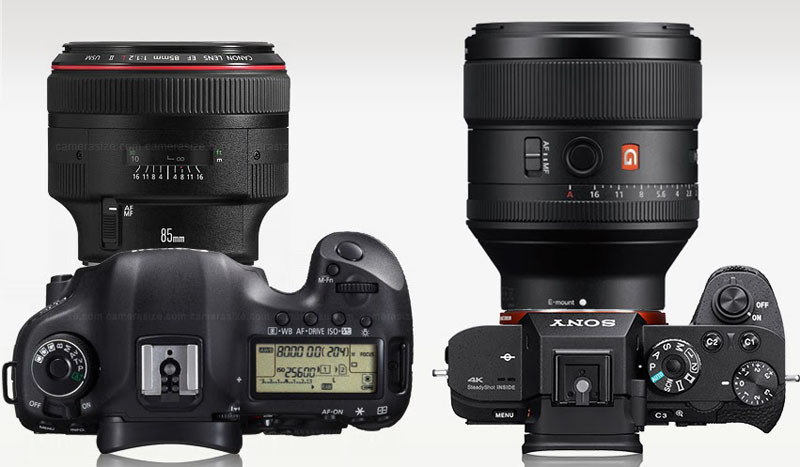
I'm thinking and hoping Canon will be the first to really offer a practical mirrorless camera in a DSLR sized package. The benefits of mirrorless, with the controls and practical use of a real sized camera.
$4,500 for a Sony with the ergos of a travel point and shoot? Pathetic.
Just buy a Fuji and be done with it.
"But mirrorless is so much more compact and lightweight" yeah...until they start slapping 2.8 zoom glass on there LOL.
$4,500 for a Sony with the ergos of a travel point and shoot? Pathetic.
Just buy a Fuji and be done with it.
"But mirrorless is so much more compact and lightweight" yeah...until they start slapping 2.8 zoom glass on there LOL.
Upvote
0
K said:"But mirrorless is so much more compact and lightweight" yeah...until they start slapping 2.8 zoom glass on there LOL.
correct. LOL
https://www.dpreview.com/news/2973316535/samyang-targets-sony-e-mount-users-with-new-35mm-f2-8-af-lens

;D
Upvote
0
L
Loswr
Guest
AvTvM said:K said:"But mirrorless is so much more compact and lightweight" yeah...until they start slapping 2.8 zoom glass on there LOL.
correct. LOL
https://www.dpreview.com/news/2973316535/samyang-targets-sony-e-mount-users-with-new-35mm-f2-8-af-lens
Are you saying the focus breathing on the Samyang 35/2.8 prime lens is so bad you consider it a zoom lens? Or is it just that you don't read well? LOL.
Upvote
0
I indeed overread the word zoom.
But it does not matter. Just can't hear the constant refrain of "mirrorless size advantage is gone as soon as you slap ... BIG FAT LENSES ... blablabla"
Why do we need to discuss this at nauseam. Why can people not get their mind around the fact, that mirrorless systems - as opposed to DSLRs ("mirrorslappers") - allow for both,
1) BIG FAT cameras and
2) ULTRA-COMPACT ...
and that we can mount big fat glass on them OR ultracompact lenses. Depending on what we want and need in a specific situation?
And why oh why does Canon not finally offer mirrorless FF cameras? In both shapes:
1. big fat chunky bodies with native EF-mount trunk up front ... for all who prefer it that way. And
2. at least one ultracompact, but fully capable camera with a new, short FFD mount plus an assortment of new native ultracompact lenses and an EF adapter for those who prefer it that way.
And for everybody who wants a small backup camera in addition to their large main camera!
win - win, would be really easy in this case
But it does not matter. Just can't hear the constant refrain of "mirrorless size advantage is gone as soon as you slap ... BIG FAT LENSES ... blablabla"
Why do we need to discuss this at nauseam. Why can people not get their mind around the fact, that mirrorless systems - as opposed to DSLRs ("mirrorslappers") - allow for both,
1) BIG FAT cameras and
2) ULTRA-COMPACT ...
and that we can mount big fat glass on them OR ultracompact lenses. Depending on what we want and need in a specific situation?
And why oh why does Canon not finally offer mirrorless FF cameras? In both shapes:
1. big fat chunky bodies with native EF-mount trunk up front ... for all who prefer it that way. And
2. at least one ultracompact, but fully capable camera with a new, short FFD mount plus an assortment of new native ultracompact lenses and an EF adapter for those who prefer it that way.
And for everybody who wants a small backup camera in addition to their large main camera!
win - win, would be really easy in this case
Upvote
0
While there's been great improvements in smaller lenses by various brands, especially Fuji ...
There are certain physical realities about light and the properties of glass that means that big glass is needed to get certain results. If they could be made smaller, they would be. Primarily for the manufacturers to save money, secondly for you the user to benefit from lighter weights. But they can't. These are currently the limit of engineering designs and materials in our era.
Losing a mirror is pointless when the best results require huge glass anyway. I would also argue the small grip and crappy buttons/control placement is a hindrance to longevity in pro shooting.
The Sony mirrorless cameras handle like travel point and shoots. Awful. It's ok for travel point and shoots, because these are not being used non-stop for hours of intensive shooting. They sacrifice that size and buttons and controls for convenience of the traveler on the move.
For a pro camera, its more convenient to have a larger body.
Not only are the Sony bodies awful to grip, try holding on to those for 8+ hours with BIG glass attached. Be sure to bring 4-5 batteries with.
Sony is not ready for PRO primetime. No matter how many DPR trolls there are extolling their greatness.
I really hope Canon goes with a larger body for mirrorless. The benefit of mirrorless is NOT space or size savings within the pro realm. The benefits are the possibilities that a live view finder gives, higher FPS and much more....
But these benefits are in their infancy. EVF is far from ideal or perfected. Until they reach extremely high resolutions with massive dynamic range and undetectable latency - OVF has an edge. Yes, I know - EVF allows for "real time chimping"
There are certain physical realities about light and the properties of glass that means that big glass is needed to get certain results. If they could be made smaller, they would be. Primarily for the manufacturers to save money, secondly for you the user to benefit from lighter weights. But they can't. These are currently the limit of engineering designs and materials in our era.
Losing a mirror is pointless when the best results require huge glass anyway. I would also argue the small grip and crappy buttons/control placement is a hindrance to longevity in pro shooting.
The Sony mirrorless cameras handle like travel point and shoots. Awful. It's ok for travel point and shoots, because these are not being used non-stop for hours of intensive shooting. They sacrifice that size and buttons and controls for convenience of the traveler on the move.
For a pro camera, its more convenient to have a larger body.
Not only are the Sony bodies awful to grip, try holding on to those for 8+ hours with BIG glass attached. Be sure to bring 4-5 batteries with.
Sony is not ready for PRO primetime. No matter how many DPR trolls there are extolling their greatness.
I really hope Canon goes with a larger body for mirrorless. The benefit of mirrorless is NOT space or size savings within the pro realm. The benefits are the possibilities that a live view finder gives, higher FPS and much more....
But these benefits are in their infancy. EVF is far from ideal or perfected. Until they reach extremely high resolutions with massive dynamic range and undetectable latency - OVF has an edge. Yes, I know - EVF allows for "real time chimping"
Upvote
0

AvTvM said:Why do we need to discuss this at nauseam.
We don't need to - it's simply a fact, viewed in the context of the equally frequent claim that one of the benefits of mirrorless is smaller bodies.
If one, then the other.
It's not the only story in town, but whenever someone mentions the size advantage of mirrorless, expect someone to point out the big lens counter-argument.
Upvote
0
I cannot understand why some posters keep on using "PRO" as focal point. Is there really a difference in the usage of camera between a"PRO" and a "serious" shooter and a " for fun" shooter ? Everyone have their own requirement or preference in camera. If everybody agree on the same requirement, there will be only ONE camera to be made. Neuro is a living example. His equipment ranges from 1Dx to M. Every camera has it own place to a particular person at a particular situation.. So we cannot say that FF must be big and chunky for the PRO.
Upvote
0
Rocky said:I cannot understand why some posters keep on using "PRO" as focal point. Is there really a difference in the usage of camera between a"PRO" and a "serious" shooter and a " for fun" shooter ? Everyone have their own requirement or preference in camera. If everybody agree on the same requirement, there will be only ONE camera to be made. Neuro is a living example. His equipment ranges from 1Dx to M. Every camera has it own place to a particular person at a particular situation.. So we cannot say that FF must be big and chunky for the PRO.
The A9 is being marketed as a Pro camera by Sony.
A7 is also considered Pro.
Sure, you can use anything you want for Professional purposes. When I see the NFL sidelines filled with A9's and wedding pros across the nation running Sony -- then I'll say they're now the new pro standard.
Sony, for now, is for hobbyists with cash to burn. Nothing wrong with that.
Upvote
0
AvTvM said:ecka said:FF isn't really that much more expensive or larger than crop systems, specially the glass. So, all that FF-fobia is just unreasonably silly.
sorry, but I cannot follow you here. My APS-C EOS-M gear with lenses from 11-200mm [eq. 18-320mm on FF] is roughly a quarter of the weight, bulk and cost of my EOS FF DSLR [5D3] + EF-lens setup.
And look at Fuji X-system [APS-C] ... compared to Sony A7/A9 FF lineup with FE glass. Both in terms of size, weight and cost.
APS-C is the absolute sweet spot in terms of "bang for the buck" and "weight/size to technical-photographic capability of gear". For both DSLRs and MILC systems.
Of course, FF has advantages in some/many specific situations. But those added capabilities do come at a fairly steep price and with quite some bulk and weight.
Do you realize that your 11-200 M glass is equivalent to 18-320 F5.6-10 FF? And such FF lenses would be just as small/light or even smaller/lighter and would cost even less, because of those unattractive F-numbers. Most crop optics are overpriced because there are millions of ignorant people, who were fooled into thinking that sensor size doesn't matter. Canon could make big money by selling that kind of optics for dummies, but they don't and (IMHO) they deserve a lot of respect for that. Take a look at Tamron's new 28-300mm. Maybe it's just as bad as your 11-200 M (which is exactly my point), but it gathers twice as much light and weights only 540g. However, I'd rather just crop some FF images or use a TC to get that 300mm FL out of something much sharper and still get similar quality, instead of buying a dedicated lens or a whole crop system for snapshots. Seriously, the EF 200F2.8L'II can give you a decent 400F5.6 crop image, or 300F4.2 crop image, or even 600F8.4 crop image, depending on what camera you are using.
Talking about mirrorless vs DSLR, you will need like 3 times as much batteries, which have their cost, weight and volume as well.
How much is your Fuji XF35/1.4(F2.2 FF equivalent) smaller and cheaper than FE50/1.8?
XF56/1.2 vs FE85/1.8?
XF50-140/2.8 vs FE70-200/4?
Any FF F1.4 pushes APS-C into blurry F0.9 territory.
Upvote
0
unfocused
Photos/Photo Book Reviews: www.thecuriouseye.com
ecka said:Do you realize that your 11-200 M glass is equivalent to 18-320 F5.6-10 FF?
Do you realize that's a load of crap?
Sorry to pick on you ecka, but I am sick and tired of people misrepresenting equivalency in crop sensors. An EF-M lens of f3.5 has exactly the same light gathering capability of an EF lens of f3.5. There is a reason why f-stops are standardized and that is so that they render the same exposure regardless of the size of the sensor.
It is ONLY in terms of depth of field that there is a difference, and that difference is completely the result of point-of-view, not sensor size. Stand in the same position and shoot the same subject with a 200 mm lens at f8 on a crop body and a 200 mm lens on a full frame body at f8 and then crop the full frame image to the same identical field of view and there will be no difference in depth of field. Differences arise only when you move the camera to try to create a similar field of view from two different vantage points.
Now, if you want to argue that EF lenses tend to be faster than EF-M lenses and that that increase in f stop contributes to the weight difference, that is legitimate. But, if the user doesn't need the faster glass and isn't all that concerned about shallow depth of field, then crop sensor lenses do offer significant size and weight advantages for equivalent focal lengths.
Upvote
0
L
Loswr
Guest
unfocused said:ecka said:Do you realize that your 11-200 M glass is equivalent to 18-320 F5.6-10 FF?
Do you realize that's a load of crap?
Sorry to pick on you ecka, but I am sick and tired of people misrepresenting equivalency in crop sensors. An EF-M lens of f3.5 has exactly the same light gathering capability of an EF lens of f3.5. There is a reason why f-stops are standardized and that is so that they render the same exposure regardless of the size of the sensor.
It is ONLY in terms of depth of field that there is a difference, and that difference is completely the result of point-of-view, not sensor size.
Are we going to have to discuss equivalence yet again? :
Sure, it's true that light gathering is the same as far as the lens goes. But we're comparing sensors of different size, so the same 'exposure' (light per unit area) falling on a smaller sensor, means less total light is captured, which means more noise for the same image...and that difference is completely the result of sensor size.
Upvote
0
unfocused
Photos/Photo Book Reviews: www.thecuriouseye.com
neuroanatomist said:Are we going to have to discuss equivalence yet again? :
I'd rather not. This topic has been beat to death and I would be more than happy if people would just stay away from simplistic claims.
To be accurate, the quote said "Do you realize that your 11-200 M glass is equivalent to 18-320 f5.6-10 FF?"
Sensor noise was never part of the discussion.
But, if we must talk about sensor noise, I will once again, use the 5D S vs. 70D example, since they have very similar pixel size and density. Are you saying that the pixels of a 5DS have more light gathering ability than the pixels on a 70D, if we assume that the 5D S is simply an upsized 70D sensor (I know that the jury is still out on whether that is truly the case, but for purposes of this example, let's assume it is)?
Upvote
0
K said:I really hope Canon goes with a larger body for mirrorless. The benefit of mirrorless is NOT space or size savings within the pro realm. The benefits are the possibilities that a live view finder gives, higher FPS and much more....
To me and many others [e.g. all Sony and Fuji customers], SIZE and WEIGHT and UNOBTRUSIVENESS of gear is a major benefit, which can only be gained by dumping the mirror. SIZE is the main rreason, my 5D3 + assorted L glass are sitting back at home in a cupboard, whereas my EOS M + EF-M lenses are with me most of the time. Roughly 6x more clicks on the M than on the 5D 3.
And as I said before, Canon could and should make both LARGE and SMALL mirrorless FF bodies. It would be quite easy to satisfy both camps.
Upvote
0
Similar threads

- Replies
- 38
- Views
- 3K

- Replies
- 51
- Views
- 5K
- Replies
- 51
- Views
- 5K
- Replies
- 191
- Views
- 29K
