Canon High End Mirrorless Camera Talk [CR2]

jolyonralph said:
I feel reasonably qualified to talk about the M5/M6 vs the A6000 as I have all three here.

I was underwhelmed by the M5 at first, I thought there were problems with the ergonomics - but I have to say that over time, I have fewer and fewer problems with it, and I'm now pretty happy with the way it works.

I got the M6 thinking I may prefer it to the M5, and in general the layout is slightly better and I prefer the adjustable EVF-DC1 viewfinder to the built-in M5 viewfinder even though it's slightly slower.

Since getting the M6, I haven't used the A6000 once - in fact I have promised it to someone else now, and as much I enjoyed using it, I won't miss it.

With the M5 and M6 Canon have pretty much nailed the mirrorless APS-C cameras. Focus speed and accuracy is superb. It took them some time, but they have done it.

I'd like to see more native EF-M lenses. But then if a decent FF mirrorless camera comes out, as long as it has the 5D IV sensor not the 6D II sensor, I'd buy it in a heartbeat.

I'm always interested it see people's opinion's of the M6 versus the M5. I'm debating on changing my kit "down" to dual M6's instead of M5's simply because of the articulating EVF and smaller camera bodies in general.
 
Upvote 0
rrcphoto said:
MayaTlab said:
no tethering ability of any kind

mmm wrong. I can wifi tether quite easily. I literally just tap my phone to the bottom of the camera. Done.

You're right : it can be tethered to a phone. I should have said : no proper tethering ability to a computer, either via Wifi or USB. I can't control it from the computer, can't properly manage it through EOS Utility, third party softwares (for focus stacking for example) can't communicate with the camera, etc.

As a result, even a cheap Rebel from 2008 has better computer tethering abilities than Canon's "expert" mirrorless camera.

rrcphoto said:
PS I've also used auto-ISO on the M's for now what would be 100's of thousands of shots. I never felt crippled by it.

Again, I think some are way too focused on specs without actually using the products.

Again.. it's about actually using the products versus looking at specs.

That's just a completely dumb, idiotic and patronising comment. As if I had to use the M5 to know exactly how its rubbish auto ISO implementation would affect me on a daily basis. As if I didn't know exactly some of the workarounds that may, in some situations, but not all, be effective replacements. More importantly : as if a camera manufacturer had ever actually bothered to list in their specification documents the way auto ISO is implemented. "Using the products" ? Well, that's exactly what the details of auto ISO implementation are about !

As it turns out, some Powershots released in the last few years have a better auto ISO implementation than Canon's "expert" mirrorless camera.
 
Upvote 0
rrcphoto said:
MayaTlab said:
rrcphoto said:
MayaTlab said:
no tethering ability of any kind

mmm wrong. I can wifi tether quite easily. I literally just tap my phone to the bottom of the camera. Done.
You're right : it can be tethered to a phone. I should have said : no proper tethering ability to a computer, either via Wifi or USB.
That's just a completely dumb, idiotic and patronising comment to assume that only tethering from a computer is proper.

to paraphrase your own words.

Fair enough. That being said it's on par with the crappiest tethering implementation they sell today. Fixing the M tethering is mandatory if they want it to be taken seriously in the long term.

rrcphoto said:
btw, my point about auto-ISO stands. btw, it has exposure compensation with auto-ISO in manual, something not even the 5D Mark III had.

Something every single digital camera should have had since, well... ever, because any competent designer would understand that in "manual mode with auto ISO" (a terminology that makes no sense, but never mind), there still is one automatically set variable, that logically begs for being compensated. That it took camera manufacturers more than a decade to get it doesn't show a lot of design acumen on their part and gross design incompetence.

rrcphoto said:
but not having a lower end to the auto-ISO adjustment as being necessary? really?

Nope, because ISO has no artistic bearing on a picture, i.e., you'll always want your ISO to be as low as possible given other exposure parameters. It's a design mistake from camera manufacturers to have a minimum ISO value in auto ISO, albeit an understandable one as it appeared to compensate for other design mistakes they've made over the years.

rrcphoto said:
or a bias? it's life or death? sorry, in the real world .. not seeing it. there's only one EF-M lens that would be affected by auto-ISO not taking into account focal - the 55-250, and parts of the 18-150mm. since 90% of my shots are with the 11-22mm, or with the 18-150 in the wide end, auto-ISO the way it is - is perfect. Thanks.

That, yes, and not just a bias, but also a fixed, manually selectable minimum shutter speed, with the option to combine both an auto bias and a manually selected minimum shutter speed - I'm expecting a brain freeze here from some people who struggle to understand how and why you might want to have the option to combine both. (BTW minimum and maximum exposure values should be more directly controlled but that's another, bigger design problem with current cameras). The fact that you think that you only need to have some degree of control over minimum shutter speed to compensate for a zoom's focal length shows a rather incomplete understanding of how these features can be exploited.

rrcphoto said:
do you also know that all canon's re-evaluate auto-ISO during AEB? something hardly any other brand actually does, and should? now THAT is far more useful IMO.

Good thing you edited your post to add the word "hardly", because, well, Canon "hardly" is the only brand to do so. -1 point for some of my older cameras in that regard :D.

- 10 000 for Fuji's bracketing implementation in every way, if that makes you pleased.

That being said, my 5DIII and 6D did lock the ISO when doing in camera HDR, but I believe that is due to a processing limitation as it concerns all in camera multiple exposures combinations.

Conversely, should we talk about Canon's stubbornly idiotic auto ISO implementation with flash ?

All camera manufacturers, anyway, have yet to get that they have put a digital sensor in their cameras and that exposure controls inspired from the 80s (or 70s) are quite limited compared to what can be done today, and as a result, all of them falter when it comes to auto ISO implementation in one way or another. One more reason to give your best in that regard and not play Canon's favourite game of "features Russian roulette".

rrcphoto said:
and btw, who's to say this is an "expert" or prosumer camera? it's still by and large, steel and plastic chassis - which is for the most part, rebel quality. which btw, has the same Auto-ISO functionality.

It's more expensive than any Rebel, on par with a "steel and plastic" 80D, with a better auto ISO implementation, and certainly more expensive than Powershots with a better auto ISO implementation. As you rightly pointed out, its control scheme and dials implementation is more sophisticated than many other Canon cameras. Which makes its fisher-price auto ISO implementation all the more jarring, irrational, and incoherent.

 
Upvote 0
I was actually NOT surprised when I heard the recent rumours from multiple sources about an upcoming large format sensor, since I personally know of 2000's era tests of Canon-made large format sensors used by space agencies.

It makes perfect business sense especially after the recent introductions of the C200 and C700 Cinema EOS cameras designed for Hollywood-style movie makers. Canon wants to go up the value chain selling less but making MORE PROFIT off of higher end gear. Selling 50,000 6D's at 2500 EUROS PALES in comparison to selling 5,000
C700's at 40,000 EUROS for the full kit (i.e. 125 Million Euros vs 200 million Euros in sales) It's a financial no-brainer to go higher up to value-added chain and serve the richer folks before bring the tech down to more affordable levels.

So I fully EXPECT that a 12 000 to 16 000 EUROS Medium Format flagship Canon stills camera will take a HUGE bite away from Hasselblad, Phase-One, Sony and Fuji.
WHY would I pay 40 000+ Euros for a Phase One when I can buy a 50 megapixel Canon Medium Format sensor system for only 16 000 Euros! AND I could still use
the system not just for my high end advertising clients, but also down at the local football pitch or F1 track for my sports magazine clients!

That type of investment for ME would also be a no-brainer! Being able to serve
my daily sports/action editors AND my advert clients with ONE mirrorless 25 fps large sensor camera is simply GOOD BUSINESS SMARTS! So when it comes out late next year, the company Visa card is eagerly awaiting for Canon's large sensor Medium Format pre-order system to go live ! AND after see the video I saw,
I am twenty-times sure this will happen by next summer or next fall 2018!
 
Upvote 0
Cthulhu said:
True, they really did treat the M line as something you shouldn't be picking up for serious shooting.

Generally agree. But that doesn't mean it can't be used for serious shooting. Usually when I travel to international urban destinations (typically on business), I take my 1D X and a few lenses (24-70/2.8L II, 11-24L, TS-E 17L/24L), and the M2 + M11-22 for daytime walkabouts (and for documenting some of the scientific content at meetings). But when going just for an overnight, where I don't want to check and bag for a tripod, I will take only my M2 + M-11-22 and a Gorillapod, and it gets the job done.

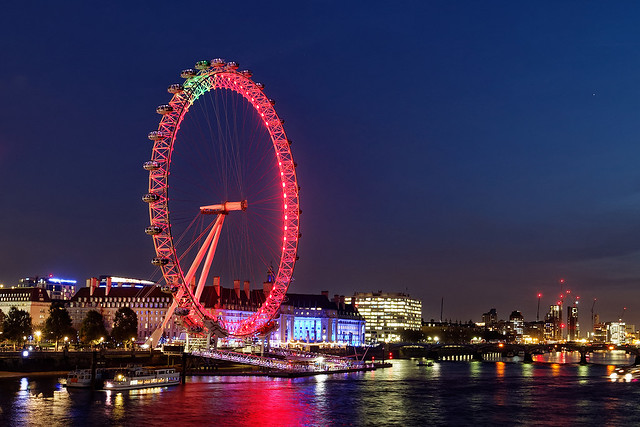
"London Eye" - Taken from one of the Golden Jubilee Bridges over the Thames.

EOS M2, EF-M 11-22mm f/4-5.6 IS STM @ 20mm, 2.5 s, f/7.1, ISO 400
 
Upvote 0
rrcphoto said:
I'm always interested it see people's opinion's of the M6 versus the M5. I'm debating on changing my kit "down" to dual M6's instead of M5's simply because of the articulating EVF and smaller camera bodies in general.

Personally, I'll be picking up an M6 before my trip to Italy next month. For me, the main advantage of the M series is the biggest sensor in the smallest body, and that's the M6. As stated above, it's useful for daytime walkabouts while traveling, but also for family outings (I'll be getting the 18-150mm kit), and as an failure backup for my 1D X (with the mount adapter along).
 
Upvote 0
MayaTlab said:
It's more expensive than any Rebel, on par with a "steel and plastic" 80D, with a better auto ISO implementation
and faster FPS, better video functions, headphone jack,etc.

it's more on par with the 77D, especially when you include the firmware feature-set. also the 80D at launch was more expensive. if anything it sits in between the 77D and 80D as far as price.

the 80D even is not an "expert" camera, but more a lower end prosumer model with the 7D being the professional / expert model.
 
Upvote 0
neuroanatomist said:
rrcphoto said:
I'm always interested it see people's opinion's of the M6 versus the M5. I'm debating on changing my kit "down" to dual M6's instead of M5's simply because of the articulating EVF and smaller camera bodies in general.

Personally, I'll be picking up an M6 before my trip to Italy next month. For me, the main advantage of the M series is the biggest sensor in the smallest body, and that's the M6. As stated above, it's useful for daytime walkabouts while traveling, but also for family outings (I'll be getting the 18-150mm kit), and as an failure backup for my 1D X (with the mount adapter along).

you'll certainly love the 18-150, even though it may feel a bit front heavy.

I'm actually waiting to see what the M20 will have, if they will put the M6 guts down into that, if so I may decide to get the M20.
 
Upvote 0
MayaTlab said:
Given that Canon's so called "expert" mirrorless camera has an auto ISO implementation that's inexplicably worse than on their own powershots, no tethering ability of any kind, and no low consumption display, Let's hope that their "high end" mirrorless camera won't follow that trend of irrational features attribution.

I use Auto ISO in manual mode on my M5 all the time and it works great. The exposure compensation dial allows quick and effective EC, not sure what it lacks... I haven't used a Powershot in years, so can't compare.
 
Upvote 0
MayaTlab said:
Given that Canon's so called "expert" mirrorless camera has an auto ISO implementation that's inexplicably worse than on their own powershots, no tethering ability of any kind, and no low consumption display, Let's hope that their "high end" mirrorless camera won't follow that trend of irrational features attribution.

Can you explain how the Auto ISO is so bad? As far as I can see it works the same as the 1DX MkII, you can control the range it will use and you can use EC with it, what is missing?

As for tethering, you know you can tether is effortlessly via WiFi to a multitude of devices, that might not give you the specific control you are looking for, but it is patently false to say "no tethering ability of any kind", besides, the tethered abilities it does have are probably far more relevant to the target market than your interests.
 
Upvote 0
privatebydesign said:
MayaTlab said:
Given that Canon's so called "expert" mirrorless camera has an auto ISO implementation that's inexplicably worse than on their own powershots, no tethering ability of any kind, and no low consumption display, Let's hope that their "high end" mirrorless camera won't follow that trend of irrational features attribution.

Can you explain how the Auto ISO is so bad? As far as I can see it works the same as the 1DX MkII, you can control the range it will use and you can use EC with it, what is missing?

As for tethering, you know you can tether is effortlessly via WiFi to a multitude of devices, that might not give you the specific control you are looking for, but it is patently false to say "no tethering ability of any kind", besides, the tethered abilities it does have are probably far more relevant to the target market than your interests.

Not sure about auto ISO, but wifi tether is painfully slow on my 5dmk4 and even worst on my 1dxm2 with a ridiculously expensive dongle. Can't imagine it being any better or very usable on the m5.
 
Upvote 0
privatebydesign said:
MayaTlab said:
Given that Canon's so called "expert" mirrorless camera has an auto ISO implementation that's inexplicably worse than on their own powershots, no tethering ability of any kind, and no low consumption display, Let's hope that their "high end" mirrorless camera won't follow that trend of irrational features attribution.

Can you explain how the Auto ISO is so bad? As far as I can see it works the same as the 1DX MkII, you can control the range it will use and you can use EC with it, what is missing?
you can only control the upper ISO value, you can't control the low end shutter speed or the bias on shutter speed.
 
Upvote 0
privatebydesign said:
As for tethering, you know you can tether is effortlessly via WiFi to a multitude of devices, that might not give you the specific control you are looking for, but it is patently false to say "no tethering ability of any kind", besides, the tethered abilities it does have are probably far more relevant to the target market than your interests.

A cheap Rebel has better both wireless and wired tethering capabilities to a computer than the M5. What's the Rebels target market BTW ?
 
Upvote 0
rrcphoto said:
That's just a completely dumb, idiotic and patronising comment to assume that only tethering from a computer is proper.

For tasks such as automated macro stacking, Wifi tethering doesn't work. You can only do this with USB tethering [edit: apparently wireless on the DSLRs seems to work, just not the wireless on the EOS M series - possibly due to the limitations of the powershot-derived firmware?]

The lack of wired tethering is, for me, the most serious drawback of the EOS M system. Which is a shame because a lighter, mirrorless camera should be ideal for macro work.
 
Upvote 0
MayaTlab said:
Conversely, should we talk about Canon's stubbornly idiotic auto ISO implementation with flash ?

This. Why on earth is Canon interpreting "Auto ISO" as "Automatically switch to ISO400" whenever something sits in the hot shoe?

Why not use the ambient reading to figure out a reasonable ISO and then measure the preflash against that sensitivity?
 
Upvote 0
privatebydesign said:
MayaTlab said:
Given that Canon's so called "expert" mirrorless camera has an auto ISO implementation that's inexplicably worse than on their own powershots, no tethering ability of any kind, and no low consumption display, Let's hope that their "high end" mirrorless camera won't follow that trend of irrational features attribution.

Can you explain how the Auto ISO is so bad? As far as I can see it works the same as the 1DX MkII, you can control the range it will use and you can use EC with it, what is missing?

As for tethering, you know you can tether is effortlessly via WiFi to a multitude of devices, that might not give you the specific control you are looking for, but it is patently false to say "no tethering ability of any kind", besides, the tethered abilities it does have are probably far more relevant to the target market than your interests.

WiFi tethering is awesome. Ever since 80D, I've dropped the USB cable when tethering for liveview (on PC). That cable is an invitation to knocking over thousands of dollars worth of stuff.

I love that you can record RAW to camera, and send JPEG to PC. That way, I can review the image in a suitable quality - quickly - and keep the RAW for later.
 
Upvote 0
Talys said:
privatebydesign said:
MayaTlab said:
Given that Canon's so called "expert" mirrorless camera has an auto ISO implementation that's inexplicably worse than on their own powershots, no tethering ability of any kind, and no low consumption display, Let's hope that their "high end" mirrorless camera won't follow that trend of irrational features attribution.

Can you explain how the Auto ISO is so bad? As far as I can see it works the same as the 1DX MkII, you can control the range it will use and you can use EC with it, what is missing?

As for tethering, you know you can tether is effortlessly via WiFi to a multitude of devices, that might not give you the specific control you are looking for, but it is patently false to say "no tethering ability of any kind", besides, the tethered abilities it does have are probably far more relevant to the target market than your interests.

WiFi tethering is awesome. Ever since 80D, I've dropped the USB cable when tethering for liveview (on PC). That cable is an invitation to knocking over thousands of dollars worth of stuff.

I love that you can record RAW to camera, and send JPEG to PC. That way, I can review the image in a suitable quality - quickly - and keep the RAW for later.

And that's exactly why there is a problem with the M line, because you can't use Eos Utility to do just that with them.
 
Upvote 0
Cthulhu said:
Not sure about auto ISO, but WiFi tether is painfully slow on my 5dmk4 and even worst on my 1dxm2 with a ridiculously expensive dongle. Can't imagine it being any better or very usable on the m5.

I've been checking out WiFi tethering on my MK IV. The speed is very dependent on how its done. When I use the camera as a access point, connect a phone or tablet to it, it works as well as could be expected. But, when connecting thru my very fast WiFi access point and gigabit home network, its painfully slow tether to my PC. I have not tried to tether my PC directly to the camera, but it will likely be similar to the phone connection.

I don't understand why its so slow to tether via my access point and wired network, I have a Eye-Fi card that downloads via my access points fast and efficiently, I'd use it for just plain wireless downloads if I needed it done wirelessly.
 
Upvote 0
jolyonralph said:
rrcphoto said:
That's just a completely dumb, idiotic and patronising comment to assume that only tethering from a computer is proper.

For tasks such as automated macro stacking, Wifi tethering doesn't work. You can only do this with USB tethering [edit: apparently wireless on the DSLRs seems to work, just not the wireless on the EOS M series - possibly due to the limitations of the powershot-derived firmware?]

The lack of wired tethering is, for me, the most serious drawback of the EOS M system. Which is a shame because a lighter, mirrorless camera should be ideal for macro work.

Magic Lantern folks looked at this with the original M. from my recollection the problem is not just the usual "nerfing" but EOS utility itself. the M's run liveview at different framerates (most likely to speed up AF) than the DSLR's. EOS utility is pretty basic and only allows one framerate. To stop this, canon just decided to block the entire thing on the M side to prevent problems.

whether or not this is true, or not. who knows. however liveview on at least the M5 goes all the way up to 120hz. certainly more than the traditional 30.
 
Upvote 0