
You are using an out of date browser. It may not display this or other websites correctly.
You should upgrade or use an alternative browser.
You should upgrade or use an alternative browser.
Canon Mirrorless in 2012?
- Thread starter traveller
- Start date
- Status
- Not open for further replies.


B
briansquibb
Guest
ronderick said:Interesting camera, I must say.
It would be quite a breakthrough if they could reproduce this model for the XXXD, though I'm not sure how that would work while still retaining the mirror and the OVF.
Why not? - this has a mirror. The camera body is VERY light and small - about 4/3 size
Upvote
0
132 x 80 x 59 mm, is the official size of the EOS IX. 128.8 x 97.5 x 61.9mm is for T1i . The EOS IX is actually longer than the T1i. The T1i is thicker due to the much bigger grip. The difference in height is substancial due to the Prisum on the T1i. reference: Canon museum.briansquibb said:ronderick said:Interesting camera, I must say.
It would be quite a breakthrough if they could reproduce this model for the XXXD, though I'm not sure how that would work while still retaining the mirror and the OVF.
Why not? - this has a mirror. The camera body is VERY light and small - about 4/3 size
Upvote
0
B
briansquibb
Guest
Rocky said:132 x 80 x 59 mm, is the official size of the EOS IX. 128.8 x 97.5 x 61.9mm is for T1i . The EOS IX is actually longer than the T1i. The T1i is thicker due to the much bigger grip. The difference in height is substancial due to the Prisum on the T1i. reference: Canon museum.
Just for comparison - GF1 is 119 mm x 71 mm x 36.3 mm - length and width about the same. Quite a bit thinner.
Upvote
0
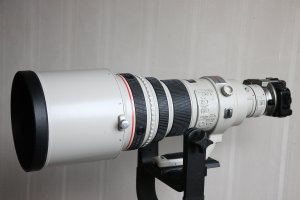
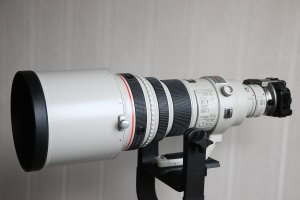
hahahahaha that is hillariousbriansquibb said:This is the picture you all wanted to see 8) 8) 8)
 it makes the lens look enormous
Upvote
0
B
briansquibb
Guest
wickidwombat said:hahahahaha that is hillariousbriansquibb said:This is the picture you all wanted to see 8) 8) 8)
There is film in it and if the sun comes out I will run the roll through it - makes me giggle at the thought of an APS camera with a 400 f/2.8 + 1.4 ...... :
 : :
: :
Upvote
0
If you look at the camera closely, the mirror box is the "round tube" between the lens and the flat part of the body. It is an APS camera. therefore a smaller mirror is used.alipaulphotography said:That is hilarious! But I would kill for a digital version! How the hell does the mirror even fit?!
Upvote
0
B
briansquibb
Guest
briansquibb said:This is the picture you all wanted to see 8) 8) 8)
First picture is from the EOS IX with the 400/f2.8 + 1.4 @5.6, kodak APS asa 200
Second picture is from the same place using the 1Ds3, iso 800. f/5.6
Attachments


Upvote
0
kapanak said:That's the thing. A DSLR, by definition, cannot have an electronic viewfinder at the same time as an optical one. It may have a second, smaller sensor for the EVF component, but we shall not get into that. Of course, OVFs have electronic parts embedded, but it is not a preview of what the sensor is seeing, because of the mirror. It is all about that mirror. Sony has their A65/77, but that lacks an OVF ...
The mirror could be flipped up when the EVF is in use though, obviously that means no contrast detect AF but then again the same would be true for any mirrorless camera.
We talk about improved EVF's but really there never going to provide the same thing as an OVF just as even the largest most hi tech TV is still obviously a TV.
Upvote
0
K
kapanak
Guest
moreorless said:kapanak said:That's the thing. A DSLR, by definition, cannot have an electronic viewfinder at the same time as an optical one. It may have a second, smaller sensor for the EVF component, but we shall not get into that. Of course, OVFs have electronic parts embedded, but it is not a preview of what the sensor is seeing, because of the mirror. It is all about that mirror. Sony has their A65/77, but that lacks an OVF ...
The mirror could be flipped up when the EVF is in use though, obviously that means no contrast detect AF but then again the same would be true for any mirrorless camera.
We talk about improved EVF's but really there never going to provide the same thing as an OVF just as even the largest most hi tech TV is still obviously a TV.
I believe you meant "no phase detect AF", which is what the addition of the AF chip with the mirror offers.
If we think of the mirror as locked for the EVF, the LCD on the back of a DSLR is technically an EVF during Live View. Also, some Mirrorless cameras offer Phase detect by using pixels on the sensor itself dedicated to the job, like the Nikon 1 series.
I still cannot see why people advocate for one side or the other. The two (DSLR and Rangefinder-style) form factors have been around for a very long time, and have co-existed peacefully. No reason to kill one in favour of the other now.
Upvote
0
kapanak said:I believe you meant "no phase detect AF", which is what the addition of the AF chip with the mirror offers.
If we think of the mirror as locked for the EVF, the LCD on the back of a DSLR is technically an EVF during Live View. Also, some Mirrorless cameras offer Phase detect by using pixels on the sensor itself dedicated to the job, like the Nikon 1 series.
I still cannot see why people advocate for one side or the other. The two (DSLR and Rangefinder-style) form factors have been around for a very long time, and have co-existed peacefully. No reason to kill one in favour of the other now.
Yeah sorry phase rather than contrast.
It just seems to me that theres little need to lose weight with DSLR's that are going to be used with a large zoom lens anyway so why give up an OVF when it shouldnt stop you having the advanatges of an EVF aswell.
My guess would be that in the coming years the high end market will be divided between DSLR's based around zooms and rangefinder similar to this new Fuji based around primes.
Upvote
0
moreorless said:Yeah sorry phase rather than contrast.
It just seems to me that theres little need to lose weight with DSLR's that are going to be used with a large zoom lens anyway so why give up an OVF when it shouldnt stop you having the advanatges of an EVF aswell.
My guess would be that in the coming years the high end market will be divided between DSLR's based around zooms and rangefinder similar to this new Fuji based around primes.
I think the distinction is more big versus small lenses than zoom versus prime. Wide angle zooms make plenty of sense for mirrorless.
What is less practical are fast telephoto lenses (zoom or prime) -- these simply require a lot of glass because of the absolute size of the aperture. It's much easier to make a small 20mm f/1.7 or even a 45mm f/1.8 than it is a 135mm f/2 or a 70-200mm f/4.
Upvote
0

I hope they stray very little from the original Canonet design. A full frame sensor and a fixed 40mm f/1.7 lens would be perfect. Alternately, a 1,5x crop sensor and a 35mm f/1.4 lens. It would be a slightly tighter view, but you not really loose as much freedom with regards to DoF. The viewfinder could be completely from any information for all I care, as long as it is at least as big as on the one on the 5D.
Upvote
0
- Status
- Not open for further replies.
Similar threads

- Replies
- 316
- Views
- 97K

- Replies
- 25
- Views
- 20K

- Replies
- 81
- Views
- 23K


- Replies
- 378
- Views
- 114K