
You are using an out of date browser. It may not display this or other websites correctly.
You should upgrade or use an alternative browser.
You should upgrade or use an alternative browser.
Canon RF 200-800mm IS USM Previews / Reviews
- Thread starter Canon Rumors
- Start date

I found an appropriate quote from Roger Cicala (LensRentals) from 2018: "Sonyfanism: The haunting fear that someone, somewhere, may be happy with other equipment. “Or, ‘I want Sony’s f/6.3 aperture’, nevermind that’s at 600mm. I mean, it’s only a 200mm difference. No real advantage for Canon there (but the Sony 200-600’s extra 100mm and 1/3-stop are so much better than the 100-500 that the latter is unusable).


Upvote
0
I believe now that Canon 200-800 is released SONY fans will be anxious!  On the other hand whoever uses their gear to produce photos does not care.
Personally I use both Canon (90% of my gear) and Nikon and I am OK with both.
On the other hand whoever uses their gear to produce photos does not care.Personally I use both Canon (90% of my gear) and Nikon and I am OK with both.
Upvote
0
I could be tempted, but can only afford one- either the 100-500 or this new 200-800 non-L. I too found that SA lady's comments strange since the 200-800 at 800 distance seemed a little soft.I've read all the written previews by those who have handled it directly, but I haven't looked at the YouTubes.
I'm a little worried about the sharpness at 800mm, although the 1.6x extra length over the 500 should outweigh it by far - 60% extra reach really boosts the resolution and contrast can be improved in post. I hope to check it out myself by beginning of January if I got my order in earlier enough. The crucial test for me is it against the 100-500mm with 2xTC.
"it delivers sharp results throughout most of the zoom range, although 800mm sharpness and contrast could be a bit better in initial tests."
https://www.digitalcameraworld.com/reviews/canon-rf-200-800mm-f63-9-is-usm-review
"The major deterrent for serious action photography is absolute image quality at the 800mm setting,"
https://www.techradar.com/cameras/camera-lenses/canon-rf-200-800mm-f63-9-is-usm-review
"Nonetheless, the images came out crispy, with plenty of detail and with next to no color aberrations if you disregard color noise of the sensor. Of course, it is not on the same level as the brilliant RF 100-500mm f/4,5-7,1 L IS USM"
https://fstoppers.com/reviews/ultim...eview-new-canon-rf-200-800mm-f63-9-usm-646982
It should be sharper - in theory, since at f/9 the front lens aperture should be 89mm, compared with only 70mm for the100-500. Using the 1.4x makes the 100-500 an f/10. But comparable. I'll have to wait for real world evaluation.
Either combo 100-500+1.4x or 200-800 ought on basic principles give similar results.
I also think contrast can be improved in post, that is often done with landscape anyway. Could be that the missing coatings that L lenses get is responsible for worse contrast, if it is.
Then there is the question of which body. R7 would be in DLA for either combo. R5 would be virtually the same. R6 would not but then has lower resolution.
Difficult Choice for those who can't afford the 600 or 200-500 f/4 coming!
Upvote
0

roby17269
R5, X2D II 100c, DJI Mavic 4 Pro & Mini 5 Pro
For what is worth... today I went to Adorama and pre-ordered one 200-800. The friendly rep told me that they have 131 orders for this lens in the queue before mine. It looks like I will have to wait for a while... 
No idea if this is a big or average or small number of pre-orders.
I have sold to them my 800 f/11 and 24-240 for a discount on the 200-800.
No idea if this is a big or average or small number of pre-orders.
I have sold to them my 800 f/11 and 24-240 for a discount on the 200-800.
Upvote
0

Alan,No. Extenders make no difference to pixels per duck. The key factor is the area of the lens, which determines the amount of light that passes through and extenders don't change the area.
To be more accurate, an 800/9 has a diameter of 89mm, and a 500/7.1 has 70.4mm (without or with extenders), so the relative areas are 89/70.4 squared = 1.6, which is 2/3rd stop better.
Some time ago you included a link to a very interesting article: "Diffraction limited Effective resolutions". According to the included table an f/9 lens would reach the limits for the colours Red (700nm), Green (550nm) and Blue (470nm) at respectively 14.7MP, 25.6MP and 32.6 MP using a Full frame sensor. I have an R5 so these values are well below the 45MP Full frame sensor on that model.
So what does this mean in real life, for example when I look at a picture I have just taken on a bird with very delicate feathering with fine vanes and barbs?
What limitations will I get/see that I would not have seen if I have had the possibility to use a lens that provided, let's say, f/5.6 on my R5 instead?
I am both interested in birds and as well an amateur astronomer. From that other world I am very familiar with the fact that the diameter of the telescope objective (or mirror) is fundamental to how tight double stars you will be able to resolve (the diffraction limit).
So translated to the bird-world it should mean that a RF 200-800 with a lens diameter of 89 mm, as stated by you, always should be able to resolve finer feathers, vanes and barbs than for instance the RF 100-500 with its 70.4 mm lens diameter in a certain situation, with lenses of a similar quality etc etc. Regardless of the f/9 and f/7.1 respectively!?
Where does the "Diffraction limited Effective resolutions" limits come into the picture and changes this?
Upvote
0

It's complicated. Leave aside the quality of a lens and consider only diffraction. For a sensor of an extremely high number of megapixels, the resolution you will get from a lens will depend only on its diameter and not its focal length or f-number. For a very low megapixel sensor, focal length is the most important factor and diffraction less as long as the f-number is not too high. On a very high resolution sensor, a f/9 800mm with a lens diameter of 89mm will be ale to resolve details up to 1.26x smaller than would an f/7.1 500mm of 70.4mm diameter. For a really low resolution sensor, the 800mm will resolve details up to 1.6x smaller. A 20 Mpx sensor will be getting you closer to the 1.6x, a 100 Mpx closer to the 1.26x. If the optical quality of the 800mm lens is not as good, it could negate some of the diffraction advantage and the lens on an R7 may be give no better resolution on than the 500mm but still be better on the R3/R6.Alan,
Some time ago you included a link to a very interesting article: "Diffraction limited Effective resolutions". According to the included table an f/9 lens would reach the limits for the colours Red (700nm), Green (550nm) and Blue (470nm) at respectively 14.7MP, 25.6MP and 32.6 MP using a Full frame sensor. I have an R5 so these values are well below the 45MP Full frame sensor on that model.
So what does this mean in real life, for example when I look at a picture I have just taken on a bird with very delicate feathering with fine vanes and barbs?
What limitations will I get/see that I would not have seen if I have had the possibility to use a lens that provided, let's say, f/5.6 on my R5 instead?
I am both interested in birds and as well an amateur astronomer. From that other world I am very familiar with the fact that the diameter of the telescope objective (or mirror) is fundamental to how tight double stars you will be able to resolve (the diffraction limit).
So translated to the bird-world it should mean that a RF 200-800 with a lens diameter of 89 mm, as stated by you, always should be able to resolve finer feathers, vanes and barbs than for instance the RF 100-500 with its 70.4 mm lens diameter in a certain situation, with lenses of a similar quality etc etc. Regardless of the f/9 and f/7.1 respectively!?
Where does the "Diffraction limited Effective resolutions" limits come into the picture and changes this?
Upvote
0
Well, at the moment I use an R5 in combination with the RF 100-500L (I also have a 1.4X extender).It's complicated. Leave aside the quality of a lens and consider only diffraction. For a sensor of an extremely high number of megapixels, the resolution you will get from a lens will depend only on its diameter and not its focal length or f-number. For a very low megapixel sensor, focal length is the most important factor and diffraction less as long as the f-number is not too high. On a very high resolution sensor, a f/9 800mm with a lens diameter of 89mm will be ale to resolve details up to 1.26x smaller than would an f/7.1 500mm of 70.4mm diameter. For a really low resolution sensor, the 800mm will resolve details up to 1.6x smaller. A 20 Mpx sensor will be getting you closer to the 1.6x, a 100 Mpx closer to the 1.26x. If the optical quality of the 800mm lens is not as good, it could negate some of the diffraction advantage and the lens on an R7 may be give no better resolution on than the 500mm but still be better on the R3/R6.
When taking pictures of birds during excursions I almost always need to use the maximum 500mm to get a decent size of the bird (but still needing to crop a lot when using Lightroom later on).
I also find it rather troublesome to add the 1.4X converter out in the field, thus that combination is not used very often.
So I find the RF 200-800 very interesting as it seems to satisfy most of my needs (although it will be heavy to have hanging at the end of my BlackRapid). Also the theoretical MTF for the 200-800 looks promising.
That is why I want to know if the change from f/7.1 & 500mm to f/9 & 800mm in reality not really can/will add more details in the RAW-picture
Upvote
0
Same here with the BlackRapid - the camera and lens you can carry is the best for you! As I mentioned several times, I am going to test the 200-800 and if it is not significantly better than the 100-500, back it goes and I'll carry less.Well, at the moment I use an R5 in combination with the RF 100-500L (I also have a 1.4X extender).
When taking pictures of birds during excursions I almost always need to use the maximum 500mm to get a decent size of the bird (but still needing to crop a lot when using Lightroom later on).
I also find it rather troublesome to add the 1.4X converter out in the field, thus that combination is not used very often.
So I find the RF 200-800 very interesting as it seems to satisfy most of my needs (although it will be heavy to have hanging at the end of my BlackRapid). Also the theoretical MTF for the 200-800 looks promising.
That is why I want to know if the change from f/7.1 & 500mm to f/9 & 800mm in reality not really can/will add more details in the RAW-picture
Upvote
0
L
Loswr
Guest
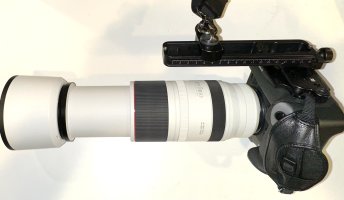
It’s not exactly a cheap solution but you could rig something with an Arca-style camera plate and a Really Right Stuff nodal slide. Won’t decrease the weight but it would at least be balanced.So I find the RF 200-800 very interesting as it seems to satisfy most of my needs (although it will be heavy to have hanging at the end of my BlackRapid).
Upvote
0

Good to have if you want to take macros, tooIt’s not exactly a cheap solution but you could rig something with an Arca-style camera plate and a Really Right Stuff nodal slide. Won’t decrease the weight but it would at least be balanced.
View attachment 213024
Upvote
0
I am going to test the 200-800 and if it is not significantly better than the 100-500, back it goes and I'll carry less.
Given that this is not an L lens I would be surprised if it was as good as the 100-500, and I think there’s even less chance it will be significantly better. Who knows though, with a bigger objective aperture it could still be a comparable performer.
I see this lens as mainly appealing to those who could not immediately afford the 100-500, but Canon is now enticing them with more capability (longer focal range) along with a cheaper price. I include myself in that group.
I find the 100-400 is good enough for my shorter range needs right now, and I was considering the 800 f/11 for longer telephoto needs but now this lens is a no brainer instead considering the greater range.
Last edited:
Upvote
0
And yet some people will never be satisfied. C'est la vie.I believe we have reached a point where there are overlaps - practically a combo for everyone!
Upvote
0
Ironically (but perhaps not coincidentally) not long after I decided this lens would be my next aspiration, the 100-500 went on such a discount the difference is substantial (a major retailer has the L for ~£1800 new with all the rebates, while the 200-800 is £2299).I see this lens as mainly appealing to those who could not immediately afford the 100-500, but Canon is now enticing them with more capability (longer focal range) along with a cheaper price.

Upvote
0
That's far less than the WEX used price - they have 7 on sale for £2360. I guess Canon caught the top dealers out as well.Ironically (but perhaps not coincidentally) not long after I decided this lens would be my next aspiration, the 100-500 went on such a discount the difference is substantial (a major retailer has the L for ~£1800 new with all the rebates, while the 200-800 is £2299).
Upvote
0
I find the sample images on https://www.photographyblog.com/reviews/canon_rf_200_800mm_f6_3_9_is_usm_review/sample_imagesSame here with the BlackRapid - the camera and lens you can carry is the best for you! As I mentioned several times, I am going to test the 200-800 and if it is not significantly better than the 100-500, back it goes and I'll carry less.
Download the original files. Very interesting.
The pictures on the Mallards are really sharp and show good details, also at the long end.
Also it is very interesting to compare details on the wooden panels on ”the shed” pictures. I get a feeling that the contrast and sharpness is a tiny bit better on the most zoomed in f/8 picture as compared to the f/9 picture.
Thus the 200-800 may be sharper and have better contrast at f8 around 630mm and thus provide more details (and not at f9 and 800mm)?!
Upvote
0
I was surprised! This deal was at Wex incidentally.That's far less than the WEX used price - they have 7 on sale for £2360. I guess Canon caught the top dealers out as well.
Upvote
0
Very perceptive of you about the duckhouse panels. The Mallards virtually fill the frame and you would expect them to show lots of detail an don't tell us much. But, as you have pointed out, the lens seems to show more detail zoomed out to 600mm. He had increased the shutter speed and iso, but even so. Maybe there was a problem with focussing and dof.I find the sample images on https://www.photographyblog.com/reviews/canon_rf_200_800mm_f6_3_9_is_usm_review/sample_images
Download the original files. Very interesting.
The pictures on the Mallards are really sharp and show good details, also at the long end.
Also it is very interesting to compare details on the wooden panels on ”the shed” pictures. I get a feeling that the contrast and sharpness is a tiny bit better on the most zoomed in f/8 picture as compared to the f/9 picture.
Thus the 200-800 may be sharper and have better contrast at f8 around 630mm and thus provide more details (and not at f9 and 800mm)?!
Upvote
0
Similar threads

- Replies
- 125
- Views
- 28K
- Replies
- 74
- Views
- 15K
- Replies
- 6
- Views
- 4K

- Replies
- 14
- Views
- 8K
