
You are using an out of date browser. It may not display this or other websites correctly.
You should upgrade or use an alternative browser.
You should upgrade or use an alternative browser.
Canon will release the EOS Ra astrophotography camera
- Thread starter Canon Rumors
- Start date


Awesome shots!
I was looking at the manual and wanted to ask you some questions. In the manual it notes this:
"noise in your shots may increase due to image sensor heat if, for some time before shooting long exposure, you record or leave the camera in standby
"noise will increase when taking long exposure, or shooting repeatedly"
Isn't the point of this camera for astrophotography, yet it claims that with long exposures which is needed for astrophotography will cause photos with noise that are unideal? Could I ask you your two cents on these two points pointed out in the leaflet
Typically "astrophotography" cameras are more aimed at deep sky use for shooting nebulae etc with the removal of low pass filter that's responsible for blocking off a lot of the Hydrogen Alpha signals that are found in a lot of nebulae. With shooting deep sky pending on condition (whether or not you're in dark sites) your exposure could be shorter or very long. With longer exposures your sensor heat up and can cause (dark current) noise which can be alleviated with dark frame subtraction whether you let the camera do it by itself (long exposure noise reduction) or take the dark frames yourself and use that to subtract the noise later (which astrophotography specific software does it automatically). Regardless of your single frame exposure time you'll be taking plenty as more data the better (also pending on how bright your object is).
I shoot Milky Way landscape and dabble in deep sky and I'd probably still prefer to use stock camera for MW landscape due to having to correct the colour after but for deep sky with a modified camera no doubt (which I have a 77D for).
Here is an example of "deep sky" astrophotography of Antares region taken from my suburban backyard with my modified 77D (with a total integration time close to 2 hours off top of my head):
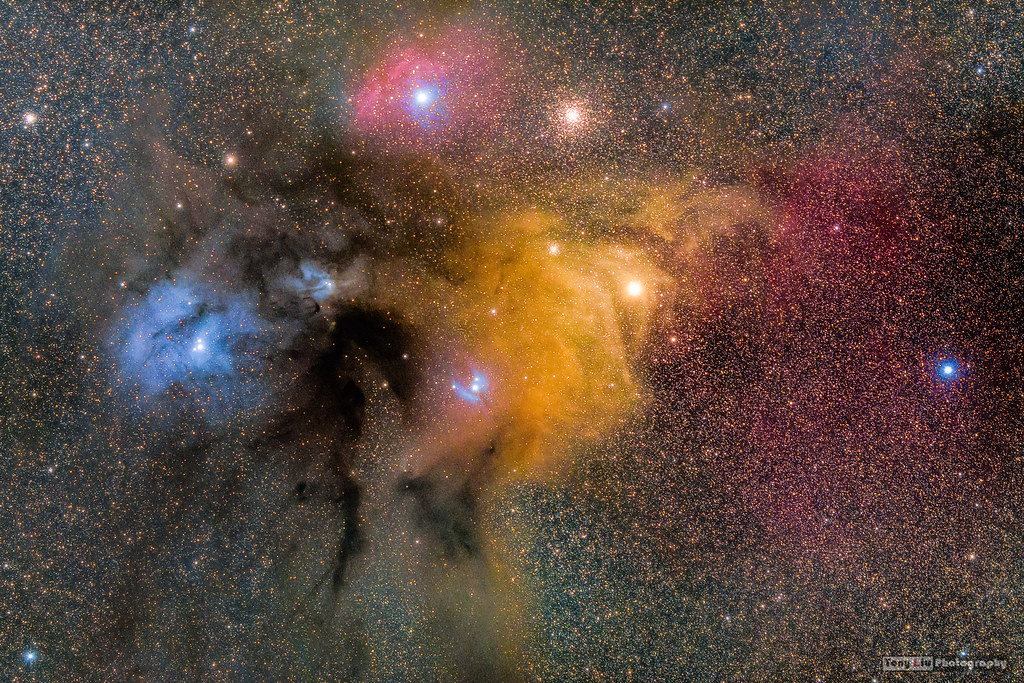 Antares Region by Tony, on Flickr
Here is a typical MW landscape with my stock 5D4 and Sigma 14mm Art (on an entry level tracker):
 Milky Way over Lake Moogerah by Tony, on Flickr
Upvote
0
This is a far better answer than I gave. Beautiful photos tooTypically "astrophotography" cameras are more aimed at deep sky use for shooting nebulae etc with the removal of low pass filter that's responsible for blocking off a lot of the Hydrogen Alpha signals that are found in a lot of nebulae. With shooting deep sky pending on condition (whether or not you're in dark sites) your exposure could be shorter or very long. With longer exposures your sensor heat up and can cause (dark current) noise which can be alleviated with dark frame subtraction whether you let the camera do it by itself (long exposure noise reduction) or take the dark frames yourself and use that to subtract the noise later (which astrophotography specific software does it automatically). Regardless of your single frame exposure time you'll be taking plenty as more data the better (also pending on how bright your object is).
I shoot Milky Way landscape and dabble in deep sky and I'd probably still prefer to use stock camera for MW landscape due to having to correct the colour after but for deep sky with a modified camera no doubt (which I have a 77D for).
Here is an example of "deep sky" astrophotography of Antares region taken from my suburban backyard with my modified 77D (with a total integration time close to 2 hours off top of my head):
Here is a typical MW landscape with my stock 5D4 and Sigma 14mm Art:

Upvote
0
This is a far better answer than I gave. Beautiful photos too
Thank you amorse. I've started playing around with using a tracker for Milky Way landscapes as well; as you stated previously the tricky part is when having to blend when there are trees etc in the image and not a clean horizon. But the ability to gather much more light instead of just jacking up the ISO does make the MW look much nicer.
Last edited:
Upvote
0
I believe it! Eventually I'll give a tracker a go, but while this system is a bit of a pain to undertake, I really appreciate the weight savings if I have to walk a long way.Thank you amorse. I've started playing around with using a tracker for Milky Way landscapes as well; as you stated previously the tricky part is when having to blend when there are trees etc in the image and not a clean horizon. But the ability to gather much more light instead of just jacking up the ISO does make the MW look much nicer.
Upvote
0

My multiple personalities and I get along just fine, thank you very much. I'm especially fond of Hannah.I love all the great info which came out of this thread.
This is what makes CR an awesome site... just have to ignore all the doom, 24p BS, dslr is dead and multiple personality crap.
Thanks!

Upvote
0

Michael Clark
Now we see through a glass, darkly...
Question - has anyone actually fully tested the DR on the M6ii? Photons to photos is often the first to measure and publish the DR results from cameras, but they've got nothing on it. Considering that the M6ii isn't yet available, and there are (to my knowledge) no full examinations on its DR which are publicly available at this time, isn't a bit soon to berate the camera for its DR?
Comment - I actually prefer the M6ii without the integrated viewfinder - with a viewfinder it is less attractive to me. Different needs for different people though. Also, I'm more excited about the 14 fps with tracking than frustrated over anything M6ii appears to be lacking.
It's the exact same sensor as the one in the 90D, which is available and has been tested already.
Upvote
0

Great work. I noticed there are traces of the same greenish-blueish banding on your 5DIV at long exposures? Partially it can be reduced by desaturation of green and aqua in HSL panel. Also in my camera it disappears mysteriously at ISO 3200. Thinking of getting a tracker too.
Typically "astrophotography" cameras are more aimed at deep sky use for shooting nebulae etc with the removal of low pass filter that's responsible for blocking off a lot of the Hydrogen Alpha signals that are found in a lot of nebulae. With shooting deep sky pending on condition (whether or not you're in dark sites) your exposure could be shorter or very long. With longer exposures your sensor heat up and can cause (dark current) noise which can be alleviated with dark frame subtraction whether you let the camera do it by itself (long exposure noise reduction) or take the dark frames yourself and use that to subtract the noise later (which astrophotography specific software does it automatically). Regardless of your single frame exposure time you'll be taking plenty as more data the better (also pending on how bright your object is).
I shoot Milky Way landscape and dabble in deep sky and I'd probably still prefer to use stock camera for MW landscape due to having to correct the colour after but for deep sky with a modified camera no doubt (which I have a 77D for).
Here is an example of "deep sky" astrophotography of Antares region taken from my suburban backyard with my modified 77D (with a total integration time close to 2 hours off top of my head):
Here is a typical MW landscape with my stock 5D4 and Sigma 14mm Art (on an entry level tracker):
Upvote
0
What banding do you mean? Are you talking about the green haze that starts to show up in some long exposures of the night sky? That is just air glow and should not disappear with higher ISO. Here's a more pronounced example of that:Great work. I noticed there are traces of the same greenish-blueish banding on your 5DIV at long exposures? Partially it can be reduced by desaturation of green and aqua in HSL panel. Also in my camera it disappears mysteriously at ISO 3200. Thinking of getting a tracker too.
It is an effect caused by Gases interacting with the sunlight and slowly releasing the energy they gained during the day, if I recall correctly. I have it only on one of my images, but it is partially purple and mostly green on that one.
Upvote
0
Great work. I noticed there are traces of the same greenish-blueish banding on your 5DIV at long exposures? Partially it can be reduced by desaturation of green and aqua in HSL panel. Also in my camera it disappears mysteriously at ISO 3200. Thinking of getting a tracker too.
Thank you! Yea I see it and always wondered if it's just traces of light pollution/air glow near the horizon. Don't bother me too much though haha.
Definitely look into getting a tracker. It's hard to go back shooting without one knowing how much more light you can now let in with one. Just have to learn to deal with the challenges when it comes to post production.
Upvote
0
Apparently there are red Aurora, although they are very rare. I couldn't find anything specific by a quick Google search, but I would think that they might benefit from the enhanced sensitivity to red.Question for those in the know. Would this be beneficial for Aurora photography or not?
For the typical green variety it should make no difference.
It's really an interesting question. I'm still on the fence about converting my old T3i to full spectrum, since I don't do anything with it and it would be cool to have a device to image those invisible things.
Upvote
0
Apparently there are red Aurora, although they are very rare. I couldn't find anything specific by a quick Google search, but I would think that they might benefit from the enhanced sensitivity to red.
For the typical green variety it should make no difference.
It's really an interesting question. I'm still on the fence about converting my old T3i to full spectrum, since I don't do anything with it and it would be cool to have a device to image those invisible things.
I thought about doing full spectrum too but decided I am mostly just using it for astro so didn't bother with it. There are issues with full spectrum I think some lenses won't focus to infinity and some will have a weird flare spot in images (I could be wrong this is just off my head was reading up on it ages ago). Would be cool to do some IR photography though.
Upvote
0

Aussie shooter
https://brettguyphotography.picfair.com/
From my location seeing the red part of the aurora is normal as we observe it from the mid latitudes and therefore see the higher parts which are often red.Apparently there are red Aurora, although they are very rare. I couldn't find anything specific by a quick Google search, but I would think that they might benefit from the enhanced sensitivity to red.
For the typical green variety it should make no difference.
It's really an interesting question. I'm still on the fence about converting my old T3i to full spectrum, since I don't do anything with it and it would be cool to have a device to image those invisible things.
Upvote
0
What banding do you mean? Are you talking about the green haze that starts to show up in some long exposures of the night sky? That is just air glow and should not disappear with higher ISO. Here's a more pronounced example of that:
It is an effect caused by Gases interacting with the sunlight and slowly releasing the energy they gained during the day, if I recall correctly. I have it only on one of my images, but it is partially purple and mostly green on that one.
Definitely not that. In this image the banding shows as strictly horizontal green-blue lines on the bottom half of the image (on the water). It's not very prominent there, I only noticed it because it's 5DIV, 3 minutes exposure and ISO 400, so I paid attention to it.
Upvote
0
Oh, I see. I didn't see that viewing it on my smartphone, had to use the PC to get that. I thought you meant the greenish horizontal striped in the sky at the middle right.the banding shows as strictly horizontal green-blue lines on the bottom half of the image (on the water).
There is a known banding issue that is present in the 5D IV and got fixed in firmware on the R. Maybe it is related. I haven't seen something this subtle in my 80D images, but when I REALLY push dark shadows they can show horizontal banding as well. Much more noticeable though.
I'm hoping to get a chance of shooting the milky way tomorrow before the moon comes up and then use a foreground illuminated by the rising moon to get a cleaner image. Haven't tried that before, but usually the timing or weather wasn't as goof as it will apparently be tomorrow. Apart from getting more light, or buying an R, I don't know how to avoid that issue.
Upvote
0
There is a known banding issue that is present in the 5D IV and got fixed in firmware on the R. Maybe it is related. I haven't seen something this subtle in my 80D images, but when I REALLY push dark shadows they can show horizontal banding as well. Much more noticeable though.
In my 5DIV, the banding is just one horisontal line that shows on long enough exposures, but it's thick and prominent when lifting the shadows (and it happens a lot in night photography).
I'm hoping to get a chance of shooting the milky way tomorrow before the moon comes up and then use a foreground illuminated by the rising moon to get a cleaner image. Haven't tried that before, but usually the timing or weather wasn't as goof as it will apparently be tomorrow. Apart from getting more light, or buying an R, I don't know how to avoid that issue.
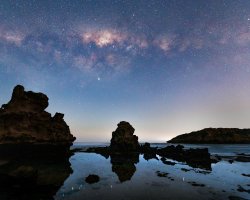
That's exactly the technique I used in this shot below a couple of days ago. The moon was rising behind be. Unfortunately I had to retreat due to the raising tide and wasn't able to do a cleaner 15-min ISO 100 exposure for the sea, but this one at ISO 3200 came out ok in terms of noise and is even printable up to A4-A3.
Upvote
0
That sounds like the 5D banding issue that's been brought up a few times. I demonstrated that it also affects the 80D (same gen sensor) in a thread about the 5DIV recently: https://www.canonrumors.com/forum/i...d-in-long-exposure-on-5dmk4.37489/post-789615In my 5DIV, the banding is just one horisontal line that shows on long enough exposures, but it's thick and prominent when lifting the shadows (and it happens a lot in night photography).
Would be an interesting test for the 90D. If Canon has managed to fix this with an older generation sensor on the R, I would hope that the current generation simply does not have this effect...
On the Astro Ra it has to be fixed as well. Maybe that's why the R got more love than the 5DIV here?
Upvote
0

Would be an interesting test for the 90D. If Canon has managed to fix this with an older generation sensor on the R, I would hope that the current generation simply does not have this effect...
At least this experiment on DPR forums failed to find any banding.
Upvote
0
Similar threads

- Replies
- 115
- Views
- 18K
- Replies
- 127
- Views
- 16K
- Replies
- 101
- Views
- 13K
- Replies
- 160
- Views
- 16K
- Replies
- 19
- Views
- 2K
