Canon's FF Mirrorless Camera Will Have Same Internals as EOS 6D Mark II

Mikehit said:
Which begs the question, if they are happy putting their 70-200 on the Sony body, how much size/weight are they actually saving percentage wise? For example, the difference in the bag you need will be minimal to negligible.

Or maybe you'll need a bigger bag for all the extra batteries. ;)
 
Upvote 0
Mikehit said:
Which begs the question, if they are happy putting their 70-200 on the Sony body, how much size/weight are they actually saving percentage wise? For example, the difference in the bag you need will be minimal to negligible.

Mike: thing is: many [most?] photographers do NOT want to put a 70-200 on a slim MILC body *all the time* or *most of the time*. Many [the large majority?] never use large lenses, because their imaging wants and needs do not neccessitate it.

Slim camera allow for both: big kit when big lenses are needed and small kit with small lenses when those are sufficient and better for the task at hand.

As non-Pro ["amateur/enthusiast"] I would like to have one camera system only. Not only for budget reasons, but even more so to be "totally familiar" with camera UI, able to operate it "blind". For great IQ and shallow DOF when needed, I'd like an FF sensor. Overall he system should be as universally capable as possible [stills only, no video] *and* as small & light as possible.

While I do own and sometimes (!) use an EF 70-200 II on my 5D3, more often than not I leave it at home, simply because it is too big, heavy and conspicuous to take along and just go with my 1st gen EOS M plus EF-M 55-200. Of course one is FF plus f/2.8 and the other is crop sensor plus "dark-zoom", but more often than not it suffices *for what I want to do*.

My ideal FF MILC would come in size and form factor like a Sony RX-1R Mk. II [with Pop-up EVF], but of course with a lens mount up front. I'd much prefer it to be Canon - both for User Interface and lenses. And yes, I'd be willing to re-purchase my lenses one more time [after EF-S, EF and EF-M] over time, if Canon launches such a mirrorless FF camera system with a new native "no comprise" FF-capable lens mount.

I am one, but surely not the only one with this "wishlist". :)
 
Upvote 0
AvTvM said:
Mikehit said:
Which begs the question, if they are happy putting their 70-200 on the Sony body, how much size/weight are they actually saving percentage wise? For example, the difference in the bag you need will be minimal to negligible.

Mike: thing is: many [most?] photographers do NOT want to put a 70-200 on a slim MILC body *all the time* or *most of the time*. Many [the large majority?] never use large lenses, because their imaging wants and needs do not neccessitate it.

AvTvM, meet reality...it seems the two of you have never been properly introduced.

Thing is: the large majority of photographers never use large lenses, because their financial wants and needs do not enable them to afford such lenses. For the same reason, the large majority of photographers do not use full frame cameras.

But...once you look as that minority of photographers with FF cameras, the proportion who use large lenses goes way up. On a FF MILC, even a 24-105/4 is ungainly. I highly doubt a majority of FF users would be willing to have a wide/normal prime as their main lens, or a zoom small enough to work well ergonomically on a small body, e.g. a 28-80 f/4-5.6 lens. That's why a full native EF mount actually makes sense for a Canon FF MILC.


AvTvM said:
My ideal FF MILC would come in size and form factor like a Sony RX-1R Mk. II [with Pop-up EVF], but of course with a lens mount up front. I'd much prefer it to be Canon - both for User Interface and lenses. And yes, I'd be willing to re-purchase my lenses one more time [after EF-S, EF and EF-M] over time, if Canon launches such a mirrorless FF camera system with a new native "no comprise" FF-capable lens mount.

I am one, but surely not the only one with this "wishlist". :)

No, you're not the only one. Just part of a small minority of the market. Yet somehow you persist in the unrealistic expectation that Canon will cater to your specific niche wants, as opposed to the majority needs.
 
Upvote 0
Well, I would be very happy with FF MILC sized similar to Sony RX-1R II. With properly chosen mount parameters I can well see a more compact native 24-70/4.0 that would suit me - in addition to ultracompact 18/4, 24/2.8, 35/2.0, 50/1.8 and 85/2.4 primes.

The rest will be done with larger lenses, but only the remaining 10% of my photography.

I do not believe this wishlist caters only to a *small minority* of the market.
 
Upvote 0
AvTvM said:
Well, I would be very happy with FF MILC sized similar to Sony RX-1R II. With properly chosen mount parameters I can well see a more compact native 24-70/4.0 that would suit me - in addition to ultracompact 18/4, 24/2.8, 35/2.0, 50/1.8 and 85/2.4 primes.

The rest will be done with larger lenses, but only the remaining 10% of my photography.

I do not believe this wishlist caters only to a *small minority* of the market.

None of the lenses you propose are interesting to me as they are all slower than the primes or zoom I currently have. Why would I want to give up anywhere from 1-2 stops of light simply to have smaller lenses? Not to mention that many of the primes are as big as they are due to their optical formulae. You seem to be okay with large IQ hits in order to have a lighter kit. I can completely understand that from an enthusiast point of view, but what you are asking is for canon to essentially give up on the EF line in order to retool their R&D to focus on creating gear that, quite frankly, most professionals don't want and wouldn't use.

If you want canon to shift into the mirrorless realm full time (again not something that I see many pros clamoring for) you need them to make pro-usable glass. That means primes at f/1.2-2, zooms at f/2.8, and very little distortion/fringing. That requires big and heavy pieces of glass/elements and the space to make the optical formula fit. All of that equals big and heavy lenses, which negates most of the benefit of your tiny mirrorless body.
 
Upvote 0
I think a very strong case can be made for canon dropping the EF mount for a futur full frame mirrorless system.

First of all.They dropped the EF-S mount for there mirrorless crop cameras. There current lineup of EF-S lenses is of course smaller then the lineup of EF lenses, and most crop shooters might not have invested as much money in to the EF-S system as the professional Full frame user has for the EF. Therefor making the alianation factor of introducing a new mount much smaller. However the fact that they were willing to use a new mount, shows precedence on the part of canon. What further diminishes the alienation factor, is that adapters are available, so that old EF and EF-S lenses don´t become obsolete.

Second. We must assume that canon is in the camera business for the long haul, and will want to make cameras for the foreseeable futur. I think most people would also agree that mirrorless is the futur, though it might not be on par with SLRs on all parameters yet it will in the end surpass them.
It might be tempthing in the short term, for canon to stay with the EF mount, for futur FF mirrorless cameras, as not to alienate customers who have invested large sums of money in to EF glass. However the EF mount, with its long flange distance, is not the optimal way to design a mirrorless camera. Staying with the EF mount would thus, in the long term, put canon at a disadvantage to other manufactures who did not have the legacy af a SLR system to take in to account, when designing there mirrorless system and thus would not have the long EF flange distance.
I basically think that it will be in canons best long term interest, to make a possible full frame mirrorless system as futurprof, versatile and competivtiv as possible. I dont think the EF mount fits that description.

And just to repeat my self, a adabter from EF to at new shorter flange distance mount will of course be available. Though this is not the optimal way to use your lenses, it will keep them from going obsolete when making the transition to mirrorless.

On the argument that canon will have to redesign their entire lens lineup. Well they are continuously doing this anyway. Older EF designs are constantly being replaced by newer and better designs. They might have to speed this up a bit for the transition, but I am sure they can manage, and in the meantime we can use adabters.

In regards to the hole aliantaion thing. From my perspective, canon does not seem to care much about this, or maybe they just dont know how to handle it. I think it is very likely that canon does not see it as a problem, that they have to redesign there lineup of lenses. Rather they might see it as a chance to sell a bunch of new lenses.
It might not be a 1 to 1 comparison, but when flat screens replaced tube-TVs, i dont think the TV manufactors saw it as a problem having to redesign there lineup of TVs. I think they saw it as a chance to make money.
 
Upvote 0
Frederik_Bo said:
I think a very strong case can be made for canon dropping the EF mount for a futur full frame mirrorless system.

First of all.They dropped the EF-S mount for there mirrorless crop cameras. There current lineup of EF-S lenses is of course smaller then the lineup of EF lenses, and most crop shooters might not have invested as much money in to the EF-S system as the professional Full frame user has for the EF. Therefor making the alianation factor of introducing a new mount much smaller. However the fact that they were willing to use a new mount, shows precedence on the part of canon. What further diminishes the alienation factor, is that adapters are available, so that old EF and EF-S lenses don´t become obsolete.

Second. We must assume that canon is in the camera business for the long haul, and will want to make cameras for the foreseeable futur. I think most people would also agree that mirrorless is the futur, though it might not be on par with SLRs on all parameters yet it will in the end surpass them.
It might be tempthing in the short term, for canon to stay with the EF mount, for futur FF mirrorless cameras, as not to alienate customers who have invested large sums of money in to EF glass. However the EF mount, with its long flange distance, is not the optimal way to design a mirrorless camera. Staying with the EF mount would thus, in the long term, put canon at a disadvantage to other manufactures who did not have the legacy af a SLR system to take in to account, when designing there mirrorless system and thus would not have the long EF flange distance.
I basically think that it will be in canons best long term interest, to make a possible full frame mirrorless system as futurprof, versatile and competivtiv as possible. I dont think the EF mount fits that description.

And just to repeat my self, a adabter from EF to at new shorter flange distance mount will of course be available. Though this is not the optimal way to use your lenses, it will keep them from going obsolete when making the transition to mirrorless.

On the argument that canon will have to redesign their entire lens lineup. Well they are continuously doing this anyway. Older EF designs are constantly being replaced by newer and better designs. They might have to speed this up a bit for the transition, but I am sure they can manage, and in the meantime we can use adabters.

In regards to the hole aliantaion thing. From my perspective, canon does not seem to care much about this, or maybe they just dont know how to handle it. I think it is very likely that canon does not see it as a problem, that they have to redesign there lineup of lenses. Rather they might see it as a chance to sell a bunch of new lenses.
It might not be a 1 to 1 comparison, but when flat screens replaced tube-TVs, i dont think the TV manufactors saw it as a problem having to redesign there lineup of TVs. I think they saw it as a chance to make money.
So many people associate mirrorless with making the body as small as possible, but this does not answer the very basic question of ergonomics. Where do you put the controls and shoulder displays in order to make them useful? The current shape/size has evolved to where it is now due to ergonomics, because that is what works for most people.

Yes, you could make the body smaller, but in doing so you end up having to bend the light more sharply in your lenses, and that leads to problems with chromatic aberration......

Yes, you could make the body smaller, but now the light hitting the corners of the sensor is at a greater angle and that leads to more vignetting....

Yes, you can make the body smaller, but you are not going to gain any appreciable size savings with long lenses...

In general, people buy FF for image quality and get big/fast lenses to deal with difficult lighting and shooting conditions. These are not the people worried about size. For those who really want a small DSLR, the path is towards an M camera (or a micro 4/3) and slow lenses.....
 
Upvote 0
Don Haines said:
So many people associate mirrorless with making the body as small as possible, but this does not answer the very basic question of ergonomics. Where do you put the controls and shoulder displays in order to make them useful? The current shape/size has evolved to where it is now due to ergonomics, because that is what works for most people.

Yes, you could make the body smaller, but in doing so you end up having to bend the light more sharply in your lenses, and that leads to problems with chromatic aberration......

Yes, you could make the body smaller, but now the light hitting the corners of the sensor is at a greater angle and that leads to more vignetting....

Yes, you can make the body smaller, but you are not going to gain any appreciable size savings with long lenses...

In general, people buy FF for image quality and get big/fast lenses to deal with difficult lighting and shooting conditions. These are not the people worried about size. For those who really want a small DSLR, the path is towards an M camera (or a micro 4/3) and slow lenses.....

This, to me, is similar to what has happened with cell phones. People used to be all about having the smallest phone or the thinnest phone possible. That phase quickly died out when people realized that usability is far more important that simple size stats. Mirrorless cameras are reaching the point of no return in size- any smaller and usability suffers greatly. The SL1 is almost too small for me to use, that is exacerbated when I hang high quality glass off the end.

Canon has, thankfully, not really taken part is the size wars for mirrorless cameras. Perhaps they will eventually build a mirrorless only line of lenses designed for full frame sensors, but they shouldn't focus on it right now. Instead they should focus on highlighting the inherent qualities of mirrorless in body and the high quality glass that they currently have on offer.

People also seem to forget why canon abandoned the FD mount in the first place- autofocus. Unless an mirrorless mount provides some great technological advantage (size is NOT the answer here) it makes no sense for canon to dedicate the resources to making a new mount AND new optical formulae.
 
Upvote 0
So many people associate mirrorless with making the body as small as possible, but this does not answer the very basic question of ergonomics. Where do you put the controls and shoulder displays in order to make them useful? The current shape/size has evolved to where it is now due to ergonomics, because that is what works for most people.

Well I never really brought up size directly in my post. I did of course bring up flange distance and how a shorter flange distance would be better. However there really is no reason why you should not be able to make a camera that retains the size and ergonomics of current DSLRs and at the same time has the shorter flange distance. I would argue that a Leica SL is close to the size of current DSLRs although ergonomically very different. So if the market really wants large DSLRs (though i personally doubt that is what the majority wants) there is nothing to hinter that.
You might ask then, what would be the point in switching from EF to a shorter flange distance mount if you ar going to make big cameras anyway?
The anser is versatility. With a short flange distance mount you would be able to make full frame cameras of all sizes. You could have full frame cameras as small as the EOS M10 and as large as the EOS 1D, all using the same lenses. Where as if you stick to the EF mount, you are much more limited in what kind of cameras you can make.
Further more, it seams most logical to have a lens mount that from the get go, is designed for the kind of cameras that you are making. In this case, mirrorless.

Yes, you could make the body smaller, but in doing so you end up having to bend the light more sharply in your lenses, and that leads to problems with chromatic aberration......

Yes, you could make the body smaller, but now the light hitting the corners of the sensor is at a greater angle and that leads to more vignetting....

Now I am not an optical engineer, but with regards to the chromatic aberration and vignetting. I would be guessing that these are problems that can be solved. Just from looking at history, there are tons of examples of rangefinders with short flange distances. Leica is still during this and everyboddy praises the quality of Leica optics. Now I am aware that non of the Leica M lenses are super wide. However it shows that short flange distances have been don in full frame, for decades with great success. It is really only with the introduction of digital and the demise of 35 mm that it has gone out af vogue.

There seems to be a pretty easy fix for the problem with the chromatic abberation and vingetting of wide-angle lenses on short flange distance bodies. If we imagine that we take a current EF mount wideangle lens, that performs up to our standards, and add an adapter for our new mirrorless mount. The lens should preform as well as on any EF mount camera, given that the adapter is of high enough quality. It would after all just be an extension tube the size of a mirrorbox.
There is no reason that you could not incorporate this extension tube in to the design of a new wideangle lens for a mirrorless camera. wula problem solved :)

Yes, you can make the body smaller, but you are not going to gain any appreciable size savings with long lenses..

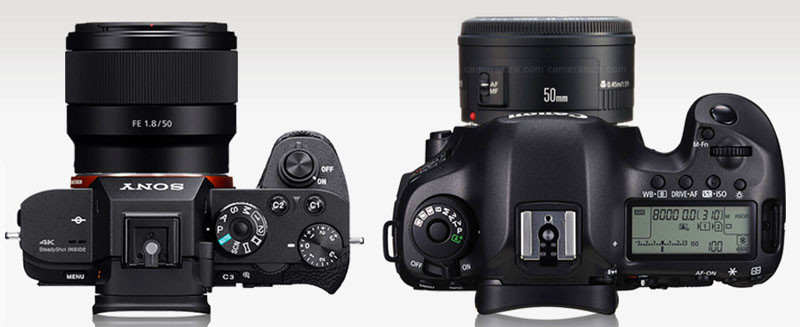
I think this is a very valid critic of mirrorless and it ties in to my solution for wideangle lenses. every cm you cut of the body, you add to the lens in order to retain the same focal length. Very well illustrated by this picture:
68ef3__a7RIIvs5DsR_niftyfifty-800x327.jpg

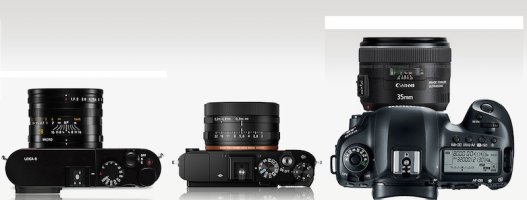
And what would you rather? Carry on big camera and a lot of small lenses or the other way around. Defiantly talks against mirrorless. But then again it is definitely possible to make vastly different size lenses of the same focal length as illustrated by these to images:

canon_leica.jpg


maxresdefault.jpg


So really lens size must to a large extent be a question of what is prioritized when designing set lens. Who is to say, that enginers wont be able to design futur lenses that are both smaller, sharper, faster and has the feauters we want.

In general, people buy FF for image quality and get big/fast lenses to deal with difficult lighting and shooting conditions. These are not the people worried about size. For those who really want a small DSLR, the path is towards an M camera (or a micro 4/3) and slow lenses.....

This might be the truth for now. But will this also be the case in in the futur as the prices of sensors goes down?

 
Upvote 0
Don Haines said:
In general, people buy FF for image quality and get big/fast lenses to deal with difficult lighting and shooting conditions. These are not the people worried about size. For those who really want a small DSLR, the path is towards an M camera (or a micro 4/3) and slow lenses.....

I agree and not sure why others don't get this. People do not want to spend more money for an FF camera that gives them the lesser IQ if the flange distance is too short, and slower lenses that would be required is you want really small size. If you want really small, Canon now offers the M5 - and you still get a APS-C size sensor which is good enough for the vast majority of users. You can still make FF mirrorless smaller (and perhaps more importantly, lighter) than a FF DSLR while still large enough for the buttons and ergonomics.
 
Upvote 0
dak723 said:
Don Haines said:
In general, people buy FF for image quality and get big/fast lenses to deal with difficult lighting and shooting conditions. These are not the people worried about size. For those who really want a small DSLR, the path is towards an M camera (or a micro 4/3) and slow lenses.....

I agree and not sure why others don't get this. People do not want to spend more money for an FF camera that gives them the lesser IQ if the flange distance is too short, and slower lenses that would be required is you want really small size. If you want really small, Canon now offers the M5 - and you still get a APS-C size sensor which is good enough for the vast majority of users. You can still make FF mirrorless smaller (and perhaps more importantly, lighter) than a FF DSLR while still large enough for the buttons and ergonomics.

Folks love to disregard logic and physics by thinking it's 2017, we should have this already! You can call names (mirrorslapper, stupid etc) all you want but that doesn't change optical formulas and costs. Large body and lens gives a wider group of options. Small body and or lens means you are limited to styles, light gathering, ergonomic balance and lens/body compatibility. I for one am partial (even though I shoot with a 5 Series body) to mid sized cameras such as the M5, 80D, etc and look forward to where those bodies will evolve.
 
Upvote 0
dak723 said:
I agree and not sure why others don't get this. People do not want to spend more money for an FF camera that gives them the lesser IQ if the flange distance is too short, and slower lenses that would be required is you want really small size. If you want really small, Canon now offers the M5 - and you still get a APS-C size sensor which is good enough for the vast majority of users. You can still make FF mirrorless smaller (and perhaps more importantly, lighter) than a FF DSLR while still large enough for the buttons and ergonomics.

I generally am pro 'Team large grip / 5d-ish body / EF mount' for mirrorless, but I'm not opposed to dropping one stop to get things smaller with mirrorless. f/2 primes are A-okay in my book.

In that 24-50mm FF range, one cannot deny f/2-ish primes with mirrorless are a really nice size savings (pic below is a 28 f/1.7, 35 f/2 and 35 f/2). But that's it -- it's really an academic distinction when you go longer or faster than 50mm or f/2.

That said, people will 100% put f/1.4 primes and f/2.8 zooms on these things on day one, and Canon should plan accordingly for that -- especially with the grip.

- A

I lined everything up on their LCDs for best comparison (CS tends to get pushed around by eye pieces), hence the PS surgery -- no scaling was applied.
 

Attachments

  • small f2 mirrorless small.jpg
    small f2 mirrorless small.jpg
    70 KB · Views: 153
Upvote 0
slclick said:
Folks love to disregard logic and physics by thinking it's 2017, we should have this already! You can call names (mirrorslapper, stupid etc) all you want but that doesn't change optical formulas and costs. Large body and lens gives a wider group of options.

Agree of course, but that unreasonable demand for [huge sensor] + [tiny lenses] will endure. People are always looking to miniaturize tech.

I'm honestly waiting for people buying in to one of the two new 'medium format' mirrorless rigs to start asking for f/8 max aperture sort-of-pancakes to create an MF rig that's smaller than their FF SLR setup. ;D

- A
 
Upvote 0
dak723 said:
It seems that a large number of Sony A7 users are using an adapter and their Canon and other brand lenses. So, the saving in size with a shorter flange distance is negated - and not an issue or consideration. As other have mentioned, it is the width and height (and perhaps most importantly, the weight savings) that are more important for those wanting a smaller FF camera. And wanting a smaller FF camera does not mean it has to be as small as an MFT or crop mirrorless. Just smaller than the current 6D. That is what I would be looking for.

Since users of the Sony models seem happy with using an adapter, Canon should pay attention. The camera can still be smaller where it counts, but without the problems the smaller flange distance creates. Therefore it seems a no-brainer for Canon to stay with the EF mount if they decide to go FF mirrorless.

To be honest using Canon lenses on my Sony is more a case of I have the lenses and can't afford to swap to fully native lenses. With the new MC11 adapter I got last week the performance of the Canon lenses has improved.

It's also worth keeping my Canon lenses in case I came back to the 6Dmkii as well :)
 
Upvote 0
GaabNZ said:
To be honest using Canon lenses on my Sony is more a case of I have the lenses and can't afford to swap to fully native lenses. With the new MC11 adapter I got last week the performance of the Canon lenses has improved.

It's also worth keeping my Canon lenses in case I came back to the 6Dmkii as well :)

exactly!

of course Canon can offer new mount mirrorless FF lenses in many flavors, just like EF glass today. a series of very compact moderately fast primes (f/1.8-2.8) and zooms (f/4,5.6) in the focal length range that allows for size savings. and faster, larger primes and zooms for those who need and want them. and slim cameras as well as cameras with larger grip. all based on one native mount.

mirrorless offers a huge bundle of advantages over mirrorslappers, making the transition fully worthwhile.
less size/weight for many kits and tasks (not all)
EVF to see how image will be recorded
absolutely no vibration (with global shutter)
no noise (with global shutter)
significantly lower production cost - with potential for lower prices (if customers force manufacturers to share some of the cost savings)
combined, these advantages are easily as valuable and desirable as the transition from manual to automatic focussing was, when canon ditched FD mount in favor of future-oriented EF mount.
 
Upvote 0
Frederik_Bo said:
Second. We must assume that canon is in the camera business for the long haul, and will want to make cameras for the foreseeable futur.

And that is the gamble that many armchair experts forget - it is no point in gong for the future if the company doesn't exist to sell the products. The cost of failure of a new mount would be immense especially in a contracting market and one in which Canon's market share is increasing despite the increasing number of mirrorless models available. As an executive what does that tell you? It tells you that what you are doing is working.
Canon have a long history of listening to professionals and working out what they need to make their life easier and better and they will be fully aware of the comments about corner quality on the Sony range that are attributable to the short flange distance. Can you imagine the furore if they scrapped the EF mount for a new mirrorless and said "I know it is softer in the corners but you save a few millimetres on size and 30 grammes on weight". Cue a massive shift to Nikon.
With any company the mantra is "Ignore your core clientele at your peril" and for Canon their core clientele is their professionals whose lenses are seen lining sports stadia, and out in the field taking landscape or in the studio taking portraits. They are Canon's advertisement and if those professionals start to feel Canon is not listening to them and are instead pandering to techno-geeks Canon is bust. Now that is dumb.

Will Canon ever create a new mount? They may well do. But introducing one for the simple reason of making a slightly smaller camera to please a small segment of the market ain't it.
 
Upvote 0
AvTvM said:
GaabNZ said:
To be honest using Canon lenses on my Sony is more a case of I have the lenses and can't afford to swap to fully native lenses. With the new MC11 adapter I got last week the performance of the Canon lenses has improved.

It's also worth keeping my Canon lenses in case I came back to the 6Dmkii as well :)

exactly!

of course Canon can offer new mount mirrorless FF lenses in many flavors, just like EF glass today. a series of very compact moderately fast primes (f/1.8-2.8) and zooms (f/4,5.6) in the focal length range that allows for size savings. and faster, larger primes and zooms for those who need and want them. and slim cameras as well as cameras with larger grip. all based on one native mount.

mirrorless offers a huge bundle of advantages over mirrorslappers, making the transition fully worthwhile.
less size/weight for many kits and tasks (not all)
EVF to see how image will be recorded I like it, a lot don't
absolutely no vibration (with global shutter) - So is this another 'condition'? Given that a viable global shutter does not exist yet for FF...
no noise (with global shutter) as above
significantly lower production cost - with potential for lower prices (if customers force manufacturers to share some of the cost savings) and how do sutomers 'force' them to share their savings? You are living in a fantasy land. The only thing that will force them is if mirrorless is commoditised just like current DSLRs to the point where being mirrorless is no longer the be all and end all and market forces are driving prices down.
combined, these advantages are easily as valuable and desirable as the transition from manual to automatic focussing was, when canon ditched FD mount in favor of future-oriented EF mount.You keep on bleating about this as if it is some mantra that will save your argument. As said countless times above, FD to EF had one massive advantage in that it enabled auto focus. None (nil, zilch, nada) of the 'advantages' you mentioned above has anywhere near that utility.
 
Upvote 0
Quote from: Frederik_Bo on February 06, 2017, 12:03:18 PM

Second. We must assume that canon is in the camera business for the long haul, and will want to make cameras for the foreseeable futur.

And that is the gamble that many armchair experts forget - it is no point in gong for the future if the company doesn't exist to sell the products. The cost of failure of a new mount would be immense especially in a contracting market and one in which Canon's market share is increasing despite the increasing number of mirrorless models available. As an executive what does that tell you? It tells you that what you are doing is working.
Canon have a long history of listening to professionals and working out what they need to make their life easier and better and they will be fully aware of the comments about corner quality on the Sony range that are attributable to the short flange distance. Can you imagine the furore if they scrapped the EF mount for a new mirrorless and said "I know it is softer in the corners but you save a few millimetres on size and 30 grammes on weight". Cue a massive shift to Nikon.
With any company the mantra is "Ignore your core clientele at your peril" and for Canon their core clientele is their professionals whose lenses are seen lining sports stadia, and out in the field taking landscape or in the studio taking portraits. They are Canon's advertisement and if those professionals start to feel Canon is not listening to them and are instead pandering to techno-geeks Canon is bust. Now that is dumb.

Will Canon ever create a new mount? They may well do. But introducing one for the simple reason of making a slightly smaller camera to please a small segment of the market ain't it.

You make it sound as if the switch from EF to a new mount would be overnight, but I could never see it happening that way. It would happen over a long period of time, maybe upwards of 10 years until EF was finally phased out. The new mount, would be introduced on the new mirrorless cameras, along side EF mount DSLRs. Just like the way sony is still making translusent mirror cameras even though they are clearly betting on mirrorless. Sony has no great SLR heritage and they are still making it a gradual transition.
Canon is a lot slower out the door then sony, but i bet, that in the end they will follow a similar path. Canon shooters will slowly migrates away from DSLRs and the EF mount will die along with the DSLR. I don't think it will be that painful. Of cause there will be a minority in the end, that will have to be pushed from DSLRs to mirrorless. Just like there were people that were pushed in to digital, when canon ceased production of there last film camera.


Can you imagine the furore if they scrapped the EF mount for a new mirrorless and said "I know it is softer in the corners but you save a few millimetres on size and 30 grammes on weight". Cue a massive shift to Nikon.

Well this really is not a good argument. If people switch to Nikon, then they will definitely have to bye all new lenses. If people switch to a new mirrorless canon mount, they can make do with a adapter in the short term.

In regards to softness in the corners, i think i made a very compelling argument, in my last post, that this problem can be overcome.

In the end the argument for a new mount goes like this. If you were to design a new Mirrorless camera from scratch, you would definitely design it with a short flange distance. That is what all manufactures, that i am aware of have don. Fuji, has don this in both there crop and medium format line, Panasonic, olympus and sony has don so. Even canon has don this with there crop mirrorless cameras.

If you want to make the best possible mirrorless camera, short flange distance is clearly the way to go. And i do believe that canon will want to do just that.
 
Upvote 0
Frederik_Bo said:
Can you imagine the furore if they scrapped the EF mount for a new mirrorless and said "I know it is softer in the corners but you save a few millimetres on size and 30 grammes on weight". Cue a massive shift to Nikon.

Well this really is not a good argument. If people switch to Nikon, then they will definitely have to bye all new lenses.

...unless Nikon sticks with the full F mount for their design to scoop up Canon pros.


It amazes me the blinders both sides have on that their respective predictions may not come to pass.

The 'Mirrorless is small (whether you like it or not)' camp cannot conceive of Canon sticking with full EF despite a mountain of pratical arguments for it -- some arguments only benefit a Canon superfan, while many others (look at Sony's painful climb up the mountain again with new lenses, the epic financial albatross of replacing all of EF) are very real market considerations.

The 'It's EF or bust' camp can't imagine why Canon would sell the future FF platform of the future without making it perfectly seamless for current FF users.

I can honestly see Canon going either way or possibly doing both: offer the skinny mount and a handful of smaller/slower mirrorless-only lenses and offer a full EF mount mirrorless (perhaps not right away) so that pros working a wedding / event can have a second body that operates identically to their first.

- A
 
Upvote 0