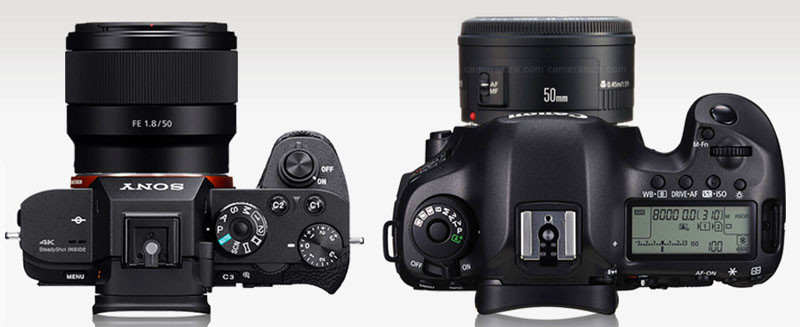
So many people associate mirrorless with making the body as small as possible, but this does not answer the very basic question of ergonomics. Where do you put the controls and shoulder displays in order to make them useful? The current shape/size has evolved to where it is now due to ergonomics, because that is what works for most people.
Well I never really brought up size directly in my post. I did of course bring up flange distance and how a shorter flange distance would be better. However there really is no reason why you should not be able to make a camera that retains the size and ergonomics of current DSLRs and at the same time has the shorter flange distance. I would argue that a Leica SL is close to the size of current DSLRs although ergonomically very different. So if the market really wants large DSLRs (though i personally doubt that is what the majority wants) there is nothing to hinter that.
You might ask then, what would be the point in switching from EF to a shorter flange distance mount if you ar going to make big cameras anyway?
The anser is versatility. With a short flange distance mount you would be able to make full frame cameras of all sizes. You could have full frame cameras as small as the EOS M10 and as large as the EOS 1D, all using the same lenses. Where as if you stick to the EF mount, you are much more limited in what kind of cameras you can make.
Further more, it seams most logical to have a lens mount that from the get go, is designed for the kind of cameras that you are making. In this case, mirrorless.
Yes, you could make the body smaller, but in doing so you end up having to bend the light more sharply in your lenses, and that leads to problems with chromatic aberration......
Yes, you could make the body smaller, but now the light hitting the corners of the sensor is at a greater angle and that leads to more vignetting....
Now I am not an optical engineer, but with regards to the chromatic aberration and vignetting. I would be guessing that these are problems that can be solved. Just from looking at history, there are tons of examples of rangefinders with short flange distances. Leica is still during this and everyboddy praises the quality of Leica optics. Now I am aware that non of the Leica M lenses are super wide. However it shows that short flange distances have been don in full frame, for decades with great success. It is really only with the introduction of digital and the demise of 35 mm that it has gone out af vogue.
There seems to be a pretty easy fix for the problem with the chromatic abberation and vingetting of wide-angle lenses on short flange distance bodies. If we imagine that we take a current EF mount wideangle lens, that performs up to our standards, and add an adapter for our new mirrorless mount. The lens should preform as well as on any EF mount camera, given that the adapter is of high enough quality. It would after all just be an extension tube the size of a mirrorbox.
There is no reason that you could not incorporate this extension tube in to the design of a new wideangle lens for a mirrorless camera. wula problem solved

Yes, you can make the body smaller, but you are not going to gain any appreciable size savings with long lenses..
I think this is a very valid critic of mirrorless and it ties in to my solution for wideangle lenses. every cm you cut of the body, you add to the lens in order to retain the same focal length. Very well illustrated by this picture:
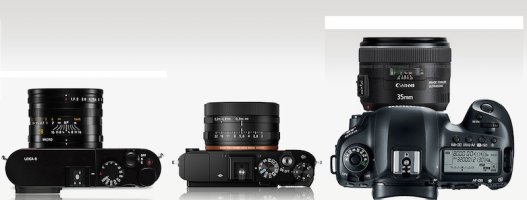
And what would you rather? Carry on big camera and a lot of small lenses or the other way around. Defiantly talks against mirrorless. But then again it is definitely possible to make vastly different size lenses of the same focal length as illustrated by these to images:
So really lens size must to a large extent be a question of what is prioritized when designing set lens. Who is to say, that enginers wont be able to design futur lenses that are both smaller, sharper, faster and has the feauters we want.
In general, people buy FF for image quality and get big/fast lenses to deal with difficult lighting and shooting conditions. These are not the people worried about size. For those who really want a small DSLR, the path is towards an M camera (or a micro 4/3) and slow lenses.....
This might be the truth for now. But will this also be the case in in the futur as the prices of sensors goes down?