Canon's FF Mirrorless Camera Will Have Same Internals as EOS 6D Mark II

rrcphoto said:
Jopa said:
sigh said:
People seem to make a lot of the fact that the EF-M mount is APS-C only (or at least I don't think anyone has proved conclusively that you can fit a FF sensor in there).

Why not? https://en.wikipedia.org/wiki/Lens_mount

Canon EF-M 18 mm APS-C 47 mm
Sony E 18 mm APS-C and 35 mm 46.1 mm (1.815 inch)

Same flange distance as the E-mount, ~1mm wider throat.

one problem with that is that canon has shifted the electrical contacts to one side more, making it bloody hindering awkward to fit a full frame sensor in there. it's a real tight squeeze.

however, why would they repeat the mistakes of sony?

sony had at one time around a 15-18% marketshare in SLT's.. now they don't even have that combined.

Was using the same mount for full frame and crop mirrorless a mistake on Sony's part? The problem is, I'm not sure how you can deconvolute that from all of their other gaffes (one of which was having too damn many mounts).

But here's some food for thought… Consider the entire complement of EF (full frame) lenses...who buys more of them – full frame owners or APS-C owners? Then consider the number of APS-C owners who buy EF lenses compatible with their crop cameras and full frame cameras, then upgrade to full frame cameras (a decision made easier by that compatibility).

If I had to guess, I would say that more EF lenses (at least, non-kit lenses) are bought by crop owners than FF owners, and that a substantial number of people buy EF lenses before buying a FF camera. Of course, I don't have those numbers...but you can bet that Canon does, and that they're going to strongly influence the choice of mount for the (presumed) forthcoming FF MILC.
 
Upvote 0
neuroanatomist said:
ahsanford said:
Probably a stupid question, but will crop factor work the same way if both the FF and APS-C mirrorless mounts have the same flange distance? I appreciate a crop sensor would be considerably smaller than a FF image circle, but I was wondering if the classic 1.6x Canon crop usage consideration was strictly a function of sensor size or if it also affected by flange distance. Please educate me, thx.

Yes, it would work the same way. AFAIK, the 1.6x crop factor was an arbitrary decision (vs. say the ~1.52x for Nikon/Sony/Fuji/etc. APS-C), although Canon's 1.6x is closest to the dimensions of a 35mm cinema film frame. If I had to guess, it's economics – the slightly smaller sensor allows Canon to eke out a few more sensors from a 300mm silicon wafer.

Given that Canon uses the same size sensor with both 44mm and 18mm flange focal distances (FFD), and Sony has a full frame sensor with an 18mm FFD, the FFD would not seem to be a limiting factor.
When they started making sensors, the yield rate was not very high. A FF sensor, with 2.5 times the area of the crop sensor, had a much lower yield rate than the crop sensors. I seem to remember hearing about yield rates of 6 or 7 good sensors per 300mm wafer and 38? good crop sensors per 300mm wafer. That makes a huge economic advantage for crop..... but as the quality has improved, the yield rates have gone up, and the cost of the sensor is now not as much of an issue. ( It used to be a FF sensor cost 10-15 times that of a crop sensor, now it is just 3)
 
Upvote 0
neuroanatomist said:
But here's some food for thought… Consider the entire complement of EF (full frame) lenses...who buys more of them – full frame owners or APS-C owners? Then consider the number of APS-C owners who buy EF lenses compatible with their crop cameras and full frame cameras, then upgrade to full frame cameras (a decision made easier by that compatibility).

If I had to guess, I would say that more EF lenses are bought by crop owners than FF owners, and that a substantial number of people by EF lenses before buying a FF camera. Of course, I don't have those numbers...but you can bet that Canon does, and that they're going to strongly influence the choice of mount for the (presumed) forthcoming FF MILC.

Totally buy that. I owned two L zooms before I jumped from crop to FF. But as much as "a substantial number of people by EF lenses before buying a FF camera" may be dead on, I also think FF people buy many more EF lenses than crop folks do on a per-person basis.

So what's the market? A massive userbase that has a passing fancy with EF that they might migrate full-time to, or a smaller userbase that buys a lot more EF glass per person?

- A
 
Upvote 0
ahsanford said:
...I also think FF people buy many more EF lenses than crop folks do on a per-person basis.

So what's the market? A massive userbase that has a passing fancy with EF that they might migrate full-time to, or a smaller userbase that buys a lot more EF glass per person?

Agree that FF shooters likely own more lenses per person. But there are likely a helluvalot more crop owners than FF owners. Lots of EF 50/1.8 and EF 75-300 lenses bought by croppers (the latter in kits). Lots of 70-300s too, and not much benefit to crop-only longer zooms.

But like I said, those are guesses – Canon has the data.
 
Upvote 0
neuroanatomist said:
But here's some food for thought… Consider the entire complement of EF (full frame) lenses...who buys more of them – full frame owners or APS-C owners? Then consider the number of APS-C owners who buy EF lenses compatible with their crop cameras and full frame cameras, then upgrade to full frame cameras (a decision made easier by that compatibility).

IMHO, one should take into account the 7D w/ supertele segment as well.
 
Upvote 0
neuroanatomist said:
ahsanford said:
...I also think FF people buy many more EF lenses than crop folks do on a per-person basis.

So what's the market? A massive userbase that has a passing fancy with EF that they might migrate full-time to, or a smaller userbase that buys a lot more EF glass per person?

Agree that FF shooters likely own more lenses per person. But there are likely a helluvalot more crop owners than FF owners. Lots of EF 50/1.8 and EF 75-300 lenses bought by croppers (the latter in kits). Lots of 70-300s too, and not much benefit to crop-only longer zooms.

But like I said, those are guesses – Canon has the data.
Also, crop shooters who go long tend to do so with EF glass. The 70-200s are very popular lenses, anything longer is EF, the 100mm macros are quite popular, the 40 mm pancake, and of course, the 50F1.8......
 
Upvote 0
AvTvM said:
This is a message, many people on this forum do not want to hear.

Of course, Canon will have to go in this direction. Ever since the first Sony A7, the genie has escaped the bottle .. short flange distance lens mount and native lenses for FF-mirrorless system is going to happen, we just don't know when Canon will finally announce it. It may however, not be 19mm flange distance [EF-M] but rather 22 or 24mm [EF -?] ;-)

For some transitional period, there will be 4 Canon lens series for DLSRs and mirrorless, each with FF and APS-C sensor. Over time, only the 2 mirrorless mounts for crop and FF will remain. EF and EF-S will become legacy. Just like FL and FD did.

Honestly though I think the reality a lot of people don't want to face up to is that the size savings that were talked up for mirrorless FF lenses for years(mostly based on film era manual rangefinder lenses) really haven't come to pass at all. You look at the Sony FE system and its really only the original 35mm F/2.8 with its limited specs that provides an overall depth smaller than its DSLR equivalent. Elsewhere the tendency is actually for FE lenses to be significantly longer than their FF equivalents to correct light angles thus negating the advantage in flange distance.

What I think the Sony A7 system has done is show that is that with FF the size saving advantages of mirrorless become more focused on the body. Your talking removing a much larger prism/mirror as well as a larger AF sensor, the A7 cameras relative to a 6D with similar lenses really are not much shallower but they are significantly shorter and weight less. Those advantages would exist with an EF mount mirrorless camera just as well as one with a shorter flange distance.

Really I think the main thing they would miss out on is the gearhead market that still buys into the idea of much smaller lenses but really is Canon ever going to get much of this? I think a lot of the appeal also rests in the rejection of the traditional brands in Canon and Nikon.
 
Upvote 0
moreorless said:
Honestly though I think the reality a lot of people don't want to face up to is that the size savings that were talked up for mirrorless FF lenses for years(mostly based on film era manual rangefinder lenses) really haven't come to pass at all. You look at the Sony FE system and its really only the original 35mm F/2.8 with its limited specs that provides an overall depth smaller than its DSLR equivalent. Elsewhere the tendency is actually for FE lenses to be significantly longer than their FF equivalents to correct light angles thus negating the advantage in flange distance.

Sony E-Mount was intended for APS-C sensors only. Sony chose mount parameters geared towards slim cameras and compact lenses, almost identical to the paramters Canon chose for EF-M mount for EOS M system.

A few years later Sony decided to also use E-mount for their mirrorless system, rather than to create yet an additional mount for A7 series. Due to narrow throat width [46.1mm] combined with very short flange focal distance [18mm] optical design of Sony FE lenses is severely compromised from he very start. Using a somewhat bigger mount and somewhat longer flange distance should certainly help to design less complex, more compact and less expensive native lenses for FF-sensor mirrorless.

Sony FE lenses are a text book example of a poor lens design compromise, brought about by using less than ideal lens mount parameters.

If lens mount is chosen wisely, compact, simple, optically very good and comparatively inexpensive, fully FF-capable mirrorless lenses are possible. Canon has demonstrated a lot of foresight and careful choice in their lens mounts - making them rather on the "oversize" side [e.g. EF vs. Nikon F] to facilitate lens design.

I would be very surprised if Canon were to repeat Sony's mistake and use its "APS-C optimized" EF-M mount also for a FF mirrorless system. I fully expect Canon to launch a new, fully FF-capable native mount for FF-mirrorless and build their future system around it.

EF-M will be relegated to exactly the same role EF-S has played for DSLRs: limited choice of - mostly - consumer grade lenses in the limited focal length range in which size-advantages for crop-sensor image circle can be utilized.
 
Upvote 0
AvTvM said:
I fully expect Canon to launch a new, fully FF-capable native mount for FF-mirrorless and build their future system around it.

EF-M will be relegated to exactly the same role EF-S has played for DSLRs: limited choice of - mostly - consumer grade lenses in the limited focal length range in which size-advantages for crop-sensor image circle can be utilized.

That's not the same role. For APS-C dSLRs, the full EF lineup mounts natively. If they have two MILC mounts, they lose a major selling point for the APS-C line...and that line is likely to be a much bigger cash cow for Canon than FF MILCs.
 
Upvote 0
Honestly AvTvM I have my doubts this is actually that big a factor with the FE lens system, perhaps it has an impact in terms of the high levels of light dropoff but the reality for me is that your simply not going to get the kind of ultra small lenses we'd always been told about that was based on manual lenses used on film.

I can certainly see Canon releasing a new FF mount but equally I don't see it as nearly so important as APSC. There your talking an entire segment of ultra small cameras no DSLR can get close to, with FF though I think the size of lenses and the demand for a more advanced manual interface, EVF, etc means your not really playing to the same market. A reworked 6D without the mirror, prism, AF sensor and a smaller grip could I think get very close to the size of an A7 camera.

Even if we reach a stage were mirrorless lens design does start to offer much smaller/better lenses in the wide/normal range Canon would also have the option of following a more extreme version of EF-S. The lens mount is afterall already quite large and having a recessed rear element would likely be possible.
 
Upvote 0
I am confident we will also get a lineup of very compact, optically good, moderately fast EF-?? primes for mirrorless FF. Basically an FF-equivalent to Canon EF-M 22/2 ... something like 15/4 - 24/2.8 - 35/2.0 - 50/1.8 - 85/2.8 ... I think, this is technically possible if mount parameters [and microlens layout on sensor etc.] are well chosen.

First there will be zooms and big, fat, expensive f/1.4 lenses, that people here are often asking for. Canon will cream those buyers off and some time later I will smartly get myself a "pancake/compact" lens setup for little money. Plus a compact 24-70/4 IS STM. Tele stuff and specialty lenses? Just use EF glass + adapter. No problem. :-)
 
Upvote 0
neuroanatomist said:
AvTvM said:
I fully expect Canon to launch a new, fully FF-capable native mount for FF-mirrorless and build their future system around it.

EF-M will be relegated to exactly the same role EF-S has played for DSLRs: limited choice of - mostly - consumer grade lenses in the limited focal length range in which size-advantages for crop-sensor image circle can be utilized.

That's not the same role. For APS-C dSLRs, the full EF lineup mounts natively. If they have two MILC mounts, they lose a major selling point for the APS-C line...and that line is likely to be a much bigger cash cow for Canon than FF MILCs.

If they use EF-M as common MILC mount Canon will face the same problems as Sony wioth their FE lenses. Severely limited lens design. Too many compromises. Too big lenses, complex design, high cost & even higher prices. I would really be surprised if Canon went this route ... they may be "stupid in many ways", but as far as lens mount decisions go, they have chosen throat and flange focal distance very well [to allow for anything, including f/1.2 FF glass] and shown excellent foresight, especially with EF mount in 1987.

Had they planned to use EF-M for both APS-C and future FF MILCs, they would have made that hole a little wider and deeper. Since they did not, I take it as an indication for a 2-mount strategy, with EF-?? lenses probably and hopefully also usable on EF-M cameras with a small "adapter ring" to bridge difference in FFD and throat width. Really the same strategy that has worked well for EF and EF-S systems.

But of course, I am only guessing. [Only] Canon knows, what they are really up to ... if anything. :P ;D
 
Upvote 0
AvTvM said:
...I take it as an indication for a 2-mount strategy, with EF-?? lenses probably and hopefully also usable on EF-M cameras with a small "adapter ring" to bridge difference in FFD and throat width. Really the same strategy that has worked well for EF and EF-S systems.

But of course, I am only guessing. [Only] Canon knows, what they are really up to ... if anything. :P ;D

I take it that they are not working on a FF mirrorless interchangeable system unless it uses native EF lenses.

Canon have stated many times that they see the overriding feature of mirrorless to be the smaller size, everybody knows a ff body and lens combination is basically the same size for both mirrorless and DSLR, ergo Canon see no point in ff mirrorless system of a quality that necessitates a larger than APS-C sensor.
 
Upvote 0
privatebydesign said:
... everybody knows a ff body and lens combination is basically the same size for both mirrorless and DSLR ...

Have to disagree here. Everybody can see, that Mirrorless systems can be *significantly smaller* than DSLR-systems for the entire focal length range used to capture an [estimated] 99% of all images globally. [~ FF FOV equivalent 24-135mm].

The percentage of images captured at either 600mm FL or f/1.2 is rather small. :-)

Mirrorless offers both options:
* full capability even for highly specialized tasks requiring big, fat 800mm lenses or big, fat f/1.2 lenses
AND
* slim camera plus pancake/ultra-compact lenses if they are sufficient to handle many tasks/situations

DSLR ... do not.
 
Upvote 0
AvTvM said:
privatebydesign said:
... everybody knows a ff body and lens combination is basically the same size for both mirrorless and DSLR ...

Have to disagree here. Everybody can see, that Mirrorless systems can be *significantly smaller* than DSLR-systems for the entire focal length range used to capture an [estimated] 99% of all images globally. [~ FF FOV equivalent 24-135mm].

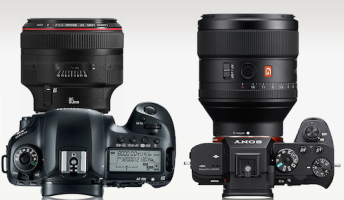
I welcome pictures of same max-apertured FF 135mm lenses bolted on to and SLR and mirrorless rig taken side by side. At those FLs, what you call significant I'd call miniscule.

(Couldn't find a 135mm FF lens at camerasize, so fast 85mm lenses will have to suffice. You get my point.)

Yes, for some FLs, the 'dream of smaller mirrorless' can be realized. Say around 24-50mm, a thin FF mirrorless rig could be noticeably smaller than a FF SLR with the same lens on it. Around 85mm you are pushing it and the lens starts to boss the aggregate footprint in your bag. At 135mm, you must be joking -- you'll save a centimeter on the body width/height but your length (and resulting space you take up in the bag) will effectively be the same.

If Canon 'goes thin' with FF mirrorless, they should offer a 24 / 35 / 50 trio of small f/2 lenses, one smallish standard zoom (24-70 f/4, perhaps a 24-50 f/2.8 ), think about an UWA zoom, think about a macro... and then put a cork in it. See if it sells and then reassess, but until it does sell, Canon should fold its arms and mail EF catalogs to everyone who wants more glass.

- A
 

Attachments

  • Screen Shot 2017-02-01 at 1.40.18 PM.png
    Screen Shot 2017-02-01 at 1.40.18 PM.png
    166.4 KB · Views: 559
Upvote 0
showing the picture over and over does not change a thing. It just gets boring.

Read my lips:
1. Sony FE lenses are larger than necessary for FF mirrorless, because *stupid Sony* chose to use an APS-C moutn for an FF sensor system.
2. With a properly designed lens moutn, FF mirrorless lenses up to about 100mm focal lens could be MUCH smaller than those behemoth Sony FE lenses.

Got it now ? :) :P
 
Upvote 0
Look to motion picture for some guidance here.
Vistavision is close to 36x24mm sensor size (Canon back focus for FF and EF-S APS-C is 44mm), Motion picture back focus varies but the most popular is 52mm (Arri). Red back focus is 27.3mm but this still needs to cater for 36x24mm sensor image circle to enable the use of stills lenses. Canon EF-M back focus is 18mm and uses an adaptor to use EF lenses. An adaptor to use FF lenses to cover FF sensor but on a camera with 18mm back focus is perfectly possible as we see with the Sony E mount which is also 18mm.

Not so silly if you view it this way and with very limited EF-M lens choice currently who is to say newer EF-M lenses could not cover FF as in the case of Sony?
 
Upvote 0
AvTvM said:
showing the picture over and over does not change a thing. It just gets boring.

Read my lips:
1. Sony FE lenses are larger than necessary for FF mirrorless, because *stupid Sony* chose to use an APS-C moutn for an FF sensor system.
2. With a properly designed lens moutn, FF mirrorless lenses up to about 100mm focal lens could be MUCH smaller than those behemoth Sony FE lenses.

Got it now ? :) :P

Could they? Where is your evidence for that? (Outside of your own head, that is, because in there it's not worth the tiny number of ions moving around to drive your fanciful imagination.)

Unless you're suggesting that the difference between a 44mm and a 24mm flange focal distance, making the lens 20mm shorter, constitutes 'MUCH smaller'. ::)
 
Upvote 0
neuroanatomist said:
AvTvM said:
showing the picture over and over does not change a thing. It just gets boring.

Read my lips:
1. Sony FE lenses are larger than necessary for FF mirrorless, because *stupid Sony* chose to use an APS-C moutn for an FF sensor system.
2. With a properly designed lens moutn, FF mirrorless lenses up to about 100mm focal lens could be MUCH smaller than those behemoth Sony FE lenses.

Got it now ? :) :P

Could they? Where is your evidence for that? (Outside of your own head, that is, because in there it's not worth the tiny number of ions moving around to drive your fanciful imagination.)

Unless you're suggesting that the difference between a 44mm and a 24mm flange focal distance, making the lens 20mm shorter, constitutes 'MUCH smaller'. ::)

+1. If both a Sony 18mm flange distance and a Canon 44mm flange distance are generating similar sized FF lenses, I fail to see how a 22mm, 24mm, etc. flange distance will magically reduce the size of what we have to carry.

- A
 
Upvote 0