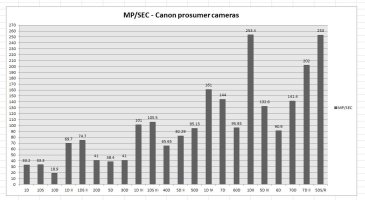
Coincidence or?? MP/SEC

This is a ridiculous thought..

Canon 5DS / 5DSR - 50.6mp - max 5/sec burst = 253mp per sec
Canon 1DX - 18.1mp - max 14/sec burst = 253mp per sec

Two highest - when summed - figures from the Canon line-up in terms of image size.

As they use different processors is there another limiting factor? or is this just stupid?

My vote is stupid, but I wanted to share it nonetheless.
 
A data transmission system is only as fast as its slowest component. Maybe there is some small component in those two cameras that has a data flow limit of 253 mp/s or Canon feels that 253 mp/s is a good balance between capability/cost/complexity?

Could be several reasons why Canon chooses to limit the dataflow to 253 mp/s.

Two separate data points, in this case the two camera models you cited, matching is the definition of a coincidence. :)
 
Upvote 0
Not quite certain what you are getting at.
The 1DX uses 3 processors (2 x Digic 5+ and 1 Digic 4) as opposed to 2 Digig 6 in the 5DS so I would expect there to be differences.
The quoted burst depth on the 5DS is 14 RAW files, with my 1DX (at 10 fps) I get 50+ RAW files before things slow down - perhaps this is the difference?
 
Upvote 0
johnf3f said:
Not quite certain what you are getting at.
The 1DX uses 3 processors (2 x Digic 5+ and 1 Digic 4) as opposed to 2 Digig 6 in the 5DS so I would expect there to be differences.
The quoted burst depth on the 5DS is 14 RAW files, with my 1DX (at 10 fps) I get 50+ RAW files before things slow down - perhaps this is the difference?


I was more just hinting that it is funny how Canon representatives impress us that the 5Ds/r can transfer 50mp files as fast as 5/sec when this transfer rate was possible with tech from years ago in the 1dx/c
 
Upvote 0
Megapixels don't equal Megabytes. It's kind of hard to compare or talk about data transmission when those (megapixels) aren't the units of measure that are used. I have a 7DII. It has a 20.2MP sensor but the files from it can be upto 30+MB in size. The amount of data depends on how much is going on in the frame. If you had a consistent image then it might be comparable.

Just pointing out why it's probably just a coincidence.
 
Upvote 0
dilbert said:
wyldeguy said:
Megapixels don't equal Megabytes. It's kind of hard to compare or talk about data transmission when those (megapixels) aren't the units of measure that are used. I have a 7DII. It has a 20.2MP sensor but the files from it can be upto 30+MB in size. The amount of data depends on how much is going on in the frame. If you had a consistent image then it might be comparable.

The file size is the output of the pipeline that involves reading data from the sensor and compressing it for CR2. The size of data in the output stage is much smaller than what comes in at the other end. Thus the measuring data rate processing capability is more correctly based on MP/sec than MB/sec.

Are you sure? Because the MP count remains the same but the file size changes depending on a lot of factors including ISO. Also processors are always rated in MB or GB/sec, granted mostly because they aren't always being used with image sensors.
 
Upvote 0
Olliecanon said:
This is a ridiculous thought..

Canon 5DS / 5DSR - 50.6mp - max 5/sec burst = 253mp per sec
Canon 1DX - 18.1mp - max 14/sec burst = 253mp per sec

Two highest - when summed - figures from the Canon line-up in terms of image size.

As they use different processors is there another limiting factor? or is this just stupid?

My vote is stupid, but I wanted to share it nonetheless.


Remember, every frame read includes the masked border pixels for calibration purposes. That increases the megapixel count above the number of pixels that actually end up in your final images, usually by around 4-6%. The 1DX actually has 19 million pixels. The 5Ds is likely to have close to 53 million pixels. Total pixels, masked ones included. So total megapixel counts per second are more like 266mp.


Every pixel is converted to a 14-bit number, that whole chunk of data is read 14 times per second for the 1Dx, or five times per second for the 5Ds. The data throughput of the DIGIC chips MUST be able to handle the RAW PIXEL INPUT throughput, which is:


Canon 1D X: 19,000,000px * 14bit/px / 8bit/byte * 14fps = 465,500,000byte/s
5Ds: 53,000,000px * 14bit/px / 8bit/byte * 5fps = 463,750,000byte/s


When you throw in overhead, both cameras are very likely using DIGIC processors capable of handling an input throughput rate of 250mb/s (since two DIGIC chips are used).


The big difference between DIGIC5 and DIGIC6 is clearly not throughput. The 7D II requires less than 400mb/s total, so it only needs 200mb/s throughput for it's pair of DIGICs. The big difference with DIGIC6 is that the chips are doing a lot more onboard processing of each pixel, reducing noise and whatnot, than the DIGIC5 chips did. Overall processing power increased, even if data throughput did not. Supposedly that increased processing results in better images. Ignoring DR, I think that is the case...OOC images from the 7D II and 5Ds definitely look better. The DIGIC 6 processors don't seem to help at all in the area of read noise (and one wouldn't expect them to), but that doesn't change the fact that these chips are doing more processing than the DIGIC 5 chips.

 
Upvote 0
At full tilt, many Nikon bodies reduce the data per frame by dropping from 14 bit to 12 bit raw.

Canon don't offer that, but the 1D X does have compromises at 14 FPS other than the mirror staying up leading to viewfinder blackout and no AF tracking - the output is JPEG only. That's likely due to the sensor output dropping to 12 bit as a work around for the high data rate. If that's the case, the sensor readout and processing has gone from 12 FPS @ 14 bits to 14 FPS @ 12 bits - which is an identical data throughout.

Add bit depth into your calculations, and the 5Ds works out at ~443 MB/s.
The 1D X tops out at ~380 MB/s at both 12 and 14 FPS.

The 5Ds is no speed demon purely in terms of FPS, but that is an unprecedented data throughput for a Canon stills camera.
 
Upvote 0
jrista said:
Olliecanon said:
This is a ridiculous thought..

Canon 5DS / 5DSR - 50.6mp - max 5/sec burst = 253mp per sec
Canon 1DX - 18.1mp - max 14/sec burst = 253mp per sec

Two highest - when summed - figures from the Canon line-up in terms of image size.

As they use different processors is there another limiting factor? or is this just stupid?

My vote is stupid, but I wanted to share it nonetheless.


Remember, every frame read includes the masked border pixels for calibration purposes. That increases the megapixel count above the number of pixels that actually end up in your final images, usually by around 4-6%. The 1DX actually has 19 million pixels. The 5Ds is likely to have close to 53 million pixels. Total pixels, masked ones included. So total megapixel counts per second are more like 266mp.


Every pixel is converted to a 14-bit number, that whole chunk of data is read 14 times per second for the 1Dx, or five times per second for the 5Ds. The data throughput of the DIGIC chips MUST be able to handle the RAW PIXEL INPUT throughput, which is:


Canon 1D X: 19,000,000px * 14bit/px / 8bit/byte * 14fps = 465,500,000byte/s
5Ds: 53,000,000px * 14bit/px / 8bit/byte * 5fps = 463,750,000byte/s


When you throw in overhead, both cameras are very likely using DIGIC processors capable of handling an input throughput rate of 250mb/s (since two DIGIC chips are used).


The big difference between DIGIC5 and DIGIC6 is clearly not throughput. The 7D II requires less than 400mb/s total, so it only needs 200mb/s throughput for it's pair of DIGICs. The big difference with DIGIC6 is that the chips are doing a lot more onboard processing of each pixel, reducing noise and whatnot, than the DIGIC5 chips did. Overall processing power increased, even if data throughput did not. Supposedly that increased processing results in better images. Ignoring DR, I think that is the case...OOC images from the 7D II and 5Ds definitely look better. The DIGIC 6 processors don't seem to help at all in the area of read noise (and one wouldn't expect them to), but that doesn't change the fact that these chips are doing more processing than the DIGIC 5 chips.

Are you certain? At 14fps the 1DX only records to 8bit/px.
 
Upvote 0
rs said:
At full tilt, many Nikon bodies reduce the data per frame by dropping from 14 bit to 12 bit raw.

Canon don't offer that, but the 1D X does have compromises at 14 FPS other than the mirror staying up leading to viewfinder blackout and no AF tracking - the output is JPEG only. That's likely due to the sensor output dropping to 12 bit as a work around for the high data rate. If that's the case, the sensor readout and processing has gone from 12 FPS @ 14 bits to 14 FPS @ 12 bits - which is an identical data throughout.

Add bit depth into your calculations, and the 5Ds works out at ~443 MB/s.
The 1D X tops out at ~380 MB/s at both 12 and 14 FPS.

The 5Ds is no speed demon purely in terms of FPS, but that is an unprecedented data throughput for a Canon stills camera.


Output data at 14fps would be JPEG, but the input data from the sensor would still be 14-bit. I don't believe Canon does any kind of downgrading on the bit depth of the ADC units (I've never found any information indicating as much anyway), so I don't believe there is a 12-bit 14fps read mode. The output data rate for JPEG (when writing to the memory card) would certainly be lower, but the input rate into the DIGIC processor would still be 14-bit. That would mean the input throughput for the 1D X is basically the same as for the 5Ds, around 465mb/s plus any additional overhead.


I still believe that DIGIC5+ and DIGIC6 are 250mb/s input throughput per chip, or a total of 500mb/s total maximum input throughput.
 
Upvote 0
I guess it is the speed of the ADC units. 14 bit at a rate of roughly 0.5 Gigasamples is fast, just today, if you need accuracy and repeatability.

Another reason might be the data transmission speed inside the camera. 500 x 14 bits means 500 Mhz bandwidth for a 14 bit parallel bus or 7 Ghz bandwidth for a single serial bus. Compare processor speeds which stagnate at roughly 2.5 Ghz for mobile devices (Notebooks) or 1.2 GHz (smarphones).

For the 7D ii: The limit isn't perhaps the internal processing or data transfer speed but the speed of the mirror / shutter mechanism at the given cost of the camera for Canon.
 
Upvote 0
jrista said:
Output data at 14fps would be JPEG, but the input data from the sensor would still be 14-bit. I don't believe Canon does any kind of downgrading on the bit depth of the ADC units (I've never found any information indicating as much anyway), so I don't believe there is a 12-bit 14fps read mode. The output data rate for JPEG (when writing to the memory card) would certainly be lower, but the input rate into the DIGIC processor would still be 14-bit.

It's difficult for anyone outside of the development team to do any more than speculate, but I'd argue that if the camera can really handle 14 bit readout at 14 FPS, then why force JPEG only on users? The buffer is still there, and if the readout and JPEG engine can keep up with 14 bits, the buffer should be able to too - so instead of forcing JPEGs on the user, why not give them a choice of a smaller buffer depth and raw? Card speeds only become relevant once the buffer fills up, and the target audience of the 1D X should in Canon's eyes be capable of deciding which trade off to choose.

I'm under the impression (falsely or not) that it's JPEG only as the readout doesn't support 14 bit CR2 files at 14 FPS.
 
Upvote 0
johnf3f said:
Not quite certain what you are getting at.
The 1DX uses 3 processors (2 x Digic 5+ and 1 Digic 4) as opposed to 2 Digig 6 in the 5DS so I would expect there to be differences.
The quoted burst depth on the 5DS is 14 RAW files, with my 1DX (at 10 fps) I get 50+ RAW files before things slow down - perhaps this is the difference?

The Digic 4 is only used for the focus system, not the transfer of data. From what I read. I could be wrong.
 
Upvote 0
rs said:
jrista said:
Output data at 14fps would be JPEG, but the input data from the sensor would still be 14-bit. I don't believe Canon does any kind of downgrading on the bit depth of the ADC units (I've never found any information indicating as much anyway), so I don't believe there is a 12-bit 14fps read mode. The output data rate for JPEG (when writing to the memory card) would certainly be lower, but the input rate into the DIGIC processor would still be 14-bit.

It's difficult for anyone outside of the development team to do any more than speculate, but I'd argue that if the camera can really handle 14 bit readout at 14 FPS, then why force JPEG only on users? The buffer is still there, and if the readout and JPEG engine can keep up with 14 bits, the buffer should be able to too - so instead of forcing JPEGs on the user, why not give them a choice of a smaller buffer depth and raw? Card speeds only become relevant once the buffer fills up, and the target audience of the 1D X should in Canon's eyes be capable of deciding which trade off to choose.

I'm under the impression (falsely or not) that it's JPEG only as the readout doesn't support 14 bit CR2 files at 14 FPS.


The readout is simply transferring charge and converting it to digital numbers. JPEG doesn't come into play until that native signal information has already entered the DIGIC chip, since it is DIGIC that is actually performing the conversion to JPEG. The sensor isn't going to natively spit out 8-bit JPEG data, as that requires processing, like color space conversion, compression and encoding, etc.


Why does Canon limit 14fps to JPEG? I don't know the answer to that. I am just quite certain that neither the sensor nor the off-die ADC units are spitting out JPEG data natively. It could be possible that the ADC units are switching to 12-bit mode at 14fps. Samsung certainly doe it at 15fps. Why Canon even bothers with a 14-bit ADC in the first place when their data barely supports more than 11 bits worth of information because of system noise levels is beyond me. If a 12-bit ADC would allow them to process 17.5fps, without any loss in DR, I don't know why they don't. That said, I've never encountered any information anywhere, including in patents, that indicates Canon switches to 12-bit data output from their ADC units. There could very well be a different reason they had to limit 14fps to JPEG.
 
Upvote 0
jrista said:
rs said:
jrista said:
Output data at 14fps would be JPEG, but the input data from the sensor would still be 14-bit. I don't believe Canon does any kind of downgrading on the bit depth of the ADC units (I've never found any information indicating as much anyway), so I don't believe there is a 12-bit 14fps read mode. The output data rate for JPEG (when writing to the memory card) would certainly be lower, but the input rate into the DIGIC processor would still be 14-bit.

It's difficult for anyone outside of the development team to do any more than speculate, but I'd argue that if the camera can really handle 14 bit readout at 14 FPS, then why force JPEG only on users? The buffer is still there, and if the readout and JPEG engine can keep up with 14 bits, the buffer should be able to too - so instead of forcing JPEGs on the user, why not give them a choice of a smaller buffer depth and raw? Card speeds only become relevant once the buffer fills up, and the target audience of the 1D X should in Canon's eyes be capable of deciding which trade off to choose.

I'm under the impression (falsely or not) that it's JPEG only as the readout doesn't support 14 bit CR2 files at 14 FPS.


The readout is simply transferring charge and converting it to digital numbers. JPEG doesn't come into play until that native signal information has already entered the DIGIC chip, since it is DIGIC that is actually performing the conversion to JPEG. The sensor isn't going to natively spit out 8-bit JPEG data, as that requires processing, like color space conversion, compression and encoding, etc.


Why does Canon limit 14fps to JPEG? I don't know the answer to that. I am just quite certain that neither the sensor nor the off-die ADC units are spitting out JPEG data natively. It could be possible that the ADC units are switching to 12-bit mode at 14fps. Samsung certainly doe it at 15fps. Why Canon even bothers with a 14-bit ADC in the first place when their data barely supports more than 11 bits worth of information because of system noise levels is beyond me. If a 12-bit ADC would allow them to process 17.5fps, without any loss in DR, I don't know why they don't. That said, I've never encountered any information anywhere, including in patents, that indicates Canon switches to 12-bit data output from their ADC units. There could very well be a different reason they had to limit 14fps to JPEG.
Hi,
Because Canon RAW files include the bias information. And bias information is useful in perform calibration of image.

By the way, 7D2 is dual pixel meaning that they actually had 40.4MP. Now if the dual-pixel operation is perform in analogue form (before the ADC), that mean the data rate will still at 20.2MP level, but if the dual-pixel AF is perform after the ADC, then the data rate will be at 40.4MP level. Just wondering??

Have a nice day.
 
Upvote 0
Hmm, yeah, calibration with the bias signal might benefit from a higher bit depth. You would more accurately represent the differences in each column of the bias... Interesting.


Regarding the 7D II, as far as I know the dual pixel read for AF is a literal dual pixel read. That would be 40.2mp in that case. I wonder if there are two separate reads, though...one for one half of each pixel, then another for the other half? It is also possible each AF read is converted to only 7 bits as well. Dunno. The specifics on that might be contained within the DPAF patents, though...
 
Upvote 0