Could Canon's Next Leap in IQ be a big one?

I would like a little more dynamic range, but realistically, my post-processing skills are not bringing out the best that Canon has to offer. So, when I get to the point where I know how to tweak black point, white point, curves, etc and know how to do straightforward manual exposure blending, and I am still wanting a little more range - then I worry. Canon ergonomics are pleasing to me, and that counts for a great deal.

All that said, there should be some sensor technology improvements resulting in IQ improvements. Lots of patents filed - a small percentage actually scale well enough to be commercially feasible.
 
Upvote 0
Don Haines said:
A change in fabrication size could increase the efficiency of Canon sensors by 10 maybe 15%. For anything else you need to change the design........but keep in mind that everything has trade-offs. For example the current canon designs have less low ISO dynamic range then the Sony design but it has greater high ISO dynamic range.change the design and you change the trade-offs.

http://www.sensorgen.info/

A Sony A7R has a 50% QE, a Canon 5D MK III has a 51% QE. I hear claims that Sony uses a different FAB, why are they not 15% higher?

The Sony A7S with its huge pixels has a 65% QE, and the Canon 7D MK II with its tiny pixels has 59%.

It really sounds to me like the sensor design has a lot more to do with efficiency than what fab was used.

The really old Minolta Konica Dynax 5 had a 90% QE.

But, the Nikon D2X had 476%! QE seems to mean little as far as Fab goes.
 
Upvote 0
My feeling is that all this would depend on Canon's forecast for future sales. If the market is declining then there is less incentive to invest in new sensors. (i.e return on investment)We already see the decline in point and shoots, it's only a matter of time before soccer mums stop buying Rebels, even most of us are thinking of moving to 4/3s instead of carting around full frame or even large crop sensor DSLRs. (even if it is a secondary camera). A very competitive market leads to smaller profit margins to recoup major investments. If improvements do come they will be more incremental unless a competitor releases such a product that threatens Canon's sales/profits substantially.
 
Upvote 0
Don Haines said:
A change in fabrication size could increase the efficiency of Canon sensors by 10 maybe 15%. For anything else you need to change the design........but keep in mind that everything has trade-offs. For example the current canon designs have less low ISO dynamic range then the Sony design but it has greater high ISO dynamic range.change the design and you change the trade-offs.
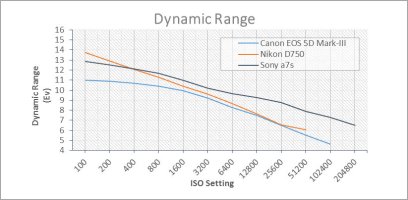
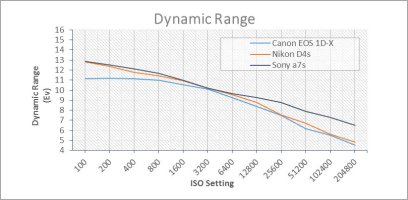
In fairness, if you want to make a peaches to apricots comparison then you should select peaches and apricots which are similar in size. A good comparison is the 5D-III_vs_D750 (both are close to 24MP) or perhaps 1Dx_vs_D4s (Both are close to 18MP). Considering these similarly resolutioned bodies then do the Canon cameras really offer more high ISO dynamic range?
 

Attachments

  • 5D-III v D750.jpg
    5D-III v D750.jpg
    68 KB · Views: 212
  • 1D-X v D4s.jpg
    1D-X v D4s.jpg
    67.5 KB · Views: 198
Upvote 0
Mt Spokane Photography said:
Don Haines said:
A change in fabrication size could increase the efficiency of Canon sensors by 10 maybe 15%. For anything else you need to change the design........but keep in mind that everything has trade-offs. For example the current canon designs have less low ISO dynamic range then the Sony design but it has greater high ISO dynamic range.change the design and you change the trade-offs.

http://www.sensorgen.info/

A Sony A7R has a 50% QE, a Canon 5D MK III has a 51% QE. I hear claims that Sony uses a different FAB, why are they not 15% higher?

The Sony A7S with its huge pixels has a 65% QE, and the Canon 7D MK II with its tiny pixels has 59%.

It really sounds to me like the sensor design has a lot more to do with efficiency than what fab was used.

The really old Minolta Konica Dynax 5 had a 90% QE.

But, the Nikon D2X had 476%! QE seems to mean little as far as Fab goes.
Possible error(s) in the data???

I stand under correction, but as far as I know Quantum Effieciency is how many incident photons are converted to an electron by the sensor. A QE of 476% means that when one photon hits the sensor then on average it liberates about 5 electrons. I'm not a physicist but that I think that's impossible.
 
Upvote 0
unfocused said:
whitedjp said:
I have been reading a lot lately how Canon has not updated its sensor fabrication process which is why we haven't seen much too too much improvement over the years...

So I come to my question: do you think that if Canon continues to increase the ?efficiency? of its systems and then integrate this with the newer sensor fabrication, that Canon would then lead the IQ pack again?

Clearly you are spending too much time reading internet forums. That's your first mistake.

Canon's image quality compares very favorably with other brands. Better in some areas, not quite as good in others, but overall, the differences among all brands are insignificant.

Those who complain generally fall into two categories: 1) persons who have very specific needs/wants that are out of the mainstream and expect highly specialized tools from mass market manufacturers (these people comprise only a tiny percentage of complainers and an even tinier percentage of the market); and 2) measurebators who read internet forums and test sites and misinterpret the tiny differences that certain test sites measure and assume that these measurements, however flawed, are somehow significant to users.

The vast majority of photographers, professional and amateur alike, find that today's tools, even at the low end, are far and away better than they generally need.

There is no prize for having marginally the "best" in one narrow category and it will not affect any company's position in the marketplace. Canon (and Nikon and others) will continue to make marginal improvements, but as the technology has matured, the improvements are likely to remain marginal and not hugely significant until the "next big thing" comes around. So far, the only thing out there that could possibly fit that description might be light field technology, but it is a long way away from being perfected.

I agree with your summary but for two points. Dynamic range IS an issue often with Canon cameras and secondly bit depth improvements rather than resolution would also be welcome for all improving color imagery.
 
Upvote 0
PureClassA said:
Mt Spokane Photography said:
There is no evidence that a fabrication process has any effect on Camera IQ. Sony's sensors have to do with Sensor design and not fabrication process. Their design is protected by patents.

Sony puts A/D converters on the sensor itself and Canon puts the A/D converter in the Digic Processor.

Canon has NR circuitry on the sensor, but the Analog signal travels to the processor which lets a small amount of noise into the path.

Yes. But Canon also has a very similar ON sensor ADC patent they haven't pulled the trigger on using. Hoping they will soon once the costs for retooling the fab process will aloow (as I assume that is at least in part the issue)
the fab process has no bearing on that.

I love people all of a sudden becoming chip designers because they read a chipworks summary report.

also that patent was only approved in January of this year - hardly enough time to "pull the trigger on it"
 
Upvote 0
Don Haines said:
...
For example the current canon designs have less low ISO dynamic range then the Sony design but it has greater high ISO dynamic range.change the design and you change the trade-offs.
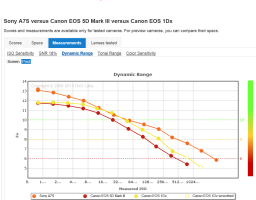
This statement is not correct.
Sony A7S has better DR across all ISO range than any Canon Camera.
At ISO25600 A7S has dynamic range which is equal to Canon 5DM3 at ISO 6400.
I am using A7S more often then 1DX now because of A7S better low light capabilities and cleaner images at high IS0. At low ISO it also has better DR.
Please see attached graph.
Regards.
 

Attachments

  • 1DX vs A7S vs 5DM3 ISO DR.PNG
    1DX vs A7S vs 5DM3 ISO DR.PNG
    72.7 KB · Views: 141
Upvote 0
StudentOfLight said:
I stand under correction, but as far as I know Quantum Effieciency is how many incident photons are converted to an electron by the sensor. A QE of 476% means that when one photon hits the sensor then on average it liberates about 5 electrons. I'm not a physicist but that I think that's impossible.
It might seem to be impossible but this fact this is possible.
And I think this could be found in some specialized applications.
Trick here is using special electrons multiplication circuit.
One photon is converted to one electron but then this electron is casing emission of several more electrons in this electrons multiplication circuit. This is different process then analog amplification. Kind of nuclear reaction but using electrons. And multiplication coefficient could be adjusted.
I remember I've seen some patent for that somewhere some time ago.
 
Upvote 0
Neutral said:
StudentOfLight said:
I stand under correction, but as far as I know Quantum Effieciency is how many incident photons are converted to an electron by the sensor. A QE of 476% means that when one photon hits the sensor then on average it liberates about 5 electrons. I'm not a physicist but that I think that's impossible.
It might seem to be impossible but this fact this is possible.
And I think this could be found in some specialized applications.
Trick here is using special electrons multiplication circuit.
One photon is converted to one electron but then this electron is casing emission of several more electrons in this electrons multiplication circuit. This is different process then analog amplification. Kind of nuclear reaction but using electrons. And multiplication coefficient could be adjusted.
I remember I've seen some patent for that somewhere some time ago.
http://www.sensorgen.info/NikonD2X.html

Here is the D2X, where QE of 476% is claimed... I will let you make you own conclusions on the validity of the the data.
 
Upvote 0