
CarlTN said:I agree, for macro photography, a crop sensor has the edge. Unless of course, you're a fan of focus stacking 10 or more images...which I'm not. A full frame sensor necessarily requires more focus stacking, unless you want your macro images with shallow depth of field...in which case either FF or crop are ok for that. I don't profess to be a macro expert, though...but I do know that a macro image I shot with an effective 270mm focal length at f/20 on a crop camera, would have needed to be at f/45 or smaller on a full frame sensor, and would have provided 1.6x less magnification to boot.
I'm not a macro expert here; but I think you're mistaken here.
I may be interpreting things incorrectly, or have the math wrong - apologies in advance if this is the case

My understanding is that for macro photography the DoF calculation is different and the lens focal length does not play a factor - only the aperture, sensor circle of confusion and image magnification are important.
See http://en.wikipedia.org/wiki/Depth_of_field (Close Up section).
By image magnification I mean the size of the object being photographed on the sensor compared to it's size in real life. So for 1:1 magnification a 1cm square object will occupy 1cm square on the sensor regardless of the camera sensor size.
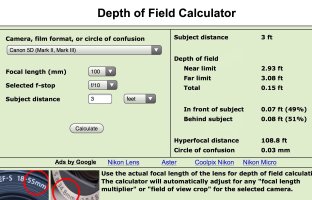
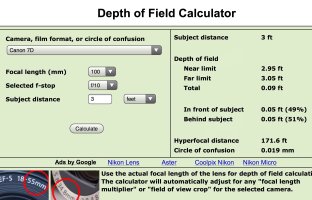
The circle of confusion on the FF camera is 0.029mm and on the APS-C camera it is 0.018mm.
http://en.wikipedia.org/wiki/Circle_of_confusion
If magnification and aperture are the same then the FF sensor has a DoF that is 1.6 times larger than the APS-C camera (0.029 / 0.018).
Obviously the two cameras are capturing different images. At 1:1 magnification the FF camera is capturing a 36mm x 24mm area of the subject, while the APS-C only captures a 14.8mm x 22.2mm area of the subject.
You could get similar DoF on the APS-C camera by decreasing aperture by 1 1/3 stops, which would require a corresponding increase of ISO or shutter speed to compensate the exposure.
I would guess that most macro photographers want to maximise the size of their subject on the sensor to get the best image possible
In order to capture the same subject size relative to the sensor size we need to change the magnification for one of the cameras. For example if the subject fills the APS-C frame at 1:1 then we need to shoot at 1.6:1 on the FF camera in order to expand the subject to fill the frame. Conversely if the subject fills the FF sensor we need to reduce magnification to 1:1.6 on the APS-C camera in order to capture the whole subject without cutting off any parts.
Increasing the magnification on the FF camera to 1.6:1 will roughly halve its DoF.
Decreasing the magnification on the APS-C camera to 1:1.6 will roughly double its DoF.
In both cases the APS-C camera will now have more DoF than the FF camera by a factor of approximately 1.25.
Of course we can now decrease the aperture on the FF camera by 1 stop and it will again have slightly greater DoF than the APS-C camera.
In summary:
- At the same magnification the FF camera has 1.6 times more DoF than the APS-C camera
- If the subject fills the same percentage of the sensor then the APS-C has the DoF advantage by a factor of 1.25. A 1 stop decrease in aperture gives the advantage back to the FF camera.
Phil.
Upvote
0


 the issue at hand is:


