
Skulker said:The issue of a cropped 2.8 and equivalence to 4.2 FF is sure to get some folks wound up and may well produce some long posts. ;D
Certainly

A FF lens being used with an APS-C sensor results in a slower system, lens+sensor. Since the APS-C sensor only captures 40% of the light projected by the lens on the image plane, the combination is slower than if the same lens had been used with a FF sensor. The lens is of course the same and doesn't know what sensor you place behind. But a lens on its own will not produce any pictures. You need a sensor as well. Really, I cannot see the controversy.
My view would be that with any lens designed to be used on a crop sensor, most of the photons entering the lens will hit the sensor, subject of course to the rectangular sensor reading a round lens. In contrast only 40% of the photons that would have hit the sensor on a full frame body will be used in a crop body (assuming a 1.6 crop) with a FF lens.
I'm getting more convinced that long lenses specifically designed for crop bodies would have a weight benefit. I still can't see Canon or Nikon making them. But maybe someone like Sigma might just do it to give themselves a USP.
What you are describing is called a speed booster, and it is available today for mirror less cameras.
http://www.metabones.com/buy-speed-booster
If, as you suggest above, you take, say, a 300 mm f/4 lens and project the otherwise wasted FF-photons onto the smaller APS-C sensor, the smaller sensor would still record the same FOV and the same amount of light as the FF sensor. This is because the aperture still has the same absolute size 300/4=75 mm.
However, by doing this you also decrease the focal length of the lens by a factor 1.6. So, while the absolute size of the aperture stays constant, its relative size increases to about f/2.5.
So, there you have it. The same FOV and the same amount of light captured by APS-C and FF. But, you have to decrease the FL with the crop sensor and keep the absolute aperture the same. This of course increases the relative size of the aperture. Hence the f/4 on FF is equivalent to f/2.5 on APS-C.
Unfortunately, if you want to capture a certain amount of light from a distant object the optics need to be of a certain size. You cannot fool the laws of physics just by cropping the sensor. Otherwise, why would e.g. the astronomers keep building larger and larger telescopes if they could just achieve the same thing by cropping their imaging sensors.
This is why its rather pointless to design APS-C only tele lenses. For WA lenses on the other hand its a different story as you can position the lens elements closer to the sensor due to the smaller mirror. Or lack of a mirror.
Upvote
0


 You know what I mean. Lets call it a "spot", if you want to get that technical.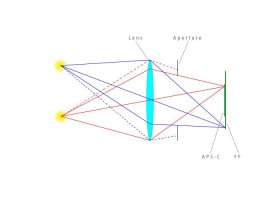
 )
)


