
You are using an out of date browser. It may not display this or other websites correctly.
You should upgrade or use an alternative browser.
You should upgrade or use an alternative browser.
Deep Sky Astrophotography
- Thread starter jrista
- Start date

Just saw the updated Pillars of Creation in the Eagle Nebula taken by the Hubble. It make me appreciate the work you guys do even more.

Upvote
0
Yeah What I see jrista do with a photo editor is amazing. I've been trying to tease out my stack of 30 taken of Comet Lovejoy and it turns to mush every time I try to tease out the detail.
A single shot from the stack looks better than the stack.
It's obviously an art itself.
A single shot from the stack looks better than the stack.
It's obviously an art itself.
Upvote
0

Nice comet, East Wind! I haven't had the opportunity to image that yet (weather :'().
How are you stacking? There are some specific techniques to stack the comet separate from the stars, stack the stars separate from the comet, then combine the two. DSS can actually do it for you, it's decent. PixInsight has comet stacking capabilities as well...more manual, more complex, but the results can be amazing.
I would download DSS (DeepSkyStacker, free) and try that first.
@dcm: Hubble stuff puts most ground-based astrophotographer's work to shame. Having no atmosphere to contend with is a HUGE bonus for Hubble...it can resolve an incredible amount of detail. Seeing is the bane of all earth-bound imagers, although with cameras like the A7s, which is so incredibly sensitive, we may be able to employ lucky imaging techniques to solve that problem within the next few years. Lucky imaging (high speed imaging, allowing you to take tens of thousands to hundreds of thousands of frames, then discard any that aren't near-perfect, integrating only the best ones), combined with adaptive/active optics, is how the new Thirty-meter and Forty-meter telescopes from ESO will resolve more detail than Hubble (by a lot.) There are some adaptive optics options for ground-based imagers...their effectiveness has never been fully verified...but combined with lucky imaging, ground-based imagers with 16-32" scopes could produce some amazing results, for sure.
How are you stacking? There are some specific techniques to stack the comet separate from the stars, stack the stars separate from the comet, then combine the two. DSS can actually do it for you, it's decent. PixInsight has comet stacking capabilities as well...more manual, more complex, but the results can be amazing.
I would download DSS (DeepSkyStacker, free) and try that first.
@dcm: Hubble stuff puts most ground-based astrophotographer's work to shame. Having no atmosphere to contend with is a HUGE bonus for Hubble...it can resolve an incredible amount of detail. Seeing is the bane of all earth-bound imagers, although with cameras like the A7s, which is so incredibly sensitive, we may be able to employ lucky imaging techniques to solve that problem within the next few years. Lucky imaging (high speed imaging, allowing you to take tens of thousands to hundreds of thousands of frames, then discard any that aren't near-perfect, integrating only the best ones), combined with adaptive/active optics, is how the new Thirty-meter and Forty-meter telescopes from ESO will resolve more detail than Hubble (by a lot.) There are some adaptive optics options for ground-based imagers...their effectiveness has never been fully verified...but combined with lucky imaging, ground-based imagers with 16-32" scopes could produce some amazing results, for sure.
Upvote
0
jrista said:Nice comet, East Wind! I haven't had the opportunity to image that yet (weather :'().
How are you stacking? There are some specific techniques to stack the comet separate from the stars, stack the stars separate from the comet, then combine the two. DSS can actually do it for you, it's decent. PixInsight has comet stacking capabilities as well...more manual, more complex, but the results can be amazing.
I would download DSS (DeepSkyStacker, free) and try that first.
@dcm: Hubble stuff puts most ground-based astrophotographer's work to shame. Having no atmosphere to contend with is a HUGE bonus for Hubble...it can resolve an incredible amount of detail. Seeing is the bane of all earth-bound imagers, although with cameras like the A7s, which is so incredibly sensitive, we may be able to employ lucky imaging techniques to solve that problem within the next few years. Lucky imaging (high speed imaging, allowing you to take tens of thousands to hundreds of thousands of frames, then discard any that aren't near-perfect, integrating only the best ones), combined with adaptive/active optics, is how the new Thirty-meter and Forty-meter telescopes from ESO will resolve more detail than Hubble (by a lot.) There are some adaptive optics options for ground-based imagers...their effectiveness has never been fully verified...but combined with lucky imaging, ground-based imagers with 16-32" scopes could produce some amazing results, for sure.
Yeah I have been working with DSS. Got a nice stack. background is bright due to the moon that night. The issue is in processing using photoshop and trying to stretch the tail out of the background. When I get done with the editing it looks like about 8 shades of grey and I give up to try again another time. I'm certainly obviously missing something.
Upvote
0
East Wind Photography said:jrista said:Nice comet, East Wind! I haven't had the opportunity to image that yet (weather :'( ).
How are you stacking? There are some specific techniques to stack the comet separate from the stars, stack the stars separate from the comet, then combine the two. DSS can actually do it for you, it's decent. PixInsight has comet stacking capabilities as well...more manual, more complex, but the results can be amazing.
I would download DSS (DeepSkyStacker, free) and try that first.
@dcm: Hubble stuff puts most ground-based astrophotographer's work to shame. Having no atmosphere to contend with is a HUGE bonus for Hubble...it can resolve an incredible amount of detail. Seeing is the bane of all earth-bound imagers, although with cameras like the A7s, which is so incredibly sensitive, we may be able to employ lucky imaging techniques to solve that problem within the next few years. Lucky imaging (high speed imaging, allowing you to take tens of thousands to hundreds of thousands of frames, then discard any that aren't near-perfect, integrating only the best ones), combined with adaptive/active optics, is how the new Thirty-meter and Forty-meter telescopes from ESO will resolve more detail than Hubble (by a lot.) There are some adaptive optics options for ground-based imagers...their effectiveness has never been fully verified...but combined with lucky imaging, ground-based imagers with 16-32" scopes could produce some amazing results, for sure.
Yeah I have been working with DSS. Got a nice stack. background is bright due to the moon that night. The issue is in processing using photoshop and trying to stretch the tail out of the background. When I get done with the editing it looks like about 8 shades of grey and I give up to try again another time. I'm certainly obviously missing something.
You want me to give processing the data a try?
Upvote
0
I also picked up a used 52mm drop in gelatin filter holder for 69 bucks. Condition was too good so paid a bit of a premium. I'll toss the glass and insert my new filter. Best deals are finding one with a scratch or crack in the glass. 
I had been wanting to pick up a lumicon comet filter for a while to pull out the C2 lines whenever they may show up. Was able to get it for 25% off. Aside from that it seems to be very good in the OxIII range 98% transmission so maybe some hope there for other things.
I had been wanting to pick up a lumicon comet filter for a while to pull out the C2 lines whenever they may show up. Was able to get it for 25% off. Aside from that it seems to be very good in the OxIII range 98% transmission so maybe some hope there for other things.
Upvote
0
jrista said:East Wind Photography said:jrista said:Nice comet, East Wind! I haven't had the opportunity to image that yet (weather :'( ).
How are you stacking? There are some specific techniques to stack the comet separate from the stars, stack the stars separate from the comet, then combine the two. DSS can actually do it for you, it's decent. PixInsight has comet stacking capabilities as well...more manual, more complex, but the results can be amazing.
I would download DSS (DeepSkyStacker, free) and try that first.
@dcm: Hubble stuff puts most ground-based astrophotographer's work to shame. Having no atmosphere to contend with is a HUGE bonus for Hubble...it can resolve an incredible amount of detail. Seeing is the bane of all earth-bound imagers, although with cameras like the A7s, which is so incredibly sensitive, we may be able to employ lucky imaging techniques to solve that problem within the next few years. Lucky imaging (high speed imaging, allowing you to take tens of thousands to hundreds of thousands of frames, then discard any that aren't near-perfect, integrating only the best ones), combined with adaptive/active optics, is how the new Thirty-meter and Forty-meter telescopes from ESO will resolve more detail than Hubble (by a lot.) There are some adaptive optics options for ground-based imagers...their effectiveness has never been fully verified...but combined with lucky imaging, ground-based imagers with 16-32" scopes could produce some amazing results, for sure.
Yeah I have been working with DSS. Got a nice stack. background is bright due to the moon that night. The issue is in processing using photoshop and trying to stretch the tail out of the background. When I get done with the editing it looks like about 8 shades of grey and I give up to try again another time. I'm certainly obviously missing something.
You want me to give processing the data a try?
Its a lot of data. need to figure out where to stash it for you. The TIFFs from DSS about about 236MB each.
Upvote
0
East Wind Photography said:jrista said:East Wind Photography said:jrista said:Nice comet, East Wind! I haven't had the opportunity to image that yet (weather :'( ).
How are you stacking? There are some specific techniques to stack the comet separate from the stars, stack the stars separate from the comet, then combine the two. DSS can actually do it for you, it's decent. PixInsight has comet stacking capabilities as well...more manual, more complex, but the results can be amazing.
I would download DSS (DeepSkyStacker, free) and try that first.
@dcm: Hubble stuff puts most ground-based astrophotographer's work to shame. Having no atmosphere to contend with is a HUGE bonus for Hubble...it can resolve an incredible amount of detail. Seeing is the bane of all earth-bound imagers, although with cameras like the A7s, which is so incredibly sensitive, we may be able to employ lucky imaging techniques to solve that problem within the next few years. Lucky imaging (high speed imaging, allowing you to take tens of thousands to hundreds of thousands of frames, then discard any that aren't near-perfect, integrating only the best ones), combined with adaptive/active optics, is how the new Thirty-meter and Forty-meter telescopes from ESO will resolve more detail than Hubble (by a lot.) There are some adaptive optics options for ground-based imagers...their effectiveness has never been fully verified...but combined with lucky imaging, ground-based imagers with 16-32" scopes could produce some amazing results, for sure.
Yeah I have been working with DSS. Got a nice stack. background is bright due to the moon that night. The issue is in processing using photoshop and trying to stretch the tail out of the background. When I get done with the editing it looks like about 8 shades of grey and I give up to try again another time. I'm certainly obviously missing something.
You want me to give processing the data a try?
Its a lot of data. need to figure out where to stash it for you. The TIFFs from DSS about about 236MB each.
How many files are you getting from DSS? If you use comet stacking, you should have just one...
DSS may not be saving the TIFF compressed, either. And, for best results, if you are saving TIFF, you probably just want to save it as 16-bit integer. I'd reintegrate and save to 16-bit TIFF, then open in PS, save it out again, and choose ZIP compression. That should reduce the file size.
I only need one integration, whichever one is best.
I also have support for FITS editing, and 32-bit FITS files are usually much better. I can load that into PixInsight. Either way, I still only need just one.
Upvote
0
jrista said:East Wind Photography said:jrista said:East Wind Photography said:jrista said:Nice comet, East Wind! I haven't had the opportunity to image that yet (weather :'( ).
How are you stacking? There are some specific techniques to stack the comet separate from the stars, stack the stars separate from the comet, then combine the two. DSS can actually do it for you, it's decent. PixInsight has comet stacking capabilities as well...more manual, more complex, but the results can be amazing.
I would download DSS (DeepSkyStacker, free) and try that first.
@dcm: Hubble stuff puts most ground-based astrophotographer's work to shame. Having no atmosphere to contend with is a HUGE bonus for Hubble...it can resolve an incredible amount of detail. Seeing is the bane of all earth-bound imagers, although with cameras like the A7s, which is so incredibly sensitive, we may be able to employ lucky imaging techniques to solve that problem within the next few years. Lucky imaging (high speed imaging, allowing you to take tens of thousands to hundreds of thousands of frames, then discard any that aren't near-perfect, integrating only the best ones), combined with adaptive/active optics, is how the new Thirty-meter and Forty-meter telescopes from ESO will resolve more detail than Hubble (by a lot.) There are some adaptive optics options for ground-based imagers...their effectiveness has never been fully verified...but combined with lucky imaging, ground-based imagers with 16-32" scopes could produce some amazing results, for sure.
Yeah I have been working with DSS. Got a nice stack. background is bright due to the moon that night. The issue is in processing using photoshop and trying to stretch the tail out of the background. When I get done with the editing it looks like about 8 shades of grey and I give up to try again another time. I'm certainly obviously missing something.
You want me to give processing the data a try?
Its a lot of data. need to figure out where to stash it for you. The TIFFs from DSS about about 236MB each.
How many files are you getting from DSS? If you use comet stacking, you should have just one...
Yeah after stacking it's 236MB. I have a couple of different stacks. One without a filter, one with a deep sky filter, and a 3rd taken the day prior but I only have maybe 12 subs but it has less moon. Got started too late.
Is it possible to attach large files to CR messages?
Upvote
0
Dropbox, Microsoft OneDrive, Box, etc. Tons of free online space. Gigs of it. I use OneDrive myself (I can just drag and drop into my OneDrive area in Windows, and it automatically syncs to the cloud drive.)
Upvote
0
Jon I have a question. I've seen some references of using lens profile correction and aberration correction prior to stacking. Does DSS read DPP or ACR sidecar files? I got to thinking about that and didn't see how that might work if we were using CR2 files as subs and not JPG. Any insight there?
I think I discovered where I was going wrong on the editing. My display adapter was not set up optimally and therefore my visual representation was being crippled. Never noticed it before but never had to stretch something as severe as this. Will give it another try tonight.
I think I discovered where I was going wrong on the editing. My display adapter was not set up optimally and therefore my visual representation was being crippled. Never noticed it before but never had to stretch something as severe as this. Will give it another try tonight.
Upvote
0
Most of the references to lens profile correction are done in-camera. For example, Roger Clark uses the built-in camera dark subtraction and lens corrections to avoid having to calibrate his subs. That is effective, to a degree. It does not produce the best results. In-camera processing power is limited, so the algorithms are lower precision. In-camera processing isn't going to use the more advanced algorithms we have today to optimally calibrate your light frames either. Plus, single-frame dark subtraction can fix hot pixels, but it tends to increase random noise.
I still recommend generating and using a proper flat, and either dithering or using a proper master dark, for calibration. None of the astro integration tools support lens profiles or anything like that. So if you didn't take the frames with in-camera calibration on, then you can't do it after the fact.
I still recommend generating and using a proper flat, and either dithering or using a proper master dark, for calibration. None of the astro integration tools support lens profiles or anything like that. So if you didn't take the frames with in-camera calibration on, then you can't do it after the fact.
Upvote
0
jrista said:Most of the references to lens profile correction are done in-camera. For example, Roger Clark uses the built-in camera dark subtraction and lens corrections to avoid having to calibrate his subs. That is effective, to a degree. It does not produce the best results. In-camera processing power is limited, so the algorithms are lower precision. In-camera processing isn't going to use the more advanced algorithms we have today to optimally calibrate your light frames either. Plus, single-frame dark subtraction can fix hot pixels, but it tends to increase random noise.
I still recommend generating and using a proper flat, and either dithering or using a proper master dark, for calibration. None of the astro integration tools support lens profiles or anything like that. So if you didn't take the frames with in-camera calibration on, then you can't do it after the fact.
I thought the in camera lens correction was only applied to jpg. So you are saying it applies to RAW as well?
Upvote
0
I don't know if it applies to RAW or not. All I know is that's what Roger Clark uses, so maybe he stacks JPEGs. Regardless, in camera, or with ACR/LR, it is not the best way to go about correcting your field, not for astrophotography. It may be simple, but it is going to diminish the quality of your results.
Generate and use a proper master bias, master dark, and master flat for the most precise results. To really get the best results possible, use PixInsight to do everything...calibrate, register, integrate, and process.
Generate and use a proper master bias, master dark, and master flat for the most precise results. To really get the best results possible, use PixInsight to do everything...calibrate, register, integrate, and process.
Upvote
0
So my stacks are coming out better. However I believe I possibly overexposed too much with the moon interfering. After I stack the tail gets lost more into the background. As if the stacking is also increasing the background glow. I used a stack of 6 from the day before and got a good tail but the noise is bad.
Trying to get a stack of 30 Going now...but not sure of the moon glow.
Trying to get a stack of 30 Going now...but not sure of the moon glow.
Upvote
0
Stacking is increasing both read and photon shot noise:
TotalSNR = S/N = (S * n)/SQRT(n * (S + R^2))
If you are imaging under light polluted skies, then the light pollution is added into the signal:
TotalS = ObjS + SkyFogS
So, yes, the background sky is going to increase in level, and it is going to increase in noise. That's not a huge deal, you simply offset to bypass the skyfog. Problem is, that eliminates the part of the signal from light pollution, but it leaves behind the added photon shot noise that additional part of the signal introduced into the total signal. You tend to get more photons from light pollution than from the object in or near the city. So for any given pixel at 1/3rd histogram (the recommended exposure level when using a DSLR), you might have, on average, 100 photons from skyfog and 10 from your object. Your background sky IS going to be fairly bright.
When processing, you can simply offset to reduce the background sky back to an acceptable level. That is easily done with the Levels tool in Photoshop. After stretching, you will have a lot of noise to contend with. You can either use more subs to solve that problem, or simply use more advanced noise reduction tools (PixInsight is packed with them), and get extremely skilled at using them.
Once you offset for skyfog, the tail should still stand out. You can use a more aggressive stretch to bring it out more, but again, that is going to reveal more noise. The best solution for that is to shoot at a dark site. See my previous answer about imaging with light pollution for the reasons why.
I can still give processing a try. I can figure out how to bring out the image details, and share my steps with you.
TotalSNR = S/N = (S * n)/SQRT(n * (S + R^2))
If you are imaging under light polluted skies, then the light pollution is added into the signal:
TotalS = ObjS + SkyFogS
So, yes, the background sky is going to increase in level, and it is going to increase in noise. That's not a huge deal, you simply offset to bypass the skyfog. Problem is, that eliminates the part of the signal from light pollution, but it leaves behind the added photon shot noise that additional part of the signal introduced into the total signal. You tend to get more photons from light pollution than from the object in or near the city. So for any given pixel at 1/3rd histogram (the recommended exposure level when using a DSLR), you might have, on average, 100 photons from skyfog and 10 from your object. Your background sky IS going to be fairly bright.
When processing, you can simply offset to reduce the background sky back to an acceptable level. That is easily done with the Levels tool in Photoshop. After stretching, you will have a lot of noise to contend with. You can either use more subs to solve that problem, or simply use more advanced noise reduction tools (PixInsight is packed with them), and get extremely skilled at using them.
Once you offset for skyfog, the tail should still stand out. You can use a more aggressive stretch to bring it out more, but again, that is going to reveal more noise. The best solution for that is to shoot at a dark site. See my previous answer about imaging with light pollution for the reasons why.
I can still give processing a try. I can figure out how to bring out the image details, and share my steps with you.
Upvote
0
Comet Lovejoy C/2014 Q2
I don't get to do comets often. They aren't in the sky that much, and even when they are, they are often low to the horizon during sunrise. Terry Lovejoy, comet-finder extraordinaire, discovered another comet in August 2014. It finally drifted into the northern horizon skies on December 24th, and I've been wanting to get some comet photons ever since. Finally got a chance last night:
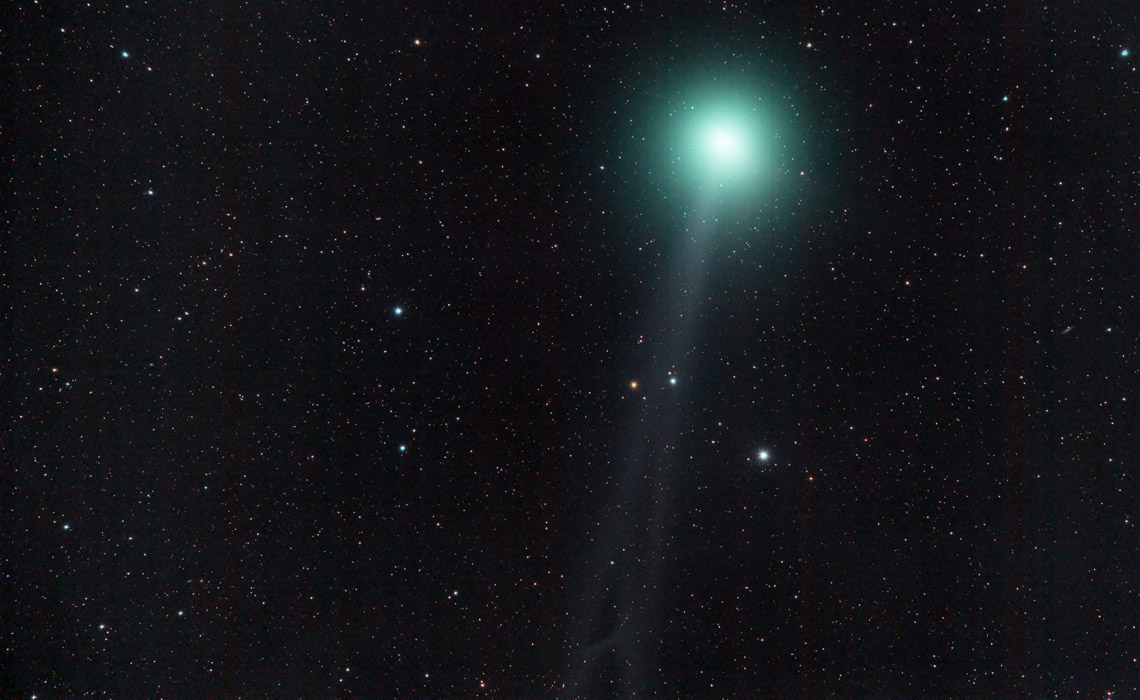
In my haste to get some data before the moon came up, I ended up underexposing my subs. That resulted in the heavy banding of the 5D III showing through. I managed to eliminate most of it, but some is still visible in the coma. This was my first tracked comet image, and I managed to get some detail on the tail, which I'm fairly happy about. Hoping I get another opportunity to image this again, and get some better data.
I don't get to do comets often. They aren't in the sky that much, and even when they are, they are often low to the horizon during sunrise. Terry Lovejoy, comet-finder extraordinaire, discovered another comet in August 2014. It finally drifted into the northern horizon skies on December 24th, and I've been wanting to get some comet photons ever since. Finally got a chance last night:
In my haste to get some data before the moon came up, I ended up underexposing my subs. That resulted in the heavy banding of the 5D III showing through. I managed to eliminate most of it, but some is still visible in the coma. This was my first tracked comet image, and I managed to get some detail on the tail, which I'm fairly happy about. Hoping I get another opportunity to image this again, and get some better data.
Upvote
0
jrista said:Comet Lovejoy C/2014 Q2
I don't get to do comets often. They aren't in the sky that much, and even when they are, they are often low to the horizon during sunrise. Terry Lovejoy, comet-finder extraordinaire, discovered another comet in August 2014. It finally drifted into the northern horizon skies on December 24th, and I've been wanting to get some comet photons ever since. Finally got a chance last night:
In my haste to get some data before the moon came up, I ended up underexposing my subs. That resulted in the heavy banding of the 5D III showing through. I managed to eliminate most of it, but some is still visible in the coma. This was my first tracked comet image, and I managed to get some detail on the tail, which I'm fairly happy about. Hoping I get another opportunity to image this again, and get some better data.
Really nice. And very nice you have dark skies! I'm going to try the 600 tonight but I'm not expecting much. What was your integration to get this?
Upvote
0
Similar threads
- Replies
- 206
- Views
- 184K