
You are using an out of date browser. It may not display this or other websites correctly.
You should upgrade or use an alternative browser.
You should upgrade or use an alternative browser.
Deep Sky Astrophotography
- Thread starter jrista
- Start date

East Wind Photography said:jrista said:Comet Lovejoy C/2014 Q2
I don't get to do comets often. They aren't in the sky that much, and even when they are, they are often low to the horizon during sunrise. Terry Lovejoy, comet-finder extraordinaire, discovered another comet in August 2014. It finally drifted into the northern horizon skies on December 24th, and I've been wanting to get some comet photons ever since. Finally got a chance last night:
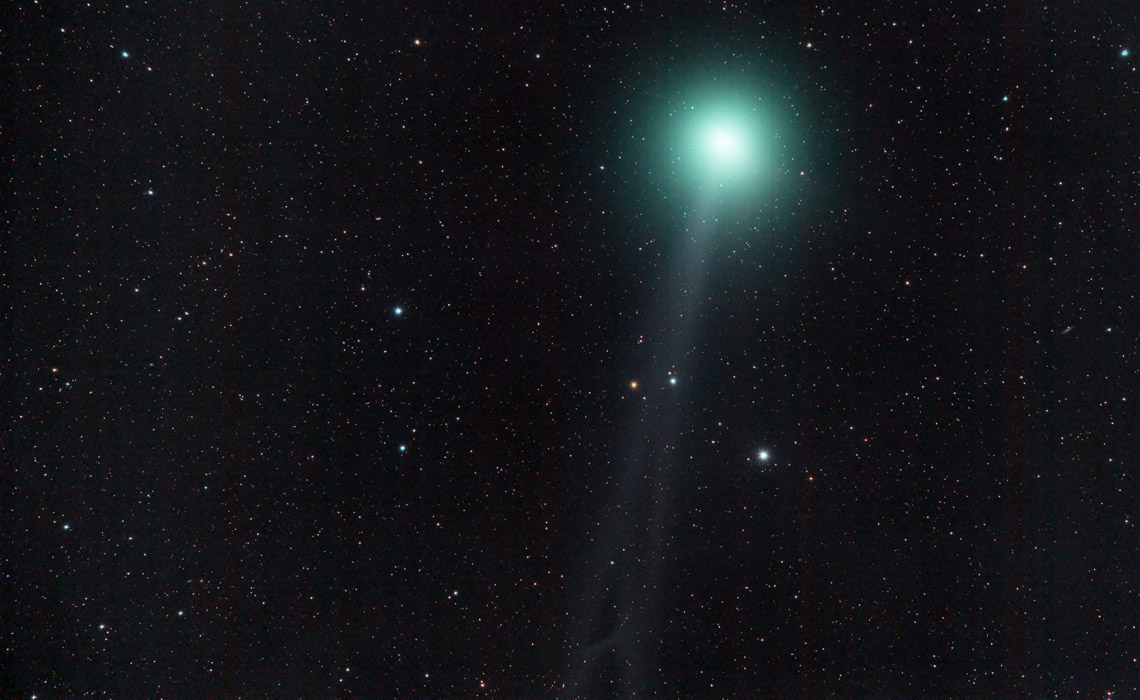
In my haste to get some data before the moon came up, I ended up underexposing my subs. That resulted in the heavy banding of the 5D III showing through. I managed to eliminate most of it, but some is still visible in the coma. This was my first tracked comet image, and I managed to get some detail on the tail, which I'm fairly happy about. Hoping I get another opportunity to image this again, and get some better data.
Really nice. And very nice you have dark skies! I'm going to try the 600 tonight but I'm not expecting much. What was your integration to get this?
This was a really short integration. I had some connectivity problems, so I went with 30x30s ISO 1600 subs. I tried to get 50x45s ISO 800 subs...not sure if they turned out (that data is still on my laptop.) I actually got about 8 to ten galaxies in the frame, at full size.

Upvote
0
Just brutal...110 subs of lovejoy tonight with the 600 and 5d3. Didn't realize it was 18 degrees F outside. Good news is that the sensor stayed at 19C the entire time.
I ended up using ISO 1600 and 20 sec shots at f 5.6. Running them now to see how many have a decent score.
This will be the last op for a while as a front is coming in tomorrow. Next window will be Friday or Saturday night.
I ended up using ISO 1600 and 20 sec shots at f 5.6. Running them now to see how many have a decent score.
This will be the last op for a while as a front is coming in tomorrow. Next window will be Friday or Saturday night.
Upvote
0
Nice one jristajrista said:Comet Lovejoy C/2014 Q2
I don't get to do comets often. They aren't in the sky that much, and even when they are, they are often low to the horizon during sunrise. Terry Lovejoy, comet-finder extraordinaire, discovered another comet in August 2014. It finally drifted into the northern horizon skies on December 24th, and I've been wanting to get some comet photons ever since. Finally got a chance last night:
In my haste to get some data before the moon came up, I ended up underexposing my subs. That resulted in the heavy banding of the 5D III showing through. I managed to eliminate most of it, but some is still visible in the coma. This was my first tracked comet image, and I managed to get some detail on the tail, which I'm fairly happy about. Hoping I get another opportunity to image this again, and get some better data.

Upvote
0

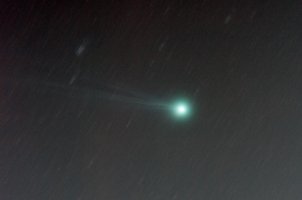
Here's my attempt of Lovejoy C/2014 Q2 last night. My Sigma 300 is lent out so I made do with a 150mm macro instead.
Equipment: Canon 7D2, ISO1600, Sigma 150mm f/2.8 macro at f/2.8, Astronomik CLS CCD filter, 161 x 30s exposures. Took more but rejected a load due to cloud. Tracking background stars unguided with lousy polar alignment.
Processing: Starting with PixInsight, flats, star align, comet align, stack, stretch, DBE (I messed up that order, should be done earlier), curves, photoshop.
Above is only the comet aligned stack. I've yet to do a star align stack.
I've tried to optimise viewing for the tail in this image. My local light pollution is rather rubbish.
Equipment: Canon 7D2, ISO1600, Sigma 150mm f/2.8 macro at f/2.8, Astronomik CLS CCD filter, 161 x 30s exposures. Took more but rejected a load due to cloud. Tracking background stars unguided with lousy polar alignment.
Processing: Starting with PixInsight, flats, star align, comet align, stack, stretch, DBE (I messed up that order, should be done earlier), curves, photoshop.
Above is only the comet aligned stack. I've yet to do a star align stack.
I've tried to optimise viewing for the tail in this image. My local light pollution is rather rubbish.
Attachments
Upvote
0
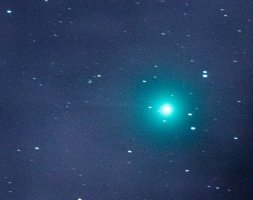
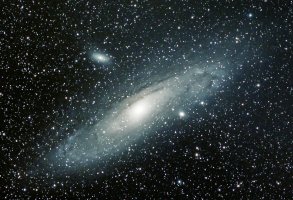
Went out to image the Pleiades last night (haven't processed yet), took a couple quick shots of Lovejoy through the trees planning to come out after dinner when it was briefly out of the trees to take some better ones, but it was back in the trees by the time I finished dinner. Including a couple other recent images I've taken.
Jrista, belated thanks for your response to my questions a couple weeks ago re DSS and raw files. I've been trying to make due with Photoshop and the free DSS, but maybe I should give PixInsight a try.
Lovejoy and M31 taken with a 70-300mm on a Canon 70D at 300 mm f/5.6 (Lovejoy heavily cropped). NA nebula taken with 100 mm macro at f/2.8. M31 and NA nebula stacked and flats, darks, and dark flats calibrated with DSS.
Jrista, belated thanks for your response to my questions a couple weeks ago re DSS and raw files. I've been trying to make due with Photoshop and the free DSS, but maybe I should give PixInsight a try.
Lovejoy and M31 taken with a 70-300mm on a Canon 70D at 300 mm f/5.6 (Lovejoy heavily cropped). NA nebula taken with 100 mm macro at f/2.8. M31 and NA nebula stacked and flats, darks, and dark flats calibrated with DSS.
Attachments
Upvote
0
Pixinsight offers a 45 day trial version. I can't think of a better time to try it out and see if it helps. Though it may take 45 days just to learn how to use it.
Downside is in 45 days you have to cough up 230 euros!
Downside is in 45 days you have to cough up 230 euros!
Upvote
0
@lol: Very nice image! You got more tail structure than I did. One thing about imaging comets...they tend to spin, so the tails spin over rather short periods. You might actually get even sharper results by stacking fewer subs, since over the duration you imaged at, the tail was surely spinning (and thus, the relative motion would result in blur when stacked.) But very, very nice image!
@Mr Bean, excellent image for a single frame! For sure!
@gruhl28: Great images! I'm glad you managed to get something going on the astro front. It's a fun hobby. Regarding PixInsight...it is a very different kind of program. My recommendation is, get the trial when you are certain you have the time to take advantage of it. There IS a learning curve. You might want to master some other things first before you dive into PI...however once you DO dive into PI, it without question has some of the most powerful tools available for astrophotographers.
@Mr Bean, excellent image for a single frame! For sure!
@gruhl28: Great images! I'm glad you managed to get something going on the astro front. It's a fun hobby. Regarding PixInsight...it is a very different kind of program. My recommendation is, get the trial when you are certain you have the time to take advantage of it. There IS a learning curve. You might want to master some other things first before you dive into PI...however once you DO dive into PI, it without question has some of the most powerful tools available for astrophotographers.
Upvote
0
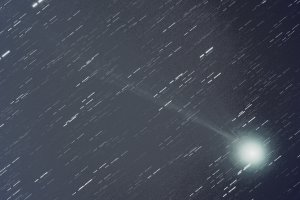
Seems that no matter what I do with DSS and the post in PS, this is the best I can get. By the time I work through the repetative curve process, the background ends up looking like 16 shades of grey. I know there is nice data here to be had but it's not coming out with the old school tools.
So I just submitted my trial license for pixinsight before I get too discouraged and give up.
So I just submitted my trial license for pixinsight before I get too discouraged and give up.
Attachments
Upvote
0
East Wind Photography said:Seems that no matter what I do with DSS and the post in PS, this is the best I can get. By the time I work through the repetative curve process, the background ends up looking like 16 shades of grey. I know there is nice data here to be had but it's not coming out with the old school tools.
So I just submitted my trial license for pixinsight before I get too discouraged and give up.
PixInsights calibration, registration, and integration tools are far better than DSS. The registration is far superior, and it includes a CometRegistration tool. I recommend following this:
http://harrysastroshed.com/pixinsight/pixinsight%20video%20files/2013%20pix%20vids/cometstack2/cometstack2.mp4
Upvote
0
jrista said:East Wind Photography said:Seems that no matter what I do with DSS and the post in PS, this is the best I can get. By the time I work through the repetative curve process, the background ends up looking like 16 shades of grey. I know there is nice data here to be had but it's not coming out with the old school tools.
So I just submitted my trial license for pixinsight before I get too discouraged and give up.
PixInsights calibration, registration, and integration tools are far better than DSS. The registration is far superior, and it includes a CometRegistration tool. I recommend following this:
http://harrysastroshed.com/pixinsight/pixinsight%20video%20files/2013%20pix%20vids/cometstack2/cometstack2.mp4
Good stuff. I'll be checking out likely all of their videos. Lol.
Today I have been experimenting with DSS settings and get varying results. They don't go into much detail on when some settings should be used or not...but I guess that's what you get for free.
Upvote
0
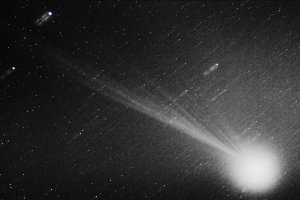
Yeah, I've been having a lot of problems with DSS comet stacking as well. I found a PDF recently that explained a specific imaging procedure. The guy was imaging with a mono CCD with color filters, so his sequencing was complex. The trick was to use 20-second gaps between frames to ensure that stars were fully separated from each other. That is the only way that DSS will be able to properly apply kappa sigma clipping to reject stars when it registers on the comet. Anything else, and you'll have problems.
I've been integrating with PixInsight, and have had largely the same problem as with DSS. I think the star-gap technique is the right way to image a comet. If I get another change, I'll be employing it.
I've been integrating with PixInsight, and have had largely the same problem as with DSS. I think the star-gap technique is the right way to image a comet. If I get another change, I'll be employing it.
Upvote
0
jrista said:Yeah, I've been having a lot of problems with DSS comet stacking as well. I found a PDF recently that explained a specific imaging procedure. The guy was imaging with a mono CCD with color filters, so his sequencing was complex. The trick was to use 20-second gaps between frames to ensure that stars were fully separated from each other. That is the only way that DSS will be able to properly apply kappa sigma clipping to reject stars when it registers on the comet. Anything else, and you'll have problems.
I've been integrating with PixInsight, and have had largely the same problem as with DSS. I think the star-gap technique is the right way to image a comet. If I get another change, I'll be employing it.
Ah interesting. Since I took 130x20sec subs, I can use every other one that passes a decent score and see how that works. That gives me a 21 second gap between subs. Surely I can get at least 40 subs still.
Upvote
0
East Wind Photography said:jrista said:Yeah, I've been having a lot of problems with DSS comet stacking as well. I found a PDF recently that explained a specific imaging procedure. The guy was imaging with a mono CCD with color filters, so his sequencing was complex. The trick was to use 20-second gaps between frames to ensure that stars were fully separated from each other. That is the only way that DSS will be able to properly apply kappa sigma clipping to reject stars when it registers on the comet. Anything else, and you'll have problems.
I've been integrating with PixInsight, and have had largely the same problem as with DSS. I think the star-gap technique is the right way to image a comet. If I get another change, I'll be employing it.
Ah interesting. Since I took 130x20sec subs, I can use every other one that passes a decent score and see how that works. That gives me a 21 second gap between subs. Surely I can get at least 40 subs still.
So one of the issues I a see with pixinsight comet integration is that it assumes all subs are taken without moving the field of view. That is you specify where the comet is on the first and last subs and it interpolates the position on every other sub. I guess you have to do a star align on every sub first to normalize the fov then do comet integration.
Upvote
0
East Wind Photography said:East Wind Photography said:jrista said:Yeah, I've been having a lot of problems with DSS comet stacking as well. I found a PDF recently that explained a specific imaging procedure. The guy was imaging with a mono CCD with color filters, so his sequencing was complex. The trick was to use 20-second gaps between frames to ensure that stars were fully separated from each other. That is the only way that DSS will be able to properly apply kappa sigma clipping to reject stars when it registers on the comet. Anything else, and you'll have problems.
I've been integrating with PixInsight, and have had largely the same problem as with DSS. I think the star-gap technique is the right way to image a comet. If I get another change, I'll be employing it.
Ah interesting. Since I took 130x20sec subs, I can use every other one that passes a decent score and see how that works. That gives me a 21 second gap between subs. Surely I can get at least 40 subs still.
So one of the issues I a see with pixinsight comet integration is that it assumes all subs are taken without moving the field of view. That is you specify where the comet is on the first and last subs and it interpolates the position on every other sub. I guess you have to do a star align on every sub first to normalize the fov then do comet integration.
Yes, generally that's how comet imaging works. Most things assume that (DSS does for it's default integration, where you only mark the comet in the first and last subs sorted by time index.) If you change the field between subs, then your on your own.

Upvote
0
jrista said:East Wind Photography said:East Wind Photography said:jrista said:Yeah, I've been having a lot of problems with DSS comet stacking as well. I found a PDF recently that explained a specific imaging procedure. The guy was imaging with a mono CCD with color filters, so his sequencing was complex. The trick was to use 20-second gaps between frames to ensure that stars were fully separated from each other. That is the only way that DSS will be able to properly apply kappa sigma clipping to reject stars when it registers on the comet. Anything else, and you'll have problems.
I've been integrating with PixInsight, and have had largely the same problem as with DSS. I think the star-gap technique is the right way to image a comet. If I get another change, I'll be employing it.
Ah interesting. Since I took 130x20sec subs, I can use every other one that passes a decent score and see how that works. That gives me a 21 second gap between subs. Surely I can get at least 40 subs still.
So one of the issues I a see with pixinsight comet integration is that it assumes all subs are taken without moving the field of view. That is you specify where the comet is on the first and last subs and it interpolates the position on every other sub. I guess you have to do a star align on every sub first to normalize the fov then do comet integration.
Yes, generally that's how comet imaging works. Most things assume that (DSS does for it's default integration, where you only mark the comet in the first and last subs sorted by time index.) If you change the field between subs, then your on your own.
Wow. PixInsight with 8 subs and no calibration already has done better than DSS and photoshop. Need a few more days of learning before I have something to post.
Upvote
0
Similar threads
- Replies
- 206
- Views
- 184K