Deep Sky Astrophotography

Don Haines said:
StudentOfLight said:
My first attempt at Orion with the 80D. Sometimes my exposure is slightly too long and there is a bit of trailing and stars become oval. In this case movement was from bottom right to top left. What is a good method to deconvolve?
First Attempt? NOT BAD!

So how did you do it and what software?
395-Light, 55-Dark, 69-Offset, 18-Flat
Stacked in DeepSkyStacker (2x drizzle)
Set DSS Output as 16-bit TIF
Imported into Lightroom 6
Created virtual copy, edited original as Bright-detail exposure and the other as Dark-detail exposure
Exported exposures as JPGs
Blended final image in GIMP

The shadows are a bit noisier than I'd prefer, but I did push the exposure 9 stops (in the bright exposure) in order to bring out some detail in the loop on top of Orion Nebula and the dust around Running Man.
 
Upvote 0
rpt said:
What do you guys set the white balance to?
During Capture I use something in the 3800-4200K range but since I'm shooting RAW don't think it really matters. In editing there is no silver bullet as light pollution varies from place to place: http://www.canonrumors.com/forum/index.php?topic=20392.msg623763#msg623763
 
Upvote 0
StudentOfLight said:
rpt said:
What do you guys set the white balance to?
During Capture I use something in the 3800-4200K range but since I'm shooting RAW don't think it really matters. In editing there is no silver bullet as light pollution varies from place to place: http://www.canonrumors.com/forum/index.php?topic=20392.msg623763#msg623763
Cool! Thanks.
 
Upvote 0
Keyhole Nebula in Carina: 214xLight 55xDark 69xBias 18xflat

Carina was still quite low to the horizon, so not ideal to shoot at the moment but light pollution and humidity were relatively low so I reckoned, what the heck, since I'm out here already give it 10minutes. The 80D shot with 2x drizzle is very similar in detail and clarity to what I got with the 6D with 3x drizzle. Interestingly my 6D shot of Carina used 43minutes of exposure while the 80D was about 9minutes. Goes to show how important dark sky is. Hopefully I can get good conditions in the next couple months when it is higher in the sky.

Keyhole Nebula in Carina
by Omesh Singh, on Flickr
 
Upvote 0
StudentOfLight said:
rpt said:
What do you guys set the white balance to?
During Capture I use something in the 3800-4200K range but since I'm shooting RAW don't think it really matters. In editing there is no silver bullet as light pollution varies from place to place: http://www.canonrumors.com/forum/index.php?topic=20392.msg623763#msg623763

I am very lucky as I am fairly close to Algonquin Park, Ontario, and it has very dark skies. I made three trips there this summer with camera, tripod, and motorized mount..... but unfortunately it was cloudy for one trip and rained the other two.... oh well, next year :)

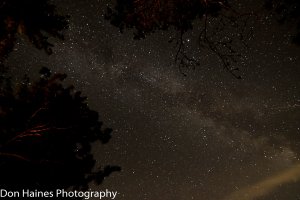
Another dark area in Eastern Ontario is Frontenac park. Unfortunately, my camping spot did not have a good view of the sky and the clouds came in shortly after sunset, but I did manage to wade out into the lake and get this snap of the Milky Way...
 

Attachments

  • D16A9220.jpg
    D16A9220.jpg
    873.1 KB · Views: 178
Upvote 0
My question is about filters.

My home is far enough out of town that the night sky is visible, but there is still some light pollution. Is there a filter (preferably 77mm) that I can use to help cope with the light pollution?
 
Upvote 0
Don Haines said:
My question is about filters.

My home is far enough out of town that the night sky is visible, but there is still some light pollution. Is there a filter (preferably 77mm) that I can use to help cope with the light pollution?

Any LP filtration will likely just diminish the quality of your results. There is always LP. In fact, airglow, natural light pollution from the ionizing layers of our atmosphere, imposes the upper limit on sky darkness at around 22-22.5mag/sq". Once you get out about half way into a yellow bortle zone or darker (you can look up maps for the scale), then LP filtration really hurts more than it helps, as it tends to decimate color fidelity.

If you are in an orange, red, or white zone, an IDAS LPS-D1 can help, although I don't think you'll ever find one in 77mm size. You might have to step down to a smaller one.
 
Upvote 0
jrista said:
Don Haines said:
My question is about filters.

My home is far enough out of town that the night sky is visible, but there is still some light pollution. Is there a filter (preferably 77mm) that I can use to help cope with the light pollution?

Any LP filtration will likely just diminish the quality of your results. There is always LP. In fact, airglow, natural light pollution from the ionizing layers of our atmosphere, imposes the upper limit on sky darkness at around 22-22.5mag/sq". Once you get out about half way into a yellow bortle zone or darker (you can look up maps for the scale), then LP filtration really hurts more than it helps, as it tends to decimate color fidelity.

If you are in an orange, red, or white zone, an IDAS LPS-D1 can help, although I don't think you'll ever find one in 77mm size. You might have to step down to a smaller one.
I'm in a light green area.... I guess that means just use the bare lens.... Thanks.
 
Upvote 0
StudentOfLight said:
My first attempt at Orion with the 80D. Sometimes my exposure is slightly too long and there is a bit of trailing and stars become oval. In this case movement was from bottom right to top left. What is a good method for deconvolution?

Nice first shot! No tracker? I have an 80D and a 70-200, but I was convinced I would have to use a tracker.

If you didn't use a tracker, I may have to consider my 80D + the Samyang 85mm 1.2 (when it becomes available, if coma is low, etc., etc.) for intermediate sky astro.
 
Upvote 0
chrysoberyl said:
StudentOfLight said:
My first attempt at Orion with the 80D. Sometimes my exposure is slightly too long and there is a bit of trailing and stars become oval. In this case movement was from bottom right to top left. What is a good method for deconvolution?

Nice first shot! No tracker? I have an 80D and a 70-200, but I was convinced I would have to use a tracker.

If you didn't use a tracker, I may have to consider my 80D + the Samyang 85mm 1.2 (when it becomes available, if coma is low, etc., etc.) for intermediate sky astro.
If you have a tracker then you don't have to shoot hundreds of exposures (so less wear and tear) and less processing time. Also when you track you will capture more faint details than possible with multiple short exposures. What happens with multiple short exposures is that the faint subjects will not supply enough light to raise them above the noise floor, so they will be averaged out in the stacking process. At least that is how I understand things.

If you can afford (or have the ingenuity and time to build) a tracking system then it will be incredibly beneficial.
 
Upvote 0
StudentOfLight said:
Keyhole Nebula in Carina: 214xLight 55xDark 69xBias 18xflat

Carina was still quite low to the horizon, so not ideal to shoot at the moment but light pollution and humidity were relatively low so I reckoned, what the heck, since I'm out here already give it 10minutes. The 80D shot with 2x drizzle is very similar in detail and clarity to what I got with the 6D with 3x drizzle. Interestingly my 6D shot of Carina used 43minutes of exposure while the 80D was about 9minutes. Goes to show how important dark sky is. Hopefully I can get good conditions in the next couple months when it is higher in the sky.

What's drizzle?
 
Upvote 0
chrysoberyl said:
StudentOfLight said:
Keyhole Nebula in Carina: 214xLight 55xDark 69xBias 18xflat

Carina was still quite low to the horizon, so not ideal to shoot at the moment but light pollution and humidity were relatively low so I reckoned, what the heck, since I'm out here already give it 10minutes. The 80D shot with 2x drizzle is very similar in detail and clarity to what I got with the 6D with 3x drizzle. Interestingly my 6D shot of Carina used 43minutes of exposure while the 80D was about 9minutes. Goes to show how important dark sky is. Hopefully I can get good conditions in the next couple months when it is higher in the sky.

What's drizzle?
It is a setting in DeepSkyStacker.

As I understand it, it scales up your subs by a factor before stacking them. So it will result in a higher resolution output file. DSS is a 32bit program so your computer the program can run out of memory and crash if you use drizzle without selecting a specific crop area.

In order to use drizzle you will need to select one of the exposures as a reference and apply a crop (otherwise DSS will crash because of running out of memory) The Drizzle option is either 2x or 3x drizzle. Depending on your stacking parameters it might temporarily require quite a bit of free hard drive space as well during the stacking process.

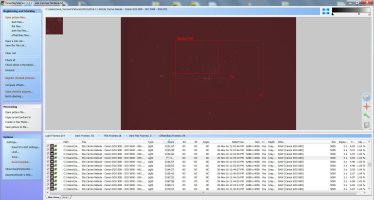
Here are a couple of screenshots from DSS:
 

Attachments

  • DSS-assign-Crop.jpg
    DSS-assign-Crop.jpg
    343.6 KB · Views: 171
  • DSS-drizzle.jpg
    DSS-drizzle.jpg
    403.8 KB · Views: 206
Upvote 0
Drizzle doesn't really scale the data up before stacking. Drizzle is a means by which you actually gain true resolution due to the way the information from all the subs is combined, assuming the data was undersampled and also properly dithered (dithering is critical for drizzling to work). It is a form of superresolution, which can potentially allow you to resolve information beyond the diffraction limit of the lens, and certainly beyond the limit of seeing.

The actual algorithm's mechanism is actually somewhat complex, so I won't go into it here. Suffice it to say, if you are undersampled (which is usually the case with the average DSLR pixel size and camera lenses or short refractors), you can get much cleaner data, rounder stars, smaller stars, and more detail if you drizzle. Also note that this is not only an option in DSS. It is an algorithm originally designed by for scientific purposes, and has been utilized by the Hubble team to increase resolution with some of the imager data from the Hubble telescope (although they tend to be significantly more precise in their dithering, down to the exact pixel level.)
 
Upvote 0
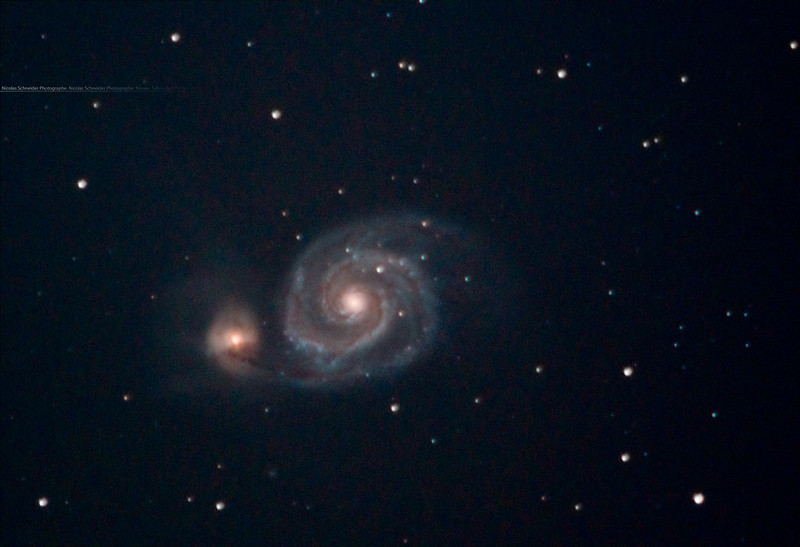
Nice work! M51 is a tough object...smallish, pretty distant.


Regarding drizzle, when you dither well and use enough frames, this is the kind of improvement you can get vs. a normal integration:

K0RMepn.gif
 
Upvote 0