DPReview: Canon Rebel T6s/T6i Lab Report added to First Impressions

Canon Rumors

Who Dey
Canon Rumors Premium
Jul 20, 2010
12,626
5,441
279,596
Canada
www.canonrumors.com
HTML:
DPReview has added lab reports to their first impressions for the brand new EOS Rebel T6s & EOS Rebel T6i.</p>
<p>Summary</p>
<blockquote><p>The new Rebels bring solid image quality improvements to the popular line. Increased resolution (24MP, up from 18MP) makes the T6s and T6i competitive against most APS-C offerings from competitors, and a weak anti-aliasing filter in both models offers the potential for sharp images. Low-light noise performance is also now competitive against peers: better than some offerings while only slightly behind class-leaders. Tie in these considerations with a well-performing JPEG engine that yields pleasing results, and you’ve got solid performers on the image quality front.</p></blockquote>
<p><strong><a href="http://www.dpreview.com/articles/2862951741/canon-rebel-t6s-t6i-lab-report-added-to-first-impressions" target="_blank">View the results at DPReview</a></strong></p>
<ul>
<li>Canon EOS Rebel T6i $749: <a href="http://adorama.evyy.net/c/60085/51926/1036?u=http://www.adorama.com/ICAT6I.html" target="_blank">Adorama</a> | <a href="http://www.bhphotovideo.com/c/product/1116100-REG/canon_0591c001_eos_rebel_t6i_dslr.html/bi/2466/kbid/3296" target="_blank">B&H Photo</a> | <a href="http://www.amazon.com/gp/product/B00T3ERFFW/ref=as_li_tl?ie=UTF8&camp=1789&creative=390957&creativeASIN=B00T3ERFFW&linkCode=as2&tag=canorumo-20&linkId=CT2FAZ2X7Y25YGNV" target="_blank">Amazon</a></li>
<li>Canon EOS Rebel T6i w/18-55 IS STM $899: <a href="http://adorama.evyy.net/c/60085/51926/1036?u=http://www.adorama.com/ICAT6IK1.html" target="_blank">Adorama</a> | <a href="http://www.bhphotovideo.com/c/product/1116103-REG/canon_0020c001_eos_rebel_t6s_dslr.html/bi/2466/kbid/3296" target="_blank">B&H Photo</a> | <a href="http://www.amazon.com/gp/product/B00T3ERFFW/ref=as_li_tl?ie=UTF8&camp=1789&creative=390957&creativeASIN=B00T3ERFFW&linkCode=as2&tag=canorumo-20&linkId=CT2FAZ2X7Y25YGNV" target="_blank">Amazon</a></li>
<li>Canon EOS Rebel T6i w/18-135 IS STM $1099: <a href="http://adorama.evyy.net/c/60085/51926/1036?u=http://www.adorama.com/ICAT6IK2.html" target="_blank">Adorama</a> | <a href="http://www.bhphotovideo.com/c/product/1116102-REG/canon_0591c005_eos_rebel_t6i_dslr.html/bi/2466/kbid/3296" target="_blank">B&H Photo</a> | <a href="http://www.amazon.com/gp/product/B00T3ERFFW/ref=as_li_tl?ie=UTF8&camp=1789&creative=390957&creativeASIN=B00T3ERFFW&linkCode=as2&tag=canorumo-20&linkId=CT2FAZ2X7Y25YGNV" target="_blank">Amazon</a></li>
<li>Canon EOS Rebel T6s $849: <a href="http://adorama.evyy.net/c/60085/51926/1036?u=http://www.adorama.com/ICAT6S.html" target="_blank">Adorama</a> | <a href="http://www.bhphotovideo.com/c/product/1116103-REG/canon_0020c001_eos_rebel_t6s_dslr.html/bi/2466/kbid/3296" target="_blank">B&H Photo</a> | <a href="http://www.amazon.com/gp/product/B00T3ERM4Q/ref=as_li_tl?ie=UTF8&camp=1789&creative=390957&creativeASIN=B00T3ERM4Q&linkCode=as2&tag=canorumo-20&linkId=WEOGU5PU54KOZVWA" target="_blank">Amazon</a></li>
<li>Canon EOS Rebel T6s w/18-135 IS STM $1149: <a href="http://adorama.evyy.net/c/60085/51926/1036?u=http://www.adorama.com/ICAT6SK.html" target="_blank">Adorama</a> | <a href="http://www.bhphotovideo.com/c/product/1116104-REG/canon_0020c003_eos_rebel_t6s_dslr.html/bi/2466/kbid/3296" target="_blank">B&H Photo</a> | <a href="http://www.amazon.com/gp/product/B00T3ERM4Q/ref=as_li_tl?ie=UTF8&camp=1789&creative=390957&creativeASIN=B00T3ERM4Q&linkCode=as2&tag=canorumo-20&linkId=WEOGU5PU54KOZVWA" target="_blank">Amazon</a></li>
</ul>
<p> </p>
 
I think we all know that the "tried and true" 18 MP sensor was getting pretty long in the tooth. It was good to see a noticeable improvement. Of course I am more curious how this new 24 MP compares to the 20 MP dual pixel sensor in the 70D, 7D2. In short, what's Canon's best crop sensor?

I didn't spend too much time, but looking at RAWs (don't care about jpeg engine) at ISO 6400, and focusing on the blacks, it did appear the 20 MP had a little less noise still? I'll have to dig more closely later.

In any case, it's good to finally start seeing some data/info on the new crop sensor.
 
Upvote 0
Luds34 said:
I think we all know that the "tried and true" 18 MP sensor was getting pretty long in the tooth. It was good to see a noticeable improvement. Of course I am more curious how this new 24 MP compares to the 20 MP dual pixel sensor in the 70D, 7D2. In short, what's Canon's best crop sensor?

I didn't spend too much time, but looking at RAWs (don't care about jpeg engine) at ISO 6400, and focusing on the blacks, it did appear the 20 MP had a little less noise still? I'll have to dig more closely later.

In any case, it's good to finally start seeing some data/info on the new crop sensor.


I'm also curious to see how the 760D/750D 24mp sensor compares to the 70D and 7Dmk2's 20mp dual pixel sensor. Not only in terms of image quality, but also in live view AF. The 760D is spec'ed and priced so closely to the 70D I bet consumers will find it hard to choose which one to buy (as for me, I'm researching to buy my kid brother his first DSLR).

As far as I can tell the 70D has advantages in:
- Video recording format (ALL-I & IPB)
- Continuous burst rate at 7fps vs 5fps
- Pentaprism viewfinder with 98% coverage & .95 magnification vs a pentamirror with 95% coverage & .82 magnification
- Dual Pixel Live View AF for both photo and video
- Uses same battery (LP-E6) found in 60D, 7Dmk1/mk2, 5Dmk2/mk3

760D/T6s Advantages:
- Lower MSRP, but the 70D is currently on sale for $250 less in the states
- Lighter & smaller 565 grams vs 755 grams
- Slightly higher res sensor 24mp vs 20mp


What appears to be a wash:
- Conventional 19 point all cross-type AF system since both use a similar system carried over from the 7Dmk1
- Image Quality at high ISO. Theoretically, the 760D should have more noise at the same ISOs because of the higher pixel density, but it does have a newer Digic 6 processor that may negate the issue for both RAW and JPG image capture.
- Build quality as both are primarily made of plastics instead of a complete magnesium alloy chassis
 
Upvote 0
According to reviews, high ISO performance (iso 6400) is very close to d5500 except rebels shows more details vs d5500. All the crop cameras seem to be very close to each other (rebels, 70d, 7d2, d5500, d7200, a5100 and a6000) in terms of low light performance. But rebels have lot more going on in terms of video and live view performance when compared to Nikon. d5500 doesn't allow manual controls during live view and no exposure simulation. Their video AF is still contrast based which is slower than rebels with hybrid sensor and stm lens. Rebels shoot at 5FPS which is same as Nikon best crop camera (d7200).
 
Upvote 0
whothafunk said:
ritholtz said:
Rebels shoot at 5FPS which is same as Nikon best crop camera (d7200).
Nikon D7100 and D7200 both shoot at 6FPS, 7FPS in crop mode.
D7000 shoots 6 FPS in 14bit 14-bit lossless RAW. Then Nikon downgraded d7100 and d7200 to 5 fps in 14-bit lossless RAW . Canon 70d shoots 7 fps and 7d2 in 10 fps without compromising bit quality.

Nikon wants every one to see and believe this:
Screen-Shot-2015-04-16-at-9.15.56-AM-960x648.png


They don't want you to see this:
Screen-Shot-2015-04-16-at-9.14.02-AM.png


I have pointed out this to dpreview. But they do not want to say negative things about Nikon. They do not want review old school contrast detecting focusing of d5500/d7200 in live view/ video AF. But they are happy to review this functionality for a6000 , rebels, 70d , 7d2 and all m4/3 cameras. According to them, they knew about this limitation with Nikon cameras. So no point in reviewing it. But one can wonder, what is the point of doing extensive exposure latitude and DR tests with Canon 70d and 7d2.

Canon (duel pixel and hybrid versions) and Sony (adding more phase detect pixels in each iteration) are improving their sensors in every iteration. Nikon is still stuck with their old sensors with old school on sensor focusing and keep recycling crop cameras.

Credit to photography life for pointing this. Shame on dpreview for not to publish/use accuate info in their review.
https://photographylife.com/dumbing-down-the-d7200-what-nikon-doesnt-get-about-wildlife-photography
 
Upvote 0
ritholtz:

Considering how all your points were addressed in the D7200 review, including listing the poor live view/movie AF and drop in dynamic range for 6 fps Raw explicitly in the Cons, as well as publishing a video that shows focus hunting in movies due to the lack of on-sensor phase-detect, I'm confused as to how we (DPReview) don't publish accurate info and 'do not want to say negative things about Nikon'.

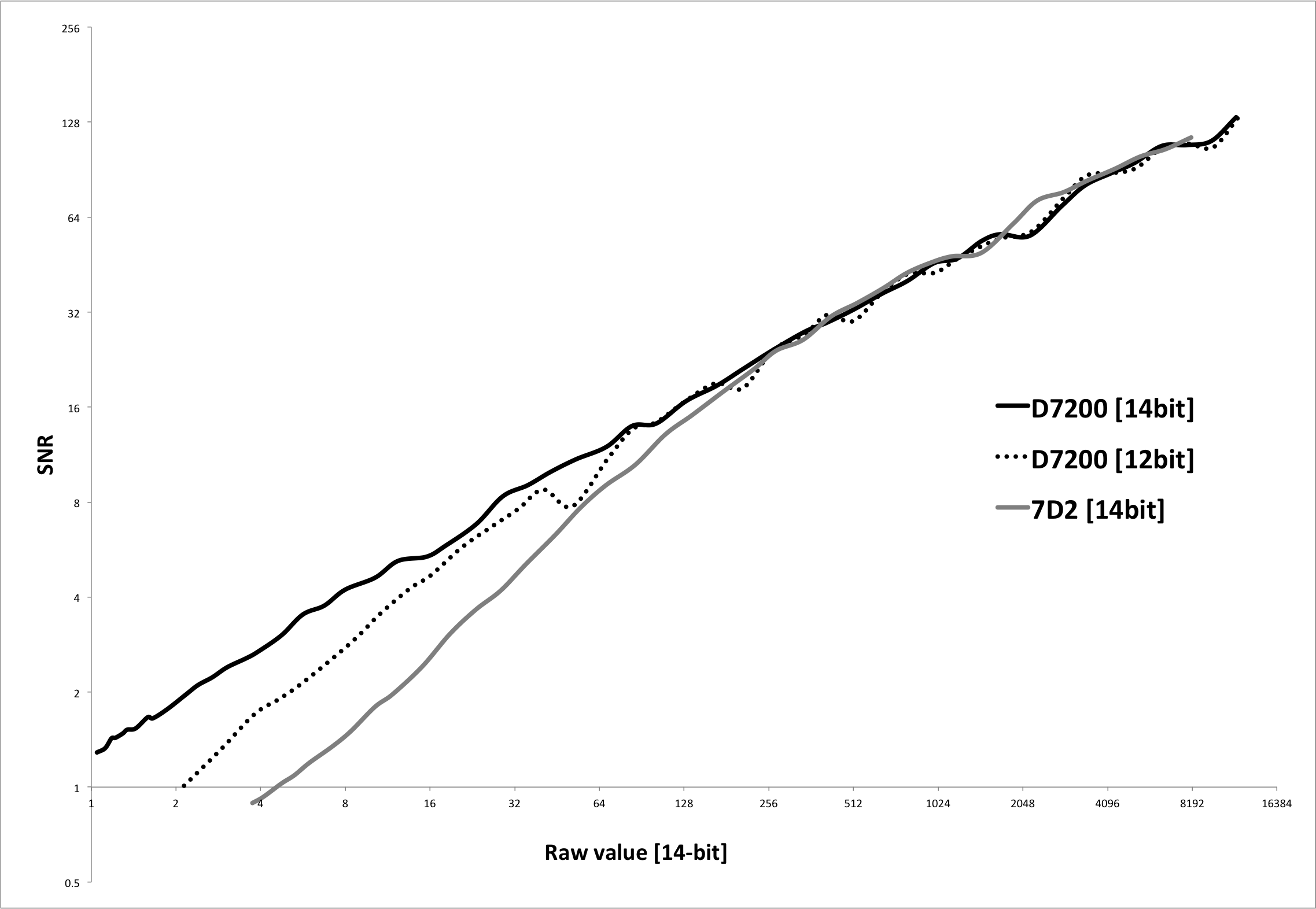
Furthermore, the decrease in dynamic range when using 12-bit is unfortunate, yes, but it is only that: a slight drop in DR relative to the class-leading DR the D7200 offers. Which still puts it well above many competitors. It's important to understand that this 12-bit mode doesn't affect any other tones but the lowest ones (hence why it only affects dynamic range), because of shot noise (http://bit.ly/shotnoise). In fact, even in 12-bit mode, the D7200 has higher SNR than the 7D Mark II at any and every tone, and has at least a whole stop more dynamic range still, using a SNR cutoff of 2, all of which you can see in our quantitative SNR analysis below:

D7200-14_vs_12bit_vs_7D2.png


So, to sum up, the D7200 has 6 fps in a mode that still yields higher DR (and equivalent or more 'tonality') than the 7D Mark II or the 70D to which it's often compared, and 7 fps in 1.3x crop mode, as someone already pointed out here.

It is therefore specious to suggest that the fact that the 70D and 7D2 shoot 'without compromising bit quality' has any relevance here, as they both still offer poorer DR and 'bit quality' than the D7200 in 12-bit mode. It takes folks some time to understand the real implications of 12 vs. 14-bit and where it matters, but that's why we have SNR analyses, as they put all speculation to bed.

All that said, is the D7200 still behind the 7D2 in shooting rate? Absolutely. By as much as you suggest? No. Do we have problems saying negative things about Nikon? I don't think so, considering our 'Con' list for the D7200 that covered all of your concerns, and countless other examples of us having no problem spelling it out like it is when it comes to where Nikon (or any) cameras suffer. For your reference, here was our Con list for the D7200:

Cons

  • No control of aperture in movie or live view modes
  • Lack of peripheral cross-type AF points
  • 6fps Raw only available in 12-bit, which sacrifices some dynamic range
  • No representation of exposure in live view
  • Movie autofocus is too fast and jumpy
  • Live view autofocus too awkward and slow to use in many applications
  • Wi-Fi app rather limited (and behavior inconsistent)
  • Secondary sensor AF less accurate than on-sensor focus systems
  • Camera is bulky when compared to mirrorless rivals

There are reasons the D7200 didn't get a Gold Award. There are reasons it scored only an 84%, the same as the 7D Mark II, despite being ranked in a class lower than the 7D Mark II.

Perhaps in the future, you could please not misrepresent our position. Finally, I need to point out that this SNR analysis was just concluded last night, and we'll be adding it to our D7200 review (in other words: we didn't purposefully leave it out).

Cheers,
Rishi
Deputy Editor / Technical Editor, dpreview.com
 
Upvote 0
Hi Rishi,
Thanks for your explanation and posting it here. This forum is going to learn a lot from your work and information. I posted here long time ago even before posting it on d7200 review. Your d7200 complete review is not available at that time. I forgot to edit back here. Sorry if I created any kind of wrong impression against dpr. I guess I wrote something here and there without understanding technical details. You have to excuse me.
That being said, if some one wants to get class leading DR (which is more than d750), they have to shoot in 5 FPS. Of course we can shoot in 6fps and match any Canon DR, but there are lot of other cameras to compare. I wish, manufactures/DPR follow some standard to publish FPS in spec sheet.

Basically Nikon did not do any improvement in terms of FPS compared to previous version. That is kinda sad. Old d7000 can do 6 fps even with 14bit mode. Any reason why Nikon not making any progress in this area and live view.

rishi_sanyal said:
ritholtz:

Considering how all your points were addressed in the D7200 review, including listing the poor live view/movie AF and drop in dynamic range for 6 fps Raw explicitly in the Cons, as well as publishing a video that shows focus hunting in movies due to the lack of on-sensor phase-detect, I'm confused as to how we (DPReview) don't publish accurate info and 'do not want to say negative things about Nikon'.

Furthermore, the decrease in dynamic range when using 12-bit is unfortunate, yes, but it is only that: a slight drop in DR relative to the class-leading DR the D7200 offers. Which still puts it well above many competitors. It's important to understand that this 12-bit mode doesn't affect any other tones but the lowest ones (hence why it only affects dynamic range), because of shot noise (http://bit.ly/shotnoise). In fact, even in 12-bit mode, the D7200 has higher SNR than the 7D Mark II at any and every tone, and has at least a whole stop more dynamic range still, using a SNR cutoff of 2, all of which you can see in our quantitative SNR analysis below:

D7200-14_vs_12bit_vs_7D2.png


So, to sum up, the D7200 has 6 fps in a mode that still yields higher DR (and equivalent or more 'tonality') than the 7D Mark II or the 70D to which it's often compared, and 7 fps in 1.3x crop mode, as someone already pointed out here.

It is therefore specious to suggest that the fact that the 70D and 7D2 shoot 'without compromising bit quality' has any relevance here, as they both still offer poorer DR and 'bit quality' than the D7200 in 12-bit mode. It takes folks some time to understand the real implications of 12 vs. 14-bit and where it matters, but that's why we have SNR analyses, as they put all speculation to bed.

All that said, is the D7200 still behind the 7D2 in shooting rate? Absolutely. By as much as you suggest? No. Do we have problems saying negative things about Nikon? I don't think so, considering our 'Con' list for the D7200 that covered all of your concerns, and countless other examples of us having no problem spelling it out like it is when it comes to where Nikon (or any) cameras suffer. For your reference, here was our Con list for the D7200:

Cons

  • No control of aperture in movie or live view modes
  • Lack of peripheral cross-type AF points
  • 6fps Raw only available in 12-bit, which sacrifices some dynamic range
  • No representation of exposure in live view
  • Movie autofocus is too fast and jumpy
  • Live view autofocus too awkward and slow to use in many applications
  • Wi-Fi app rather limited (and behavior inconsistent)
  • Secondary sensor AF less accurate than on-sensor focus systems
  • Camera is bulky when compared to mirrorless rivals

There are reasons the D7200 didn't get a Gold Award. There are reasons it scored only an 84%, the same as the 7D Mark II, despite being ranked in a class lower than the 7D Mark II.

Perhaps in the future, you could please not misrepresent our position. Finally, I need to point out that this SNR analysis was just concluded last night, and we'll be adding it to our D7200 review (in other words: we didn't purposefully leave it out).

Cheers,
Rishi
Deputy Editor / Technical Editor, dpreview.com
 
Upvote 0
No worries. Understood. Small correction: 12-bit on a D7200 still exceeds, rather than matches, the 7D Mark II dynamic range (evident from the SNR plots I included above).

Yes, it's unfortunate that there isn't a higher spec'd Nikon APS-C body. No, I don't know why - we specifically asked Nikon about this, and at least one good thing that came out of that was there clear respect for the 7D Mark II. They fully acknowledged it fulfilled a need in the market. They didn't rule out the possibility of answering, but one thing to keep in mind is that before the introduction of the 7D Mark II, the D7200 would've been competitive from a FPS standpoint. So credit where credit is due: Canon was forward thinking in this case - introducing an affordable high FPS body. But now with the 7D Mark II, the credible mirrorless options (although still with some downsides for certain types of photography, of course), I wouldn't be surprised if Nikon felt the need to respond. In my opinion, they should - to stay competitive in the sports arena, for example.

One thing I've wondered is whether or not there are technical challenges due the 3rd party sensor. Canon is more vertically integrated in this sense, since it doesn't rely as heavily on third-party sensors. But, then again, there's definitely a (or two) Sony sensor that does really high frame rates - so if those are for sale, I wouldn't be surprised to find one in a future Nikon body.

We'll have to wait and see.
 
Upvote 0
rishi_sanyal said:
ritholtz:

D7200-14_vs_12bit_vs_7D2.png


It is therefore specious to suggest that the fact that the 70D and 7D2 shoot 'without compromising bit quality' has any relevance here, as they both still offer poorer DR and 'bit quality' than the D7200 in 12-bit mode. It takes folks some time to understand the real implications of 12 vs. 14-bit and where it matters, but that's why we have SNR analyses, as they put all speculation to bed.

That nicely sums up the difference between the 2 systems.
Altho I find that dip in d7200 12b data between 32 and 64 a trifle concerning it shows t go ya that Canon's generally wasting memory space and bandwidth with 14 bit conversions that only have 11 bits of tonal data.

7d2, if it were also running at 12 bits, might have the processing ability to run even faster if that mirror could be made to slap around a little faster and there'd still be an extra bit to add some tonal dithering.
 
Upvote 0
I wouldn't pay too much attention to the dips... our wedge needs some finessing. We basically need larger patches, ideally completely isolated as well, so that our quantitation is less sensitive to things like dust particles and other imperfections that can cause a drastic SNR drop (though we do shoot everything out-of-focus).

My point being - you can believe the general trends, but there is some 'noise' in the data. We're working on completely rehauling our quantitative dynamic range setup.
 
Upvote 0
rishi_sanyal said:
I wouldn't pay too much attention to the dips... our wedge needs some finessing. We basically need larger patches, ideally completely isolated as well, so that our quantitation is less sensitive to things like dust particles and other imperfections that can cause a drastic SNR drop (though we do shoot everything out-of-focus).

My point being - you can believe the general trends, but there is some 'noise' in the data. We're working on completely rehauling our quantitative dynamic range setup.

OK, some improvements are still to be made in the setup which should then provide more consistent data. I look forward to having another source of data to evaluate an imaging system.

How many data points/wedge-steps are used to generate this chart?
 
Upvote 0